The ultra-Taylorist Soviet utopianism of Aleksei Gastev

Including Gastev’s landmark book
How to work/Как надо работать

Untitled.
Image: From the USSR to America,
the chronometric revolution (1925)

untitled2.

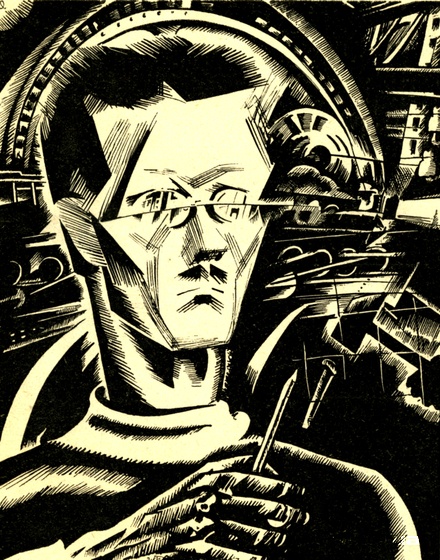
Futuristic drawing of Aleksei Gastev by Tolkachev (1924)

Download Алексей Гастев – Как надо работать (1923) [Aleksei Gastev – How to Work]

The following are excerpts from my thesis on the scientific management of labor and psychotechnics in the Soviet Union during the 1920s and 1930s.

Arsenij Avraamov’s Symphony of Sirens

The Constructivists’ goal to rationalize artistic labor and thus enter life can be traced to the early Soviet intellectual fascination with the Taylorist industrial theory of scientific management. As was covered in the previous section, American Taylorism exerted an influence throughout the European world of modernist art and architecture. However, the especially central role it played through its reception and dissemination in the Soviet Union warrants further contextual reflection. For the Soviet architectural avant-garde did not simply absorb the influence of Taylorism through its mediation by the Constructivists in art, but also directly from a number of academic sources as well. Taylorism was enthusiastically embraced in the USSR by many in the revolutionary intelligentsia and even some leading Bolsheviks, including Trotskii and Lenin himself[562] (despite his 1914 article “Taylor’s System: The Enslavement of Man to the Machine”). It was mostly popularized by writers like Osip Ermanksii[563] and later advocates of the Scientific Organization of Labor (abbreviated NOT [for Nauchnaia organizatsiia truda]) like the poet and factory worker Aleksei Gastev. Gastev was the founder and, from 1920 to 1937, the director of TsIT (Central Institute of Labor). TsIT was dedicated to the improvement of industrial efficiency. Under Gastev, its official philosophy was that of Taylorism. He was doubtless the most passionate exegete of Soviet Taylorism. For Gastev, Taylor was modern industrialism’s greatest theoretician, and Henry Ford its greatest practitioner. Ford was a heroic figure for many in the Soviet Union during the 1920s for his contribution to assembly-line production and his rationalization of labor practices. Gastev, however, took this much further, going so far as to align Ford with Karl Marx as compatible (and indeed complementary) thinkers in his 1927 article “Marx and Ford.”[564] For reasons that will be discussed later, Taylorism and machine-worship was stronger in Russia than in Western Europe. As the Hungarian academic René Fülöp-Miller keenly observed, “[i]n contrast to the intoxicated enthusiasm with which Russians speak of the application of the mechanizing process to the whole of existence, Europeans describe the invasion of their life by technical elements in a completely skeptical fashion.”[565]

Motion tests, TsIT (1924)

Motion tests, TsIT (1924)

The choreography of labor: TsIT cyclograph testing motive efficiency

The Constructivists’ artistic and architectural appropriation of Taylorism in large part came by way of Gastev. Indeed, Gastev’s significance as an interlocutor can hardly be overstated, since it was his own distinctive interpretation of Taylor that so lent itself to modernist aesthetics. It was his fanatical promotion of its aspects of automation and mechanization, emerging out of a decidedly Futurist Weltanschauung, that made it a vital contribution to the early Soviet cult of the machine. He advocated “systematic planning,” the “chronometration [khronometrirovanie] of time” through the introduction of time cards, and an “automated uniformity of labor” through that standardization of the most efficient laboring motions.[566] Addressing the workers’ relation to industrial machinery, Gastev wrote:

The modern machine…possesses its own laws of pulsation, functioning, and relaxation — laws that do not stand in conformity with the rhythm of the human organism. The world of the machine, the world of mechanical equipment [oborudovaniia] and urbanized labor [trudnogo urbanizma], produces specially connected collectives, begets certain types of people. These are people who we must accept, just as we accept the machine, though we must not smash their heads on its gears. We must bring some kind of equalizing coefficient into the machine’s iron disciplinary pressure, though history insistently demands we pose these not as petty problems of the social protection of the individual personality [lichnosti], but rather the bold engineering [proektirovaniia] of human psychology according to such an historical factor as machinism.[567]

Motion tests, TsIT (1923)

Motion tests, TsIT (1923)

Cover page of Aleksei Gastev’s “Kultures” (Kharkhov 1923), along with a futuristic representation

In training workers, reasoned Gastev, “[w]e begin with the most primitive, the most elementary motions and carry out the mechanization of man himself. This mechanization we understand in the following manner: the less perfect the motion, the greater the element of deceleration and the less kinetic automatization. The perfect mastery of a given movement implies maximum automatization.” Furthermore, “[t]his principle of the mechanization or biological automatization [of man] must go very far, all the way to his so-called mental activity.”[568] Notice also, then, that here psychology is encompassed by biology (or physiology). Continue reading

Moisei Ginzburg, “New Methods of Architectural Thought”/Моисей Гинзбург, «Новые методы архитектурного мышления» (1926)

[From Modern Architecture, 1926 (no. 1, pgs. 1-4)]

[Pg. 1]

One decade separates us from the architectural “affluence” of the pre-Revolutionary era, when in Petersburg, Moscow, and other great centers the best Russian architects lightheartedly cultivated every possible “style.”

Is a decade so much?

It is a small fissure in time.  But the Revolution, in sweeping away the stagnant prejudices and outlived canons, has turned the fissure into an abyss.  On the far side of that abyss remain the last witherings of the already decrepit system of European thinking, of that unprincipled eclecticism which always has a thousand aesthetic recipes at the ready, all of them approved by our grandfathers and great-grandfathers.  Such thinking was ready to ladle out truth from wherever suited — provided it was from a source in the past.

On this side of the abyss is opening up a new path which still has to be paved, and great new expanses of space which still have to be developed and populated.  The outlook and worldview of the contemporary architect is being forged in the circumstances of today and new methods of architectural thinking are being created.

Instead of the old system in architectural designing, where the plan, construction, and external treatment of the building were in a state of constant antagonism, and where the architect had to use his powers to the full as peacemaker in irreconcilable conflicts of interest, the new architectural work is characterized above all by its single indivisible aim and aspiration.  It is a process in which the task is hammered out logically and which represents a consciously creative [sozidatel’ny] process from beginning to end.

In place of the abstracted and extremely individualistic inspiration of the old-style architect, the contemporary architect is firmly convinced that the architectural task, like any other, can only be solved through a precise elucidation of the factors involved [the “unknowns”] and by pursuing the correct method of solution.

The architect sees around him the fearless creativity of inventors in various fields of contemporary technology, as with gigantic steps it conquers the earth, the ocean depths, and the air, winning new bridgeheads by the hour.  It is not difficult to see that these astonishing successes of human genius are explained, in general, by the fact that the right method was pursued in tackling the task.  The inventor knows full well that however energetic the upsurge of his creative enthusiasm may be, it wil be useless without a sober consideration of all the minutiae in the circumstances surrounding his activity.  He is fully armed with contemporary knowledge.  He takes account of all the conditions of today.  He conquers the future.

Certainly it would be naïve to replace the complex art of architecture by an imitation of even the [Pg. 2] most sparkling forms of contemporary technology.  This period of naïve “machine symbolism” is already outdated.  In this field it is only the inventor’s creative method that the contemporary architect must master.  Any mould or model from the past must be categorically repudiated, however beautiful it may be, for the pursuits of the architect are in their essence precisely such invention, just like all other invention.  His is a work of invention which has set itself the aim of organizing and constructing a concrete practical task not just in response to the dictates of today but as something that will serve the needs of tomorrow.

Original model of the Vesnin brothers’ proposal for the Leningrad Pravda building

Thus first and foremost we face the question of clearly exposing all the unknowns of the problem.  First among these are the unknowns of a general charcter, dictated by our epoch as a whole.  Here we are identifying those particular features of the problem which derive from the emergence of a new social consumer of architecture — the class of workers, who are organizing not only their own contemporary way of life but also the complex forms of new economic life of the State.  It is not a question of adapting to the individual tastes of this new consumer.  Unfortunately, in posing the problem it is often reduced to precisely this, and people hastily try to attribute to worker tastes and preferences which are essentially echoes of old pre-revolutionary attitudes.

Least of all is it a matter of tastes here at all.  What we are concerned with is elucidating the characteristics of the new consumer, as a powerful collective which is building a socialist state.

It is a question, above all, of the principle of plannedness.  This must not just be a feature of the way leading state organs operate, but must become part of the work of every architect.  It is how the solving of individual problems becomes part of the larger productive network of the country as a whole.

The character of a contemporary architect’s work is radically altered by the fact that he recognizes his activity to be the establishing of architectural standards for the organization of new dwellings and towns, rather than the fulfillment of individual commissions.  He sees it as his task to be continually advancing and improving those standards, in connection with the larger characteristics of production and with the advancing technological levels both here and internationally.  In the conditions through which we are living as we develop socialism, each new solution by the architect, be it a dwelling block, a workers’ club, or a factory, is conceived by us as the invention of a more advanced model or type, which answers the demands of its brief and is suitable for multiple production in whatever quantities the needs of the state require.  From the very start, this situation diverts the architect’s energy away from the pursuit of a solution answering individual tastes, and redirects it towards further improvement of the standard type which he has devised, and a fuller, more sophisticated standardization of its details.  But in order that these type-solutions may undergo a genuinely radical renewal, they must derive from the new principles of a rational urbanism which will satisfy tomorrow’s needs as well as today’s. It is thus obvious that the conditions of our State will authoritatively throw us from the single architectural unit, through a complicated manufacturing process, to the whole complex, the village, the township, and the city.

Sketch of the Vesnins’ Leningrad Pravda Building (1924)

Unfortunately, the specialists at the head of those state organs in charge of our building are the ones least concerned about this important issue, who are least of all inclined to keenly look ahead. They [Pg. 3] are quite satisfied, for example, that construction in the largest center of the USSR — Moscow — is limited to four-or six-storey buildings.

It is needless to say that for smaller cities or housing estates these are nothing better than garden cities [goroda-sada], with their small mansions, courtyards, and flower-gardens, and yet no one seems to have this on his mind. But meanwhile this Howardian [Ebenezer Howard — RW] ideal has lagged behind modernity for no less than ten years (and also behind our Soviet modernity for an even more substantial period of time)?

In order for a modern architect to deal with such anachronisms, the greater is his need to fight on two fronts: [1] the elaboration of new, rational principles for the planning of architecture for the aggregate population [naselennykh mest] and [2] the creation of standards that would serve as a prerequisite for the foundation of a new, more prudent image of the city.

The social conditions of our modern world are such that questions of individual aesthetic developments in architecture arise only secondarily.  Today’s conditions focus our attention first and foremost onto the problem of rational new types in architecture, and by including the architect within the overall production chain of the country, they abolish the isolation which previously existed between various forms of architectural and engineering activity.  Certainly the complex development of our life is such that more than at any other time, it compels the architect to specialize in a specific field, but at the same time the firm conviction that has arisen amongst all contemporary architects that their different specialties — housing, community buildings, factories — are merely subsections of a homogeneous territory [ubezhdenie v odno-znachnosti ikh tvorchekoi deiate’nosti].  So some are busy creating a new type of housing, others with the development of new public facilities, and still others with the building of a new factory or plant.  And precisely because construction possessing a factory/industrial or engineering character was never firmly linked to the stagnant traditional art of the past, [the engineers] found that the principles underlying their mode of creation were much more responsive to the needs the time, and better suited to the serving of a new life.  As a result, not only has the boundary between engineering structures and public architecture been wiped out of our thinking, but those very engineering structures themselves have come to be seen as front-line pioneers in the shaping of a genuinely contemporary architecture.

Sober calculation of all these circumstances, which have been created and intensified by our present social conditions, is not just the first condition for a correct solution of our architectural tasks.  It is also the source of all those purely architectural possibilities which lie concealed within the changes which have taken place in our mode of life.

But alongside these, there is a series of other “unknowns” facing the architect, which derive quite separately from the particularities of each factor of the given piece of work, from the particular features of the task in hand, from its functional requirements and from the productive and locational conditions obtaining in that situation.

The solving of these ‘unknowns’ leads to an entirely new method of architectural thinking: to the method of functional design.

Free from the handed-down models of the past, from prejudices and biases, the new architect analyzes all sides of his task, all its special features.  He dismembers it into its component elements, groups them according to functions and organizes his solution on the basis of these factors.  The result is a spatial solution which can be likened to any other kind of rationally conceived [razumnyi] organism, which is divided into individual organs that have been developed in response to the functional roles which each fulfills.

As a result of this we are seeing in the works of contemporary architects the emergence of entirely new types of plan.  These are generally asymmetrical, since it is extremely rare for functional parts of a building to be absolutely identical.  They are predominantly open and free in their configurations, because this not only better bathes each part of the building in fresh air and sunlight, but makes its functional elements more clearly readable and makes it easier to perceive the dynamic life that is unfolding within the building’s spaces.

That same method of functional creativity leads not only to clear calculation of the ‘unknowns’ of the task, but to an equally clear calculation of the elements of its solution.

The architect then arranges [ustanavlivaet] the main path to the secondary in his work, from the core to the outer shell.  Only functional architectural thinking establishes [ustanavlivaet] the spatial organization firmly as the starting point of the work, indicating the place at which the bulk of the impact should be directed.  Thus, the determination [ustanovlenie] of the specific conditions of the job — the number of individual spatial variables, their dimensions and mutual connection — emerges as the primary function. From this first point alone does the modern architect proceed; it is this that compels him to unfold his plan from the inside out, rather than vice versa, as was done during the period of eclecticism.   This directs his entire future path.

The second moment for the architect becomes the framing from within of the spatial problem or from a particular material and one or another methods of construction.  It is clear that this is an inevitable function of the baseline spatial resolution.

The next stage in the work of the new architect is the ratio of the spatial volume of the outside, a grouping of architectural masses.  Their rhythm and proportions follow naturally from the first half of the architect’s activity — they stand as a function of the constructive material of the exterior and its hidden spaces.

[Pg. 4]

And finally, there is the interpretation of some wall surfaces and the design of individual — elements, holes, poles, etc. — all the functions of some of these, or any other extraneous data.

Thus the very method of functional creativity leads us to a unified organic creative process where one task leads from another with all the logic of a natural development, instead of the old-style chopping up into separate independent tasks which are usually in conflict with each other.  There is no one element, no one part of the architect’s thinking which would be arbitrary.  Everything would find its explanation and functional justification in its suitability for a purpose.  The whole unifies everything, establishes equilibrium between everything, creates images of the highest expressiveness, legibility, and clarity, where nothing can be arbitrarily changed.

In place of the ready-made models of the past which have been chewed over endlessly, the new method radically re-equips the architect.  It gives him a healthy direction to his thiking, inevitably leading him from the main factors to the secondary ones.  It forces him to throw out what is unnecessary and to seek artistic expressiveness in that which is most important and necessary.

There is absolutely no danger in the asceticism of the new architecture which emerges from this method.  It is the asceticism of youth and health.  It is the robust asceticism of the builders and organizers of a new life.

[Из Современной архитектуры 1926 (No. 1, pgs. 1-4)]

Одно десятилетие отделяет нас от архитектурного «благополучия» довоенного времени, когда в Ленинграде, Москве и других крупных центрах лучшие русские зодчие беззаботно насаждали всевозможные «стили».

Много ли десятилетие?

Маленькая трещинка времени. Но революция, уничтожив косные предрассудки и отжившие каноны, превратила трещинку в пропасть. По ту сторону пропасти остался последний этап увядания одряхлевшей системы европейского мышления, беспринципный эклектизм, имеющий наготове тысячу художественных рецептов, апробованных нашими дедами и прадедами, готовый черпать истину откуда угодно, — но только в прошлом.

По эту сторону открывается новый путь, который еще надо прокладывать, новые просторы, которые нужно еще заселить. В обстановке сегодняшнего дня куется миросозерцание современного зодчего, создаются новые методы архитектурного мышления.

Вместо старой системы архитектурного творчества, где план, конструкция и внешнее оформление задания постоянно находились во взаимной вражде и где архитектор был по мере сил своих примирителем всех этих неразрешимых конфликтов, — новое архитектурное творчество, прежде всего, характеризуется своим единым нераздельным целевым устремлением, в котором органически выковывается задача и к которому сводится созидательный процесс от начала до конца.

Вместо отвлеченного и крайне индивидуалистического вдохновения старого архитектора — современный зодчий твердо убежден в том, что архитектурная задача решается, как и всякая иная, лишь в результате точного выясненияне известных и отыскания правильного метода решения.

Зодчий видит вокруг себя смелое творчество изобретателя в разных областях современной техники, гигантскими шагами побеждающей землю, недра и воздух, с каждым часом отвоевывающей все новые и новые позиции. Не трудно понять, что этот изумительным успех человеческого гения объясняется, главным образом, правильным методом творчества. Изобретатель твердо знает, что как бы ни был ярок подъем его творческого энтузиазма — он будет бесцелен без трезвого учета мельчайших обстоятельств, окружающих его деятельность.  Он во всеоружии современного знания, он учитывает все условия сегодняшнего дня, он смотрит вперед завоевывает будущее.

Конечно, наивно было бы подменить сложное искусство архитектуры подражанием тем или иным, хотя бы [Pg. 2] самым блестящим формам современной техники. Этот период наивного «машинного символизма» уже изжит. Лишь творческий метод изобретателя должен быть завоеван современным архитектором. Должно быть категорически отвергнуто наличие каких-либо штампов прошлого, как бы прекрасно оно ни было, ибо искания зодчего по существу своему такое же изобретение, как и всякое другое, изобретение, ставящее себе целью организовать и сконструировать конкретную практическую задачу, не только диктуемую сегодняшним днем, но и пригодную для завтрашнего.

Итак, прежде всего, ясное раскрытие всех неизвестных. И, в первую очередь, неизвестных общего характера, диктуемых нашей эпохой в целом, раскрытие особенностей, связанных с появлением нового социального потребителя архитектуры — класса трудящихся, организующего не только свой современный быт, но и сложные формы новой хозяйственной жизни государства. Тут, конечно, речь идет не о подлаживании к индивидуальным вкусам нового потребителя. К сожалению, часто именно к этому сводят постановку вопроса, при чем еще стараются поспешно приписать рабочему вкусы и вкусики, являющиеся по существу отголоском старых дореволюционных взглядов.

Но тут дело меньше всего заключается во вкусах. Речь идет о выяснении особенностей нового потребителя, как мощного коллектива, строящего социалистическое государство.

Речь идет, прежде всего, о принципе плановости, который должен войти в работу не только тех или иных руководящих государственных органов, но и в работу каждого зодчего, о включении отдельных замыслов в общую производственную сеть всей страны.

Коренным образом меняет характер работы современного архитектора то, что он сознает свою деятельность не как выполнение отдельных заказов, а как установку стандартов архитектуры, организующих новые жилища и города, как непрерывное совершенствование этих стандартов, в связи с общими производственными особенностями, с уровнем нашей и международной строительной техники. В условиях переживаемого нами строительства социализма, каждое новое решение архитектора — жилой дом, клуб, фабрика — мыслится нам, как изобретение совершенного типа, отвечающего своей задаче и пригодного к размножению в любом количестве, сообразно с потребностями государства. Это обстоятельство заранее отводит энергию архитектора от поисков индивидуально-вкусового решения — к совершенствованию своего стандарта, к уточнению и максимальной типизации всех его деталей. Но для того, чтобы эти стандарты были действительно радикально обновлены, для того, чтобы они стали подлинно новыми архитектурными произведениями, конечно, они должны быть задуманы не на индивидуальном участке, не произвольной прихотью, не в тесных рамках скученного и случайно планированного города, а обратно, исходить из общего целого, из новых принципов рационального урбанизма, пригодного и для завтрашнего дня. Таким образом, очевидно, что условия нашей государственности властно отбрасывают нас от архитектурной единицы через сложный производственный процесс к целому комплексу, селению, поселку, городу.

К сожалению, специалисты, стоящие во главе государственных органов, ведающих нашим строительством, меньше всего озабочены этим важным вопросом, меньше всего расположены пытливо смотреть вперед. Они [Pg. 3] вполне удовлетворены тем, что ограничили, например, застройку крупнейшего центра СССР — Москвы — четырех-или шестиэтажными домами.

Нечего говорить о том, что для меньших городов или рабочих поселков ничего лучше города-сада, со своими маленькими особнячками, двориками и цветничками, и в мыслях не имеется. А между тем этот Говардовский идеал не отстал ли от современности не меньше чем на десяток лет, а от нашей советской современности и на более значительный срок?

Тем острее необходимость современного зодчего бороться с подобными анахронизмами, бороться с двух стороп: разработкой новых рациональных принципов планировки архитектуры населенных мест и созданием стандартов, которые послужили бы предпосылкой к созданию нового разумного облика города.

Социальные условия современности таковы, что они ставят лишь во вторую очередь вопросы индивидуально художественного развития архитектуры, они обращают наше внимание прежде всего на проблему новых рациональных типов архитектуры и, включая архитектора в общую производственную цепь страны, уничтожают обособленность, которая существовала раньше между различными видами архитектурной и инженерной деятельности. Конечно, сложное развитие нашей жизни таково, что более чем когда-либо заставляет зодчего специализироваться в той или иной области, но в то же время у всех современных зодчих выросло твердое убеждение в однозначности их творческой деятельности: одни заняты созданием типа нового жилья, другие нового общественного сооружения, а третьи — новой фабрики или завода. И именно потому, что сооружения фабрично-заводского и инженерного характера никогда не были крепко связаны с косными традициями художественного прошлого, они оказались, по принципам, лежащим в их созидании, на много более отвечающими потребностям момента, более пригодными к обслуживанию новой жизни. Таким образом, не только стерлась в нашем представлении грань между гражданским или инженерным сооружением, но даже это последнее оказалось передовым застрельщиком в формации подлинно современной архитектуры.

Трезвый учет всех этих? обстоятельств, выдвинутых и обостренных новыми социальными условиями, не только первое условие правильного решения архитектурной задачи, но и источник тех чисто архитектурных возможностей, которые таятся в изменившихся условиях нашей жизни.

Но на ряду с ними, перед архитектором стоят и другие «неизвестные», вытекающие из особенностей каждого момента работы в отдельности, из особенностей самого задания, его функций, условий и места производства.

Решение этих «неизвестных» приводит к совершенно новому методу архитектурного мышления — к методу функционального творчества.

Свободный от всяких штампов прошлого, от предрассудков и предубеждений, новый зодчий анализирует все стороны задания, его особенности, он расчленяет его на составные элементы, группирует по их функциям и организует свое решение по этим предпосылкам. Получается пространственное решение, уподобленное всякому разумному организму, расчлененное на отдельные органы, получающие то или иное развитие, в зависимости от функций, ими выполняемых.

В силу этого, мы видим в работах современных архитекторов появление совершенно нового плана, большей частью асимметричного, — так как редко функции частей эданин бывают абсолютно одинаковыми — предпочтительно открытого и свободного в своей конфигурации, потому что тогда не только лучше омываются все части сооружения воздухом и светом, но и четче читается его функциональная члененность, легче угадывается развертывающаяся в них динамическая жизнь.

Тот же метод функционального творчества приводит не только к ясному учету «неизвестных» задачи, но к такому же учету элементов ее решения.

Зодчий устанавливает тогда в своем творчестве путь от главного к второстепенному, от костяка к оболочке. Только функциональное архитектурное мышление жестко устанавливает пространственную организацию, как исходную точку работы, указывает то место, куда должен быть направлен основной удар. Таким образом, выясняется как первая функция конкретных условий задания — установление количества отдельных пространственных величин, их размеров и взаимной связи. Из этого, прежде всего, исходит современный архитектор, это заставляет его развертывать свой замысел изнутри наружу, а не обратно, как это делалось в периоды эклектизма, это направляет весь его дальнейший путь.

Вторым моментом становится конструирование изнутри развертывающейся пространственной задачи из того или иного материала и теми или иными конструктивными методами. Ясно, что оно является неизбежной функцией основного пространственного решения.

Дальнейший этап работы нового архитектора: — соотношение пространственных объемов извне, группировка архитектурных масс, их ритм и пропорции вытекают естественно из первой половины его деятельности, — становятся функцией сконструированной материальной оболочки и скрытого за ней пространства.

[Pg. 4]

И, наконец, трактовка той или иной стенной поверхности, оформление отдельных элементов, отверстий, опор и т. д., все это функции тех или иных перечисленных, или каких-либо других привходящих данных.

Таким образом, самый метод функционального творчества вместо старого дробления на отдельные независимые и обычно враждебные друг другу задачи — приводит к единому органическому творческому процессу, где одна из задач вытекает из другой со всей логикой естественного развития. Нет ни одного элемента, ни одной части замысла архитектора, который был бы стихиен. Все находит себе объяснение и функциональное оправдание в своей целесообразности. Целое все объединяет, все уравновешивает, создает образцы высочайшей выразительности, четкости, ясности, где ничто не может быть изменено.

Вместо готовых, бесчисленное множество раз пережеванных образцов прошлого, новый метод коренным образом перевооружает зодчего. Он дает здоровое направление его мыслям, неизбежно устремляя их от главного к второстепенному, заставляет его отбрасывать ненужное и искать художественную выразительность в самом важном и необходимом.

Нет никакой опасности в вытекающем из этого метода аскетизме новой архитектуры, который отпугивает близоруких. Это — аскетизм молодости и здоровья, бодрый аскетизм строителей и организаторов новой жизни.

Moisei Ginzburg’s “The international front of modern architecture”

Translated from the Russian 

Untitled.
Image: Photograph of Moisei Ginzburg,
editor of Modern Architecture (1927)

untitled2.

[From Modern Architecture (1926) № 2]

[Pg. 41]

If one takes a cursory glance at everything that is now taking place in the architectural life of all countries, the first impression will be this: the world is split into two halves. In one of them, eclecticism still reigns — having lost any point of departure, having exhausted itself through and through — perfectly symbolizing the deteriorating culture of old Europe. In the other [half] young, healthy shoots push themselves through — landmarks, the beginnings of a new life start to emerge, from which it is not difficult to extend the single, unified thread of an international front of modern architecture. Despite all the differences and peculiarities of different countries and peoples, this front really exists. The results of the revolutionary pursuits of the modern architectural avant-gardes of all nations intersect with one another closely in their main lines of development. They are forging a new international language of architecture, intelligible and familiar, despite the boundary posts and barriers.

But it is worth examining this picture a little closer, as it now becomes evident that within the overall stream [of modern architecture] merge various currents.  The path of the creative pursuit in different countries and among different peoples is not quite the same. For along with the general similarity there also exist differences — differences not only in the formal expression of this language, but also in the basic principles that inform it. Continue reading

Cenotafio de Newton: Boullée, Étienne-Louis,

Revolutionary precursors

Radical bourgeois architects in
the age of reason and revolution 

Untitled.
Étienne-Louis Boullée’s
Cénotaphe a Newton
(Cenotaph to Newton), 
night & day

untitled2

Emil Kaufmann’s classic 1952 study,
Three revolutionary architects:
Boullée, Ledoux, and Lequeu

See also the image gallery included at the end.

Étienne-Louis Boullée's reimagined Cénotaphe a Newton (1795), interior

Étienne-Louis Boullée’s reimagined Cénotaphe a Newton (1795), interior

In honor of the Platypus Affiliated Society’s Radical Bourgeois Philosophy summer reading group, I thought I would devote a blog entry to the celebration of radical bourgeois architecture.  I’ve been writing a lot of posts related to the subject of the revolutionary avant-garde architecture that followed October 1917 in Russia and in Europe, so I think that it might be fitting to take a step back and review some of the architectural fantasies that surrounded that other great revolutionary date, 1789, the year of the glorious French Revolution.  The three utopian architects whose work I will be focusing on here also happen to be French — perhaps not coincidentally.

Jean-Jacques Lequeu's Monument to Isocrates

Jean-Jacques Lequeu’s Monument to Isocrates

Claude-Nicolas Ledoux's Théâtre de Besançon, Interior (1784)

Claude-Nicolas Ledoux’s Théâtre de Besançon, interior (1784)

Étienne-Louis Boullée (1728-1799), Claude-Nicolas Ledoux (1736-1806), and Jean-Jacques Lequeu (1772-1837) were each architects and thinkers whose ideas reflected some of the most radical strains of liberal bourgeois philosophy, with its cult of reason and devotion to the triplicate ideals of liberté, égalité, and fraternité. The structures they imagined and city plans they proposed were undeniably some of the most ambitious and revolutionary of their time. At their most fantastic, the buildings they envisioned were absolutely unbuildable — either according to the technical standards of their day or arguably even of our own. Continue reading

On the first socialist tragedy

Andrei Platonov

.
It is essential not to thrust oneself forward and not to get drunk on life; our time is both better and more serious than blissful delight. Everyone who gets drunk is sure to be caught, sure to perish like a little mouse that messes with a mousetrap in order to “get drunk” on the fat on the bait. All around us lies fat, but every piece of this fat is bait. It is necessary to stand in the ranks of the ordinary people doing patient socialist work — that is all we can do.

The arrangement of nature corresponds to this mood and consciousness. Nature is not great and is not abundant. Or her design is so rigid that she has never yet yielded her greatness and her abundance to anyone. This is a good thing; otherwise — in historical time — we would long ago have looted and squandered all nature; we would have eaten our way right through her and got drunk on her right to her very bones. There would always have been appetite enough. Had the physical world been without what is, admittedly, its most fundamental law — the law of the dialectic — it would have taken people only a few centuries to destroy the world completely. More than that, in the absence of this law, nature would have annihilated itself to smithereens even without any people. The dialectic is probably an expression of miserliness, of the almost insuperable rigidity of nature’s construction — and it is only thanks to all this that humanity’s historical development has been possible. Otherwise everything would long ago have come to an end on this earth — like a game played by a child with sweets that melt in his hands before he has even had time to eat them.

What is the truth to be seen in the historical picture of our own time?

It goes without saying that this picture is tragic — if only because true historical work is being carried out not on the whole of the earth but only on a small, and greatly overburdened, part of the earth.

Truth — in my opinion — lies in the fact that “technology decides everything”. It is indeed technology that constitutes the theme of our contemporary historical tragedy — if technology is understood to mean not only the entire complex of man-made production tools but also the social organization that is based on the technology of production, and if ideology too is included in this understanding. Ideology, incidentally, is located not in the superstructure, not on some “height”, but somewhere within, in the heart of society’s sense of itself. To be more precise, unless in our concept of technology we also include the technician himself — the human being — our understanding of the question will remain obtuse and leaden.

The relationship between technology and nature is tragic. Technology’s aim is “Give me a fulcrum and I shall overturn the world”. But nature’s construction is such that she does not like being outmaneuvered. With the right moment of force it is possible to overturn the world, but so much will be lost in the journey and in the travel time of the lever that in practical terms the victory will be useless. This is an elementary example of the dialectic. Let us look now at a fact from our own time: the splitting of the atomic nucleus. It is the same thing. The hour will come when we expend n quantity of energy on the destruction of an atom and in return receive n + 1 — and we will be ever so pleased with this meagre increase, because this absolute gain will have been obtained by virtue of something like an artificially induced change to nature’s most fundamental principle: the dialectic itself. Nature stays aloof, she keeps us at bay; a quid pro quo — or even a trade with a mark-up in her own favor — is the only way she can work. Technology, however, strains to achieve the opposite. It is through the dialectic that the external world is defended against us. And so, however paradoxical this may seem: nature’s dialectic is both humanity’s enemy and its instructor. The dialectic of nature constitutes the very greatest resistance to technology; the aim and function of technology is to deny, or at least mitigate, the dialectic. Up until now its success in this has been modest, which is why the world cannot yet be kind and good for us.

And at the same time, the dialectic is our only instructor and our only means of defense against the premature and senseless destruction involved in childish delight. Just as the dialectic is itself the power that has created all our technology.

In sociology, in love, in the depth of a human being, the law of the dialectic functions no less immutably. A man with a ten-year-old son left the boy with the boy’s mother — and married a young beauty. The boy began to long for his father and patiently, clumsily hanged himself. A gram of delight on one end of the lever is balanced by a ton of graveyard earth on the other. The father took the rope from the boy’s neck and soon followed him into the grave. What he wanted was to get drunk on the innocent beauty; he wanted to bear love not as a duty, not as an obligation with a single wife, but as pleasure. Don’t get drunk — or it will be the end of you.

Some naïve people may retort that the contemporary crisis of production overturns this point of view. It does not overturn anything. Imagine the extremely complex technical equipment of the society of contemporary imperialism and fascism, the grinding exhaustion and destruction of the people of these societies — and it will become only too clear at what price this increase in the forces of production has been achieved. Self-destruction in fascism, war between states — these are the losses entailed by increased production, these are nature’s revenge for it. The tragic knot is cut — but without being resolved. What results cannot — in the classical sense of the word — even be called tragedy. Without the USSR, the world would be certain to destroy itself in the course of no more than a century.

The tragedy of man, armed with machine and heart, and with the dialectic of nature, must in our country be resolved by way of socialism. But it must be understood that this task is an extremely serious one. Ancient life on the “surface” of nature was able to obtain what was essential to it from the waste products and excretions of elemental forces and substances. But we mess about deep inside the world, and in return the world crushes us with an equivalent strength.

Translated by Robert Chandler, Elizabeth
Chandler, Jonathan Platt, and Olga Meerson

Андрей Платонов

Надо не высовываться и не упиваться жизнью: наше время лучше и серьезней, чем блаженное наслаждение. Всякий упивающийся обязательно попадает и гибнет, как мышонок, который лезет в мышеловку, чтобы «упиться» салом на приманке. Кругом нас много сала, но каждый кусок на приманке. Надо быть в рядах обыкновенных людей терпеливой социалистической работы, больше ничего.

Этому настроению и сознанию соответствует устройство природы. Она не велика и не обильна. Или так жестко устроена, что свое обилие и величие не отдавала еще никому. Это и хорошо, иначе — в историческом времени — всю природу давно бы разворовали, растратили, проели, упились бы ею до самых ее костей: аппетита всегда хватило бы. Достаточно, чтобы физический мир не имел одного своего закона, правда, основного закона — диалектики, и в самые немногие века мир был бы уничтожен людьми начисто. Больше того, и без людей в таком случае природа истребилась бы сама по себе вдребезги. Диалектика наверно есть выражение скупости, трудно оборимой жесткости конструкции природы, и лишь благодаря этому стало возможно историческое воспитание человечества. А то бы все давно кончилось на земле, как игра ребенка с конфетами, которые растаяли в его руках, и он не успел их даже съесть.

В чем же истина современной нам исторической картины?

Конечно, эта картина трагична, — уже потому, что действительная историческая работа совершается не на всей земле, а только на меньшей ее части с огромной перегрузкой.

Истина, по-моему, в том, что «техника… решает все». Техника это и есть сюжет современной исторической трагедии, понимая под техникой не один комплекс искусственных орудий производства, а и организацию общества, обоснованную техникой производства, и даже идеологию. Идеология, между прочим, находится не в надстройке, не на «высоте», а внутри, в середине общественного чувства общества. Точнее говоря, в технику надо включить и самого техника — человека, чтобы не получилось чугунного понимания вопроса.

Между техникой и природой трагическая ситуация. Цель техники — «дайте мне точку опоры, я переверну мир». А конструкция природы такова, что она не любит, когда ее обыгрывают: мир перевернуть

можно, подобрав нужные моменты рычага, однако надо проиграть в пути и во времени хода длинного рычага столько, что практически победа будет бесполезной. Это элементарный эпизод диалектики. Возьмем современный факт: расщепление атомного ядра. То же самое. Настанет всемирный час, когда мы, затратив на разрушение атома П — количество энергии, получим в результате П+1 и этим убогим добавком будем так довольны, потому что он, абсолютный выигрыш, получен в результате как бы искусственного изменения самого принципа природы, т. е. диалектики. Природа держится замкнуто, она способна работать лишь так на так, даже с надбавкой в свою пользу, а техника напрягается сделать наоборот. Внешний мир защищен против нас диалектикой. Поэтому, пусть это кажется парадоксом: диалектика природы есть наибольшее сопротивление для техники и враг человечества. Техника задумана и работает в опровержение или в смягчение диалектики. Удается ей пока это скромно, и поэтому мир для нас добрым быть еще не может.

Одновременно лишь диалектика является единственным нашим наставником и средством против ранней, бессмысленной гибели в детском наслаждении. Так же, как она же явилась силой, создавшей всю технику.

В социологии, в любви, в глубине человека диалектика действует столь же неизменно. Мужчина, имевший десятилетнего сына, оставил его с матерью, а сам женился на красавице. Ребенок затосковал по отцу и терпеливо, неумело повесился. Грамм наслаждения на одном конце уравновесился тонной могильной земли на другом. Отец взял с шеи ребенка бечеву и вскоре ушел за ним вслед, в могилу. Он хотел упиться невинной красавицей, он любовь хотел нести не как повинность с одной женой, а как удовольствие. Не упивайся — или умирай.

Некоторые наивные могут возразить: современный кризис производства опровергает такую точку зрения. Ничего не опровергает. Представьте сложнейшую арматуру общества современного империализма и фашизма, истощающее измождение, уничтожение тамошнего человека, и станет ясно, за счет чего достигнуто увеличение производительных сил. Самоистребление в фашизме, война государств — есть потери высокого производства и отмщение за него. Трагический узел разрубается, не разрешаясь. В классическом смысле трагедии даже не получается. Мир без СССР несомненно уничтожился бы сам собою в течение одного ближайшего века.

Трагедия человека, вооруженного машиной и сердцем, и диалектикой природы, должна разрешиться в нашей стране путем социализма. Но надо понимать, что это задание очень серьезно. Древняя жизнь на «поверхности» природы еще могла добывать себе необходимое из отходов и извержений стихийных сил и веществ. Но мы лезем внутрь мира, а он давит нас в ответ с равнозначной силой.

El Lissitzky’s “Architecture in the USSR” (1925)

.Untitled
IMAGE: El Lissitzky’s Wolkenbügel (1924)
.Untitled

 From Die Kunstblatt, No. 2 (February 1925)

Modern architecture in Russia?

There is no such thing.  What one does find is a fight for modern architecture, as there is everywhere in the world today.  Still nowhere is their a new architectonic CULTURE.  Any isolated really new buildings were designed only to meet the need of the moment, and only by some anonymous character, some engineer, over the head of the artist with a diploma.  At the same time, modern architects in various countries have been fighting for some decades to establish a new tectonics.  The main watchwords remain the same: expedient, in suitable material, constructive.  Every generation puts a different meaning into the same ideas.  For many this process is not developing rapidly enough.  There is certainly no lack of forces.  The trouble lies in the economic abnormality of the present time and the utter confusion of their intentions.

In the world of today, Russia is moving at record speed.  This is manifested even in the name of the country: — Russia, RSFSR, SSSR.  Art also advanced at the same tempo.  There the revolution in art began by giving form to the elements of time, of space, of tempo and rhythm, of movement.  Before the war cubists in France and futurists in Italy advanced new theses in art.  There re-echoed loudly in Russia; but from the early years of our isolation we went our own way and put forward antitheses.

The European thesis was: THE FINE ARTS (BEAUX-ARTS) FOREVER.  Thus the arts were made to become a completely private, subjective-aesthetic concern.  The antithesis was: ANYTHING BUT THE FINE ARTS.  [372] Let us have something universal, something clear and simple.  Thus a square is simple, or a glass cylinder.  Out with the painting of pictures! ‘The future belongs to those who have a remarkable lack of talent for the fine arts.’  Organic growth is a simple thing — so is building, architecture.

Continue reading

Color illustration from Modern Architecture (1929) of a disurbanized dwelling

Ginzburg’s reply to Le Corbusier on deurbanization

.Untitled
IMAGE: Color illustration in Modern Architecture
of a “disurbanized” dwelling unit (1929)

.Untitled

My dear Le Corbusier,

Our recent conversation about city planning and your letter have compelled me to rethink the entire problem, to recall your objections, the objections you made when you visited me and which you now write about in your letter.

Like all my friends, I value you tremendously not only as a subtle master architect but also as a man with the ability to solve radically and fundamentally the important problems of organization.

For me you are today the greatest and most brilliant representative of the profession that gives my life content, goal, and meaning.

That is why your ideas and solutions in the area of city planning have for us a quite exceptional interest and importance. Continue reading

El Lissitzky,Proposal for a monument to Rosa Luxemburg (1919)

A response to Reid Cane’s “Leninism or Luxemburgism?”

.Untitled
IMAGE: El Lissitzky, Monument
to Rosa Luxemburg (1919)

.Untitled

The following is a response to some critical remarks made by Reid Kane on his blog, The Luxemburgist, in an entry entitled “Leninism or Luxemburgism?”.  Reid was responding in this post to some comments I’d made on a different entry, in which I objected to his opposition of Vladimir Lenin’s articulation of a Marxist politics to that of Rosa Luxemburg.  These are, after all, two organizational models that have frequently been held up as antithetical.  I asserted that their split had been grossly exaggerated by both Stalinists seeking to discredit Luxemburg’s former colleagues and anti-authoritarian/anti-Bolshevik tendencies in the New Left, who exalt Luxemburg as an heroic “alternative” to Lenin.  Reid provides a thoroughgoing, reasoned critique of my objection, maintaining that it is not enough to ignore their differences merely because their disagreements have been blown out of proportion.  In this I cannot but agree.  The differences between Luxemburg and Lenin cannot simply be glossed over.  And so, though this topic has been dealt with countless times by writers on the Left, I feel it is not too much to add my own thoughts on the matter here, in response to Reid’s excellent post.

Continue reading

Dawn and decline: Two eschatological visions in turn-of-the-century Russia

.Untitled
IMAGE: 19th-century Russian
premonitions of a new “Mongolism”

.Untitled

“People who witness the beginning of great and momentous events, who can obtain only very incomplete, inexact, and third-hand information of what is taking place, will not, of course, hazard a definite opinion until a timelier moment comes.  The bourgeois papers, which continue as of old to speak of revolt, rioting, and disturbances, cannot help seeing the truly national, nay, international, significance of these events.  Yet it is this significance which invests events with the character of revolution.  And those who have been writing of the last days of the rioting find themselves involuntarily referring to them as the first days of the revolution.  A turning-point in Russia’s history has been reached.”

Lenin, “What is Happening in Russia?” From Revolutionary Days, January 1905

It has often been noted by historians of the period that a distinctly apocalyptic mood prevailed throughout large sections of the Russian intelligentsia from the last decade of the nineteenth century up through the 1917 Revolution.  Even ideological tendencies that lay in great tension with one another (if not in direct antithesis) found a common outlook in this respect.  This observation certainly finds support in the writings of the major representatives of these movements.  Intellectual currents as far apart as Marxist materialism and religio-philosophical idealism at this time both shared the sense that one age was coming to an end and another was now appearing on the horizon.  This common understanding served as the lens through which the major events of the day were interpreted, events which in turn then helped to modify the structure of these discourses.

In a strange way, many parallels existed between these two major schools of thought, Marxist materialism and religio-philosophical idealism.  These movements, which stood in starker contrast to one another than perhaps any other pair to be found amongst the Russian intelligentsia, possessed a number of similar concerns.  Each struggled to ascertain Russia’s national character, and thus grappled with questions of the country’s unique historical development and its possible role in shaping world history.  Radical political theorists like Lenin and Trotskii and religious philosophers like Vladimir Solov’ev and Sergei Bulgakov were both interested in Russia’s relation to European modernity and to its own barbaric, “Asiatic” past.  Moreover, members from these rival camps each held that Russia was to play an important part in an impending world crisis — either as the savior of European civilization from its own spiritual degeneracy or as a gateway through which revolution would spread to the most advanced industrial nations of the West.

Continue reading

Lenin’s critique of the politics of spontaneity in What is to be Done?

.Untitled
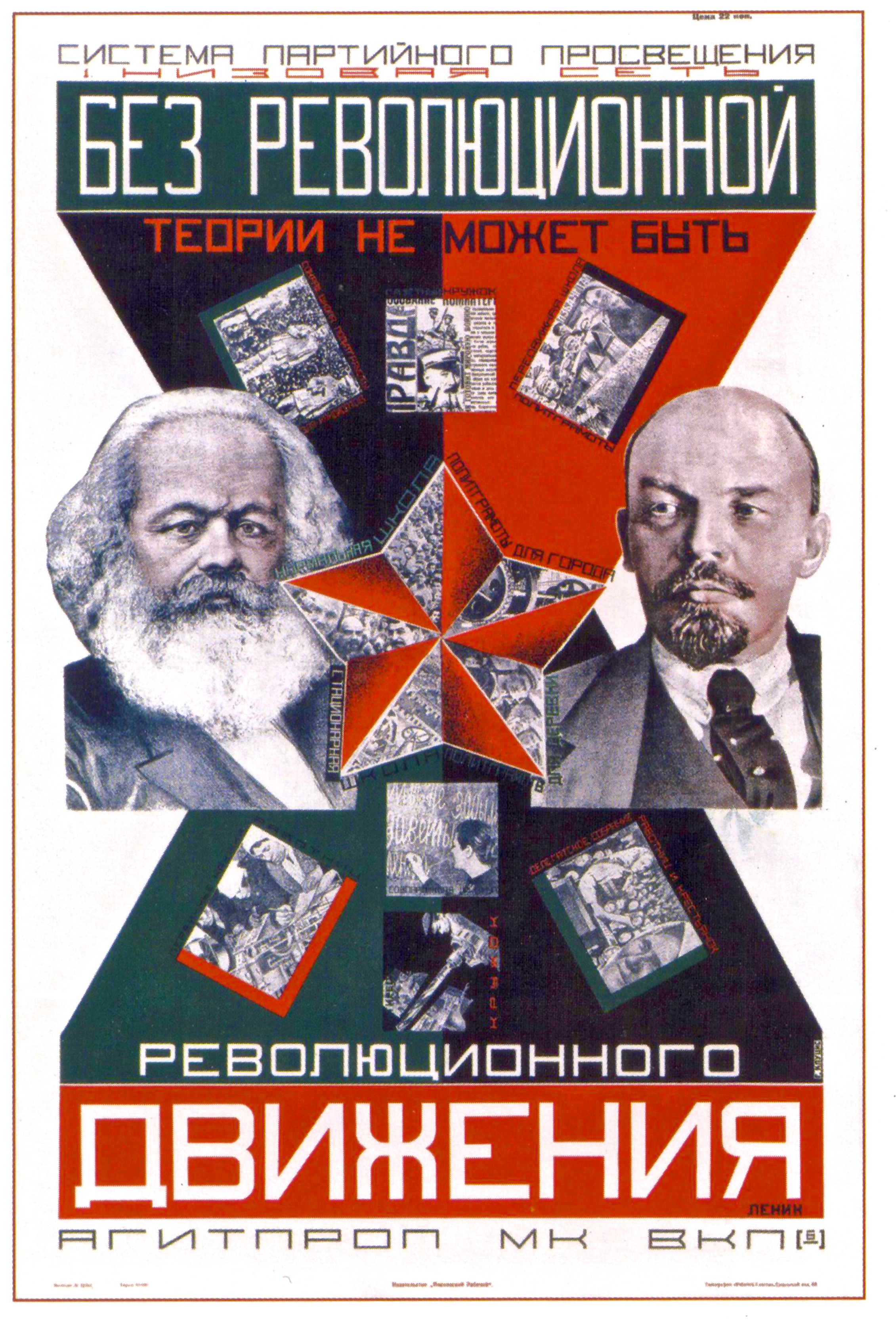
IMAGE: Agitprop poster, 1920s:
“Without revolutionary theory,
there can be no revolutionary movement.”

.Untitled

In preparing my presentation on Lenin’s What is to be Done? this week for the UChicago Platypus reading group, I found myself returning again and again to his description of the so-called “spontaneity” of the masses.  It was on this supposed spontaneity, of course, that the Economists pinned their hopes of social revolution (should there be one at all).  I noticed that in his critique of the notion of the working class’ spontaneity, Lenin employed a number of categories borrowed from classical German philosophy.  All of these categories pertain to consciousness, and constitute an epistemology of sorts.  I found, moreover, that this seemed to provide a theoretical link to Lukács’ later account of reification.  Though this began as little more than a meditation, I brought it up at the reading group and found that it was well received.  Afterward, Sunit encouraged me to elaborate on this notion and submit my thoughts online. Continue reading