On the history of political parties

.
A forthcoming piece I’ve written makes the point that political parties are themselves an artifact of bourgeois society. They were unknown to antiquity, absent from Athenian democracy and the Roman republic alike, to say nothing of the Middle Ages. Moses Finley wrote that, in thinking about the ancient world, “we must concentrate our minds and our imaginations on a political system without modern parallels: there were no structured political parties and there was no government in the sense of an appointed or elected group of men formally entrusted for the moment with the right or the duty to make policy proposals.”1

Research remains to be done on the history of the party-form, building on the classic literature. To that end, I’ve compiled a reading list, which I hope to use to write an article along with someone else who’s interested in the topic:

Ostrogosrky, in particular, seems promising. Though he was Russian, he wrote his two-volume treatise originally in French. Later on Evgenii Pashukanis would translate it back into Russian. For obvious reasons, Michels is also a fascinating figure. Weber’s lecture on “Politics as a Vocation” was delivered partially in response to the October Revolution, making reference to Trotsky. He was a socialist for many years, before his rightward turn. Duverger was likewise a communist.

Whatever I end up writing, I will probably make use of Edmund Burke’s oft-cited definition of a party as “a body of men united, for promoting by their joint endeavours the national interest, upon some particular principle in which they are all agreed.”2 I would of course welcome any further suggestions, either in terms of primary source literature or secondary sources. Any articles by Marx, Lenin, Trotsky, Bordiga, etc.

My working thesis is that when the first modern parties took shape in the seventeenth and eighteenth centuries, liberal statesmen were horrified by the idea of permanent organizations made up of professional politicians vying for power while sowing the spirit of faction. Thus did George Washington, for example, rail “against the baneful effects of the spirit of party.”3 Gradually, as the franchise was extended, legislative blocs turned into machines for winning elections, looking to oversee an elephantine bureaucracy renewed by periodic plebiscites. Bourgeois parties saw civil associations as mere constituencies, politically as voters and economically as donors.

In the late nineteenth and early twentieth centuries, mass proletarian parties hoped to conquer state power so as to transform society and thereby abolish the state. Membership meant paying dues and other obligations. Registering as a Democrat or Republican in the twenty-first century United States, in other words, is not the same as belonging to the SPD or RSDLP over a hundred years ago. Such parties had been the most advanced section of a working-class movement already mobilized against the capitalist order.


1 Moses Finley, Politics in the Ancient World (New York, NY: Cambridge University Press, 1983), p. 75.
2 Edmund Burke, Thoughts on the Cause of the Present Discontents [1770], Prerevolutionary Writings (New York, NY: Cambridge University Press, 1993), p. 187.
3 George Washington, “Farewell Address” [19 September 1796], Political Writings (New York, NY: Cambridge University Press, 2023), p. 497.

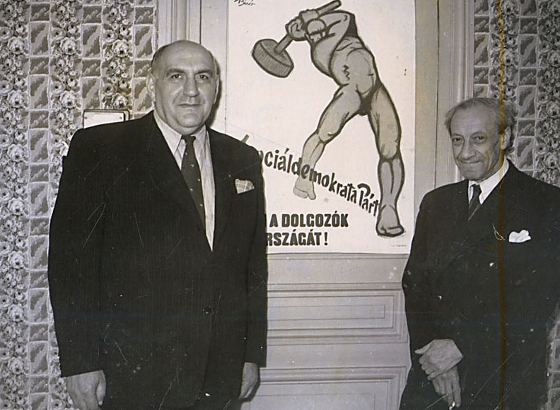
Mihály Biró, 1886-1948

Bud­apest nat­ive Mihály Biró (1886-1948) joined the So­cial Demo­crat­ic cause early in life. He spent the peri­od between 1910 and 1914, design­ing strik­ing and widely noted posters and il­lus­tra­tions for the SZDP [Hun­gari­an So­cial Demo­crat­ic Party].

Fol­low­ing the First World War, Biró be­came the graph­ic mouth­piece of the new Red Army of the Hun­gari­an So­viet Re­pub­lic. The ad­vent of the right-wing dic­tat­or­ship of Miklós Hort­hy soon forced him to flee to Vi­enna, however, where he cre­ated the Hort­hy Port­fo­lio (1920), con­sist­ing of col­or litho­graphs doc­u­ment­ing the at­ro­cit­ies of the Hort­hy re­gime.

Along­side the polit­ic­al posters — Biró’s true call­ing — he also cre­ated posters for in­di­vidu­al busi­nesses and the boom­ing film in­dustry. Biró fi­nally fled from Aus­tro­fas­cism in 1934 and settled in Czechoslov­akia, where he be­came ill and deeply de­pressed. In 1938, he suc­ceeded in flee­ing on to Par­is, where he was to stay un­til 1947.

It was only in 1947 that he was able to re­turn to Bud­apest, where he died in 1948.

Continue reading

Wilhelm Reich’s synthesis of Marxism and psychoanalysis

Back in June, in a post fea­tur­ing cri­tiques Karl Korsch and Georg Lukács wrote on Freu­di­an psy­cho­ana­lys­is, I an­nounced that I’d shortly be post­ing a num­ber of works by the Marxi­an psy­cho­ana­lyst Wil­helm Reich. A couple days earli­er, of course, I’d pos­ted an ex­cel­lent piece by Ber­tell Oll­man on Reich from his 1979 es­say col­lec­tion So­cial and Sexu­al Re­volu­tion. Need­less to say, this post is long over­due.

Some brief re­marks are there­fore ap­pro­pri­ate, in passing, to frame Reich’s rel­ev­ance to the present mo­ment.

First of all, Reich is rel­ev­ant to con­tem­por­ary dis­cus­sions of fas­cism. His work on The Mass Psy­cho­logy of Fas­cism re­mains one of the most in­nov­at­ive and pro­found Marx­ist ef­forts to un­der­stand ideo­logy as a ma­ter­i­al force that has ap­peared to date.

Moreover, this forms a pivotal point of de­par­ture for a host of sub­sequent at­tempts to the­or­ize re­volu­tion­ary sub­jectiv­ity — both in terms of con­scious­ness and of de­sire. To­mor­row or the next day I hope to jot down some of my own thoughts on the mat­ter, us­ing Reich for ref­er­ence.

Last but not least, Reich’s thoughts on sexu­al eman­cip­a­tion are con­sid­er­ably ahead of their time. Con­sider, for ex­ample, this ex­cerpt from one of his journ­al entries dated 1939, while in Oslo:

The past few nights I wandered the streets of Oslo alone. At night a cer­tain type of per­son awakes and plies her trade, one who these days must view each bit of love with great fear but who will someday hold sway over life. Today prac­tic­ally a crim­in­al, to­mor­row the proud bear­er of life’s finest fruits. Whores, os­tra­cized in our day, will in fu­ture times be beau­ti­ful wo­men simply giv­ing of their love. They will no longer be whores. Someday sen­su­al pleas­ure will make old maids look so ri­dicu­lous that the power of so­cial mor­al­ity will slip out of their hands. I love love!

While some of his views on ho­mo­sexu­al­ity might seem an­ti­quated or back­wards today — he saw it as a de­vi­ant be­ha­vi­or, linked to lat­ent au­thor­it­ari­an tend­en­cies — the fact re­mains that Reich favored de­crim­in­al­iz­a­tion and pro­tested adam­antly against its re­crim­in­al­iz­a­tion in the So­viet Uni­on un­der Stal­in.

In­cid­ent­ally, this is why I find it so ab­surd that left­ists look to ex­cuse Castro’s ho­mo­phobic policies pri­or to 1980. Eduard Bern­stein was pro­mot­ing gay rights dur­ing the 1890s, and Au­gust Bebel ad­voc­ated the re­peal of laws against sod­omy as early as 1898.

Re­gard­less, here are the prom­ised PD­Fs, along with some rare im­ages and a trans­lated art­icle by the Itali­an Trot­sky­ist Aless­andro D’Aloia. I have taken the liberty of de­let­ing some need­less asides about the Big Bang, a pe­cu­li­ar hangup the In­ter­na­tion­al Marx­ist Tend­ency re­tains with re­spect to the­or­et­ic­al phys­ics des­pite none of its mem­bers be­ing qual­i­fied enough to judge the mat­ter.

Continue reading

Early Soviet children’s books, 1924-1932

.
The Young Polytechnician: Housing
(1931)

the-young-polytechnician-housing-al%ca%b9bom-dli%ef%b8%a0a%ef%b8%a1-raboty-v-shkole-i-stupeni-a-workbook-for-elementary-schools001 the-young-polytechnician-housing-al%ca%b9bom-dli%ef%b8%a0a%ef%b8%a1-raboty-v-shkole-i-stupeni-a-workbook-for-elementary-schools002 the-young-polytechnician-housing-al%ca%b9bom-dli%ef%b8%a0a%ef%b8%a1-raboty-v-shkole-i-stupeni-a-workbook-for-elementary-schools003 the-young-polytechnician-housing-al%ca%b9bom-dli%ef%b8%a0a%ef%b8%a1-raboty-v-shkole-i-stupeni-a-workbook-for-elementary-schools004 the-young-polytechnician-housing-al%ca%b9bom-dli%ef%b8%a0a%ef%b8%a1-raboty-v-shkole-i-stupeni-a-workbook-for-elementary-schools005 the-young-polytechnician-housing-al%ca%b9bom-dli%ef%b8%a0a%ef%b8%a1-raboty-v-shkole-i-stupeni-a-workbook-for-elementary-schools006 the-young-polytechnician-housing-al%ca%b9bom-dli%ef%b8%a0a%ef%b8%a1-raboty-v-shkole-i-stupeni-a-workbook-for-elementary-schools007 the-young-polytechnician-housing-al%ca%b9bom-dli%ef%b8%a0a%ef%b8%a1-raboty-v-shkole-i-stupeni-a-workbook-for-elementary-schools008 the-young-polytechnician-housing-al%ca%b9bom-dli%ef%b8%a0a%ef%b8%a1-raboty-v-shkole-i-stupeni-a-workbook-for-elementary-schools009 the-young-polytechnician-housing-al%ca%b9bom-dli%ef%b8%a0a%ef%b8%a1-raboty-v-shkole-i-stupeni-a-workbook-for-elementary-schools010 the-young-polytechnician-housing-al%ca%b9bom-dli%ef%b8%a0a%ef%b8%a1-raboty-v-shkole-i-stupeni-a-workbook-for-elementary-schools011 the-young-polytechnician-housing-al%ca%b9bom-dli%ef%b8%a0a%ef%b8%a1-raboty-v-shkole-i-stupeni-a-workbook-for-elementary-schools012 the-young-polytechnician-housing-al%ca%b9bom-dli%ef%b8%a0a%ef%b8%a1-raboty-v-shkole-i-stupeni-a-workbook-for-elementary-schools013 the-young-polytechnician-housing-al%ca%b9bom-dli%ef%b8%a0a%ef%b8%a1-raboty-v-shkole-i-stupeni-a-workbook-for-elementary-schools014 the-young-polytechnician-housing-al%ca%b9bom-dli%ef%b8%a0a%ef%b8%a1-raboty-v-shkole-i-stupeni-a-workbook-for-elementary-schools015 the-young-polytechnician-housing-al%ca%b9bom-dli%ef%b8%a0a%ef%b8%a1-raboty-v-shkole-i-stupeni-a-workbook-for-elementary-schools016

Out with bourgeois crocodiles!
How the Soviets rewrote children’s books

Stuart Jeffries
The Guardian
May 4, 2016
.

.
In 1925, Galina and Olga Chichagova il­lus­trated a two-pan­el poster that called for a re­volu­tion in chil­dren’s il­lus­tra­tion in the new So­viet Uni­on. The left pan­el fea­tured tra­di­tion­al char­ac­ters from Rus­si­an fairytales and folk­lore — kings, queens, the Fire­bird, the witch Baba Yaga and, my fa­vor­ite, a cro­codile in el­eg­ant night­cap and dress­ing gown. “Out,” read the cap­tion, “with mys­ti­cism and fantasy of chil­dren’s books!!” Continue reading

Demonology of the working class

One of the most common charges leveled at Marxists is that, for all their atheistic pretensions, they retain a quasi-religious faith in the revolutionary dispensation of working class dictatorship. “It’s become an almost compulsory figure of speech to refer to Marxism as a Church,” observed the French literary critic Roland Barthes in 1951. Barthes was reviewing a book by the surrealist author Roger Caillois, which had just been released, but if anything the use of this lazy metaphor has grown more frequent over time. Just a few years after Barthes’ review was published, the public intellectual Raymond Aron came out with a polemic cuttingly titled The Opium of the Intellectuals (1955). He’d lifted the title from a bon mot by the philosopher Simone Weil, who despite her youthful Bolshevism in the twenties had gone on to publicly debate Leon Trotsky during the thirties. Repeating this old anticommunist jibe, Aron quipped that “in Marxist eschatology, the proletariat is cast in the role of collective savior… that is, the class elected through suffering for the redemption of humanity.” Evidently, in Aron’s understanding, workers were held up as an object of mythic exaltation among the socialists.

To be sure, some of the language adopted by Marxists — e.g., heresies, dogma, sects, orthodoxy, schisms — is clearly borrowed from theological disputes. Furthermore, the recantations made by ex-communists at times seems to lend credence to this view. You need look no further than the famous 1949 essay collection The God that Failed for proof of this fact. Wolfgang Eckhardt’s newly-translated study of The First Socialist Schism (2016), on the split between Bakunin and Marx in the Workingmen’s International, is only the latest in a very long line of examples. André Gorz opened his Farewell to the Working Class (1980) with a chapter on “The Working Class According to Saint Marx,” riffing on the section of The German Ideology dedicated to a critique of “German socialism according to its prophets.” Gorz thus concluded that “orthodoxy, dogmatism, and religiosity are not accidental features of Marxism, since the philosophy of the proletariat is a religion.” More recently, the former Situationist TJ Clark confessed that his own Farewell to an Idea (1999) will likely be seen “as a vestige of early twentieth-century messianism.” Clark sardonically added that “if I can’t have the proletariat as my chosen people any longer, at least capitalism remains my Satan” (though he got this last part a bit mixed up, as we shall see).

Socialism, however, is not about worshiping but rather abolishing the worker. Karl Marx and Friedrich Engels, perhaps the two most prominent theorists of proletarian revolution during the nineteenth century, by no means deified the class they felt might lead to the socialization of humanity. In their first written collaboration, from 1845, the young firebrands maintained:

When socialist writers ascribe [a] world-historic role to the proletariat, it is not at all… because they regard the proletarians as gods. Rather the contrary. In the fully-formed proletariat the abstraction of all humanity, and even of the semblance of humanity, is practically complete. The conditions of life of the proletariat sum up all the conditions of life of society today in their most inhuman form; since man has lost himself in the proletariat, and at the same time has not only gained theoretical consciousness of that loss, but through urgent, no longer removable, no longer disguisable, absolutely imperative need — the practical expression of necessity — is driven directly to revolt against this inhumanity, it follows that the proletariat must emancipate itself. But it cannot emancipate itself without abolishing the conditions of its own life, and cannot abolish the conditions of its own life without abolishing all the inhuman conditions of life of society today which are summed up in its own situation.

Expanding on this passage, the French phenomenologist Maurice Merleau-Ponty insisted on the terrestrial foundations of the Marxist hypothesis. “If [Marxism] accords a privilege to the proletariat, it does so because on the basis of the internal logic of its condition… apart from any messianic illusion,” he claimed in Humanism and Terror (1947). “Proletarians, ‘who are not gods,’ are the only ones in a position to realize humanity. Marxists discern a mission in the proletariat — not a providential, but an historical one — and this means that, if we take the proletariat’s role in the present social constellation, it moves toward the recognition of man by man…” Nevertheless, in the meantime workers are hardly godlike; indeed, they’re barely even human, if Marx and Engels are to be believed. As the former would later explain in Capital (1867), “manufacture proper not only subjects the previously independent worker to the discipline and command of capital, but converts the worker into a crippled monstrosity.” His description is reminiscent of the lyrics to that old Tennessee Ernie Ford song “Sixteen Tons,” written about a Kentucky coal miner in 1947: “Some people say a man is made outta’ mud / A poor man’s made outta’ muscle and blood / Muscle and blood and skin and bones / A mind that’s a-weak and a back that’s strong / You load sixteen tons, what do you get? / Another day older and deeper in debt / Saint Peter don’t you call me ’cause I can’t go / I owe my soul to the company store.”

Over and above the image of the proletariat as divine redeemer, here emerges a picture of the proletariat as beyond redemption. Workers have sold their souls to the company store. Consider the following lines from Marx’s Capital on the topic of automation: “An organized system of machines, to which motion is communicated by the transmitting mechanism from an automatic center, is the most developed form of production by machinery. Here we have, instead of the isolated machine, a vast mechanical monster whose body fills whole factories, and whose demonic power [dämonische Kraft], at first hidden by the slow and measured motions of its gigantic members, finally bursts forth in the fast and feverish whirl of its countless working organs.” Little wonder that the Italian left communist Amadeo Bordiga drew upon these words in elaborating his own “Doctrine of the Body Possessed by the Devil,” from 1951. Quoting Marx, who in turn was quoting Goethe, Bordiga explained how, “by incorporating living labor into capital’s lifeless objectivity, the capitalist simultaneously transforms value, i.e. past labor in its objectified and lifeless form, into capital, value which can perform its own valorization process, an animated monster which begins to ‘work’, ‘as if possessed by the devil’.” The dispossessed (which is, after all, just another word for “proletariat”) are thus demonically possessed by the alienated products of their labor. For Marx, this was all part of “the magic and necromancy [der Zauber und Spuk] that surrounds the products of labor on the basis of commodity production.”

Gáspár Miklós Tamás, the Hungarian communist dissident turned born-again Marxist, is one of the only theorists in recent memory to have grasped the demonic character of the working class. In his brilliant 2006 essay “Telling the Truth About Class,” Tamás framed his view by contrasting it with that of the British cultural historian EP Thompson:

There is an angelic view of the exploited (that of Rousseau, Karl Polányi, E.P. Thompson) and there is a demonic, Marxian view. For Marx, the road to the end of capitalism (and beyond) leads through the completion of capitalism, a system of economic and intellectual growth, imagination, waste, anarchy, destruction, destitution. It is an apocalypse in the original Greek sense of the word, a “falling away of the veils” which reveals all the social mechanisms in their stark nakedness; capitalism helps us to know because it is unable to sustain illusions, especially naturalistic and religious illusions. It liberated subjects from their traditional rootedness (which was presented to them by the ancien régime as “natural”) to hurl them onto the labor market where their productive-creative essence reveals itself to be disposable, replaceable, dependent on demand — in other words, wholly alien to self-perception or “inner worth.” In capitalism, what human beings are, is contingent or stochastic; there is no way in which they are as such, in themselves. Their identity is limited by the permanent reevaluation of the market and by the transient historicity of everything, determined by — among other contingent factors — random developments in science and technology. What makes the whole thing demonic indeed is that in contradistinction to the external character, the incomprehensibility, of “fate,” “the stars,” participants in the capitalist economy are not born to that condition, they are placed in their respective positions by a series of choices and compulsions that are obviously manmade. To be born noble and ignoble is nobody’s fault, has no moral dimensions; but alienation appears self-inflicted.

Marx is the poet of that Faustian demonism: only capitalism reveals the social, and the final unmasking; the final apocalypse, the final revelation can be reached by wading through the murk of estrangement which, seen historically, is unique in its energy, in its diabolical force. Marx does not “oppose” capitalism ideologically; but Rousseau does. For Marx, it is history; for Rousseau, it is evil.

Here Tamás was somewhat unfair to Thompson — not to mention Rousseau — but his caricatured presentation served to throw their perspectives into sharper relief. Thompson may have been guilty, from time to time, of romanticizing the English working class, but he entertained no illusions as to the hellish conditions out of which it emerged. After all, it was Thompson who wrote of “the denizens of ‘Satan’s strongholds’ [inhabitants of proletarian neighborhoods in industrial cities], of the ‘harlots, publicans, and thieves’ whose souls the evangelists wrestled for in a state of civil war against the ale-houses.” Every religious doctrine of the age, stated Thompson, had to be “held up to a Satanic light and read backwards” so as to properly grasp their context. One popular Methodist refrain, which he noted in his Making of the English Working Class (1963), spoke of factories as follows: “There is a dreadful Hell, / And everlasting pains, / Where sinners must with devils dwell, / In darkness, fire, and chains.” Regarding “that monstrosity, the disposable working population held in reserve” (to quote Capital), Thompson echoed Marx’s military metaphor in describing “…an unsettling element in the formative working-class community, a seemingly inexhaustible flow of reinforcements to man the battlements.”

Continue reading

Hatred of homosexuality

Gegen Kapital und Nation
Streifzüge (April 15 2014)
.
.

Theses toward a critique
of bourgeois sexuality
.

A) Nature, society, individual

.
1
Homo-, hetero-, and bisexuality are not biologically determined. Every scientific inquiry into the biological origins of homosexuality seeks to establish statistical correlation between sexual preference and physical attributes. Bigger earlobes, the properties/condition of testicles, shape of the brain, DNA sequences, etc., cannot count as causes, even if correlates exist within the group under review. For, in order to prove cohesion, one has to find not only a formal coherence of phenomena, but material coherence as well. After all, the high incidence of men with white beards and red coats around Christmas Eve does not prove that Santa Claus in fact brings the presents. Human sexuality is a specifically social thing. So it is just wrong to look for purely biological determinants or explanations.1

2 Nature provides the material preconditions of human sexuality: a body equipped with nerves, the brain, diverse fluids, etc. But it’s society that provides the historical conditions under which it takes place: everything from the form of political authority with its rules and acts, the prevailing perceptions, expectations, and aspirations of human coexistence, as well as the available knowledge about sexuality (including stimulants, toys, assorted utilities). The forms and contents of sexuality, however, originate in the thoughts and feelings of individuals who interpret these biological preconditions and sociological conditions.

3 The reason the “nature” argument appears obvious to so many people is that their sexual desires cannot be changed at a mere whim. Even if their sexual orientation changes once again after a certain point in their lives, they quite often think that now they’ve finally discovered their very own, formerly suppressed, true sexual identity. Precisely because modern human beings want to express their true nature in love and sexuality, they also seem to find here the identity of who they really are (not as determined by others). Henceforth, their sexuality and falling in love shall be entirely their own. The long road bourgeois subjects must take from birth so as to develop explicit sexual fantasies and practices — along with the wealth of experiences and decisions, all the sensible and senseless thoughts and feelings about human desire, objects of desire and their behaviors — this then appears to them like the long road to themselves. And all of this is put retrospectively in order to make sense of it. When this result is obtained, the process is at an end.

4 [“Born this way”] sexual inheritance was politically welcomed by the gay movement, because it could serve as an argument against concepts of therapy to reform and punish gay people. It also came in handy to confront fundamentalist Christians with the following question: Why would the Lord create gay and lesbian people, if he hates them so much? The notion of sin implies free will, the ability to violate God’s commandments. If homosexuality is inherited, it can’t be a sin. Yet this argument is defensive, often helpless, but always foolish and dangerous. At worst, it could even have brutal consequences. Defensive because gays appear as predetermined ninnies who might want to be otherwise if only they could, instead of saying that it’s fun and doesn’t harm anyone.2 Helpless because ideologies long ago evolved to reconcile the contradiction between divine creation and allegedly natural homosexuality (e.g., “special burden,” or “we love homosexuals but hate their sinful lifestyle,” etc.). Right-wing moralists will not be dissuaded from their hatred of gays after learning about gay penguins. Foolish and dangerous because the argument affirms biologism, which purports to derive everything from the links between amino acids to unemployment, French kissing [Zungenkuss], as well as Zionism. Manmade affairs are thereby transfigured into unalterable matters of nature. Lastly, it could have at worst brutal consequences, for if homosexuality is seen as an evil caused by nature this might lead to the conclusion that homosexuals and other miscellaneous “deviants” need to be outlawed and marginalized, if not annihilated outright.2

5 Humans make their own sexuality, but they do not make it as they please. They cannot simply undo what has already happened to them, either by or without their consent, as well as what they have (un)consciously made of these experiences. Psychoanalysis once promised to render these mechanisms visible and thereby enable patients to better handle them. That sounded appealing to a number of gay people looking for a psychoanalytic “cure” in the 1950s, 1960s, and 1970s. With regard to homosexuality, over the decades psychoanalysis developed into a form of heteronormative enforcement therapy, in only partial compliance with its founder. It managed to promote some of the silliest and most contradictory psychological theories about homosexuality being conditioned by the family. Either the mother was too cold, affectionate, dominant, absent, or the father was too cold, affectionate, dominant, absent. Nowadays psychologists will say “multifactorial,” at least putting it on record that they have no idea where homos come from either.

6 Still, this isn’t so bad given that the question itself is somewhat stupid. Usually it’s just a prelude to pathologization or persecution which turns gays, lesbians, bisexuals, and transgender people into an anomaly demanding explanation. Rather than, say, putting into question the concept of choosing a partner or fuck buddy based on primary or secondary sexual characteristics, of all things. Even if a certain type of build, one’s hairiness, or the presence of a penis or vagina4 can be more or less sexually attractive:

a) biological sex is, in most cases, simply a matter of chance, since men and women and trans* and intersex are fortunately not as uniform as commonly maintained, and
b) the sexual function of bodily attributes is not independent of the thoughts and emotions people have about it.

Moreover, the commonplace notion is that love somehow naturally coincides with sexual attraction. But that’s not necessarily the way things work. Continue reading

It is better to be feared than loved

.
A question arises: is it better to be loved than feared, or to be feared than loved? The answer is that a prince would like to be both. Yet, since it is difficult to reconcile these two, it is much safer to be feared than loved — if the one must cede to the other.

It may be said of men in general that they are ungrateful, fickle, dissembling, hypocritical, cowardly, and greedy. So long as you treat them well, they are all yours. When the need is far off, they will offer you their blood, their property, their lives, and their children. But when the need is at hand, they change their minds. Any prince who relies on their word alone, without any other precaution, is ruined. For friendships acquired through money rather than through greatness and nobility of character may be bought, but they are not owned: they cannot be drawn upon in times of need.

Men are less reluctant to cause trouble for someone who makes himself loved than for someone who makes himself feared. Love is supported by a bond of obligation which, since men are evil, they break on any occasion when it is useful for them to do so; but fear is supported by a dread of retribution which can always be counted on. Nevertheless a prince should make himself feared in such a way that, if he does not gain love, he does avoid hatred: being feared and not being hated are sentiments that readily go together.

Classical revolutionary historiography and revisionist endeavors

Albert Soboul
La Pensée
Fall 1974
.
.

The French Revolution has often been presented as the crowning achievement of the century of the Enlightenment and thus essentially as an ideological act.1 It still appears as such in the work of François-Alphonse Aulard.2 Jean Jaurès was the first who wanted to see in it a social phenomenon and thus of economic origin.3 Not that Jaurès had denied any importance to the philosophical movement. “Just as it would be vain and false,” he writes in the introduction to his Socialist History of the French Revolution, “to deny the dependence of thought and even dreams on the economic system and the concrete forms of production, so it would be puerile and crude to summarily explain the movement of human thought solely by the evolution of economic forms.” It is not solely by the force of things that the Revolution was accomplished; it is also “by the force of men, by the energy of consciousness and will.” It is nevertheless true, and Jaurès notes it vigorously, that the Revolution itself was the result of a long economic and social evolution that made the bourgeoisie master of power and the economy. The historiography of the French Revolution has remained at that point: Albert Mathiez reedited the work of Jaurès in 1922; Georges Lefebvre acknowledged Jaurès as his master.4

Actually, the Jaurès interpretation is not new. From the period of the Restoration, historians of the liberal school, even if they were hardly interested in the economic origins of the social movement, had strongly emphasized one of the essential characteristics of our national history: the appearance, growth and final triumph of the bourgeoisie; between the people and the aristocracy, the bourgeoisie had slowly created the framework and clarified the ideas of a new society of which 1789 was the consecration. Such is Guizot’s essential idea in his course on The History of Civilization in France.5 Such was also the conviction of both Tocqueville6 and Taine.7

From the period of the Revolution, however, Barnave had pushed the social analysis further. In his Introduction to the French Revolution, written in 1792, after having posited the principle that property influences institutions, Barnave states that the institutions created by the landed aristocracy impeded and slowed the arrival of a new era. “Once the arts and commerce succeeded in penetrating the people and created a new means to wealth to aid the laboring class, all was ready for a revolution in political laws: a new distribution of wealth produced a new distribution of power.”8 It is to this line of thought that the 1847 Communist Manifesto of Karl Marx, and then the first volume of Capital in 1867, subscribe. Thus the social interpretation of the French Revolution plunges deeply into our historical past. From the beginning, this interpretation alone, through its scholarly demands and critical reflection, established itself as truly scientific: compare the work of Guizot — or even that of Thiers — always concerned with documents, even if they were official ones, to that of Lacretelle.9 This interpretation was gradually perfected, in order to realize the complexity of the Revolution. Philippe Sagnac, in the last volume of The History of France published under the direction of Ernest Lavisse, and even more strongly Albert Mathiez, have clarified what was in the eighteenth century the aristocratic reaction that culminated in 1787-1788 in the nobiliary revolt.10 Yet it is not enough to distinguish between the revolt of the aristocracy and the revolution of the Third Estate. First Jaurès and then Mathiez after him have insisted on the rapid disintegration of the latter.

Antagonisms were quickly manifested between the various bourgeois categories and between the bourgeoisie and the popular masses, accounting for the complexity of revolutionary history and the progression of its various stages. Following in the same spirit with his study of the peasant masses, Lefebvre demonstrated the existence, in the general framework of the Revolution, of a peasant current possessing autonomy and specificity in its origins, procedures, crises and tendencies. This same approach has been applied by several of his students to the study of the popular urban masses.11

Thus the social interpretation of the French Revolution was gradually perfected through a long development, secular to say the least. By its constant recourse to scholarly research (“Without scholarship there is no history,” Lefebvre repeated), by its critical spirit, by its efforts at theoretical reflection, by its global vision of the Revolution, it alone merits to be considered truly scientific.

This deepening of the social interpretation of the Revolution has progressed to the rhythm of history itself. It would be banal to recall here that the vision of history is shaded or modified by each generation of historians: it is under the weight of lived experiences and real history that history is also written. The history of the French Revolution could not escape this law. For almost two centuries, each generation in its turn, through its hopes and dreams, studied the Revolution, matrix of our history, either to exalt it or reject it. Not without results. The movement of history has gradually revealed to each generation new aspects, more and more numerous factors and a more and more complex interaction. Thus new meanings, up to then masked by the very complexity of the phenomenon, have been brought to light. It is significant that it was in Kiev, in that Ukraine where the peasant had just been freed from serfdom, but without gaining property, that Loutchisky became that first to be attracted to the study of the agrarian question during the French Revolution; in 1897, he published Small Property in France before the Revolution and the Sale of National Lands. It is significant that it was during the First World War that Mathiez understood the economic necessities for conducting a great national war and the requirement of a controlled economy; he then wrote the studies that formed, in 1927, The High Cost of Living and the Social Movement during the Terror.

Thus the social interpretation of the French Revolution progressed at the same rhythm as history. And if, in the middle of our century, the attention of its historians is focused on the popular urban masses, wouldn’t it be because the world has entered an era of mass movements? These movements don’t exist without frightening the ruling classes; this leads, in the opposite direction, to those vain efforts to deny the French Revolution its historical reality or its social and national specificity, a vain precedent. Consequently, a revisionist line confronts the classical social interpretation. Thinking to discredit it, certain revisionists have baptized the classical interpretation “Jacobin historiography” of the Revolution, a description we do not challenge, understanding by that, as Lefebvre has taught us, the understanding and faithfulness to the cause of the people, but without the historian abandoning any of the essential requirements of the scholarly method and critical spirit. Let us say more precisely, a progressive tradition of revolutionary historiography, from Jules Michelet to Lefebvre, passing through Jaurès, Aulard, and Mathiez, and whatever may have been the shades of difference and divergences among these men — the only tradition which, in its principled progression, has been and remains scientific. Continue reading

Remembering revisionism: The reform vs. revolution debate in Second International Marxism

.
The so-called “revisionism” debate represented the greatest trial of Second International Marxism prior to its crisis in August 1914 and subsequent collapse. Its result was probably the most important theoretical outcome of the period, whatever practical disagreements remained hidden beneath the unified doctrine of Marxian orthodoxy (only to be exposed later on). Eduard Bernstein, the executor of Engels’ estate and a longtime exponent of the theories of Marx, had come to have doubts about the revolutionary predictions made by his recently departed mentors from the 1840s up through the 1860s. From about the middle of the 1890s to the turn of the century, Bernstein would wage a fierce polemic against those aspects of Marxist theory he considered falsified or outdated. Namely, the idea of a violent revolution leading to the seizure of state power, which he felt was founded on the residual idealism inherited by Marx and Engels via the Hegelian dialectic.

Several texts are helpful in understanding the origins, development, and consequences of the revisionist controversy. A great deal of it centered on the famous question: “Reform or revolution?” (I’ve already expressed my opinion of this dichotomy, along with a third term of “resistance,” in the past). But other issues were necessarily drawn into it as well, such as the notion of the progressive immiseration or pauperization of the masses culminating in a breakdown or collapse [Zusammenbruch], as well as problems of Marxist methodology mentioned above. The most comprehensive survey of this struggle within the party, by far, is the collection edited by H. and J.M. Tudor. Preconditions of Socialism by Bernstein, which condensed and systematized his arguments over the two preceding years, is also a crucial work. Last but not least, when it comes to primary documents, there is Rosa Luxemburg’s outstanding Reform or Revolution? (1898). What is to be Done?, Lenin’s well-known diatribe against the economists, can be seen — and indeed was seen by Lenin himself — as an echo of the revisionism debate in the Russian context.

You can download these three primary sources, translated into English, by clicking below:

Secondary sources are always helpful, too, so here are some that might aid readers in their effort to understand the significance of this dispute. Here are some good ones:

Below you will find a remarkable essay by the Italian Marxist Lucio Colletti on “Bernstein and the Marxism of the Second International.” Frankly, it surprised me, given Colletti’s reputation as a staunch anti-Hegelian. Readers of this blog will know that I am above all sympathetic to the Hegelian Marxist reading that emerged around Lenin right before the war and continued by Georg Lukács and Karl Korsch after the war. In this essay, Colletti is deeply critical of his former master Galvano Della Volpe, and finds himself in agreement with many things Lukács wrote during the 1920s and Korsch wrote during the 1930s (I find Korsch had already declined by this point, but he still had the occasional insight). Colletti also makes use of an Hegelian metaphor in explaining the way labor-time “congeals” in Marx’s account of the commodity. He discusses, moreover, the writings of Luxemburg and Preobrazhenskii — left-wingers within the Second and Third Internationals, respectively. Moishe Postone even considers Colletti’s insights in this essay quite valuable: “Like Isaak Rubin, Colletti maintains that what has rarely been understood is that Marx’s theory of value is identical to his theory of the fetish. What must be explained is why the product of labor assumes the form of the commodity and why, therefore, human labor appears as a value of things…Colletti’s argument parallels some aspects of that developed in this work, [although] his critique remains one of the mode of distribution.” The argument Colletti builds on the basis of abstract labor and its relation to fetishism and the value-form helps to explain the revisionism debate very well.

A couple words about the aftermath of the revisionism debate, specifically with regard to the way many matters were left unsettled. Karl Korsch explained admirably in Marxism and Philosophy how its apparent resolution in favor of revolutionism masked deeper divisions which persisted up to World War I:

At the beginning of the twentieth century, the long period of purely evolutionary development of capitalism came to an end, and a new epoch of revolutionary struggle began. Because of this change in the practical conditions of class struggle, there were increasing signs that Marxist theory had entered a critical phase. It became obvious that the extraordinarily banal and rudimentary vulgar Marxism of the epigones had an extremely inadequate awareness of even the totality of its own problems, let alone any definite positions on a whole range of questions outside them. The crisis of Marxist theory showed itself most clearly in the problem of the attitude of social revolution towards the State. This major issue had never been seriously posed in practice since the defeat of the first proletarian revolutionary movement in 1848, and the repression of the revolt of the Commune of 1871. It was put concretely on the agenda once again by the World War, the first and second Russian Revolutions of 1917, and the collapse of the Central Powers in 1918. It now became clear that there was no unanimity whatever within the camp of Marxism on such major issues of transition and goal as the “seizure of State power by the proletariat,” the “dictatorship of the proletariat,” and the final “withering away of the State” in communist society. On the contrary, no sooner were all these questions posed in a concrete and unavoidable manner, than there emerged at least three different theoretical positions on them, all of which claimed to be Marxist. Yet in the prewar period, the most prominent representatives of these three tendencies — respectively Renner, Kautsky, and Lenin — had not only been regarded as Marxists but as orthodox Marxists. For some decades there had been an apparent crisis in the camp of the Social Democrat parties and trade unions of the Second International; this took the shape of a conflict between orthodox Marxism and revisionism. But with the emergence of different socialist tendencies over these new questions, it became clear that this apparent crisis was only a provisional and illusory version of a much deeper rift that ran through the orthodox Marxist front itself. On one side of this rift, there appeared Marxist neo-reformism which soon more or less amalgamated with the earlier revisionism. On the other side, the theoretical representatives of a new revolutionary proletarian party unleashed a struggle against both the old reformism of the revisionists and the new reformism of the “center,” under the battle-cry of restoring pure or revolutionary Marxism. This crisis erupted within the Marxist camp at the outbreak of the World War.

Of course, there had been developments in the meantime — especially after 1909 — that should have been recognized internationally and acted upon (at the very least) nationally. Lukács explained in an article I posted previously the rapprochement between Kautsky and Bernstein around 1910. Even Lenin was unaware of the depths to which the German party had sunk. Trotsky recalled: “Rosa Luxemburg did not pose the question of the struggle against centrism with the requisite completeness. Lenin’s position was entirely superior in this respect. But between October 1916, when Lenin wrote about the Junius pamphlet, and 1903, when Bolshevism had its inception, there is a lapse of thirteen years; in the course of the major part of this period Rosa  was to be found in opposition to the Kautsky and Bebel Central Committee, and her fight against the formalistic, pedantic, and rotten-at-the-core ‘radicalism’ of Kautsky took on an ever increasingly sharp character. Up until 1914, Lenin did not participate in this fight and did not support Luxemburg. Passionately absorbed in Russian affairs, he preserved extreme caution in international matters. In Lenin’s eyes Bebel and Kautsky stood immeasurably higher as revolutionists than in the eyes of Luxemburg, who observed them at closer range, in action, and who was much more directly subjected to the atmosphere of German politics.”

Nevertheless, despite the inadequacies of the revisionism controversy in this connection, its official revolutionary policy remains an important legacy. Of course, in the absence of a mass movement, the existence of which Luxemburg, Kautsky, and Bernstein took more or less for granted, the question “reform or revolution?” is purely hypothetical today. Reform is unlikely to come about without at least the plausible threat of revolutionary upheaval. Bourgeois parties like the Democrats in the US can barely tolerate a soft Social Democrat like Sanders running in its primary. My earnest hope is that these questions will become less abstract given time, with the increase of an independent proletarian movement in the core capitalist countries.

Erinnerungskarte mit den Mitgliedern der sozialdemokratischen Reichstagsfraktion, 1890

Bernstein and the Marxism
of the Second International

Lucio Colletti
Ideology and
Society
(1969)
.
.

Engels’ “political testament”
.

In the introduction he wrote for the first reprinting of The Class Struggles in France, in March 1895 — only a few months before his death — Engels observes that the chief error made by Marx and himself at the time of the 1848 revolution was that they had treated the European situation as ripe for socialist transformation:

History has proved us, and all those who thought like us, wrong. It has made clear that the state of economic development on the continent at that time was not by a long way ripe for the elimination of capitalist production; it has proved this by the economic revolution, which, since 1848, has seized the whole of the continent… and has made Germany positively an industrial country of the first rank.1

According to Engels, this error of judgment concerning the real level of capitalist development in 1848 was to a considerable extent matched by a mistaken political conception that he and Marx had derived from preceding revolutionary experience, and particularly that of France: the idea of revolution as the action of a minority. “It was… natural and unavoidable that our conceptions of the nature and course of the “social” revolution proclaimed in Paris in February 1848, of the revolution of the proletariat, should be strongly colored by memories of the prototypes of 1789 and 1830.” While “all revolutions up to the present day have resulted in the displacement of one definite class rule by another,” “all ruling classes up to now have been only small minorities in relation to the ruled mass of the people”; hence, “the common form of all these revolutions was that they were minority revolutions. Even when the majority took part, it did so — whether wittingly or not — only in the service of the minority; but because of this, or simply because of the passive, unresisting attitude of the majority, this minority acquired the appearance of being the representative of the whole people.”

The undue extension of this character of preceding revolutions to “the struggle of the proletariat for its emancipation” had now been sharply contradicted by history. History “has done even more: it has not merely dispelled the erroneous notions we then held; it has also completely transformed the conditions under which the proletariat has to fight. The mode of struggle of 1848 is today obsolete in every respect, and this is a point which deserves closer examination on the present occasion.”

Continue reading

Albert Mathiez on Robespierre and the cult of the Supreme Being

.
Jacobin
recently published an article by Harrison Fluss about the Robespierrist Cult of the Supreme Being, instituted 1794. An okay article, overall, useful for sharing an obscure bit of revolutionary history (if for no other reason). The piece is marred by several historical inaccuracies and theoretical assumptions, which I address in a piece that is forthcoming on a couple of websites. Bhaskar Sunkara, editor of Jacobin, informed me that Fluss’ essay was a bit of a departure from the stuff they usually publish, so they weren’t planning on running a response.

In any case, one of the main historiographical controversies I touch on toward the end of my response is the dispute between François-Alphonse Aulard and his former pupil Albert Mathiez. Both men were partisans of the French Revolution, defenders of its legacy, but where the former was more of an historian of the popular movement (an historian “from below,” as they say) the latter was more an historian of the revolutionary government (an historian “from above”). Mathiez is a bit blinded, at times, by his unwavering devotion to Robespierre, but he is right that Aulard unfairly adopts some of the Thermidorian rhetoric regarding the Incorruptible’s private ambitions to dictatorship, etc. He never provides an adequate response to Aulard’s central contention, however, that Robespierre counterposed his own Cult of the Supreme Being to the Cult of Reason proposed by Hébert. Nevertheless Mathiez raises a number of pertinent points here, in his usual lively polemical style.

Evaluations, overviews, and synopses of this crucial conflict of interpretations between Mathiez and Aulard are almost ubiquitous in the literature on this subject. Ferenc Fehér, Arno Mayer, R.R. Palmer, and Albert Soboul all dedicate several pages to an assessment of the debate. So I was somewhat flabbergasted to see it wasn’t mentioned at all by Fluss in his article. It is not a minor omission, especially if it concerns Robespierre and the Hébertists. The scholars Fluss cites instead are Lewis Feuer and Nick Nesbitt. While Feuer’s book on Spinoza and the Rise of Liberalism is an otherwise excellent text, he’s mistaken to see a Spinozist influence in Robespierre’s doctrine of the Supreme Being. Robespierre insisted on the immortality of the soul, something Spinoza explicitly denied. Feuer admits as much: “Spinoza…held to a view which was tantamount to a denial of personal immortality.” Indeed, this was ostensibly the reason he was excommunicated from Amsterdam’s Jewish quarter in 1656. Nesbitt, whose book Caribbean Critique I have read (despite Fluss’ allegations to the contrary) and whose name Fluss seems unable to spell (“Nisbett”), nowhere argues that Spinoza was a source of the civic religion proposed by Rousseau and actualized, albeit briefly, by Robespierre. Paul Vernière is the classical source of this line of inquiry. Machiavelli’s Discourses on Livy clearly would have been a more direct influence on Rousseau, who Robespierre took this idea from, particularly the chapters dealing with Roman religion. It surprises me that Fluss would be so enthusiastic about Robespierre’s Supreme Being, in any case, seeing as his philosophical master Hegel referred to it derisively in the Phenomenology (§586) as “the exhalation of a stale gas, of the vacuous l’Être Suprême.”

Anyway, Mathiez is an interesting character, a self-styled Jacobin and Robespierrist who, despite his chauvinist support of France during World War I, later sympathized with the Bolsheviks in Russia. There’s a lot of language praising the Jacobins’ patriotism, their love of Fatherland, etc. Below are some images of the Festival of the Supreme Being from the period, followed by the text. You can enlarge them and scroll through by clicking on them. Enjoy!

Robespierre and the cult
of the Supreme Being

Albert Mathiez
Annales révolutionnaires
April-June 1910
.
.

The figure of Robespierre has been so misrepresented during the last twenty years, even by republican historians, that to talk of the Incorruptible’s religious ideas nowadays may seem a rash undertaking.

Robespierre, it is proclaimed, was a narrow intelligence, a man of the ancien régime, a coldly ambitious nature who desired to reign over France by imposing upon the country, through the Terror, a counterfeit Catholicism, a deism glorified into a religion of State.

I cannot hope to study here the whole religious policy of Robespierre backed up by the documents and proofs.

It must suffice to choose one example; to examine precisely what part was played by Robespierre in the establishment of the Cult of the Supreme Being: especially since this is the usual butt of all his detractors.

What do the republican historians hostile to Robespierre say? They contrast the Cult of the Supreme Being with the Cult of Reason. The Cult of Reason, which they praise unreservedly, was, according to them, the Hébertist party’s own creation. It was, they say, a pantheistic or even atheistic cult, a means of intellectual emancipation. The Cult of the Supreme Being, on the contrary, they allege to have been invented by Robespierre, in all its details, for the satisfaction of his unbridled ambitions and mystical passions. It was, they say, an attempt at political enslavement and intellectual reaction.

Now, however generally accepted this contrast between the two revolutionary cults may be, it is nonetheless false. Far from having been the invention of a few men, Chaumette, Fouché, Hébert, and Cloots, or even of a party, the Cult of Reason was merely the culminating point in a series of civic festivals, the origin of which goes back to the great Feast of the Federation of July 14, 1790.1 The Festival of Reason resembled all the preceding ones. The same odes were sung, the same processions went through their evolutions, the same patriotic emotion stirred men’s hearts at the sight of the same republican symbols. The new feature of the 20th Brumaire, Year II, the day on which the Commune and the Convention glorified Reason in Notre-Dame de Paris, was not even the place chosen for the ceremony — a cathedral — for churches had already, witnessed similar scenes beneath their vaulted roofs. The new feature was this: that the fall of constitutional Catholicism, the secularization of the churches, and the abdication of the priests coincided with this festival.

But even the overthrow of the constitutional Church cannot be ascribed to the Hébertist party alone, for the Girondins themselves, such as Pierre Manuel, Guadet, and Vergniaud, had worked for it energetically since the days of the Legislative Assembly.

Nor was the solemn abdication of the Archbishop of Paris, Gobel, which gave an impulse to the dechristianizing movement, exclusively the work of the Hébertists; for it arose from the initiative of Pereira, Proli, and their friends, the party of the Enragés [extremists] which had its center in the people’s societies in the sections, and caused the Commune and Convention a moment’s alarm; and the initiative of the people’s societies was seconded by some notoriously moderate men, such as Thuriot, Basire, and Chabot,2 The truth is that the Hébertists, Chaumette, Cloots, and Hébert were merely falling into line with the obscure patriots of the sections, the nameless crowd of sans-culottes in the outlying parts of Paris. Continue reading