Moisei Ginzburg’s constructivist masterpiece: Narkomfin during the 1930s

.
Recently I happened across a cache of extremely rare photos of Moisei Ginzburg’s constructivist masterpiece, Dom Narkomfin, in Moscow. They are reproduced here along with a brief popular exposition of the building’s history and current status by Athlyn Cathcart-Keays, which I thought quite good (despite an overly personalized narrative). Most of the photos were taken by three different individuals:

  1. Charles Dedoyard, a Frenchman and contributor to the avant-garde journal L’Architecture d’aujourd’hui;
  2. Vladimir Gruntal, a noted constructivist photographer and member of Rodchenko’s October Association; and
  3. Robert Byron, a British travel writer and Byzantine historian known for his deep appreciation of architecture.

It’s difficult for me to say whose photographs of Narkomfin I like best, as each capture very different “moods” of the building. Byron’s are dark, brooding, and ominous, while those of Gruntal and Dedoyard are comparatively sunny, vivacious, and light. Someone who knows more about photography, especially architectural photography, might say more about them. Ginzburg’s revolutionary communal housing structure is as photogenic as ever, though the real complexity of the building tends to get lost in single snapshots (whether taken indoors or from the outside). Hopefully I’ll be writing a longer article on Narkomfin soon. Please contact me if you’d like to publish it.

Lately, apart from work, I’ve been wasting far too much time antagonizing tankies on Twitter — defending friends and Slavoj Žižek along the way — instead of spending it on more productive ventures. They’re young, and I’m bored, but it’s not like my trolling and ceaseless mockery will persuade them of anything. So I apologize to anyone I’ve offended these past several weeks. From now on, I’ll try to redirect my energies to more fruitful ends. Besides a few pieces I’ve already written and have stowed on the backburners, I think I’m going to finally finish that book for Zer0. Enjoy these for now.

Charles Dedoyard
Dedoyard, C. Exterior view of the People's Commissariat for Finance (Narkomfin) Apartment Building, 25 Novinskii Boulevard, Moscow September 1932 Dedoyard, C.  Exterior view of the Narkomfin (People's Commissariat for Finance) Apartment Building, 25 Novinskii Boulevard, Moscow, September 1932b Dedoyard, C.  Exterior view of the Narkomfin (People's Commissariat for Finance) Apartment Building, 25 Novinskii Boulevard, Moscow, September 1932a Dedoyard, C.  Exterior view of the Narkomfin (People's Commissariat for Finance) Apartment Building, 25 Novinskii Boulevard, Moscow, September 1932 Dedoyard, C.  Exterior view of the People's Commissariat for Finance (Narkomfin) Apartment Building, 25 Novinskii Boulevard, Moscow, September 1932

Vladimir Gruntal

Robert Byron

Unknown

Unknown  Interior views of the House-commune of transitional type communal centre, some showing Solomon Lisagor, Rostokino, Moscow, 1928-1930 [www.imagesplitter.net]-1-1 Unknown  Interior views of the House-commune of transitional type communal centre, some showing Solomon Lisagor, Rostokino, Moscow, 1928-1930 [www.imagesplitter.net]-1-0 Unknown  Interior views of the House-commune of transitional type communal centre, some showing Solomon Lisagor, Rostokino, Moscow, 1928-1930 [www.imagesplitter.net]-0-1 Unknown  Interior views of the House-commune of transitional type communal centre, some showing Solomon Lisagor, Rostokino, Moscow, 1928-1930 [www.imagesplitter.net]-0-0

Moisei Ginzburg’s Narkomfin building in Moscow: A Soviet blueprint for collective living

Athlyn Cathcart
The Guardian
May 5, 2015

.
In the shadow of one of Stalin’s Seven Sisters skyscrapers in Moscow’s Presnenskii District, an unkempt park gives way to a trio of yellowing buildings in varying states of decay. The crumbling concrete and overgrown wall-garden don’t give much away, but this is the product of the utopian dreams of a young Soviet state — a six-storey blueprint for communal living, known as the Narkomfin building.

Designed by architects Moisei Ginzburg and Ignatii Milinis in 1928, the building represents an important chapter in Moscow’s development — as both a physical city and an ideological state. Built to house the employees of the Narodnyo Kommissariat Finansov (Commissariat of Finance), Narkomfin was a laboratory for social and architectural experimentation to transform the byt (everyday life) of the ideal socialist citizen. Continue reading

Cognord: The Syriza trilogy

.
COGNORD
is unfortunate enough to have been born in Greece, and fortunate enough to have participated in the social movements which attempted to put a halt to the capitalist devaluation of that country. Shortly after the farewell party of the movement (the magnificent general strike and intense riots of February 12th, 2012) he left Greece and settled in a cold place. Occasionally, he writes articles about his native land. He is also a member of the Communists in Situ collective, whose blog everyone should check out.

In my opinion, Cognord’s articles provide far and away the best Marxist analysis of Syriza and Greece.

i3xjVsu copy

Is it possible to win the war after losing all the battles?

Cognord
Brooklyn Rail
February 2015

.
Prehistory of a success

.
The announcement of national elections in Greece, roughly two years before the coalition government of New Democracy and Pasok completed their term, immediately sparked a renewed interest in this southern and economically peripheral European country. The relative silence that preceded this novel attention for the last two years was, at least in media terms, understandable. If Greece enjoyed an earlier moment of fame, it was primarily due to the unprecedented austerity measures imposed by the troika — the European Commission, European Central Bank (ECB), and International Monetary Fund (IMF) — in exchange for new loans, designed to “assist” the Greek state after it officially announced, in April 2010, that it was unable to repay its existing, “non-viable” sovereign debt (120 percent of GDP at the time). The reactions to the implementation of the austerity program were also pivotal in bringing Greece into the spotlight: general strikes, violent demonstrations, and the movement of the squares ensured, between 2010 and 2012, that the future of Greece’s “fiscal consolidation program” (to borrow the official economic jargon) was seriously threatened. Along with the memorandum imposed by the troika, what came under attack was the legitimacy of the political system,1 generating wild speculation about the future of Greece’s membership in the Eurozone, as well as the unpredictable consequences this could have for the EU, not to mention the global economy.

However, the movement which tried to halt the austerity program failed. The reasons are varied, and it is not within the scope of this article to explain them in detail. Suffice it to say that, as in every other social movement, this failure should be traced to both the violent determination of the government(s) to proceed with austerity at all costs (for which the ruling factions have paid a price) and the inability of the movement to transform itself from a defensive mobilization to protect existing conditions into an offensive attack on the conditions that created the crisis.

Nonetheless, the attention that Greece received was justifiable. Without exaggeration, one could argue that many of the political strategies of resistance which the international left has only read about in books were tried and tested in Greece in the years after the crisis: general strikes with massive participation, bringing economic activities to a halt; militant and violent demonstrations with constantly growing numbers of participation; neighborhood assemblies that sought to act as minuscule formations of self-organization, attempting to deal with immediate issues caused by the crisis; one of the most militant squares movements, which managed to call for two successful general strikes; a climate of continuous antagonism that gradually but steadily involved more and more people.

It is, however, no exaggeration to say that none of these inspiring moments managed to counteract the effects of the crisis and its management by the state. However exhilarating, promising, and tense these outbreaks were for those of us who participated in them, it has become imperative to understand their failure to achieve even a small (however reformist) victory.

In official terms, the crisis has only become worse in the last years. Overall unemployment has risen to 27 percent (from 12.5 percent in 2010), primarily hitting young people (60.6 percent for those aged 17-25); wage cuts across the public sector are between 30 and 40 percent, while in the private sector the number is only slightly lower (25 percent on average).2 Small businesses (the backbone of the Greek economy, constituting around 95 percent of all business activity) have been devastated by the crisis and the austerity measures (more than 250,000 have been closed), while cuts in the Health and Education budgets amount to more than 25 percent. Total GDP losses amount to 24 percent, while despite these cuts (or, as some would say, as a result of them), state debt in Greece has dramatically risen from 120 percent in 2010 to 176 percent of GDP today.

Continue reading

Gosprom: The State Industry building in Kharkov, 1925-1928

Robert Byron, Gosprom in Kharkov (1929)a Robert Byron, Gosprom in Kharkov (1929)b Robert Byron, Gosprom in Kharkov (1929)c Robert Byron, Gosprom in Kharkov (1929)d

.
The most breathtaking of all constructivist projects has to be the Gosprom complex (or “Palace of Industry”) in the Ukrainian city of Kharkov. There can’t have been anything else of this scale and ambition anywhere else in Europe at the time: indeed, it resembles more some particularly ambitious work of the late 1960s than the mid-twenties, an unacknowledged prototype of that sixties motif, the elevated walkway, the street in the sky. Constructed between 1926 and 1928, apparently by volunteers from the local Komsomol, this is Metropolis — or Aelita — actualized. Concrete and glass blocks from 7 to 13 storeys connected by skyways, curving round a huge public square, this resembles a small city in its own right. Its designers, Serafimov, Kravets, and Felger, appear to have been as obscure at the time as they have been since, yet only an El Lissitsky, a Gropius, or a Corbusier were designing anything as ambitious in 1926. Eisenstein and Vertov both used it on film (The General Line and Three Songs of Lenin, respectively), aptly, as the contrasts, angles and multiple levels had spatial affinities to their montage techniques: more literally, Friedrich Ermler used it in Fragment of Empire, a communist Rip van Winkle tale, as exemplar of the incomprehensible new world that the sleeper awakes to.

(From Owen Hatherley’s Militant Modernism)

Continue reading

No, Žižek did not attribute a Goebbels quote to Gramsci

.
After I debunked Molly Klein’s baseless claim that Žižek was the editor of the Ljubljana student zine Tribuna when it printed a translation of The Protocols of the Elders of Zion, a few of her dimwitted supporters kept saying that I was focusing too much on this one claim and ignoring the mountain of other “evidence” she’d compiled regarding the Slovenian philosopher. So I figured I’d have a crack at another of her outrageous claims.

By the way, I swear to god this is the last one of these things I’m going to write. Klein’s modus operandi seems to go something like this:

  1. Make as many ridiculous and poorly researched, half-literate claims as possible.
  2. If anyone disputes one of your claims or clearly demonstrates that it’s incorrect, either ignore him/her or
    1. accuse them of ignoring all the other “legitimate” criticisms she’s advanced.
    2. simply continue making same ridiculous claims despite direct evidence disproving them.
  3. Repeat.

For bonus points, call everyone a “fascist” or suggest that they’re a “psyop.” Žižek doesn’t really need my help. Still, it’s fun to beat up on feeble-minded frauds like Klein. Enjoy the carnage below.

.
Another spurious claim Molly has repeatedly made is that Žižek deliberately conflated a pair of quotes by two quite distinct individuals. Namely, the Nazi propaganda minister, Joseph Goebbels, and the Italian Marxist, Antonio Gramsci. It so happens that the quote in question is one of Žižek’s favorites. He likes to use it a lot. So it appears in several of his texts, not just the article he wrote for New Left Review. At any rate, the quote Žižek attributes to Gramsci runs as follows: “The old world is dying, and the new world struggles to be born: now is the time of monsters.”

Recent photo of myself alongside fellow Twitter proles doing battle with Molly Klein the foul monster pictured at the top

Recent photo of myself alongside other nameless Twitter proles doing battle with Molly Klein the grotesque monster pictured at the top

Klein is convinced for some unknown reason that Žižek is in fact quoting Goebbels, with slight modifications added to throw readers off the scent. She laid it all out in a blog post a few years back. “Needless to say,” remarked Klein, “Gramsci said no such thing.” Following this there is a long quotation from the original Italian, though only one line from it was relevant: La crisi consiste appunto nel fatto che il vecchio muore e il nuovo non può nascere: in questo interregno si verificano i fenomeni morbosi piú svariati. Rendered more literally into English, as the 1971 International Publishers edition does, it reads: “The crisis consists precisely in the fact that the old is dying and the new cannot be born, in this interregnum a great variety of morbid symptoms appear.”

Indeed, from this it would seem that Žižek either translated Gramsci very loosely, or is substituting a different quote for Gramsci’s entirely. Where could Žižek have gotten it from? Naturally, Klein’s first instinct is to look for some source in the annals of Nazism that resembles the one Žižek supposedly put in the mouth of Gramsci. A few keyword searches on Google and there you have it — gold, jackpot, Goebbels! “We know today that the old world is dying and that we are seeing the struggle for a new world,” the propaganda minister wrote in 1939, a few months before his country plunged Europe into war. Somewhat similar, sure. “Old world” and “new world” vs. “the old” and “the new.” Klein concludes: “that is Goebbels via Žižek passed off as Gramsci.” Continue reading

Fauxcahontas: On Andrea Smith, colonialism, and “authenticity”

.
The Andrea Smith debacle likely won’t get as much play as the Rachel Doležal incident from a few weeks back. In my opinion, though, Smith is way worse than Doležal. Not only has she been lying about her heritage for more than two decades, she’s positioned herself as a major theorist within “decolonial” studies and discourse. Her papers are still widely cited across the field, author of the hugely influential Conquest: Sexual Violence and American Indian Genocide and an editor for Decolonization: Indigeneity, Education, and Society, as well as the collection Theorizing Native Studies. Smith is much more prominent intellectually and institutionally in indigenous politics than Doležal ever was in black politics.

Most of the reactions I came across on social media regarding Smith were of shocked disbelief, especially those that showed some prior familiarity with her work and awareness of her standing as a leading theoretician of decoloniality. “Wow — Andrea Smith has been a force,” remarks one. “All built on a lie about identity.” Clearly surprised, another recalls: “Just found out Andrea Smith was faking her indigenous ancestry. It went on so long. Her work was big when I was in uni in 2005.” Zehra Husain exclaims, incredulous: “What? What? Andrea Smith?”

Those who’d studied her texts closely were hit even harder by the news. “This is really surprising and troubling as someone who has studied her work,” one student writes. Ayanna Dozier reacts similarly: “Well, damn. This is very upsetting. I have to rethink my relationship to Andrea Smith’s work.” Matt Jaber Stiffler candidly admits: “Andrea Smith was on my dissertation committee. Feeling torn today.”

Others are more apologetic. “Andrea Smith enhanced the debate, the conversation, the thinking, the thought,” Rinaldo Walcott maintains. “Regardless of Andrea Smith’s identity, the power and clarity of her seminal work Conquest cannot be denied. It still informs my thinking,” expresses another.  “Opportunistic white people should keep their mouths on the Andrea Smith case,” opined Karen Macrae, herself white.

Joanne Barker of the Delaware Tribe published a fairly scathing critique of Smith, though. Entitled “Rachel Doležal and Andrea Smith: Integrity, Ethics, Accountability, Identity,” it anticipated the charges against Smith would be met with defensive and dismissive responses, “including criticisms of those who did the circulating [of information] as witch-hunters, mean-spirited, lacking logic, not knowing what they were talking about, and the like.” Klee Benally, another well known indigenous activist, immediately leapt to Smith’s defense, confirming this prediction. She publicly decried what she called

a witch hunt against fierce feminist author and friend, Andy Smith. While I’m not privy to all that’s been published, so far I’ve read Barker’s response and a couple others. Her statements eerily evoke COINTELPRO bad-jacketing rather than Indigenous feminism. Reading it I couldn’t help ask myself what interests are served via this pillory?

When Ward Churchill’s identity was called into question it clearly served a conservative agenda. My position then was that his identity is between him and the creator and an issue for his family and Nation to address internally through their own cultural process. After all, the primary issues regard accountability, colonialism, and white supremacy. I still maintain that his political contributions shouldn’t be uncritically thrown out when challenged with the colonial institution of “blood-quantum.”

And here we Marxists thought colonialism meant the dispossession and oppression of the native population in order to create a racially-structured, low-cost workforce. Turns out colonialism is actually just being mean to self-proclaimed representatives of “the indigenous.” What a silly and inconsequential thing colonialism would be, in that case.

Such suspicions are not entirely unjustified. Churchill, the scholar who Benally mentioned above, has detailed a long history of infiltration and counterintelligence pursued by the federal government against the Amerindian movement (before serious inconsistencies were noticed in several statements he made concerning his own ancestry). The Trotskyist International Socialist Organization, or ISO, has raised similar doubts about those making accusations within their milieu.

However, all of the documents compiled regarding Smith’s heritage seem to be vetted and verified. If the allegations are true — and Smith is not only not Cherokee, but is not of native descent at all — then there is no more damning critic of her actions than Smith herself. As she wrote in her 1994 article, “For All Those Who Were Indian In A Former Life”:

When white “feminists” see how white people have historically oppressed others and how they are coming very close to destroying the earth, they often want to disassociate themselves from their whiteness. They do this by opting to “become Indian.” In this way, they can escape responsibility and accountability for white racism. Of course, white “feminists” want to become only partly Indian. They do not want to be part of our struggles for survival against genocide, and they do not want to fight for treaty rights or an end to substance abuse or sterilization abuse. They do not want to do anything that would tarnish their romanticized notions of what it means to be an Indian.

Moreover, they want to become Indian without holding themselves accountable to Indian communities. If they did they would have to listen to Indians telling them to stop carrying around sacred pipes, stop doing their own sweat lodges and stop appropriating our spiritual practices. Rather, these New Agers see Indians as romanticized gurus who exist only to meet their consumerist needs. Consequently, they do not understand our struggles for survival and thus they can have no genuine understanding of Indian spiritual practices.

“The work of Andrea Smith does not excuse her blatant disrespect toward and appropriation of the experiences of Native American women,” writes one commentator, stating the obvious. Less egregious than the scandal surrounding The Education of Little Tree (1976), a children’s book about a wee lad growing up between two worlds: the alienating world of “white” modernity on the one hand, and the mystical organic Volksgemeinschaft of his Cherokee grandfather on the other. Everyone ate it up like pigs at a trough, including prominent Native Americans who affirmed that the author clearly must be a genuine native. It won awards, was taught in schools. Some diligent indigenous scholars later found out toward the end of the 1970s that the author was in fact white. And not just any white man, either, but Asa Earl Carter (using the pseudonym “Forrest”). Carter was a notorious white supremacist and a speechwriter for George Wallace. He’d written the infamous “segregation now, segregation forever!” speech a decade or so earlier.

One has to love this category, “authenticity.” It seizes on a real shortcoming within bourgeois society, the persistence of injustice and inequality, and then redirects this recognition to reactionary ends, embracing the perceived irrationalism of that which escapes civilizational norms. “The bourgeois form of rationality has always needed irrational supplements in order to maintain itself as what it is, continuing injustice through justice,” wrote Theodor Adorno in The Jargon of Authenticity. “Such irrationality in the midst of the rational is the working atmosphere of authenticity. The latter can support itself on the fact that over a long period of time literal as well as figurative mobility, a main element in bourgeois equality, always turned into injustice for those who could not entirely keep up.” Affirming irrationality or mysticism, that seemingly genuine immediacy that escapes so-called “Western” modes of rationality or enlightenment, is no better than what it opposes or denies. In no way does it transcend the abstract totality of modern society, or remove the layers of mediation that exist therein. Quite the opposite: it sustains it.

Smith’s fakery is more along the lines of Ward Churchill than Rachel Doležal or Binjamin Wilkomirski, let alone Forrest Carter. Outrageous nevertheless. Probably the sickest burn I came across online, however, caustically observed that “[t]here are plenty of members of the Wanabi tribe.” Inverting the title of Glen S. Coulthard’s recent book, Red Skin, White Masks, we might say that Andrea Smith is a case of someone with white skin who wears a red mask. Fauxcahontas, then?

Against accelerationism, for Marxism

.
In­tro­duct­ory note

I re­pro­duce here a short post by my friend Re­id Kane cri­tiquing the fun­da­ment­al premises of “left ac­cel­er­a­tion­ism.” For those un­fa­mil­i­ar with this the­or­et­ic­al form­a­tion, I ad­vise they check out #Ac­cel­er­ate: An Ac­cel­er­a­tion­ist Read­er, which presents its self-se­lec­ted ante­cedents as well as some ori­gin­al ma­ter­i­als writ­ten by pro­ponents of the move­ment. Ben­jamin Noys’ book Ma­lign Ve­lo­cit­ies, which is brief but quite good, is also worth look­ing in­to for any­one seek­ing a more crit­ic­al per­spect­ive. McK­en­zie Wark, Ant­o­nio Negri, and nu­mer­ous oth­ers have writ­ten re­sponses as well. A few months back I sum­mar­ized a de­bate between Peter Wolfend­ale and An­thony Paul Smith and ad­ded some of my own thoughts on “The Fu­ture of En­light­en­ment.” Then later I wrote a bit de­fend­ing the Pro­methean as­pect of Marx’s thought, “Against In­ad­vert­ent Cli­mate Change.”

My only oth­er re­mark re­gard­ing Re­id’s piece is that it is use­fully sup­ple­men­ted by an­oth­er short doc­u­ment, this time by Karl Marx. His “Speech on the Tenth An­niversary of the People’s Pa­per is avail­able at the Marx­ists in­ter­net archive, and is to my mind the most con­cise sum­mary of Marx’s con­tri­bu­tion to polit­ic­al thought out­side of the Mani­festo. In it, he un­leashes a series of com­pact dia­lect­ic­al in­ver­sions that cap­ture the am­bi­val­ence of cap­it­al­ist de­vel­op­ment that Re­id is driv­ing at. An ad­um­brated ver­sion of its main points ap­pears be­low:

The so-called re­volu­tions of 1848 were but poor in­cid­ents — small frac­tures and fis­sures in the dry crust of European so­ci­ety. However, they de­nounced the abyss. Be­neath the ap­par­ently sol­id sur­face, they be­trayed oceans of li­quid mat­ter, only need­ing ex­pan­sion to rend in­to frag­ments con­tin­ents of hard rock. Nois­ily and con­fusedly they pro­claimed the eman­cip­a­tion of the pro­let­ari­an, i.e. the secret of the nine­teenth cen­tury, and of the re­volu­tion of that cen­tury.

That so­cial re­volu­tion, it is true, was no nov­elty in­ven­ted in 1848. Steam, elec­tri­city, and the self-act­ing mule were re­volu­tion­ists of a rather more dan­ger­ous char­ac­ter than even cit­izens Barbés, Raspail, and Blan­qui…On the one hand, there have star­ted in­to life in­dus­tri­al and sci­entif­ic forces, which no epoch of the former hu­man his­tory had ever sus­pec­ted. On the oth­er hand, there ex­ist symp­toms of de­cay, far sur­pass­ing the hor­rors re­cor­ded of the lat­ter times of the Ro­man Em­pire. In our days, everything seems preg­nant with its con­trary: Ma­chinery, gif­ted with the won­der­ful power of short­en­ing and fructi­fy­ing hu­man labor, we be­hold starving and over­work­ing it; the new­fangled sources of wealth, by some strange weird spell, are turned in­to sources of want; The vic­tor­ies of art seem bought by the loss of char­ac­ter.

At the same pace that man­kind mas­ters nature, man seems to be­come en­slaved to oth­er men or to his own in­famy. Even the pure light of sci­ence seems un­able to shine but on the dark back­ground of ig­nor­ance. All our in­ven­tion and pro­gress seem to res­ult in en­dow­ing ma­ter­i­al forces with in­tel­lec­tu­al life, and in stul­ti­fy­ing hu­man life in­to a ma­ter­i­al force.

This ant­ag­on­ism between mod­ern in­dustry and sci­ence on the one hand, mod­ern misery and dis­sol­u­tion on the oth­er hand; this ant­ag­on­ism between the pro­duct­ive powers and the so­cial re­la­tions of our epoch is a fact, palp­able, over­whelm­ing, and not to be con­tro­ver­ted. Some parties may wail over it; oth­ers may wish to get rid of mod­ern arts, in or­der to get rid of mod­ern con­flicts. Or they may ima­gine that so sig­nal a pro­gress in in­dustry wants to be com­pleted by as sig­nal a re­gress in polit­ics. On our part, we do not mis­take the shape of the shrewd spir­it that con­tin­ues to mark all these con­tra­dic­tions. We know that to work well the new­fangled forces of so­ci­ety, they only want to be mastered by new­fangled men — and such are the work­ing men. They are as much the in­ven­tion of mod­ern time as ma­chinery it­self.

His­tory is the judge. Its ex­e­cu­tion­er, the pro­let­ari­an.

En­joy Re­id’s art­icle, along with some im­ages from pro­duc­tions of the Czech play­wright Karel Čapek’s RUR (or Ros­sum’s Uni­ver­sal Ro­bots).

Against ac­cel­er­a­tion­ism, for Marx­ism

Re­id Kane

Reb­logged from bar­bar­ie della re­flessione

.
To the ex­tent that left ac­cel­er­a­tion­ists draw upon Marx, they are re­flect­ing Marx’s re­cog­ni­tion of the pos­it­ive his­tor­ic­al role cap­it­al­ism can and must play, spe­cific­ally in its ca­pa­city to de­vel­op the forces of pro­duc­tion, in­creas­ing in­tens­ively and ex­tens­ively the pro­ductiv­ity of hu­man activ­ity.

Yet in­so­far as they re­ject the dia­lectic, they lose Marx’s cru­cial polit­ic­al in­sight. This de­vel­op­ment­al dy­nam­ic is in­tim­ately tied to the struggle of the work­ing class to in­crease value of its labor power, and thus to di­min­ish the need to work. Yet tech­no­logy is em­ployed not to eman­cip­ate the work­er from the need to work, but from the op­por­tun­ity to do so, and thus to eman­cip­ate the cap­it­al­ist from the work­er. It is em­ployed in or­der to drive down the value of labor power, pre­cisely to the point at which their labor-power be­comes cheap­er than “labor-sav­ing” al­tern­at­ives. Continue reading

Can a homosexual be a communist? Harry Whyte’s letter to Stalin, 1934

.
Editor’s Note. 
The following is an excerpt from
Moscow (Ugly Duckling Presse, Brooklyn, 2013), the new book by New York-based artist Yevgeniy Fiks. Moscow, which will be officially released on February 15, documents gay cruising sites in Soviet Moscow, from the early 1920s to the USSR’s dissolution in the early 1990s. Photographed in 2008 in a simple but haunting documentary style, these sites of the bygone queer underground present a hidden and forgotten Moscow, with a particular focus on Revolutionary Communist sites appropriated by queer Muscovites. The book concludes with the first English-language publication of a 1934 letter to Joseph Stalin in which British communist Harry Whyte presents a Marxist defense of homosexuality in light of its re-criminalization in the USSR.

Given post-Soviet Russia’s recent turn towards aggressive official homophobia, we thought it might be illuminating for our readers to read Whyte’s letter. We thank Yevgeniy Fiks and Ugly Duckling Presse for their permission to reprint it in full here.

See also “Cruising Past: Moscow’s Forgotten Gay History.”

P.S., the image at the top is André Gide speaking before a crowd atop Lenin’s tomb in Moscow, 1936. Molotov and Stalin stand behind him. I am ironically including images below from the 1950s, celebrating the short-lived friendship between the USSR and PRC. Not only to travesty the shamefully homophobic legacies of Stalin and Mao (though that also), but because they’re some of the most unconsciously homoerotic images I’ve ever seen.

e15-542 -китаец

Can a homosexual be a member of the Communist Party?
.

Harry Whyte
Moscow, USSR
May 1934

.
Comrade STALIN,

The content of my appeal is briefly as follows. The author of this letter, a member of the Communist Party of Great Britain, requests a theoretical grounding of the March 7 decree of the USSR Central Executive Committee on [the institution of] criminal liability for sodomy.[1] Since he strives to approach this question from a Marxist viewpoint, the author of this letter believes that the decree contradicts both the facts of life itself and the principles of Marxism-Leninism.

Here is a summary of the facts that are discussed in detail in the attached letter:

  1. On the whole, the condition of homosexuals under capitalism is analogous to the condition of women, the colored races, ethnic minorities, and other groups that are repressed for one reason or another;
  2. The attitude of bourgeois society to homosexuality is based on the contradiction between:
    1. capitalism’s need for “cannon fodder” and a reserve army of labor (leading to repressive laws against homosexuality, which is regarded as a threat to birth rates);
    2. the ever-growing poverty of the masses under capitalism (leading to the collapse of the working-class family and an increase in homosexuality).
  3. This contradiction can be resolved only in a society where the liquidation of unemployment and the constant growth of the material well being of workers fosters conditions in which people who are normal in the sexual sense can enter into marriage.
  4. Science confirms that an insignificant percentage of the population suffers from constitutional homosexuality.
  5. The existence of this insignificant minority is not a threat to a society under the dictatorship of the proletariat.
  6. The new law on homosexuality has provoked the most various and contradictory interpretations.
  7. The March 7 law fundamentally contradicts the basic principle of the previous law on this question.
  8. The March 7 law essentially calls for “leveling” in the realm of sexual life.
  9. The March 7 law is absurd and unjust from the viewpoint of science, which has proven the existence of constitutional homosexuals and has no means at its disposal to change the sexual nature of homosexuals.

Dear Comrade Stalin:

Although I am a foreign communist who has not yet been promoted to the AUCP(b),[2] I nevertheless think that it will not seem unnatural to you, the leader of the world proletariat, that I address you with a request to shed light on a question that, as it seems to me, has huge significance for a large number of communists in the USSR as well as in other countries.

The question is as follows: can a homosexual be considered someone worthy of membership in the Communist Party?

The recently promulgated law on criminal liability for sodomy, which was affirmed by the USSR Central Executive Committee on March 7 of this year, apparently means that homosexuals cannot be recognized as worthy of the title of Soviet citizen. Consequently, they should be considered even less worthy to be members of the AUCP(b).

Since I have a personal stake in this question insofar as I am a homosexual myself, I addressed this question to a number of comrades from the OGPU and the People’s Commissariat for Justice, to psychiatrists, and to Comrade Borodin, the editor-in-chief of the newspaper where I work.[3]

plakat_45+67

All that I managed to extract from them was a number of contradictory opinions which show that amongst these comrades there is no clear theoretical understanding of what might have served as the basis for passage of the given law. The first psychiatrist from whom I sought help with this question twice assured me (after verifying this with the People’s Commissariat for Justice) that if they are honest citizens or good communists, his patients may order their personal lives as they see fit. Comrade Borodin, who said that he personally took a negative view of homosexuality, at the same time declared that he regarded me as a fairly good communist, that I could be trusted, and that I could lead my personal life as I liked. Somewhat earlier, when the arrests of homosexuals had only just begun, Comrade Borodin was quite disinclined to view me as a potential criminal; he did not regard me as a bad communist, and this was confirmed by the fact that he promoted me at work by appointing me head of editorial staff, which is the highest-ranking supervisory position with the exception of members of the editorial board. Somewhat later, when the December 17 version of the law already existed, but before the March 7 decree, I contacted the OGPU in connection with the arrest of a certain person with whom I had had homosexual relations. I was told there that there was nothing that incriminated me.

All these statements produced the impression that the Soviet organs of justice were not prosecuting homosexuality as such, only certain socially dangerous homosexuals. If this is really the case, then is there a need for the general law?

On the other hand, however, after the law was issued on March 7, I had a conversation in the OGPU in which I was told that the law would be strictly applied to each case of homosexuality that was brought to light.

In connection with the lack of clarity that exists in this matter, I turn to you in the hope that you will find the time to give me an answer.

Allow me to explain to you this question as I understand it.

First and foremost, I would like to point out that I view the condition of homosexuals who are either of working-class origin or workers themselves to be analogous to the condition of women under the capitalist regime and the colored races who are oppressed by imperialism. This condition is likewise similar in many ways to the condition of the Jews under Hitler’s dictatorship, and in general it is not hard to see in it an analogy with the condition of any social stratum subjected to exploitation and persecution under capitalist domination.

When we analyze the nature of the persecution of homosexuals, we should keep in mind that there are two types of homosexuals: first, those who are the way they are from birth (moreover, if scientists disagree about the precise reasons for this, then there is no disagreement that certain deep-seated reasons do exist); second, there are homosexuals who had a normal sexual life but later became homosexuals, sometimes out of viciousness, sometimes out of economic considerations.

As for the second type, the question is decided relatively simply. People who become homosexuals by virtue of their depravity usually belong to the bourgeoisie, a number of whose members take to this way of life after they have sated themselves with all the forms of pleasure and perversity that are available in sexual relations with women. Amongst those who take to this way of life out of economic considerations, we find members of the petit bourgeoisie, the lumpenproletariat, and (as strange as it might seem) the proletariat. As a result of material necessity, which is particularly aggravated during periods of crisis, these people are forced temporarily to turn to this method of satisfying their sexual urges insofar as the absence of means deprives them of the possibility of marrying or at least contracting the services of prostitutes. There are also those who become homosexuals not in order to satisfy their urges, but in order to earn their keep by means of prostitution (this phenomenon has become especially widespread in modern Germany).

But science has established the existence of constitutional homosexuals. Research has shown that homosexuals of this type exist in approximately equal proportions within all classes of society. We can likewise consider as established fact that, with slight deviations, homosexuals as a whole constitute around two percent of the population. If we accept this proportion, then it follows that there are around two million homosexuals in the USSR. Not to mention the fact that amongst these people there are no doubt those who are aiding in the construction of socialism, can it really be possible, as the March 7 law demands, that such a large number of people be subjected to imprisonment?

Just as the women of the bourgeois class suffer to a significantly lesser degree from the injustices of the capitalist regime (you of course remember what Lenin said about this), so do natural-born homosexuals of the dominant class suffer much less from persecution than homosexuals from the working-class milieu. It must be said that even within the USSR there are conditions that complicate the daily lives of homosexuals and often place them in a difficult situation. (I have in mind the difficulty of finding a partner for the sexual act, insofar as homosexuals constitute a minority of the population, a minority that is forced to conceal its true proclivities to one degree or another.)

What is the attitude of bourgeois society to homosexuals? Even if we take into account the differences existing on this score in the legislation of various countries, can we speak of a specifically bourgeois attitude to this question? Yes, we can. Independently of these laws, capitalism is against homosexuality by virtue of its entire class-based tendency. This tendency can be observed throughout the course of history, but it is manifested with especial force now, during the period of capitalism’s general crisis.

Capitalism, which needs an enormous reserve army of labor and cannon fodder in order to flourish, regards homosexuality as a factor that threatens to lower birth rates (as we know, in the capitalist countries there are laws that punish abortion and other methods of contraception).

Of course, the attitude of the bourgeoisie to the homosexual question is typical hypocrisy. Strict laws are the cause of few nuisances for the bourgeois homosexual. Anyone who is at all familiar with the internal history of the capitalist class knows of the periodic scandals that arise in this regard; moreover, members of the dominant class who are mixed up in these affairs suffer to an insignificant degree. I can cite a little-known fact in this connection. Several years ago, one of the sons of Lord and Lady Astor was convicted of homosexuality. The English and American press omitted to report this fact, with the exception of the Morning Advertiser. This newspaper is owned by beer manufacturers, and it was in its interests to compromise Lord and Lady Astor, who had been agitating for the introduction of prohibition. Thus the fact of [Astor’s conviction] became known thanks to contradictions within the dominant class.

Thanks to its wealth, the bourgeoisie can avoid the legal punishment that descends in all its severity on homosexual workers with the exception of those cases when the latter have prostituted themselves to members of the dominant class.

I have already mentioned that capitalism, which has need of cannon fodder and a reserve army of labor, attempts to combat homosexuality. But at the same time, by worsening the living conditions of workers, capitalism produces the objective conditions for an increase in the number of homosexuals who take to this way of life by virtue of material necessity.

This contradiction is reflected in the fact that fascism, which employed the pederast [Marinus] van der Lubbe[4] as a weapon in its provocation, at the same time brutally suppressed the liberal-intelligentsia “liberation” movement of homosexuals led by Dr. Magnus Hirschfeld.[5] (See the Brown Book, which cites the Hirschfeld case as an instance of the anti-cultural barbarism of the fascists.)[6]

Another reflection of this contradiction is the figure of André Gide, French homosexual writer, leader of the antifascist movement, and ardent friend of the USSR. The general public in France knows about Gide’s homosexuality, for he has written about it openly in his books. And despite this, his authority amongst the masses as a fellow traveller of the communist party in France has not been shaken. The fact that Gide has joined the revolutionary movement has not hindered its growth or the support of the masses for the leadership of the communist party. In my view, this shows that the masses are not intolerant of homosexuals. Continue reading

Sociology of the Charleston massacre: White nationalism, terrorism, “lone wolves,” and gun control

.
Dylann Roof’s manifesto can be read here. (Update: It seems to have been removed, but you can read a full PDF version of the document here). Roof compiles a dossier of the various “races,” their putative prospects and faults. He has stuff on Jews and Hispanics — seems mostly ambivalent toward both — but it’s obvious this white nationalist fuck was mostly preoccupied with black people. The section on “blacks” takes up more than half of the document, dwarfing all the others combined. Jews and Hispanics were not the main object of Roof’s virulent hatred, and he expressed “a great deal of respect” for East Asians.

Nothing infuriates me more than white supremacists. “Last Rhodesian.” Go figure.

.
“Lone wolf” as organizational strategy
.

Anyway, this massacre is not a matter of some deranged individual. People like Dylann Roof don’t just pop up out of nowhere, in isolation from historically-evolved social and material conditions. They are products of a racist society. So it’s a structural and systemic issue rather than an issue of one or two “bad apples.”

However, as a friend pointed out to me, the “lone wolf” description actually makes sense when it comes to the strategy that’s been consciously cultivated by neo-Nazi organizations in the US over the years. Not to unduly “individualize” this phenomenon or anything like that. This kid discovered websites online that seemed to support and further articulate his preexisting racial prejudices, and he networked face-to-face with local hate groups. But this matches the pattern of decentralized organizational behavior that’s cropped up in recent decades. My friend put it best:

The anger at the use of the term “lone wolf” to describe Dylann Roof is severely misplaced. The use of the term in this context does not medicalize racist violence, it actually deepens our understanding of it. A ‘lone wolf’ is a white supremacist terrorist that is acting according to the decentralized organizational model that neo-Nazi leaders like Tom Metzger, founder of White Aryan Resistance, began to promote in the 1990s. Older American neo-Nazis, like George Lincoln Rockwell, had simply tried to mimic the NSDAP’s structure and ride the wave of 1950s anticommunism to cultural and political success. This shift in tactics was caused, primarily, by the decline of segregationist supporting institutions and politicians, including David Duke, as well as the successful infiltration of many White Supremacist groups by the federal government. Beyond transitioning to a decentralized organizational model, many neo-Nazi groups also began to deploy a whole host of entryist strategies to try and infiltrate mainstream conservative groups like the Minute Men and government institutions like the military. They also tried to repackage and, consequently, normalize their beliefs through a number of campaigns that transitioned their public views away from explicit eliminatory antisemitism, white imperialism, lynching, and eugenics and toward conspiracy theories about the United Nations, nativist opposition to immigration, criminal stereotyping, and race realism. Many of these groups also began to promote apartheid South Africa as a model for their vision of America and increasingly distanced themselves from Hitler and his followers. By not using the term “lone wolf,” antiracists end up stripping part of the recent history of neo-Nazism in the United States out of their description of this murderous fascist.

Just to reiterate, this does not in any way call into question the pervasiveness of racism in American society. Nor does it entertain the fantastic explanation of the attack as some sort of “assault on our religious liberty,” as 2016 presidential candidate Rick Santorum characterize the killings.  It’s pointless to psychologize this tragedy, chalking it up to mental illness or imbalance, or to attribute it to some other ideology (like anti-Christian hatred).

.
Terrorism and hate crime as legal categories
.

Clearly, the shooting was ideologically motivated: namely, by notions of racial supremacy. It was a deliberate act of terrorism targeting the black community of Charleston.

Legally speaking, however, I think categories such as “hate crime” and “terrorist” are superfluous. Not just here, but also in the case of Frazier Glenn Cross/Miller with the triple-homicide at that Jewish center in Kansas a couple years ago. I’m not suggesting that these aren’t terrorist or racist crimes. Obviously they are. Still, I’m not sure if these categories really add to the crime of premeditated mass murder. For clearly biased political reasons, the appellation “terrorist” is typically only applied in cases of jihadist violence (and not with white supremacist killings). Both are terrorist, no doubt. At the juridical level, however, this classification is mostly just tacked on in order to compound the number of years faced by persons accused of more minor crimes. Usually it’s used to threaten or punish individuals of Middle Eastern descent entrapped by law enforcement in supposed terror plots.

While we’re on the subject, a few words on this last point. Cenk Uygur of the Young Turks broadcast has pointed out an unsettling truth: since 2002, right-wing homegrown white terrorists have killed more Americans than Muslim extremists. So much for the spurious notion that foreign jihadists constitute the greatest threat to American lives. Continue reading

No tears for tankies

.
.
Amber A’Lee Frost had an article published on The Baffler yesterday, “Flakes alive! On not attending the Left Forum.” It is, among other things, a hilarious send-up of the weird, wacky, and hopelessly insular world of fringe leftist subcultures. Plus, it’s extremely well written, so I highly recommend that everyone read it.

Not everyone was pleased by Frost’s various jabs at “tankies, truthers, and tofu,” however. Unsurprisingly, her piece managed to ruffle a few feathers.  Some of the responses have been a bit more measured. Others, who were the butt of her jokes, were predictably a little less kind. But nowhere has the backlash been worse than on Stalinist Twitter: a peculiar mélange of social justice paraphernalia, Komsomol Manga, and Red Army porn. Edgy conspiracy theories — debunking the misinformation spread by the “mainstream media,” exposing government infiltrators and agents provocateurs, flagging “false flag” operations by imperialist powers — are also common in this milieu.

I know what you’re thinking. “Stalinist Twitter?” you’ll ask yourself, incredulously. “That can’t be real.”

Were that it wasn’t. Yes, it’s a real thing. And to those of you who don’t believe me, I invite you to dip your toe into the tepid kiddie-pool that is the tankie Twitterverse. For most reasonably well-adjusted people, it’s “an absolute shitshow of nerds and social rejects,” as Amber accurately put it. Reader discretion is advised, however. It’s not exactly the most enlightening experience out there, but at the very least it makes for some good entertainment. Welcome to the leper colony that is the contemporary Left.

Briefly, a word on the provenance and history of the term “tankie,” for the uninitiated. Amber’s definition — “slang for Soviet apologist, or actual Stalinist” — is serviceable, but rather imprecise. “Tankie” was an epithet coined on the British left several decades ago to denote anyone who still supported the Kremlin line after the Soviet invasion of Hungary in 1956. Khrushchev had delivered his so-called “secret speech” on Stalin’s cult of personality and its consequences earlier in the year, but the tanks rolling into Budapest signaled a quite obvious return to form.

So to be clear, the term isn’t necessarily anti-Marxist or anti-communist: it’s anti-Stalinist, and anti-Maoist insofar as Mao continued to defend and draw upon Stalin’s legacy. For Marxists like me, or indeed anyone of a more Trotskyist or left communist persuasion, the term is inoffensive. The same goes for nondenominational socialists like Amber, whose membership in the DSA is openly admitted in her article (though Frost’s critics continue to point this out as if it’s some earth-shattering revelation). Personally, I have my issues with the DSA’s mild-mannered Menshevism and tailing of Bernie Sanders. But compared to the old guard Stalinists in the CP-USA, who’ve backed the Democrats in every major national election since the seventies, DSA cadre end up looking like urban guerrillas. Don’t forget that Lenin, too, was for most of his political career a Social Democrat.

Sarcophhaguspg144

I feel it is necessary to point this out, since some self-proclaimed Stalinists have expressed consternation and confusion over the “tankie” label. One young member of the Stalinist Twitter crowd has even gone so far as to suggest that the term “increasingly [just] means ‘principled anti-imperialist’.” Maybe so, if anti-imperialism means mindlessly boosting Putin, Assad, and the late Colonel Gaddafi against local insurrections of various ideological flavors. But I’ve opposed every U.S. military intervention during my lifetime, without at the same time lending support to tin-pot dictators and their henchmen who proclaim themselves “anti-imperialists.” So what would I know about anti-imperialism?

Anyway, it’s not as if they don’t resort to petty name-calling themselves. The Twitter Stalinists seem to oscillate wildly between Third Period-style accusations of “social fascism” (whereby any socialist or communist who disagrees with them is immediately branded “no better” than fascists) and Dmitrov-era popfront calls for unity and discipline (so as to keep up comradely appearances, or else rationalize coalitions with reactionary religious groups). Moreover, it’s hard not to laugh at all the tankie tears shed about being “purged,” considering their continued outspoken admiration for Stalin, who had more communists killed and imprisoned than any right-wing, red-baiting American politician. And when these Twitter Stalinists worry about being “purged,” what they really mean is they fear their panels won’t pass muster and be accepted. Not purged in the time-tested tankie sense of a show trial in front of Yezhov or Beria, followed by either an NKVD bullet to the back of the head or decades of frostbitten exile in some remote corner of the GULag archipelago.

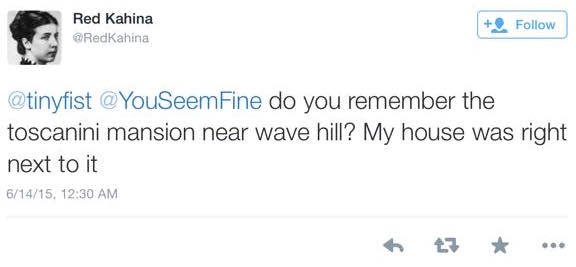
Queen tankie Molly Klein — a fabulously rich heiress who grew up next to the Toscanini mansion on Wave Hill, daughter of the dude who invented PlayboyTV — routinely smears anyone who crosses her as “racist,” including the young black DSA member, Douglas Williams. Klein, alias RedKahina and numerous other sock-puppet accounts and anonymous online handles, has charged me on multiple occasions with antisemitism and antiziganism, despite my own Jewish and Roma ancestry. Now that Amber dared to make fun of her paranoiac panel from last year, accusing the Slovenian philosopher Slavoj Žižek of being a CIA plant and psyop, they’ve begun making borderline misogynist remarks like “Amber Frost has to be a porn name” and “yuk, Frost wanders through the Left Forum like a dog with her tongue out thinking ‘whose leg can I hump?’.” Tarzie, the self-described “rancid honeytrap,” hoped that Amber would be hit by a bus. Charming lot, truly. Continue reading

About Two Squares: El Lissitzky’s 1922 suprematist picture book for kids

Originally published in the
Cambridge Literary Review
.

Most children’s books do not come with instructions for how to read them. El Lissitzky’s About Two Squares is not most children’s books.

Lissitzky first announced his plan to write a “suprematist tale”[1] about two intergalactic squares while teaching graphic arts and printmaking at the Vitebsk Institute of Popular Art in 1920. Traces of the idea can be detected as early as September 1919, however, shortly after he arrived in the city. Initially a disciple of the Jewish folk painter Marc Chagall, Lissitzky soon came under the spell of the charismatic avant-garde pioneer Kazimir Malevich (who usurped Chagall’s role as rector of the Institute that winter). Almost immediately one notices a shift in the form and subject-matter of Lissitzky’s oeuvre, as he abandoned village scenes and stylized conventional figures in favor of planar abstractions and floating rectilinear shapes. Within a matter of months, his entire artistic worldview was transformed.

Part of this transformation involved a change in Lissitzky’s approach to typography and book design. These were fields in which he showed prior interest. He had prepared a songbook for the traditional Passover poem Chad Gadya in 1917, and then again in 1919. Both of these versions clearly demonstrate the abiding influence of Chagall, though by the time the second one was published, suprematist elements already began to enter in. Following the release of the 1919 edition, Lissitzky informed Malevich of his newfound perspective:

It is my belief that the thoughts we drink from the book with our eyes must be poured over every visible shape. The letters and punctuation marks, which introduce order to thoughts, must also be taken into account. Besides that, the way the rows are set corresponds to certain condensations of thought; these should be condensed for the benefit of the eye as well.[2]

Evidently, suprematism for Lissitzky had consequences well beyond the realm of the painted object. It implied a broader reconsideration of the medium of print. Lissitzky was an ardent — if self-trained — bibliologist, and in 1926 he hypothesized what effect modern art might have on the future of the book. “There are today two dimensions to the word,” he maintained in an article for the Gutenberg-Jahrbuch. “As sound, it is a function of time; as exposition, of space. The book of the future must be both.”[3]

Yve-Alain Bois, a Swiss art critic and Lissitzky scholar, has noted that authors only began to take an interest in the visuals of their books toward the end of the nineteenth century.[4] Questions of format, font, and layout generally seemed besides the point. Little attention was paid to the arrangement of text upon the page. With the advent of photography and improved printing technology, however, new possibilities were opened. Citing the development of “facsimile-electrotype (or half-tone blocks),” Lissitzky speculated that this would allow for greater flexibility in the illustration of written materials.[5] Great innovators like F.T. Marinetti likewise had a role to play in Lissitzky’s scheme, discerning the potential of boldface lettering and ALL CAPS to convey emphasis or emotion.[6] Nevertheless, the aesthetics of print continued to lag behind other fields of art until the outbreak of World War I, usually held up as a cultural watershed.

Russia was no exception to this trend. “Before October 1917,” Lissitzky explained in a catalog ten years later, “our artists hardly concerned themselves with typesetting. That matter was left to the printers.” He continued: “After October, many of our premier artists in different fields, hoping to express the new through the specific properties of each medium, took up the task of reinventing the book according to the material of the book itself — i.e., type.”[7] Painters especially participated in this process, starting even before the war, working together with poets to revolutionize the medium.[8] By the 1920s, swept along by the maelstrom of revolution, avant-garde bookmakers were employed in the production of posters as propaganda for the masses. Lissitzky even likened such placards and printed visual displays to single pages ripped from books, magnified and blown up several dozen times.[9]

This new movement, which sought to break down the barrier separating art from life, entailed the “death” of painting as it had hitherto been known. Aleksandr Rodchenko gave up painting in order to pursue photography and agitprop. Varvara Stepanova abandoned the canvas for fabrics and textile patterns. For Lissitzky, the prewar experiments in painting had simply prepared artists for the revolutionary enterprise of construction, an idea charged with meaning at the time. His celebrated PROUN series merely provided the point of departure, being “the way station between art and architecture.”[10] Similarly, the book displaced painting and sculpture as the most monumental art form of revolutionary Russia.[11] It was this fact, in Lissitzky’s view, that sealed the fate of older forms of artistic production. “Once the printed page started to seduce the artist,” he wrote morbidly, “painting slowly died.”[12]

Bois has referred to this rhetorical conceit regarding the death of easel painting as “the cliché of the era.”[13] Was it really nothing more than a cliché, though? Might it not have had a real sociohistoric basis?

Indeed, About Two Squares can be read as a dramatization of this very aspiration, though intended for children. Lissitzky stressed the importance of such literature in the upbringing of the New Man: “We should add to the number of illustrated weeklies the flood of children’s picture-books. Children’s reading teaches them a new plastic language. They grow up with a different relation to image and color, the world and space.”[14] About Two Squares recapitulates Lissitzky’s belief that revolutionary form heralds the arrival of revolutionary content, and that the former must act as a vehicle for the latter.

The book finally appeared in 1922, roughly two years after Lissitzky envisioned it, under the imprimatur of the Scythian press [Skythen Verlag] in Berlin. On the back cover, however, was a symbol indicating its origin in Vitebsk: the UNOVIS logo — a red square set inside a thin black frame, partially circumscribed within a circle. Scythian publishing house was loosely affiliated with the Left Socialist-Revolutionary party in Russia, run mostly by Russian symbolist poets living abroad. In some ways it may be seen as a prototype of later samizdat operations. About Two Squares was among the first modernist publications they put out. Continue reading