Mac Intosh, 1940-2021

.
Was sad to learn that Mac Intosh of Internationalist Perspective passed away on Friday. I don’t know enough details about his life to really write a proper obituary. But I’m told that IP plans to release a statement about his passing, so I will be sure to link to that once it appears. For now, I thought I’d write a brief personal note and then include an outstanding article he wrote that’s since become hard to find online. You can read a moving tribute by another one of his friends here.

Milchman’s biography and political trajectory are quite remarkable. Once he became a Marxist, he and became a founding member of the International Communist Current before leaving to form the more councilist, theory-oriented group Internationalist Perspective. He participated on a couple panels on Wertkritik and on democracy as well, which are worth checking out.

I met him a few times at a Lukács reading group he was running at the New School back in 2013, and he came to a couple events I organized where Loren Goldner spoke. Great guy. The photo below was taken by a friend.

Below that photo you can read an article by Mac Intosh that was obviously up my alley. I had a couple conversations with him about this piece, which I was quite taken with. He discusses Postone’s notion of capital as the automatic subject, replacing the Lukácsian identification of the proletariat with the subject of history. My feeling was that one way to square the two seemingly opposite conceptions is to recognize that capital is the actual subject of history under capitalism, while the proletariat is the potential subject as its obverse. The condition for the proletariat’s (or the collective worker’s) historical subjectivity is revolutionary class consciousness. Alan really liked that formulation.


The Value Form, Reification, and the Consciousness of the Collective Worker

Mac Intosh
Internationalist Perspective
Issue 57: Winter 2010

.
Marx’s critical theory exposed a mode of production, a civilization, based on value, which he described as a “deranged” or “perverted form” [verrückte Form], in which social relations between persons are inverted and appear as relations between things. It is the abstract labor of the working class that produces and reproduces this deranged form. As Max Horkheimer, in 1937, put it in “Traditional and Critical Theory”: “[H]uman beings reproduce [erneuern], through their own labor, a reality which increasingly enslaves them.”1 It was Georg Lukács, in his essay “Reification and the Consciousness of the Proletariat,” in the collection History and Class Consciousness (1923), who had first elaborated a theory of reification through which the effects of the value form, that perverted form, and the commodity fetishism that was integral to it, seized hold of society. Lukács’ accomplishment, even before many of Marx’s own vast “economic” manuscripts had been published, was a theoretical breakthrough upon which Marxism as a negative critique of capitalism is still based. As Lukács persuasively argued:

Just as the capitalist system continuously produces and reproduces itself economically on higher and higher levels, the structure of reification progressively sinks more deeply, more fatefully and more definitively into the consciousness of man.2

However, Lukács’ concept of reification also entailed the claim that the proletariat, as identical subject-object, could escape the enslavement of reification to which Horkheimer would later point. For Lukács, while the consciousness of the bourgeoisie is “imprisoned” within the reified forms imposed by capital, capable only of grasping the immediacy of its social situation, the worker can become “aware of himself as a commodity,” in which case “the fetishistic forms of the commodity system begin to dissolve: in the commodity the worker recognizes himself and his own relations with capital.”3 In short, for Lukács, despite the reification to which the worker is subject, the possibility of escape for the working class is inherent in the capitalist labor process itself. Indeed, Lukács asserts that the proletarian is compelled to “surpass the immediacy of his condition.”4 But what, then, really permits the proletariat to escape that reified consciousness? Lukács’ answer, a theoretically and sociologically unsatisfactory answer in my view, is:

For the proletariat to become aware of the dialectical nature of its existence is a matter of life and death, whereas the bourgeoisie uses the abstract categories of reflection… to conceal the dialectical structure of the historical process in daily life…5

But can the “need” to be aware of the dialectical nature of its existence really explain how the proletariat can escape the effects of reification? Indeed, Lukács’ “explanation” seems more a leap of faith, almost a Pascalian bet, rather than a theoretically rigorous account of the potential that exists within the capitalist labor process, and is instantiated in the “collective worker,” the Gesamtarbeiter. Continue reading

Moishe Postone, 1942-2018

.
(Caricature depicting Postone on the left,
next to Karl Marx and Karl Liebknecht)

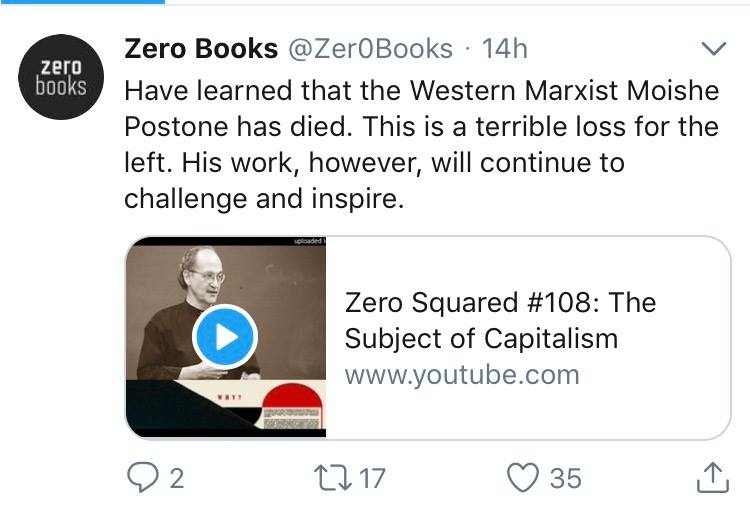
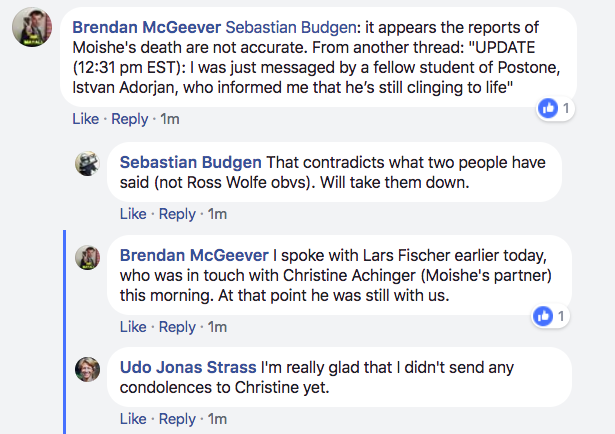
Yesterday morning I saw it announced across social media and on several sites, namely by Zer0 Books and Shades Magazine, that my former teacher Moishe Postone has died. I had known from friends close to his family that he was very ill, and heard they were taking him off life support this last weekend. So when news circulated that he had left us, I assumed it was fact and wrote the short tribute published here. Later, a fellow student of Moishe, Istvan Adorjan, contacted me to say the reports were false, and that he was still clinging to life (though probably not for much longer). Obviously, I did not intend to mislead anyone by passing along this information, since I believed it to be true, much less disrespect him or his loved ones.

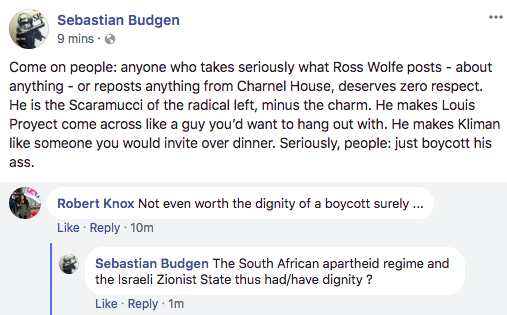
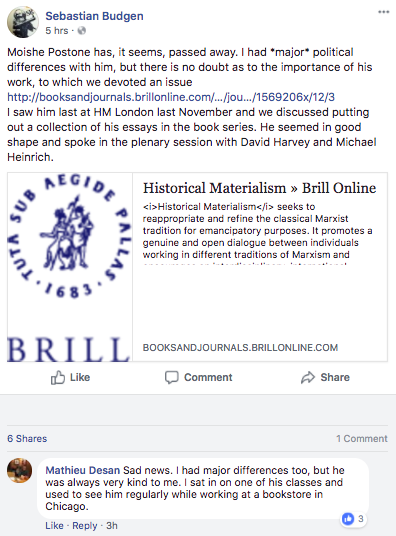
As soon as I learned of the mistake, I tried to publicize as far as possible that Moishe was still alive. Many others had by then written premature obituaries, including Peter Frase of Jacobin, though he likewise went on to correct it. For some reason,Sebastian Budgen of Verso and Historical Materialism began alleging that that I’d invented the malicious rumor Moishe was dead, despite the fact Budgen had widely shared the false reports of his passing across multiple platforms hours before I even saw anything about it. Ironically, Budgen only learned Moishe was still alive at that point thanks to Brendan McGeever’s crosspost of my note. Nevertheless, he fulminated that I ought to be “boycotted like apartheid South Africa or Zionist Israel” (I can only imagine what Moishe would have said about that).

That the sad occasion of Moishe’s passing would be used by Budgen to perpetuate his silly beef with me is of course petty beyond belief, but it is not surprising, just as little as it should surprise anyone that sycophants hoping to get published by him would kiss his ass all over that status update. Regardless, I intend to dedicate the remainder of this post to the memory of Postone, without worrying about what these idiots might say. Jennifer Moran, a family friend, contacted me a couple hours ago to tell me she had just received a pastoral notice from the synagogue that the funeral will be held at Rodfei Zadek tomorrow. Goodbye, Moishe. You will be missed immensely.

When I attended his lectures on Capital almost ten years ago he was undergoing treatment for cancer, which was subsequently in remission. Apparently it came back. Still, if you haven’t read his groundbreaking contributions to the reinterpretation of Marx’s mature critique, you should do so without delay. His works in English and German can be downloaded below.

An interview with Postone, published almost exactly ten years ago, can be read following a photograph showing him visiting the grave of the Frankfurt School critical theorist Herbert Marcuse. For worthwhile critical engagements with Postone’s Time, Labor, and Social Domination, see Loren Goldner’s appreciative “Critique of Pure Theory: Moishe Postone’s Dialectic of the Abstract and Abstract” (2003), Michael Heinrich’s somewhat captious “Too Much Production: Postone’s New Interpretation of Marx’s Theory Provides a Categorical Critique with Deficits” (2004), Chris Arthur’s “Subject and Counter-Subject” (2004), Slavoj Žižek’s sustained reading of it in Living in the End Times (2009), and Chris Cutrone’s “When was the Crisis of Capitalism? Moishe Postone and the Legacy of the 1960s New Left” (2014).

Marx after Marxism:
An interview with Moishe Postone

Benjamin Blumberg & Pam Nogales
Platypus Review 3 | March 1, 2008


BB: We would like to begin by asking some questions about your early engagement with Marxism and the impetus for your contribution to it. Very basically, how did you come upon Marx?

MP: I went through various stages. My first encounter was, as is the case with many people, the Communist Manifesto, which I thought was… rousing, and not really relevant. For me, in the 1960s, I thought it was a kind of a feel-good manifesto, not that it had been that in its own time, but that it no longer was really very relevant. Also, hearing the remnants of the old Left that were still around campus — Trotskyists and Stalinists arguing with one another — I thought that most of it was pretty removed from people’s concerns. It had a museum quality to it. So, I considered myself, in some vague sense, critical, or Left, or then the word was “radical,” but not particularly Marxist. I was very interested in issues of socialism, but that isn’t necessarily the same as Marxism.

Then I discovered, as did many in my generation, the 1844 Manuscripts. I thought they were fantastic… At that point, however, I still bought into the notion, very widespread then, that the young Marx really had something to say and that then, alas, he became a Victorian and that his thought became petrified. A turning point for me was an article, “The Unknown Marx,” written by Martin Nicolaus while translating the Grundrisse in 1967. Its hints at the richness of the Grundrisse blew me away. Continue reading

Society, totality, and history

.
Dia­lectics elude straight­for­ward defin­i­tion. No doubt it is easi­er to say what dia­lectics is not, rather than to say what it is. Against Ferdin­and Las­salle, Marx re­marked in a let­ter to En­gels that “Hegel nev­er de­scribed as dia­lectics the sub­sump­tion of vast num­bers of ‘cases’ un­der a gen­er­al prin­ciple,” and there­fore con­cluded that “the dia­lect­ic­al meth­od is wrongly ap­plied.”1 Vladi­mir Len­in like­wise poin­ted out that Geor­gii Plekhan­ov, the founder of Rus­si­an Marx­ism, erred in treat­ing dia­lectics as “the sum-total of ex­amples,” a mis­take from which even En­gels was not fully ex­empt.2

Still less is dia­lectics re­du­cible to an ab­stract for­mula or ste­reo­typed pro­ced­ure of thes­is-an­ti­thes­is-syn­thes­is. James re­garded this series as “a ru­in­ous sim­pli­fic­a­tion” in his 1948 Notes on Dia­lectics,3 while Len­in fol­lowed Hegel in con­sid­er­ing “the ‘tripli­city’ of dia­lectics… [as] its ex­tern­al, su­per­fi­cial side.”4 In sim­il­ar fash­ion, the Frank­furt School the­or­ist Theodor Ad­orno re­called that “Hegel ex­pressed the most cut­ting ob­jec­tions to the claptrap tripli­city of thes­is, an­ti­thes­is, and syn­thes­is as a meth­od­o­lo­gic­al schema.”5 Early in his ca­reer, Len­in up­braided the pop­u­list Nikolai Mikhail­ovsky for his fatu­ous por­tray­al of the ma­ter­i­al­ist dia­lectic as some sort of par­lor trick which “proves” cap­it­al­ism must col­lapse. “Marx’s dia­lect­ic­al meth­od does not con­sist in tri­ads at all,” ex­plained Len­in in 1894, “but pre­cisely in the re­jec­tion of ideal­ism and sub­ject­iv­ism in so­ci­ology.”6

How can this meth­od be re­tained in so­ci­ology, however, while at the same time get­ting rid of its ideal­ist residues? Ob­vi­ously, if the dia­lectic is to be any­thing more than a sub­ject­ive ad­di­tion, an ar­bit­rary “way of think­ing” about the world, its lo­gic has to be dis­covered in the ob­ject (i.e., so­ci­ety) it­self. The ma­ter­i­al­ist in­ver­sion of Hegel’s dia­lectic can only be jus­ti­fied if its con­tours ap­pear at the level of so­cial real­ity. “Dia­lect­ic­al un­der­stand­ing is noth­ing but the con­cep­tu­al form of a real dia­lect­ic­al fact,” wrote Georg Lukács in his 1924 mono­graph Len­in: A Study in the Unity of His Thought.7 Lukács’ con­tem­por­ary, the Bolshev­ik re­volu­tion­ary Le­on Trot­sky, main­tained that the meth­od should not be ap­plied to just any sphere of know­ledge “like an ever-ready mas­ter key,” since “dia­lectics can­not be im­posed upon facts, but must be de­duced from their char­ac­ter and de­vel­op­ment.”8 Re­flect­ing on his con­ver­sion to Marx­ism, Trot­sky wrote that “the dia­lect­ic­al meth­od re­vealed it­self for the first time, not as an ab­stract defin­i­tion, but as a liv­ing spring found in the his­tor­ic­al pro­cess.”9

Trot­sky’s meta­phor of the spring re­curs fre­quently in his art­icles and speeches. “Marx­ism without the dia­lectic is like a clock without a spring,” he later de­clared.10 Wound tightly in­to the shape of a spir­al, the ma­ter­i­al­ist dia­lectic simply mir­rors the dy­nam­ic ten­sion of cap­it­al­ism it­self. “Cycles ex­plain a great deal,” Trot­sky main­tained in 1923, “form­ing through auto­mat­ic pulsa­tion an in­dis­pens­able dia­lect­ic­al spring in the mech­an­ism of cap­it­al­ist so­ci­ety.”11 Earli­er in the year he stressed that an ad­equate so­ci­olo­gic­al ac­count must be both strong and flex­ible, since “dia­lect­ic­al thought is like a spring, and springs are made of tempered steel.”12

Continue reading

Capital as subject and the existence of labor

kupka-egalite-4 kupka-fraternite-4

Werner Bonefeld
Open Marxism
Volume 3, 1995
.
.

Editorial note
.

Been reading furiously through the Theories of Surplus Value and the 1863 manuscripts on the relation of “subject” and “object” in Marx’s later writings. My hunch is that Postone is right in his reversal of Lukács, who had the proletariat as the simultaneous subject-object of History. For Postone, it’s capital that is the simultaneous subject-object of History. The thing is, they’re both right. And I’m not saying this just so as not to pick a side, though I think ultimately it’s Lukács who gets the better of Postone (at the precise moment the latter seems to have the upper hand).

Living labor or variable capital — i.e., the proletariat as the embodiment of wage-labor — is the subjective factor in production. Dead labor or constant capital — i.e., the bourgeoisie, or rather the means of production they own, as the embodiment of capital — is the objective factor in production. Early in Capital, Marx identifies the vitality of labor-power as “the subjective factor of the labor process,” and goes on to state that “the same elements of capital which, from the perspective of the labor process, can be distinguished respectively as the objective and subjective factors, as means of production and labor-power, can be distinguished from the perspective of the valorization process as constant and variable capital.”

 However, under capitalism these roles appear reversed: the products rule over their producers. Consider a couple passages from the 1863 manuscripts. First,

Objectified, past labor… becomes the sovereign of living, present labor. The relation of subject and object is inverted. If already in the presupposition the objective conditions for the realization of the worker’s labor capacity and therefore for actual labor appear to the worker as alien, independent powers, which relate to living labor rather as the conditions of their own preservation and increase — the tool, the material [of labor] and the means of subsistence only giving themselves up to labor in order to absorb more of it — this inversion is still more pronounced in the result. In both directions, therefore, the objective conditions of labor are the result of labor itself, they are its own objectification, and it is its own objectification, labor itself as its result, that confronts labor as an alien power, as an independent power; while labor confronts the latter again and again in the same objectlessness, as mere labor capacity.

[Die vergegenständlichte, vergangene Arbeit wird so zum Herrscher über die lebendige, gegenwärtige Arbeit. Das Verhältnis von Subjekt und Objekt wird verkehrt. Wenn in der Voraussetzung schon dem Arbeiter die gegenständlichen Bedingungen zur Verwirklichung seines Arbeitsvermögens und daher zur wirklichen Arbeit als fremde, selbständige Mächte gegenüber erscheinen, die sich vielmehr zur lebendigen Arbeit als die Bedingungen ihrer eignen Erhaltung und Vermehrung verhalten — Werkzeug, Material, Lebensmittel, die sich nur an die Arbeit hingeben, um in sich selbst mehr Arbeit einzusaugen —, so erscheint dieselbe Verkehrung noch mehr im Resultat. Die gegenständlichen Bedingungen der Arbeit sind selbst Produkte der Arbeit und, soweit sie von der Seite des Tauschwerts betrachtet werden, nichts als Arbeitszeit in gegenständlicher Form. Nach beiden Seiten hin sind also die gegenständlichen Bedingungen der Arbeit Resultat der Arbeit selbst, ihre eigne Vergegenständlichung, und es ist diese ihre eigne Vergegenständlichung, sie selbst als ihr Resultat, die ihr als fremde Macht, als selbständige Macht, gegenübertritt und der gegenüber sie immer wieder in derselben Gegenstandslosigkeit, als bloßes Arbeitsvermögen, gegenübertritt.]

Next,

Since the economists identify past labor with capital — past labor being understood in this case not only in the sense of concrete labor embodied in the product, but also in the sense of social labor, materialized labor time — it is understandable that they, the Pindars of capital, emphasize the objective elements of production and overestimate their importance as against the subjective element, living, immediate labor. For them, labor only becomes efficacious when it becomes capital and confronts itself, the passive element confronting its active counterpart. The producer is therefore controlled by the product, the subject by the object, labor which is being embodied by labor embodied in an object, etc. In all these conceptions, past labor appears not merely as an objective factor of living labor, subsumed by it, but vice versa; not as an element of the power of living labor, but as a power over this labor.

[Da die Ökonomen die vergangene Arbeit mit dem Kapital identifizieren — vergangene Arbeit hier sowohl im Sinne der konkreten, in den Produkten realisierten Arbeit, als im Sinne der gesellschaftlichen Arbeit, materialisierter Arbeitszeit — , so versteht sich bei ihnen, als den Pindaren des Kapitals, daß sie die gegenständlichen Elemente der Produktion geltend machen und ihre Bedeutung überschätzen gegenüber dem subjektiven Element, der lebendigen, unmittelbaren Arbeit. Die Arbeit wird ihnen erst adäquat, sobald sie Kapital wird, sich selbst gegenübertritt, das Passivum der Arbeit ihrem Aktivum. Das Produkt ist daher bestimmend über den Produzenten, der Gegenstand über das Subjekt, die realisierte Arbeit über die sich realisierende etc. In allen diesen Auffassungen tritt die vergangene Arbeit nicht auf als bloß gegenständliches Moment der lebendigen und von ihr subsumierten, sondern umgekehrt; nicht als ein Machtelement der lebendigen Arbeit, sondern als Macht über diese Arbeit.]

Capital is the actual, albeit unconscious, form of society’s self-objectifying subjectivity, while the proletariat is rather its potential form. Only by becoming conscious of its position within the totality of production (in other words, by attaining class consciousness in the Lukácsean sense) can the subjectivity of the latter be actualized. Wage labor and capital are, after all, only two sides of the same value-relation, constitutive of yet antithetical to one another. Inverting this inverted relationship — expropriating the expropriators, negating the negation — humanity masters its own social organization and finally sets itself off from the rest of the animal kingdom.

Marx’s famous dictum that “the emancipation of the workers [object] must be the task of the workers themselves [subject]” captures precisely this image of the proletariat as subject and object of social emancipation. Yet this “historic mission” does not mean affirming the class essence of workers. Socialist revolution will not result in universal proletarianization; capitalism has already accomplished this. “Just as the condition for the liberation of the third estate, of the bourgeois order, was the abolition of all estates and all orders, so the condition for the emancipation of the working class is the abolition of every class.”

Postone is of course understandably wary of the “notion of the proletariat as the revolutionary Subject, in the sense of a social agent that both constitutes history and realizes itself in socialism.” He writes: “Far from entailing the realization of the proletariat, overcoming capitalism involves the material abolition of proletarian labor.” But Lukács wholeheartedly agreed with this assessment:

Subjectively, i.e. for the class consciousness of the proletariat, the dialectical relationship between immediate interests and objective impact on the whole of society is located in the consciousness of the proletariat itself. It does not work itself out as a purely objective process quite apart from all (imputed) consciousness — as was the case with all classes hitherto. Thus the revolutionary victory of the proletariat does not imply, as with former classes, the immediate realization of the socially given existence of the class, but, as the young Marx clearly saw and defined, its self-annihilation.

Qua embodied negativity, as the negative condition of class society and the promise of its dissolution, “affirmation” of the proletariat can only mean abolishing the present state of affairs. This is what Engels meant when he remarked that “communism is the doctrine of the conditions of the liberation of the proletariat.”

As I’ve written elsewhere, capital is nothing other than the alienated agency of unrealized humanity. The proletariat does not presently represent the material human community in nuce, but it alone is capable of realizing it. By taking command over the accumulated instruments of production, it finally makes possible the advent of a truly human history. Lukács confirms this:

The “realm of freedom,” the end of the “prehistory of mankind” means precisely that the power of the objectified, reified relations between men begins to revert to man. The closer this process comes to its goal the more urgent it becomes for the proletariat to understand its own historical mission and the more vigorously and directly proletarian class consciousness will determine each of its actions. For the blind power of the forces at work will only advance “automatically” to their goal of self-annihilation as long as that goal is not within reach. When the moment of transition to the “realm of freedom” arrives this will become apparent just because the blind forces really will hurtle blindly towards the abyss, and only the conscious will of the proletariat will be able to save mankind from the impending catastrophe.

Werner Bonefeld addresses some of these same issues in the essay appended below, albeit in a somewhat different manner than I do here. He’s addressing Bob Jessop, rather than Postone, whose work he engages with elsewhere. Bonefeld makes many similar points, although as a rule he tends to denigrate “class consciousness.” I take this to be symptomatic of his anti-Leninism, but otherwise agree with his position.

To be sure, he’s right that “[i]n Marx’s work there is hardly any reference to ‘class consciousness’… Marx was not interested in the psychology of the working class.” Nevertheless, though the word Klassenbewußtsein does not appear in Marx’s work, its rudiments can be made out in numerous places. E.g., the Manifesto, where it is written that “the proletarian movement is the self-conscious, independent movement of the immense majority, in the interest of the immense majority.”

(As far as I can tell, Kautsky coined the “class consciousness,” indicated by Engels’ 1891 comment: “Instead of ‘class-conscious,’ which in our circles is an easily understood abbreviation, I would say the following to facilitate universal understanding and translation into foreign languages: ‘with workers conscious of their class position,’ or something like it.”)

Personally, I think the issue of proletarian consciousness, what Luxemburg in Reform or Revolution called “the subjective factor in the socialist transformation,” is indispensable. “The stronger [the] contradiction [within production] becomes,” wrote Lenin in 1899, “the more developed become the objective conditions for this transformation, as well as the subjective conditions [объективные условия этого превращения, так и субъективные условия], the workers’ consciousness of this contradiction [сознание противоречия работниками].”

Contra Kautsky, sixteen years later, Lenin thundered: “Not every revolutionary situation…gives rise to a revolution; revolution arises only out of a situation in which the… objective changes are accompanied by a subjective change, namely, the ability of the revolutionary class to take revolutionary mass action strong enough to break (or dislocate) the old government, which never, not even in a period of crisis, ‘falls,’ if it is not toppled over.” Continue reading

Anatomy of a controversy

Race, religion, and ideology
in contemporary debates on
the French communist Left
.
.

How to moralize with a sledgehammer

.
On the night of April 21, 2016, the windows of an anarchist library and bookshop in Paris were smashed with a sledgehammer. Above the broken glass, next to hollowed-out frames, one word had been spraypainted: RACIST. This was the third such attack to take place at the location in under a year. La Discordia opened its doors back in May 2015 to provide a space for discussion, theory, and debate. “Discord is profound disagreement,” reads La Discordia’s founding charter, “violent dissent which sets people against each other.” So it would seem to be living up to its stated mission, if repeated acts of vandalism are any indication. What’s odd about these incidents, though, is that La Discordia wasn’t targeted by right-wing thugs or fascists — the usual suspects whenever anarchists receive threats of this sort — but rather by other anarchists. It wasn’t the work of national-anarchists, either, but those professing a decolonial brand of anarchism. Yves Coleman, who serves as correspondent for the left communist periodical Insurgent Notes in France, characterized the hoodlums as “left identitarians [identitaires de gauche], social chauvinists, and assorted Third Worldists.” Magazin Redaktion, the German-language Turkish collective, wrote that “La Discordia and the friendly associated website non fides have lately been exposed to a certain hostility and multiple threats; among other things, the store was recently defaced… by fractions of the ‘antiauthoritarian’ scene [die Teilen der ‚antiautoritären’ Szene] with slogans calling it ‘fascist’ and ‘racist’.”

How does anybody know who carried out this act of petty property destruction? Clearly, the volunteers who run La Discordia suspect it was a crude attempt at intimidation. Nevertheless, protests and street demonstrations have occurred on an almost nightly basis in Paris, and throughout the country, since roughly the beginning of April. Up All Night [Nuit debout] debuted on March 31, to drum up public opposition to the hated loi du travail, so it’s not beyond the realm of possibility that the library might have suffered incidental damage in the confusion. “Why is this happening right now, while we are all concentrated on what is going on in the streets?” asked the Discordians in their official statement on the matter. “Evidently because, for those who hold race and religion sacrosanct, it’s more important to defend these things than to combat capital and state. Again, no other sign of attack was to be seen in the neighborhood that night, neither banks nor churches nor the premises of political parties. Just an anarchist library.” Back in February, right after the initial attack, Dialectical Delinquents published a letter of solidarity with La Discordia:

Several months in the planning, a debate on “Islamophobia: A Conceptual and Political Racket” was finally held January 26. La Discordia wanted to confront a topic at the heart of the current struggles, conflating condemnation of racism with a defense of religion. Our joint conversations were interesting. More than sixty comrades came to the event — we promise to rent a larger venue next time, and with more chairs! — demonstrating that many feel the need for a revolutionary critique of religion. Every religion, including Islam, which others would like to palm off as the “religion of the oppressed”…

Upon arriving Tuesday afternoon, we saw that the storefront had been tagged during the night. Poorly-written, ill-thought-out epithets (“fascists,” “racists,” etc.) appeared next to circled As (thank you!) in black spray paint, along with a leaflet of demands. We were allegedly acting as a vehicle for “Islamophobic and racist theories” and “ideologies of power,” etc. A thought for the atheist “fascists,” the unbelievers who from Tehran to Saint-Denis are now treated as “Islamophobic” as much by fearsome powers as by this arriviste of the French academic petit bourgeois who knows only the racism of his own class, whose only practice over a decade is to leave illegible tags on anarchist libraries and organize conferences with religious authorities.

Dialectical Delinquents’ declaration of support was succeeded by a similarly sympathetic note from the editors of the anarchist street paper Paris Sous Tension, posted on Indymedia Nantes right after the first attack and updated in March after the second. “In striving to make sense of this gesture, committed by purported anarchists (as they claimed to be in the message they left), …we see that its only purpose is to empty anarchism of any anti-religious content,” they wrote. “The revolt against religious dogma… has always been a part of revolutionary criticism, here in Europe and the rest of the world, where a great many atheists, blasphemers, revolutionaries, ‘freethinkers,’ and simple nonconformists face ferocious repression on the part of divine spokespersons… We’d like to publicly express our support for the comrades at La Discordia against this imbecilic and gross manifestation of the… ‘convergence’ between politicians of the extreme left and reactionary Islamists.” Barely an hour had passed before angry commenters were accusing La Discordia and its sympathizers of “justifying and rationalizing Islamophobia.” Not long after, another threatened: “Come the revolution the monks of atheism [les religieux de l’atheisme] will be gunned down.” Yet the coup de grâce was delivered by somebody named “Patlotch,” who accused an old left communist internationalist [vieux sympathisant de la gauche communiste internationaliste] of Eurocentrism. About this Patlotch, we’ll hear more later. La Discordia vowed to continue cursing “the confused pseudo-radicals and theo-compatibles” [les pseudo-radicaux confus et théo-compatibles], reciting some of the lines to La père Duschesne, an anonymous ode to Hébert that the anarchist Ravachol sang on his way to the guillotine in 1892: “Cut the priests in two, bloody hell / Tear the churches to the ground, blood of God / And good Lord in the shit, bloody hell!” [«Coupe les curés en deux, Nom de Dieu / Fout les églises par terre, Sang Dieu / Et l’bon dieu dans la merde, Nom de Dieu!»]

Each of these two letters of solidarity echoes the event description for «Islamophobie: du racket conceptuel au racket politique», from the talk in January. “Numerous so-called ‘revolutionaries’ seek to reappropriate the concept [of Islamophobia], and thereby develop a blindness to the authoritarian and pacifying role played by every religion,” the promotional post states. “Islam is wrongly defended as the religion of the oppressed (as Irish Catholicism and Tibetan Buddhism were before it). Behind this lurks the idea that relations of domination become emancipatory when borne by those who are supposedly oppressed. Religion remains a major obstacle to those looking to radically transform the world, however, and so criticism is necessary now more than ever. For there are no ‘religions of the oppressed,’ only religions that oppress.” Who would actually try to claim Islam is anywhere the “religion of the oppressed,” much less on a global scale? At first this sounds like a straw-man. Mahmoud Senadji of the Parti des Indigènes de la République wrote an essay in 2009 on Iran and Foucault in which he asserted Islam alone had the capacity to serve as a medium for revolution, “Islam being the religion of the oppressed” [l’islam étant la religion des opprimés]. (The Indigènes are big fans of Kevin Anderson’s book Marx at the Margins, which is admittedly quite good, but the reason they like it is that it seems to validate their own preexisting views. Or rather, it presents a reading of Marx more amenable to their politics. How surprised they’d be if they ever took a look at the study Anderson wrote along with Janet Afary in 2005, Foucault and the Iranian Revolution: Gender and the Seduction of Islamism). Continue reading

The (anti-)German ideology: Towards a critique of anti-German “communism”

Raph Schlembach
Interface journal
November 2010
.

The specter of the anti-Germans has easily become the Feindbild for activists of the Anglophone Left; yet rarely does this translate into a fundamental or informed criticism of the anti-German premise. This article, then, offers an introductory description and a critical analysis of pro-Israeli, anti-German communism in its context within the post-war German Left and as a contemporary protest movement that sits oddly on the fringes of radical politics. Its origins and politics are examined to depict the radicalization of a broad anti-nationalist campaign against German re-unification, and its evolution into a small but coherent anti-German movement, controversial for its pro-Israel polemics and provocations. Current debates within the anti-fascist German Left are reviewed to explore anti-German positions on the Holocaust, Israel, Islam, anti-imperialism, and Germany’s foreign policy. Theoretical works that have heavily influenced anti-German communism are discussed to comprehend the movement’s intellectual inspirations. The purpose of the article is to introduce one of Germany’s most controversial protest movements to an English-speaking audience and to hint at the formulation of a critique that is more than a knee-jerk reaction to pro-Israeli agitation.

Introduction

.
Anti-German communism is a political tendency that grew from within the German radical Left, and that has adopted a pro-Western/pro-Israel discourse and critiques of post-Nazi Germany and Islamic antisemitism as its defining ideological characteristics. Despite being intellectually inspired by the writings of Karl Marx and the critical theory of the Frankfurt School, the subsequent reinterpretation and political contortion of these texts by the “anti-Germans” has fueled an antagonistic relationship with large parts of the German (and global) Left. The common left-wing premises of anti-imperialism and anti-Zionism are regarded by the anti-Germans as expressions of a continuation of the “logic of Auschwitz” that reflects totalitarian, fascistic thought in the national mindsets of most Germans, Europeans, and beyond.

Talking about the anti-Germans is a bit anachronistic, of course. Anti-German communism as a movement, in the sense of informing the practical and strategic politics of German anti-fascism, is connected to the decade or so immediately after German re-unification. In its more narrow sense, as a theoretically distinct but practically irrelevant contrarian position, anti-German communism has also seen its heyday. Anti-German ideas still persist nonetheless, in a number of periodicals and communist organizations, and continue to have some influence on the German anti-fascist movement and some unorthodox Marxist circles. It is also rather unhelpful to speak of “the anti-Germans” as if they represented a homogenous movement. This is even more so as the ideas and positions of anti-German authors, activists and groups have tended to undergo rapid development in an effort to gain “avant-garde” status in the radical Left. A first categorization is often used in German-language debates to distinguish between various “hardcore” and “softcore” trends. Hardcore anti-Germans, around the journal Bahamas and the Freiburg Initiative Sozialistisches Forum, have now mostly taken leave from left-wing political movements; yet it is they who often remain the object of controversy. Bahamas and their supporters in particular have made a point of declaring both left-wing and Islamist anti-imperialism as their enemy, often descending into vitriolic attacks against Muslims and Arabs in Europe — to such an extent that the tendency might now be best described as an “anti-Islam materialism.” The various softcore anti-German projects continue to exert some theoretical influence especially on anti-fascist politics. The journal Phase 2 for example has emerged from the German “Antifa” movement and now combines anti-German thought with elements from critical theory and post-structuralism to form a political perspective that is sometimes described as “post-Antifa.” Now defunct is the journal 17 Grad, which was based on Foucauldean theory and discourse analysis. The longstanding magazine Konkret has evolved from a more orthodox Marxist analysis but has also supported and developed anti-German positions in the past. The widely-read weekly newspaper Jungle World regularly publishes anti-German authors, but actually prints articles from a variety of radical political perspectives. However, it has been years since anti-German publications regularly sparked controversy and sometimes violent conflict amongst the German Left. Now, many writers, publishers and activists who had spearheaded the anti-German movement have retreated from left-wing circles and discussion. Nonetheless, in the English-speaking Left in particular, the anti-Germans are still subject to polemical controversy and outrage, often resulting from a fascination with the waving of American, British, and Israeli national flags by German anti-fascists. There are very few substantial English-language texts available however (Grigat 2005; Radke 2004 are amongst the more illuminating introductions), although whenever the topic is raised on left-wing online forums, blogs or in face-to-face conversation it is sure to generate long discussions. To date, there is only one academic publication about the anti-Germans in English language. The article in the Jewish Political Studies Review is largely descriptive and focuses on the pro-Israel stance of the movement. Keeping in mind the somewhat sketchy information so far available to the English-language reader, what I offer here is primarily a historical overview of the origins and political formation of the anti-Germans and, secondly, a suggestion towards a more fundamental critique of their politics.

.
Events in the recent history of the extra-parliamentary Left in Germany are crucial to understanding why anti-German currents play a prominent role in it. I trace the development of anti-German communist thought in four steps. First, I look at some of the influences that can be found in the work of pre-unification writers, such as Jean Améry or Eike Geisel. Second, the movement against German political reunification will be discussed as the immediate “trigger” or springboard for the emergence of anti-German communism as protest movement. Third, the anti-German response to events such as the Kosovo war and 9/11 illustrate how parts of the movement have severed their ties with the politics of the Left. In a final section, I indicate how the anti-German ideology remains firmly stuck in nationalist and identity politics.

Post-Holocaust origins

.
The anti-German self-understanding is one that combines criticism of German nationalism and political Islam with a more general critique of nation and state. It explicitly sees itself in contrast to the anti-imperialist and autonomous Left of the 1970s and 80s with its strong support for national liberation movements and vocal opposition to American and Israeli militarism. Put very simply, for the anti-Germans, anti-fascism in a world divided into states is synonymous with solidarity with Israel. The Israeli state is seen as the necessary reaction to the fascist barbarism of the Third Reich and that continues to rear its head in the Bundesrepublik. This inversion of the anti-imperialist premise is certainly at odds with left-wing politics in Anglo-Saxon countries and elsewhere outside this context. However, calls for solidarity with Israel and distrust of anti-Zionism are more commonplace in the German radical Left. Some of the most fervent critics of the anti-Germans would go to length to defend Zionism as the basis of the Israeli state (for example Robert Kurz 2003). Also many anti-fascist groups that do not belong to the anti-German spectrum practice and demonstrate solidarity with Israel and focus strongly on the continuing antisemitism in neo-Nazi movements.

The specificity of its National Socialist history has always been a central point of reference for the (West-)German Left. Concerned with “explaining the unexplainable,” the Left subscribed to a politics of remembrance. The “lessons” drawn from the terror of National Socialism and the Holocaust thereby remain fundamental to a radical theory and practice. Concepts and ideologies that had been paramount to the Third Reich, such as “the German people,” “nation,” or antisemitism are thus important points of reference. Radical left-wing criticism of anti-Zionism in Germany also emerged long before one could speak of an anti-German movement. Even texts from an armed anti-militarist group (Revolutionäre Zellen 1991) and an autonomist group (Autonome LUPUS-Gruppe 2001) criticized some aspects of anti-Zionism and anti-imperialism. The question of antisemitism had thus taken a prominent place in the internal discussion of the German Autonome movement already in the 1970s and 1980s. Critical voices were often the result of the failures of national liberation movements. A striking example was a failed attempt to liberate a number of Palestinian prisoners and members of the Red Army Faction, including Andreas Baader and Ulrike Meinhof. In 1976, a commando group of Palestinians and members of the Revolutionäre Zellen had hijacked a plane leaving Israel, demanding the release of political prisoners. The hijackers eventually let non-Jewish and non-Israeli hostages disembark from the grounded aircraft, while Israeli Jews were kept hostage until their liberation by anti-terror units. Nevertheless, accusations that anti-imperialist politics had slipped into overt antisemitism were voiced by only a few in the radical Left (see Hanloser 2004b).

Continue reading

On publishing practice: Architecture, history, politics

The Charnel-House
interviewed by Kerb

.
The following interview is taken from Kerb 21: Uncharted Territories (2013), a yearly publication put out by the Royal Melbourne Institute of Technology in Australia. A few months back, some of its editors contacted me for an interview on my rationales and routines for publishing. I was quite flattered, especially given that all of the other publications that were chosen by Kerb (such as Log, Topos, ScapegoatTerragrams306090) have a much, much wider pull than The Charnel-House. To be quite honest, I was surprised they found space for any of us considering the room it takes to house Marina Abramović’s ego, whom they also interviewed. — Just kidding!

Anyway, the physical journal is gorgeous and available for purchase online. I encourage all of you who have the means to pick up a copy. Below is a slightly more expansive series of responses to the questionnaire they asked me to fill out

The Charnel-House: From Bauhaus to Beinhaus

The Charnel-House: From Bauhaus to Beinhaus

EDITORIAL INTRODUCTION: Kerb: A Journal of Landscape Architecture approaches blogs, journals, magazines online and in print because it is interested to know how publishing practices operate and contribute to disciplines. Platforms of design and cultural discussion hosted by individuals and collectives offer varying insights and perspectives into the state of design. The ways in which the subject matter is curated and represented outlines one’s practice.

KERB: Describe a regular day in your “office.”

Ross Wolfe: A regular day blogging for The Charnel-House is hardly ever regular. Rather, it consists in a cluster of tightly-knit irregularities. Since there’s no strict timeline according to which updates are set to appear, the factors determining the generation of new content tend to emerge more or less by accident. Here and there (now and then), something will pique my interest, spark my imagination, or move me to issue a response. Such are the moments in which I write. (Of course, to be sure, there is a loose imperative to keep restocking the site with fresh supplies of images and information. Apart from this minimum, periodic upkeep, there’s very little in the way of discipline to maintain a regimented schedule.)

No matter when it comes, however, inspiration for new material on the blog usually doesn’t have anything to do with the environment in which writing takes place. Or if it does, it’s indirect. More often than not, the cues for what to write come from the virtual world rather than my immediate surroundings (which generally remain static throughout). The objects that lie about almost never change; at most they are rearranged. Constants like this can thus sink seamlessly into the background, a kind of visual “white noise,” and function by their total absence from my attention. As such, they create a sense of comfort and familiarity while I peruse the web in search of more direct engagements.

They say Sartre thrived on the hustle-and-bustle, penning some of his most famous tracts and novellas in the middle of packed, hectic, noisy Parisian cafés. It doesn’t seem all that far-fetched to me, really. When a topic is sufficiently engrossing, I’m able to tune out just about anything. Yet for the most part, I stick to a routine of place. Sometimes a change of scenery is warranted, but not always.

KERB: We have defined “practice” as the ongoing accumulation of knowledge that test ideas through research and application. Upon reflection, do you have your own mode of practice as an editor? What is it, what is it based on?

Ross Wolfe: Practically speaking, there is very little in the way of “testing” that goes on in blogging for The Charnel-House. That is to say, there is nothing that would approximate a “trial-and-error” method. However, it would be false to suggest that there is no empirical basis to the selection and curation of material for publication. Some programs are built into the blog service I use that allow me to see what kind of content attracts the most visitors, which posts draw the most comments, and which tend to get “liked.” Continue reading

Marx and Wertkritik

Elmar Flatschart
Alan Milchman
Jamie Merchant

.

Originally published in the Platypus Review. On Saturday, April 6, 2013, the Platypus Affiliated Society hosted a panel, “Marx and Wertkritik,” at its Fifth Annual International Convention, held at the School of the Art Institute Chicago. The panel featured Elmar Flatschart of the German theoretical journal EXIT!, Alan Milchman of Internationalist Perspective, and Jamie Merchant of Permanent Crisis. It was moderated by Gregor Baszak, of Platypus. What follows is an edited transcript of their discussion. A full recording of the event can be found online. 

Event Description

.
Perhaps one of the most influential developments in Marxist thought coming from Germany in the last decades has been the emergence of value critique. Building on Marx’s later economic works, value critics stress the importance of abolishing value (the abstract side of the commodity), pointing out problems in traditional Marxism’s emphasis on the “dictatorship of the proletariat”. The German value-critical journal Krisis has famously attacked what they believed was a social democratic fetishization of labor in their 1999 Manifesto Against Labor. Such notions have drawn criticism from more “orthodox” Marxists who miss the role of the political in value critique and the possibility of immanent transformation through engaging the realities of capitalist societies.

Did the later Marx abandon his political convictions that he expressed in the Manifesto? What about his later political writings, such as his “Critique of the Gotha Program,” in which he outlines the different phases of early communism? Is Marxism a scientific project, as claims from value critics seem to indicate? Was Marx trying to develop of a “science of value” in his later works? What can value critique teach us after the defeat of the Left in 20th century? Did traditional Marxism necessarily lead to the defeat of the Left?
.

Elmar Flatschart: Value critique, or, following the theorem developed by Roswitha Scholz, a critique of value-diremption [Wertabspaltungskritik], seeks to understand and critique the fundamental mechanisms that govern modern society. This critique is not as interested in the political Marx of class struggle and the workers’ movement, but more in the philosophical aspects of his work that focus on the abstract and fetishized character of modern domination. This approach tries to keep the abstract critical theory of society strictly separate from the contradictory practical attempts to overcome capitalism. Marxism shouldn’t be understood as an identity-giving, wholesome position, which history proved to be erroneous, but should be reduced to a theoretical core that can help us to understand society, via a negative critique, even if it does not necessarily provide us with a way out. The call for the abolition of labor does not have immediate ramifications for Marxist politics.

There is no new program or a master plan for emancipation that can be developed out of the abolition of value. Rather, it can be seen as a condition of emancipation from value and the abstract system of oppression it represents. How emancipation will be achieved is a more complex story. We know what will not work: much of what the Old Left proposed as Marxist politics. A lot of that should be abandoned because, essentially, abstract domination cannot be abolished through the imposition of some other kind of direct, personal domination. If we are to critique the abstractions of the economic forms, we similarly have to target the political form itself. While Marx and Engels suggested as much by their formulation of the state eventually “withering away,” I think we need to be a lot more radical. Emancipation ultimately has to mean the abolishment of the political as well. This is contradictory in the present political situation, but we should not try to postpone this task until after the revolution. We should see the constraints and the fetishizations immanent to the political form as something we want to get rid of now. Continue reading

Isaak Rubin

Marx and “Wertkritik”

A video and panel description 

Untitled.
Image: Photograph of Isaak
Rubin with his wife

untitled2.

A panel held on April 6, 2013, at the 2013 Platypus International Convention at the School of the Art Institute of Chicago. Originally posted on Platypus’ media website.

Video

[youtube=http://www.youtube.com/watch?feature=player_embedded&v=nhRI9QHgTjc]

Description

Perhaps one of the most influential developments in Marxist thought coming from Germany in the last decades has been the emergence of value critique. Building on Marx’s later economical works, value critics stress the importance of abolishing value (the abstract side of the commodity), pointing out problems in traditional Marxism’s emphasis on the “dictatorship of the proletariat”. The German value critical journal Krisis has famously attacked what they believed was a social democratic fetishization of labor in their 1999 Manifesto Against Labor. Such notions have drawn criticism from more “orthodox” Marxists who miss the role of the political in value critique and the possibility of immanent transformation through engaging the realities of capitalist societies. Did the later Marx abandon his political convictions that he expressed in the “Manifesto”? What about his later political writings, such as his “Critique of the Gotha Program” in which he outlines the different phases of early communism? Is Marxism a scientific project as claims from value critics indicate? Was Marx trying to develop of a “science of value” in his later works? What can value critique teach us after the defeat of the Left in 20th century? Did traditional Marxism necessarily have to lead to the defeat of the Left?

PLEASE NOTE: Due to technical errors, the last fifteen minutes of the video are cut off. The audio version is complete, however.

Speakers

  • Elmar Flatschart (EXIT)
  • Jamie Merchant (Permanent Crisis)
  • Alan Milchman (Internationalist Perspective)

Podcast: Play in new window | Download

Three models of “resistance”

Untitled

.
Image: Ferdinand Schmutzer,
Portrait of Sigmund Freud (1926)

2. The “resistance” of humanity to its own self-conscious transformation

.
Go to Three models of “resistance” — Introduction
Go to Three models of “resistance” — 1. The “resistance” of the world to humanity’s conscious attempts to transform it

The second major historical conceptualization of “resistance” examined in this essay comes by way of psychoanalysis directly, rather than through the indirect affinity between Freud’s reality principle and Dilthey’s account of the reality of the external world.  Indeed, Freudian analysis largely hinges on the various forms of resistance the analyst encounters in trying to disembed layers of repressed experience buried in the patient’s unconscious: “[The] opposition…during psychoanalytic treatment…against our effort to transform what is unconscious into what is conscious…is what we perceive as resistance.  We…[name the] pathogenic process demonstrated by this resistance…repression.”[36]

Here the operative concept is the “resistance” — whether conscious or unconscious — of the subject (and more specifically the ego)[37] to the task of working through its own past, which has been systematically repressed.  Once again, this resistance expresses an extreme conservatism.  In part, the subject avoids revisiting its own history because it finds many of its experiences traumatic and disturbing.  But the patient is not simply afraid of its past.  It is also afraid of its future.  The subject is gripped by a primitive urge for self-preservation, and balks at the prospect that it might potentially become something other than what it already is.  Having fallen in love with the symptoms of its own unfreedom, the analysand stubbornly resists the idea of living without them.

This notion of “resistance,” I submit, corresponds to the work of figures like Karl Korsch, Georg Lukács, and above all Wilhelm Reich early in their careers.  Each of these thinkers sought to digest the legacy of the international workers’ movement in the aftermath of its defeat between 1917 and 1923.  Following the spectacular series of capitulations, conciliations, schisms, and betrayals that shook the Second International in the decades leading up to World War I, all three authors came to the conclusion that the greatest obstacle to the proletariat’s emancipation was the proletariat itself — or more precisely, its inability to “work through” its own reified forms of consciousness.  For the emancipation of the working class was to be self-emancipation.  The “resistance” thus encountered was no longer that of the world maintaining itself against the actions of humanity.  In this case, the “resistance” was instead that of humanity in preserving its present condition of unfreedom against the challenge of fulfilling its destiny. Continue reading