Moishe Postone, 1942-2018

.
(Caricature depicting Postone on the left,
next to Karl Marx and Karl Liebknecht)

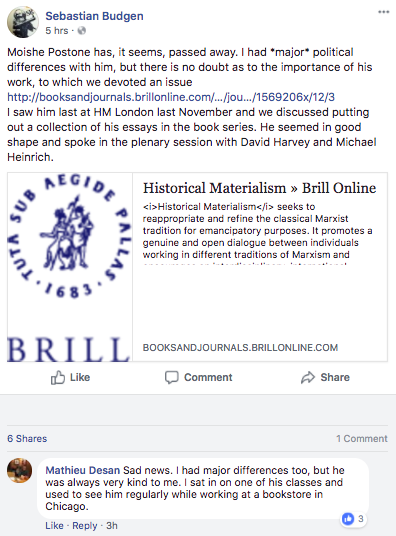
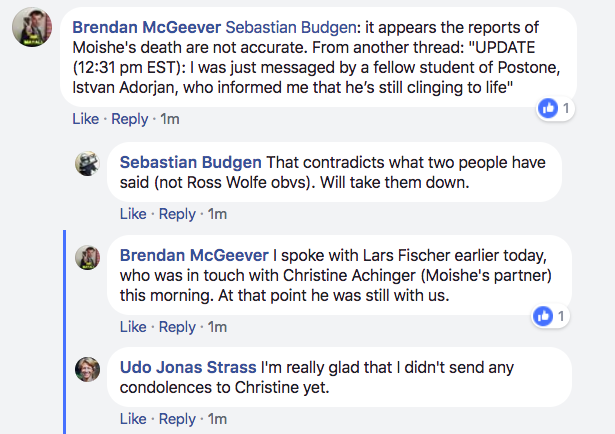
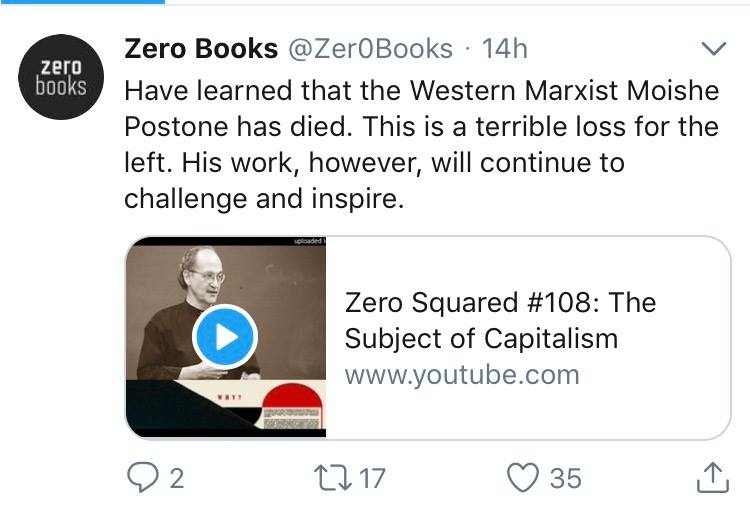
Yesterday morning I saw it announced across social media and on several sites, namely by Zer0 Books and Shades Magazine, that my former teacher Moishe Postone has died. I had known from friends close to his family that he was very ill, and heard they were taking him off life support this last weekend. So when news circulated that he had left us, I assumed it was fact and wrote the short tribute published here. Later, a fellow student of Moishe, Istvan Adorjan, contacted me to say the reports were false, and that he was still clinging to life (though probably not for much longer). Obviously, I did not intend to mislead anyone by passing along this information, since I believed it to be true, much less disrespect him or his loved ones.

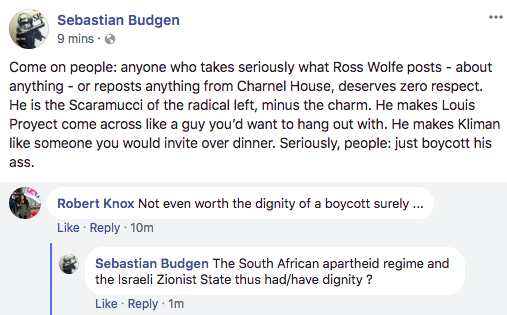
As soon as I learned of the mistake, I tried to publicize as far as possible that Moishe was still alive. Many others had by then written premature obituaries, including Peter Frase of Jacobin, though he likewise went on to correct it. For some reason,Sebastian Budgen of Verso and Historical Materialism began alleging that that I’d invented the malicious rumor Moishe was dead, despite the fact Budgen had widely shared the false reports of his passing across multiple platforms hours before I even saw anything about it. Ironically, Budgen only learned Moishe was still alive at that point thanks to Brendan McGeever’s crosspost of my note. Nevertheless, he fulminated that I ought to be “boycotted like apartheid South Africa or Zionist Israel” (I can only imagine what Moishe would have said about that).

That the sad occasion of Moishe’s passing would be used by Budgen to perpetuate his silly beef with me is of course petty beyond belief, but it is not surprising, just as little as it should surprise anyone that sycophants hoping to get published by him would kiss his ass all over that status update. Regardless, I intend to dedicate the remainder of this post to the memory of Postone, without worrying about what these idiots might say. Jennifer Moran, a family friend, contacted me a couple hours ago to tell me she had just received a pastoral notice from the synagogue that the funeral will be held at Rodfei Zadek tomorrow. Goodbye, Moishe. You will be missed immensely.

When I attended his lectures on Capital almost ten years ago he was undergoing treatment for cancer, which was subsequently in remission. Apparently it came back. Still, if you haven’t read his groundbreaking contributions to the reinterpretation of Marx’s mature critique, you should do so without delay. His works in English and German can be downloaded below.

An interview with Postone, published almost exactly ten years ago, can be read following a photograph showing him visiting the grave of the Frankfurt School critical theorist Herbert Marcuse. For worthwhile critical engagements with Postone’s Time, Labor, and Social Domination, see Loren Goldner’s appreciative “Critique of Pure Theory: Moishe Postone’s Dialectic of the Abstract and Abstract” (2003), Michael Heinrich’s somewhat captious “Too Much Production: Postone’s New Interpretation of Marx’s Theory Provides a Categorical Critique with Deficits” (2004), Chris Arthur’s “Subject and Counter-Subject” (2004), Slavoj Žižek’s sustained reading of it in Living in the End Times (2009), and Chris Cutrone’s “When was the Crisis of Capitalism? Moishe Postone and the Legacy of the 1960s New Left” (2014).

Marx after Marxism:
An interview with Moishe Postone

Benjamin Blumberg & Pam Nogales
Platypus Review 3 | March 1, 2008


BB: We would like to begin by asking some questions about your early engagement with Marxism and the impetus for your contribution to it. Very basically, how did you come upon Marx?

MP: I went through various stages. My first encounter was, as is the case with many people, the Communist Manifesto, which I thought was… rousing, and not really relevant. For me, in the 1960s, I thought it was a kind of a feel-good manifesto, not that it had been that in its own time, but that it no longer was really very relevant. Also, hearing the remnants of the old Left that were still around campus — Trotskyists and Stalinists arguing with one another — I thought that most of it was pretty removed from people’s concerns. It had a museum quality to it. So, I considered myself, in some vague sense, critical, or Left, or then the word was “radical,” but not particularly Marxist. I was very interested in issues of socialism, but that isn’t necessarily the same as Marxism.

Then I discovered, as did many in my generation, the 1844 Manuscripts. I thought they were fantastic… At that point, however, I still bought into the notion, very widespread then, that the young Marx really had something to say and that then, alas, he became a Victorian and that his thought became petrified. A turning point for me was an article, “The Unknown Marx,” written by Martin Nicolaus while translating the Grundrisse in 1967. Its hints at the richness of the Grundrisse blew me away. Continue reading

CLR James, critical theory, and the dialectic

The writings of the Trinidadian Marxist and revolutionary Cyril Lionel Robert James contain some of the noblest reflections on human freedom ever put to page. Obviously the present author does not agree with all of James’ arguments, especially those concerning national self-determination as a step toward global emancipation. Eventually this mistaken belief led him to extend his “critical support” to Fidel Castro’s Cuba and Mao Tse-Tung’s China, as Matthew Quest has amply shown for Insurgent Notes. Nevertheless, there is much to be gained from reading the works of James.

Postcolonial theorists in particular would do well to learn from his appreciation of the universal achievements of capitalist modernity. “I denounce European colonialism,” he wrote in 1980. “But I respect the learning and profound discoveries of Western civilization.” Similarly, James always insisted that “the race question is subsidiary to the class question in politics.” He stressed in his landmark study of The Black Jacobins that “to think of imperialism in terms of race would be disastrous.” Whiteboy academic Chris Taylor, who blogs under the handle Of C.L.R. James, ought to take note.

James might well be denounced as a “class reductionist” these days for his 1960 speech before an audience in Trinidad. “The great problem of the United States,” he declared, “with all due respect to the color of the majority of my audience, is not the ‘negro question’… If the question of workers’ independent political organization were solved, the ‘negro question’ would be solved. As long as this is not solved the ‘negro question’ will never be solved.” From first to last, James remained a Marxist in his strict emphasis on the primacy of working-class autonomy.

Even as the yoke of colonial oppression was finally being lifted, in 1958, he maintained: “We are breaking the old connections, and have to establish new ones… Let us not repel [onlookers] by showing them that we are governed by the same narrow nationalist and particularist conceptions which have caused so much mischief in Europe and elsewhere… Help [from the rest of the world] is precious and, far from being a purely economic question, is a social and political necessity. Industrial expansion is not merely a question of material forces but of human relations.”

Zimbabwe is only the latest example of a failed postcolonial state. Apart from a few stray tankies like Caleb Maupin — who somehow still contends that Mugabe was not a dictator, despite having ruled the country for 37 years straight — not too many tears have been shed on account of the African leader’s sudden downfall. No one, except for brazen racists and white nationalists, longs for a return to colonial times or the restoration of Rhodesia. Yet Zimbabwe is proof that underdevelopment was not solely due to colonialism. The once-rich nation has plummeted into poverty over the past couple decades.

Moreover, I feel vindicated by James’ skepticism toward cultural studies programs. Jewish studies, to speak only of the discipline that’s grown up around my culture of origin, have always seemed to me a colossal waste of time. “I do not know, as a Marxist, black studies as such,” James told students in 1968, “but simply the struggle of people against tyranny and oppression in a certain social and political setting [capitalism]. During the last two hundred years, in particular, it’s impossible to separate black studies from white studies in any theoretical point of view.”

Regardless, enough from me already. You can download the following works by James by clicking on the links below:

  1. At the Rendezvous of Victory: Selected Writings, 1931-1981
  2. The Life of Captain Cipriani: An Account of British Government in the West Indies (1932)
  3. Toussaint Louverture: The Story of the Only Successful Slave Revolt in History; A Play in Three Acts (1934-1936)
  4. World Revolution, 1917-1936 (1937)
  5. A History of Pan-African Revolt (1938)
  6. The Black Jacobins: Toussaint L’Ouverture and the Haitian Revolution (1938)
  7. On the “Negro Question” (1939-1950)
  8. “Historical Retrogression or Socialist Revolution?” (1946)
  9. with Raya Dunayevskaya, A New Notion: The Invading Socialist Society and Every Cook Can Govern (1947, 1956)
  10. Notes on Dialectics: Hegel, Marx, Lenin (1948)
  11. with Grace Lee Boggs and Raya Dunayevskaya, State Capitalism and World Revolution (1950)
  12. Mariners, Renegades, and Castaways: The Story of Herman Melville and the World We Live In (1952)
  13. The Nobbie Stories for Children and Adults (1953-1956)
  14. Modern Politics (1960)
  15. Beyond a Boundary (1963)
  16. Marxism for Our Times: On Revolutionary Organization (1963-1981)
  17. “Wilson Harris and the Existentialist Doctrine” (1965)
  18. Lectures on The Black Jacobins (1970)
  19. with Grace Lee and Cornelius Castoriadis, Facing Reality (1974)

And you can download the following pieces of secondary literature:

  1. Louise Cripps, C.L.R. James: Memories and Commentaries (1997)
  2. Aldon Lynn Nielsen, C.L.R. James: A Critical Introduction (1997)
  3. Frank Rosengarten, Urbane Revolutionary: C.L.R. James and the Struggle for a New Society (2008)
  4. Ornette D. Clennon, The Polemics of C.L.R. James and Contemporary Black Activism (2017)
  5. Beyond Boundaries: C.L.R. James and Postnational Studies (2006)
  6. C.L.R. James’ Caribbean (1992)
  7. The Black Jacobins Reader (2017)
  8. Christian Høgsbjerg, C.L.R. James in Imperial Britain (2014)

What follows is an exploration of the affinities between James and the Frankfurt School critical theorist Theodor Adorno, written by the Italian Marxist Enzo Traverso as part of his new book Left-Wing Melancholia: Marxism, History, and Memory (2016). It adopts the speculative form of a “missed encounter,” or desencuentro, which Bruno Bosteels has theorized as obeying a logic of “structural-historical antagonism or constitutive discontent.” Oddly, however, the two men actually met on more than one occasion, as Traverso begins by pointing out.

Traverso is more than a bit unfair to Adorno in characterizing, really caricaturing, him as “an aristocratic Marxist ‘mandarin’ affected by an incurable phobia of images and popular music.” Colonial racism was never the focus of Adorno’s thought, to be sure, but neither was metropolitan antisemitism the focus of James’ thought. Still, the former made clear in a late work that “even the old theories of imperialism have not been rendered obsolete by the great powers’ withdrawal from their colonies. The process they described survives today in the conflicts between the two monstrous power blocs.”

James and Adorno do indeed share many similarities, as Traverso otherwise skillfully elaborates.

Trinidad-born journalist Cyril Lionel Robert James (1901 ? 1989), 1989. (Photo by Steve Pyke/Getty Images)

A missed dialogue

Enzo Traverso
New York: 2016
.
.

Let us go ahead… and compare two thinkers who embody the legacy of Marx. Adorno depicted the “dialectic of Enlightenment,” abandoning the idea of progress and extracting from Marx’s theory of reification a critique of instrumental reason. His melancholy, analytical gaze focused on Western totalitarianism and completely ignored the colonial world. C.L.R. James, on the other hand, scrutinized modernity as imperial domination, shifting its core from the West to the South and emphasizing the emancipatory potentialities of the colonized subjects. Both of them developed and enriched some premises of Marx’s theory. Western Marxism and anticolonial Marxism, nevertheless, remained two separate intellectual continents.

The name of C.L.R. James never appears in the Gesammelte Schriften of Theodor W. Adorno, or the name of the Frankfurt philosopher in the impressive work of the author of Black Jacobins. Thus, it is quite surprising to discover that they met a couple of times during the 1940s.1 They met for lunch in New York, near the New School for Social Research — probably thanks to their common friend Herbert Marcuse — when Manhattan was a crossroads between the trajectories of German-Jewish exiles and the Black Atlantic.2 There is no doubt that it was a failed encounter, and we can legitimately suppose that they met only to acknowledge their mutual dislike and incomprehension. We should try to explain why a dialogue between them did not take place — why it was, perhaps, impossible — adding that nevertheless this wasted opportunity was damaging for both of them. We are compelled to think in terms of counterfactual intellectual history in order to imagine the possible results of a dialogue that did not take place. Continue reading

Materialism, postmodernity, and Enlightenment

Jac­obin pub­lished an art­icle just over a week ago en­titled “Ali­ens, An­ti­semit­ism, and Aca­de­mia,” writ­ten by Landon Frim and Har­ris­on Fluss. “Alt-right con­spir­acy the­or­ists have em­braced post­mod­ern philo­sophy,” the au­thors ob­serve, and re­com­mend that “the Left should re­turn to the En­light­en­ment to op­pose their ir­ra­tion­al and hate­ful polit­ics.” While the ar­gu­ment in the body of the text is a bit more nu­anced, re­fer­ring to the uni­ver­sal­ist­ic egal­it­ari­an “roots of En­light­en­ment ra­tion­al­ity,” the two-sen­tence con­dens­a­tion above the byline at least has the vir­tue of blunt­ness. The rest of the piece is fairly me­dio­cre, as per usu­al, a rather un­ob­jec­tion­able point de­livered in a flat pop­u­lar style. Fluss and Frim strike me as ly­ing some­where between Do­men­ico Los­urdo and Zer­stö­rung der Ver­nun­ft-vin­tage Georg Lukács, minus the Stal­in­oid polit­ics. But the gen­er­al thrust of their art­icle is sound, draw­ing at­ten­tion to an­oth­er, more ori­gin­al cur­rent of thought that arises from the same source as the ir­ra­tion­al­ist ideo­lo­gies which op­pose it — i.e., from cap­it­al­ist mod­ern­ity. Plus it in­cludes some amus­ing tid­bits about this Jason Reza Jor­jani char­ac­ter they went to school with, whose ideas eli­cit a certain mor­bid fas­cin­a­tion in me. Gos­sip is al­ways fun.

Is it pos­sible to “re­turn to the En­light­en­ment,” however? Some say the past is nev­er dead, of course, that it isn’t even past. Even if by­gone modes of thought sur­vive in­to the present, em­bed­ded in its un­con­scious or en­shrined in prom­in­ent con­sti­tu­tions and leg­al codes, this hardly means that the so­cial con­di­tions which brought them in­to ex­ist­en­ce still ob­tain. One may in­sist on un­timely med­it­a­tions that cut against the grain of one’s own epoch, chal­len­ging its thought-ta­boos and re­ceived wis­dom, but no one ever en­tirely es­capes it. So it is with the En­light­en­ment, which now must seem a dis­tant memory to most. Karl Marx already by the mid-nine­teenth cen­tury was seen by many of his con­tem­por­ar­ies as a com­pos­ite of thinkers is­su­ing from the Auf­klä­rung. Moses Hess wrote en­thu­si­ast­ic­ally to Ber­thold Auerbach about the young re­volu­tion­ary from Tri­er: “You will meet in him the greatest — per­haps the only genu­ine — philo­soph­er of our gen­er­a­tion, who’ll give schol­asti­cism and me­di­ev­al theo­logy their coup de grâce; he com­bines the deep­est in­tel­lec­tu­al ser­i­ous­ness with the most bit­ing wit. Ima­gine Rousseau, Voltaire, Hol­bach, Less­ing, Heine, and Hegel fused in­to one per­son (I say fused, not jux­ta­posed) and you have Marx.” Though steeped in the an­cients, he was also a great ad­mirer of mod­ern po­ets and play­wrights like Shakespeare and Goethe. Denis Di­derot was Marx’s fa­vor­ite polit­ic­al writer.

Cer­tainly, Marx and his fol­low­ers were heirs to the En­light­en­ment project of eman­cip­a­tion. Louis Men­and has stressed the qual­it­at­ive break­through he achieved, however, along with En­gels and sub­se­quent Marx­ists. Ac­cord­ing to Men­and, “Marx and En­gels were phi­lo­sophes of a second En­light­en­ment.” What was it they dis­covered? Noth­ing less than His­tory, in the em­phat­ic sense:

In pre­mod­ern so­ci­et­ies, the ends of life are giv­en at the be­gin­ning of life: people do things in their gen­er­a­tion so that the same things will con­tin­ue to be done in the next gen­er­a­tion. Mean­ing is im­man­ent in all the or­din­ary cus­toms and prac­tices of ex­ist­en­ce, since these are in­her­ited from the past, and are there­fore worth re­pro­du­cing. The idea is to make the world go not for­ward, only around. In mod­ern so­ci­et­ies, the ends of life are not giv­en at the be­gin­ning of life; they are thought to be cre­ated or dis­covered. The re­pro­duc­tion of the cus­toms and prac­tices of the group is no longer the chief pur­pose of ex­ist­en­ce; the idea is not to re­peat, but to change, to move the world for­ward. Mean­ing is no longer im­man­ent in the prac­tices of or­din­ary life, since those prac­tices are un­der­stood by every­one to be con­tin­gent and time­bound. This is why death in mod­ern so­ci­et­ies is the great ta­boo, an ab­surdity, the worst thing one can ima­gine. For at the close of life people can­not look back and know that they have ac­com­plished the task set for them at birth. This know­ledge al­ways lies up ahead, some­where over his­tory’s ho­ri­zon. Mod­ern so­ci­et­ies don’t know what will count as valu­able in the con­duct of life in the long run, be­cause they have no way of know­ing what con­duct the long run will find it­self in a po­s­i­tion to re­spect. The only cer­tain know­ledge death comes with is the know­ledge that the val­ues of one’s own time, the val­ues one has tried to live by, are ex­pun­ge­able. Marx­ism gave a mean­ing to mod­ern­ity. It said that, wit­tingly or not, the in­di­vidu­al per­forms a role in a drama that has a shape and a goal, a tra­ject­ory, and that mod­ern­ity will turn out to be just one act in that drama. His­tor­ic­al change is not ar­bit­rary. It is gen­er­ated by class con­flict; it is faith­ful to an in­ner lo­gic; it points to­ward an end, which is the es­tab­lish­ment of the class­less so­ci­ety.

Ed­mund Wilson like­wise saw this drama in nar­rat­ive terms. That is to say, he un­der­stood it as hav­ing a be­gin­ning, middle, and end. Wilson gave an ac­count of this dra­mat­ic se­quence in his 1940 mas­ter­piece To the Fin­land Sta­tion, for which Men­and wrote the above pas­sage as a pre­face. It began in Par­is in the last dec­ade of the eight­eenth cen­tury. (Per­haps a long pro­logue could also be in­cluded, in­volving murky sub­ter­ranean forces that took shape un­der feud­al­ism only to open up fis­sures that sw­al­lowed it whole). After this first act, though, a fresh set of dramatis per­sonae take the stage. Loren Gold­ner ex­plains that “it was not in France but rather in Ger­many over the next sev­er­al dec­ades that philo­soph­ers, above all Hegel, would the­or­ize the ac­tions of the Par­isi­an masses in­to a new polit­ics which went bey­ond the En­light­en­ment and laid the found­a­tions for the com­mun­ist move­ment later ar­tic­u­lated by Marx… This real­iz­a­tion of the En­light­en­ment, as the re­volu­tion ebbed, was at the same time the end of the En­light­en­ment. It could only be salvaged by fig­ures such as Hegel and Marx.” Bur­ied be­neath re­ac­tion, the lu­min­ous dream of bour­geois so­ci­ety would have to en­dure the night­mare of in­dus­tri­al­iz­a­tion be­fore ar­riv­ing with Len­in in Pet­ro­grad. Among Len­in’s first ex­ec­ut­ive acts after the Bolshev­ik seizure of power in Oc­to­ber 1917 was to or­gan­ize a Com­mis­sari­at of En­light­en­ment [Ко­мис­са­ри­ат про­све­ще­ния], where his sis­ter Maria would work un­der his long­time friend and com­rade Anato­ly Lun­acharsky.

Continue reading

Race and the Enlightenment

.
I wrote a preamble to this piece relating it to a recent debate over postmodernism and Enlightenment. Since it got a bit overlong, I decided to repost as a standalone entry. But you can still read Goldner’s excellent essay on “Race and the Enlightenment” below.
.
.
.

Race and the Enlightenment

Loren Goldner
Race Traitor
August 1997
.
.

Part one
Pre-En­light­en­ment phase: Spain, Jews, and In­di­ans1
.

It is not of­ten re­cog­nized that, pri­or to the sev­en­teenth and eight­eenth cen­tur­ies, the peri­od which West­ern his­tory calls the En­light­en­ment, the concept of race did not ex­ist.

It is still less of­ten re­cog­nized that the ori­gin of the concept of race, in the last quarter of the sev­en­teenth cen­tury, in very spe­cif­ic so­cial cir­cum­stances, was pre­ceded by cen­tur­ies of a very dif­fer­ent vis­ion of Afric­ans2 and New World In­di­ans, which had to be erad­ic­ated be­fore the concept of race could be in­ven­ted, ex­press­ing a new so­cial prac­tice in new so­cial re­la­tions.

In the cur­rent cli­mate, in which the En­light­en­ment is un­der at­tack from many spe­cious view­points, it is im­port­ant to make it clear from the out­set that the thes­is of this art­icle is em­phat­ic­ally not that the En­light­en­ment was “ra­cist,” still less that it has valid­ity only for “white European males.” It is rather that the concept of race was not ac­ci­dent­ally born sim­ul­tan­eously with the En­light­en­ment, and that the En­light­en­ment’s “on­to­logy,” rooted in the new sci­ence of the sev­en­teenth cen­tury, cre­ated a vis­ion of hu­man be­ings in nature which in­ad­vert­ently provided weapons to a new race-based ideo­logy which would have been im­possible without the En­light­en­ment. Pri­or to the En­light­en­ment, Europeans gen­er­ally di­vided the known world between Chris­ti­ans, Jews, Muslims, and “hea­thens”;3 be­gin­ning around the 1670s, they began to speak of race, and col­or-coded hier­arch­ies of races.

What was this al­tern­at­ive “epi­stem­o­lo­gic­al grid” through which, pri­or to the 1670s, the West en­countered the “Oth­er”?

Continue reading

Fidel Castro on the Frankfurt School

One of the last Cold War­ri­ors left stand­ing fi­nally bit the dust last night. If we’re lucky, Henry Kis­sing­er will also be dead by year’s end. Good fuck­ing rid­dance. Com­rade Emanuel San­tos put it splen­didly: “Fi­del Castro, Sta­lin­ist butcher and en­emy of the work­ers, is dead. The work­ing class won’t be happy un­til the last bur­eau­crat is hung with the in­test­ines of the last cap­it­al­ist.” [Fi­del Castro, ver­dugo Es­ta­linista y en­emigo de los obrer­os, ha falle­cido. La clase tra­ba­jadora no estará con­tenta hasta que el último burócrata cuelgue de las entrañas del último cap­it­alista].

An­oth­er com­rade, Ash­meet Teemsa, ex­claimed that “the en­emy of Cuban pro­let­ari­at is dead, a man no more a friend of the work­ing class than Thatch­er,” adding: “Shame on the ‘an­arch­ists’/’com­mun­ists’ who eu­lo­gize or mourn!” He then quoted from the In­ter­na­tion­al Com­mun­ist Cur­rent’s Ba­sic Po­s­i­tions: “The strat­i­fied re­gimes which arose in the USSR, east­ern Europe, China, Cuba etc and were called “so­cial­ist” or “com­mun­ist” were just a par­tic­u­larly bru­tal form of the uni­ver­sal tend­ency to­wards state cap­it­al­ism.”

There is no such thing as so­cial­ism in one coun­try, and na­tion­al­ism (wheth­er Amer­ic­an or Cuban, “right-wing” or “left-wing”) is noth­ing more than the con­sort of war, de­signed to fa­cil­it­ate the di­vi­sion of the world pro­let­ari­at, to lead the work­ing-class onto the bat­tle­field, march­ing un­der “its own” na­tion­al flag, and pre­pare the sep­ar­ated sec­tions of the work­ing class for re­cip­roc­al slaughter, all this in the name of “their” na­tion­al in­terest, the in­terest of “their” na­tion’s bour­geois­ie. The self-pro­claimed Castroite “anti-im­per­i­al­ists” (i.e. anti-west­ern im­per­i­al­ism) fail to un­der­stand that im­per­i­al­ism is simply the lo­gic of world cap­it­al­ism’s atom­ic com­pon­ents, na­tion-states — im­per­i­al­ism is cap­it­al­ism’s meta­bol­ism in a world di­vided in­to na­tion-states. As com­pet­ing zones of ac­cu­mu­la­tion with­in this world-sys­tem, na­tion-states are led to clash with one an­oth­er. Only the dis­sol­u­tion of na­tion-states, as politico-eco­nom­ic units, can put an end to this sys­tem, and hence bring about world pro­let­ari­an re­volu­tion.

What we see in Cuba, Venezuela, etc., con­trary to tankie/Chom­sky­ite non­sense, is noth­ing pro­gress­ive, no step for­ward for the work­ing class. The dis­place­ment of the old bour­geois­ie and their re­place­ment by a new, “red” bour­geois­ie and the re­place­ment of privat­ized in­dus­tries and free-mar­ket cap­it­al­ism with na­tion­al­ized in­dus­tries and state-cap­it­al­ism (and a flour­ish­ing black mar­ket) are ir­rel­ev­ant. The ob­vi­ous fea­tures of cap­it­al­ism, as de­scribed by Marx in Cap­it­al — the ac­cu­mu­la­tion of value, com­mod­it­ies, the ex­ploit­a­tion of work­ers, etc. — re­main the same. In­ter­na­tion­al­ists re­ject the choice between “cap­it­al­ist” bosses, po­lice and pris­ons and “so­cial­ist” bosses, po­lice and pris­ons. Between “right-wing”/pro-Amer­ic­an and “left-wing”/anti-Amer­ic­an re­gimes or coun­tries. This is all su­per­fi­cial, left­ist (left of cap­it­al) non­sense. In­ter­na­tion­al re­la­tions are in­her­ently flu­id. Those who eu­lo­gize or pro­pa­gand­ize on be­half of the “red” bour­geois­ie help to foster and re­in­force il­lu­sions about the “re­volu­tion­ary” or “pro­gress­ive” nature of vari­ous anti-pro­let­ari­an, na­tion­al­ist re­gimes and state-cap­it­al­ism. We have reas­on neither to mourn nor cel­eb­rate.

My own thoughts add little to this, though one might also con­sult the ex­cel­lent 1966 bul­let­in on “Cuba and Marx­ist The­ory.” Leav­ing aside the egre­gious treat­ment of LGBT in­di­vidu­als in Cuba un­der Fi­del, forced in­to labor camps from 1959 to 1979, a few words might be said.

Continue reading

Anatomy of a controversy

Race, religion, and ideology
in contemporary debates on
the French communist Left
.
.

How to moralize with a sledgehammer

.
On the night of April 21, 2016, the windows of an anarchist library and bookshop in Paris were smashed with a sledgehammer. Above the broken glass, next to hollowed-out frames, one word had been spraypainted: RACIST. This was the third such attack to take place at the location in under a year. La Discordia opened its doors back in May 2015 to provide a space for discussion, theory, and debate. “Discord is profound disagreement,” reads La Discordia’s founding charter, “violent dissent which sets people against each other.” So it would seem to be living up to its stated mission, if repeated acts of vandalism are any indication. What’s odd about these incidents, though, is that La Discordia wasn’t targeted by right-wing thugs or fascists — the usual suspects whenever anarchists receive threats of this sort — but rather by other anarchists. It wasn’t the work of national-anarchists, either, but those professing a decolonial brand of anarchism. Yves Coleman, who serves as correspondent for the left communist periodical Insurgent Notes in France, characterized the hoodlums as “left identitarians [identitaires de gauche], social chauvinists, and assorted Third Worldists.” Magazin Redaktion, the German-language Turkish collective, wrote that “La Discordia and the friendly associated website non fides have lately been exposed to a certain hostility and multiple threats; among other things, the store was recently defaced… by fractions of the ‘antiauthoritarian’ scene [die Teilen der ‚antiautoritären’ Szene] with slogans calling it ‘fascist’ and ‘racist’.”

How does anybody know who carried out this act of petty property destruction? Clearly, the volunteers who run La Discordia suspect it was a crude attempt at intimidation. Nevertheless, protests and street demonstrations have occurred on an almost nightly basis in Paris, and throughout the country, since roughly the beginning of April. Up All Night [Nuit debout] debuted on March 31, to drum up public opposition to the hated loi du travail, so it’s not beyond the realm of possibility that the library might have suffered incidental damage in the confusion. “Why is this happening right now, while we are all concentrated on what is going on in the streets?” asked the Discordians in their official statement on the matter. “Evidently because, for those who hold race and religion sacrosanct, it’s more important to defend these things than to combat capital and state. Again, no other sign of attack was to be seen in the neighborhood that night, neither banks nor churches nor the premises of political parties. Just an anarchist library.” Back in February, right after the initial attack, Dialectical Delinquents published a letter of solidarity with La Discordia:

Several months in the planning, a debate on “Islamophobia: A Conceptual and Political Racket” was finally held January 26. La Discordia wanted to confront a topic at the heart of the current struggles, conflating condemnation of racism with a defense of religion. Our joint conversations were interesting. More than sixty comrades came to the event — we promise to rent a larger venue next time, and with more chairs! — demonstrating that many feel the need for a revolutionary critique of religion. Every religion, including Islam, which others would like to palm off as the “religion of the oppressed”…

Upon arriving Tuesday afternoon, we saw that the storefront had been tagged during the night. Poorly-written, ill-thought-out epithets (“fascists,” “racists,” etc.) appeared next to circled As (thank you!) in black spray paint, along with a leaflet of demands. We were allegedly acting as a vehicle for “Islamophobic and racist theories” and “ideologies of power,” etc. A thought for the atheist “fascists,” the unbelievers who from Tehran to Saint-Denis are now treated as “Islamophobic” as much by fearsome powers as by this arriviste of the French academic petit bourgeois who knows only the racism of his own class, whose only practice over a decade is to leave illegible tags on anarchist libraries and organize conferences with religious authorities.

Dialectical Delinquents’ declaration of support was succeeded by a similarly sympathetic note from the editors of the anarchist street paper Paris Sous Tension, posted on Indymedia Nantes right after the first attack and updated in March after the second. “In striving to make sense of this gesture, committed by purported anarchists (as they claimed to be in the message they left), …we see that its only purpose is to empty anarchism of any anti-religious content,” they wrote. “The revolt against religious dogma… has always been a part of revolutionary criticism, here in Europe and the rest of the world, where a great many atheists, blasphemers, revolutionaries, ‘freethinkers,’ and simple nonconformists face ferocious repression on the part of divine spokespersons… We’d like to publicly express our support for the comrades at La Discordia against this imbecilic and gross manifestation of the… ‘convergence’ between politicians of the extreme left and reactionary Islamists.” Barely an hour had passed before angry commenters were accusing La Discordia and its sympathizers of “justifying and rationalizing Islamophobia.” Not long after, another threatened: “Come the revolution the monks of atheism [les religieux de l’atheisme] will be gunned down.” Yet the coup de grâce was delivered by somebody named “Patlotch,” who accused an old left communist internationalist [vieux sympathisant de la gauche communiste internationaliste] of Eurocentrism. About this Patlotch, we’ll hear more later. La Discordia vowed to continue cursing “the confused pseudo-radicals and theo-compatibles” [les pseudo-radicaux confus et théo-compatibles], reciting some of the lines to La père Duschesne, an anonymous ode to Hébert that the anarchist Ravachol sang on his way to the guillotine in 1892: “Cut the priests in two, bloody hell / Tear the churches to the ground, blood of God / And good Lord in the shit, bloody hell!” [«Coupe les curés en deux, Nom de Dieu / Fout les églises par terre, Sang Dieu / Et l’bon dieu dans la merde, Nom de Dieu!»]

Each of these two letters of solidarity echoes the event description for «Islamophobie: du racket conceptuel au racket politique», from the talk in January. “Numerous so-called ‘revolutionaries’ seek to reappropriate the concept [of Islamophobia], and thereby develop a blindness to the authoritarian and pacifying role played by every religion,” the promotional post states. “Islam is wrongly defended as the religion of the oppressed (as Irish Catholicism and Tibetan Buddhism were before it). Behind this lurks the idea that relations of domination become emancipatory when borne by those who are supposedly oppressed. Religion remains a major obstacle to those looking to radically transform the world, however, and so criticism is necessary now more than ever. For there are no ‘religions of the oppressed,’ only religions that oppress.” Who would actually try to claim Islam is anywhere the “religion of the oppressed,” much less on a global scale? At first this sounds like a straw-man. Mahmoud Senadji of the Parti des Indigènes de la République wrote an essay in 2009 on Iran and Foucault in which he asserted Islam alone had the capacity to serve as a medium for revolution, “Islam being the religion of the oppressed” [l’islam étant la religion des opprimés]. (The Indigènes are big fans of Kevin Anderson’s book Marx at the Margins, which is admittedly quite good, but the reason they like it is that it seems to validate their own preexisting views. Or rather, it presents a reading of Marx more amenable to their politics. How surprised they’d be if they ever took a look at the study Anderson wrote along with Janet Afary in 2005, Foucault and the Iranian Revolution: Gender and the Seduction of Islamism). Continue reading

All in the family: Hendrik de Man and his nephew, Paul

.
Texts by Paul de Man

  1. Aesthetic Ideology
  2. Allegories of Reading: Figural Language in Rousseau, Nietzsche, Rilke, and Proust
  3. Critical Writings, 1953-1978
  4. Notebooks
  5. Romanticism and Contemporary Criticism
  6. The Post-Romantic Predicament
  7. The Resistance to Theory

Texts on Paul de Man

  1. The Political Archive of Paul de Man: Property, Sovereignty, and the Theotropic
  2. Material Events: Paul de Man and the Afterlife of Theory

Texts by Hendrik de Man

  1. The Psychology of Marxian Socialism
  2. Beyond Marxism: Faith and Works

Texts on Hendrik de Man

  1. Zeev Sternhell, The Idealist Revision of Marxism: The Ethical Socialism of Henri De Man
  2. José Carlos Mariátegui, A Defense of Marxism

Texts on Paul and Hendrik de Man

  1. Dick Pels, The Intellectual as Stranger: Studies in Spokesmanship

.

Hendrik and Paul de Man

.
In a 1973 article on “Semiology and Rhetoric,” the literary theorist Paul de Man raised a question posed by Archie Bunker: “What’s the difference?” Bunker was of course the lovably racist protagonist of the popular sitcom All in the Family. Playing on the character’s last name, de Man therefore continued: “Suppose it is a de-bunker rather than a ‘Bunker,’ and a de-bunker of the arche (or origin), an archie Debunker such as Nietzsche or Derrida for instance, who asks the question ‘What is the difference?’ — and we cannot even tell from his grammar whether he ‘really’ wants to know ‘what’ difference is or is just telling us that we shouldn’t even try to find out.”

Deconstruction takes, or took, such punning deadly serious. One hesitates over the tense because, well, it’s unclear whether deconstruction is taken too seriously anymore. After all, the term is usually taken to derive from Martin Heidegger’s Destruktion, as Derrida made clear in a 1986 interview: “It was a kind of active translation that displaces somewhat the word Heidegger uses: Destruktion, the destruction of ontology, which also does not mean the annulment, the annihilation of ontology, but an analysis of the structure of traditional ontology.” (Later Derrida would trace the concept further back to the thought of another German named Martin: namely Luther, whose word destructio prefigured its contemporary use by several centuries. This is somewhat beside the point, however).

Paul de Man accusations leveled against him

Skeletons in the closet

.
Ever since the publication of Victor Farías’ incendiary, if imperfect, 1985 exposé Heidegger and Nazism, the great German thinker has fallen into disrepute. Numerous titles were released in the wake of this bombshell, by scholars like Hans Sluga, Tom Rockmore, and Domenico Losurdo. Recently the discovery of the so-called Black Notebooks, which contain Heidegger’s lecture notes for 1933 up through 1935, has added to the mountain of evidence proving he was a committed fascist and virulent antisemite both in private and in public. Translation into English is slated to come out this year from Indiana University Press, but a lengthy commentary and introduction by Emmanuel Faye has been out since 2009.

Many of the criticisms made since Farías reignited the controversy have simply confirmed the judgment already passed on fundamental ontology by figures like Günther Anders and Theodor Adorno. As early as 1948, Anders accused Heidegger of nihilism: “He had no principle whatsoever, no social idea: nothing. When the trumpet of National Socialism started blaring into his moral vacuum, he became a Nazi.” In 1963, Adorno polemicized against The Jargon of Authenticity (by which he meant Heidegger’s philosophy). “Jargon even picks up banal [words], holds them high and bronzes them in the fascist manner which wisely mixes plebeian with elitist elements.”

Jean-Pierre Faye, father of Emmanuel, further implicated Heidegger’s French admirers in the camp of deconstruction already in the 1970s. Unlike Anders or Adorno, who primarily addressed a German and American readership, Faye extended his critique of Heideggerianism to the Francophone world. Loren Goldner, a left communist and outspoken opponent of poststructuralism, explained the substance of his critique in a review entitled “Jean-Pierre Faye’s Demolition of Derrida”:

[He] shows that the famous word Dekonstruktion was first used in a Nazi psychiatry journal edited by the cousin of Hermann Göring, and that the word Logozentrismus was coined (for denunciatory purposes) in the 1920s by the protofascist thinker Ludwig Klages. In short, sections of French and, more recently, American academic discourse in the “human sciences” have been dominated for decades by a terminology originating not in Heidegger but first of all in the writings of Nazi scribblers, recycled through Latin Quarter Heideggerians. Faye zeroes in with surgical skill on the evasions of those, particularly on the left, for whom the “greatest philosopher” of the century of Auschwitz happened to be — as a mere detail — a Nazi.

After 1933, under pressure from Nazi polemics, Heidegger began to characterize the prior Western metaphysical tradition as “nihilist” and worked out the whole analysis for which he became famous after 1945: the “fall” in the Western conception of Being after Parmenides and above all Aristotle, the essence of this fall in its modern development as the metaphysics of the “subject” theorized by Descartes, and the evolution of this subject up to its apotheosis in Nietzsche and the early Heidegger of Being and Time. Between 1933 and 1945, this diagnosis was applied to the decadent Western democracies overcome by the “internal greatness” of the National Socialist Movement; after 1945, Heidegger effortlessly transposed this framework to show nihilism culminating not in democracy but…in Nazism. In the 1945 “Letter on Humanism” in particular, Western humanism as a whole is assimilated to the metaphysics of this subject The new project, on the ruins of the Third Reich, was to overthrow the “Western humanism” that was responsible for Nazism! Thus the initial accommodation to Krieck and other party hacks, which produced the analysis in the first place, passed over to a “left” version in Paris, barely missing a step. The process, for a more American context, goes from Krieck to Heidegger to Derrida to the postmodern minions of the Modern Language Association. The “oscillation” that Faye demonstrated for the 1890-1933 period in Langages totalitaires has its extension in the contemporary deconstructionists of the “human sciences,” perhaps summarized most succinctly in Lyotard’s 1988 call to donner droit de cite a l’inhumain.

Faye is tracking the oscillation whereby, in 1987-1988, it became possible for Derrida, Lyotard, Lacoue-Labarthe, and others, to say, in effect: Heidegger, the Nazi “as a detail,” by his unmasking of the nihilistic “metaphysics of the subject” responsible for Nazism, was in effect the real anti-Nazi, whereas all those who, in 1933-1945 (or, by extension, today) opposed and continue to oppose fascism, racism, and antisemitism from some humanistic conviction, whether liberal or socialist, referring ultimately to the “metaphysics of the subject”-such people were and are in effect “complicit” with fascism. Thus the calls for an “inhuman” thought.

Paul de Man’s reputation in the meanwhile has suffered a fate similar to that of Heidegger. Shortly after his death in 1983, it was revealed that he enthusiastically welcomed the Nazi occupation of Belgium. Between 1940 and 1942, de Man contributed a number of articles to Le Soir while the newspaper was under the management of fascist ideologues. One of the articles, on “The Jews and Contemporary European Literature,” was extremely antisemitic. Coming fresh on the heels of the Heidegger controversy, defenders of deconstruction were now faced with another scandal. De Man’s friends and co-thinkers rallied to defend his memory, organizing conferences in the vain hope that his legacy might yet be salvaged. Though several essay collections resulted from this engagement, featuring heavyweights from across the theoretical spectrum, de Man’s writings are no longer fashionable. Not the way they once were.

DoubleLifeofPauldeMan

Last year, though, Evelyn Barish released a biography detailing The Double-Life of Paul de Man. Suzanne Gordon, one of his former students, wrote a piece for Jacobin in which she denounced de Man as “a Nazi collaborator, embezzler, bigamist, serial deadbeat, and fugitive from justice in Belgium.” Here is not the place to wag fingers at de Man’s extramarital affairs, lackluster parenting skills, or casual misappropriations. While public interest in these aspects of his life is perhaps to be expected, as is its craving for salacious details, a lot of the information in Barish’s book is pure tabloid. Rumors and gossip do not merit serious consideration in the evaluation of a person’s work. Biography is not destiny.

Continue reading

Toward a materialist approach to the question of race: A response to the Indigènes de la République

.
The Charnel-House
introduction

.
A few months ago, I wrote up a critique of the “decolonial dead end” arrived at by groups like the Indigènes de la République. Despite being welcomed in some quarters of the Left, wearied by the controversy stirred up after the Charlie Hebdo massacre, it was not well received by others. Last month, however, a French comrade alerted me to the publication of a similar, but much more detailed and carefully argued, piece criticizing Bouteldja & co. in Vacarne. I even asked a friend to translate it for the new left communist publication Ritual. But before he could complete it, someone describing himself as “a long-time reader/appreciator of The Charnel-House” contacted me to let me know he’d just finished rendering it into English.

The authors of the original piece — Malika Amaouche, Yasmine Kateb, and Léa Nicolas-Teboul — all belong to the French ultraleft, militant feminists and communists active in different groups. I am grateful they brought up the PIR’s execrable position opposing intermarriage and submitted it to ruthless criticism, offering a Wertkritik-inspired analysis of some antisemitic tropes reproduced by the self-proclaimed Indigènes. Regarding the provenance of “philosemitism,” a concept employed by Bouteldja which the authors critique: the term was invented by antisemites during the nineteenth century, as a reproach to supposed “Jew-lovers.” Not a title that would be claimed by those who were themselves sympathetic to the plight of Jews in Europe and elsewhere.

Translator’s introduction

.
The following text, a critique of the Parti des Indigènes de la République by three of its former members, originally appeared in the French journal Vacarme. A radical anti-colonial party, Parti des Indigènes came to wide attention among the English-speaking Left for their sharp critiques of secularism and racism on the French Left following the Charlie Hebdo attacks of 2015. While they seem to enjoy great respect in certain sectors of the Left, the translator of this document believes such respect is mistaken; that PIR’s identitarian politics seeks an alliance with the identitarian far right of Le Pen, Dieudonné, and Soral; and that such an approach to politics poses a great threat to the Left.

Secondly, this document provides a much-needed insight into the problem of antisemitism. Following the Charlie Hebdo attacks, the media hysterically speculated that Europe was on the verge of a pogrom, to be carried out by its numerous Muslim immigrants; Israeli Prime Minister Benyamin Netanyahu took up the hysteria, calling for French Jews to emigrate. The backlash among certain leftists, whom the present translator otherwise respects, was perhaps equally hysterical. Some questioned whether antisemitism was even extant in contemporary Europe; others seemed to blame antisemitic acts on crimes of the Israeli state, rather than the perpetrators. As this document’s analysis shows, antisemitism is not only a threat against Jews, but against any movement of the working class.

Rosa Luxemburg in Martinique

Toward a materialist approach to the racial question: A response to the Indigènes de la République

Malika Amaouche, Yasmine
Kateb, & Léa Nicolas-Teboul
Vacarme (June 25, 2015)
.
.

.
.
Les Indigènes de la République have helped to shed light on racism within the Left, supported by the racism of French society at large. But are they also prisoners of racism? We propose a systematic analysis of the forces exercised upon the most precarious: a critique of the erasure of race and gender; while escaping the identitarian project of the extreme right; remaining anchored in critique of political economy.


From the dead refugees of the Mediterranean, to the Baltimore riots, to the events of everyday metropolitan life, we are constantly drawn back to the question of race. It seems necessary to propose an analysis of the foundations of racism, which will not be merely a shallow response to current events.

Today, we observe mounting Islamophobia and antisemitism. These two are a pair: in a context where social segregation is becoming stronger, and the logic of all-against-all becomes uncontrollable, we must work to think of these things in conjunction. That means to reject the logic of competition between different racial oppressions; but also to examine Islamophobia and antisemitism together in all their specificity. And in all this, the general context — growing social violence, a hardening of class segmentation, and effects of structural racism (in housing, work, and so on). It is harder and harder for the poor, and for those who are the most precarious (racial minorities and women).

With the [Charlie Hebdo] attacks in January, the left was hit with its own denial of the issue of racism. It made a specialty of denouncing the victimization, and of dismissing racism as a massive structural phenomenon. Institutional feminists’ obsession with the veil functioned as a spotlight on the racism of a Left clinging to an abstract, ahistorical, and highly aggressive universalism.

This was why we were enthusiasts of the great work of exposing the racism of the Republican left — a project in which the Parti des Indigènes de la République has participated since 2004. There are many of us who worked to undermine this “respectable” racism, under which the indigènes were never truly equal.1 If the Left was never explicitly against racialized people, its arguments were dismissive of the great values meant to emancipate them. An entire history of the condescension and paternalism of the French Left remains to be written. Such a history would note the way the discourse of class was used to stratify the hierarchies of the workers’ movement itself.

Nevertheless, it seems to us that PIR is slipping. Riding the gathering wave of identitarianism, it proposes a systematic cultural, almost ethnocentric, reading of social phenomena. This leads to the adoption of dangerous positions on antisemitism, gender, and homosexuality. It essentializes the famous “Indigènes sociaux,” the subaltern it aims to represent. It is as if the racialized working class, who face the most violent racism, are being instrumentalized in a political strategy which basically plays in the arena of the white left and à la mode radical intellectuals.

For us, descendants of Muslim and Jewish Algerians, to lead the critique of the PIR, just as we led the critique of the Left, is a matter of self-defense. We believe we have nothing to win from a political operation which subsumes all questions under those of race. For us, not only the question of race, but also those of political economy, and the social relations of sex, are the order of the day.

Political economy and Islamophobia

.
Anyone who has taken the RER to Gare du Nord in the morning knows that those who look Arab, black, or Roma, face a constant pressure. “Face control,” police killings, housing in only the most distant banlieues — racial minorities face geographical, social, and symbolic segregation. This integral racism (to take up a phrase of Frantz Fanon), consubstantial with French society, begins with orientation in the fourth grade, or with the search for an internship, or the first job… and extends to all the dimensions of existence. In its multiple appearances, it extends from the streets of rich towns where ethnic men are turned away from nightclubs, to the edges of seas where they are let drown with all the indifference that attends to those who dare cross borders.

In France, Islamophobia — i.e., anti-Muslim racism — is to be understood not merely as a secular opposition to religion, but as a form of racism directed against all who are black or Arab. Its presence is seen in the public space, whether against veiled women, or young people loitering against a wall. The events of January only accentuated this process of stigmatization. From the attacks on mosques to the assaults on veiled women, to the police summons given to eight-year-olds who preferred not to say “Je suis Charlie,” it has become almost impossible for an Arab to speak politically without first prefacing that they are not an Islamist.

But it does not only operate through discriminations or prejudices. Islamophobia returns to a more central issue, the issue of race. This issue functions by assigning a place in the division of labor to certain sections of the population based on their origin or skin color. One need only observe a construction site to note that the heavy labor is performed by blacks, the technical work by Arabs, and that the overseers are white.2 Racism is the regime of material exploitation which has organized the development of European capitalism.

In effect, capitalism promotes market competition not only between capitalists, but between workers as well. This competition takes the form of a process of “naturalization,” which allows a specific devaluation of labor power. Certain sociohistoric traits of the immigrant workforce (for example, qualification, disposition, specialization) are “essentialized”: they are stretched, “typecast.” And this permits employers to bring down cost of labor.

But this process cannot be simply reduced to a “racial premium” of exploitation. It is a total social phenomenon. One may therefore submit that racialization is an essential dynamic under capitalism, which always needs greater labor power, and produces, at the same time, a “surplus” of labor power, always too much.3

Insufficiency of the “colonial” framework

.
This racism marks, materially and symbolically, the European metropolitan space. Nevertheless, the strict decolonial framework proposed by PIR prevents us from comprehending the actual dynamics of racism, which exist only in conjunction with the development of global capitalism.

The history of colonialism as such is behind us, but it has left traces. The West — that is, the historical center of accumulation now threatened by crisis — perpetuates, through its “War on Terror,” the continuation of structural exploitation on the world scale. Take, for example, the wars over access to natural resources (oil or “strategic” minerals). But equally at play is the intensification of exploitation in all class segments, beginning with the most fragile. This process of immiseration and marginalization ends by engulfing those subjects who are not black, Arab, or the descendants of the colonized. Continue reading

Against religious fanaticism, against the state

Mouvement Communiste and
Kolektivně proti kapitálu on
irrationalism and the caliphate

.

Neither God nor master! [Ni dieu ni maître!]

— Auguste Blanqui

Communism begins from the outset with atheism; but atheism is at first far from being communism; indeed, that atheism is still mostly an abstraction.

— Karl Marx

Whatever were the aims of those responsible for the massacre at Charlie Hebdo, the consequence was to terrorize the whole population. To terrorize so as to prevent understanding, so as to set up even higher artificial barriers between people on the basis of religious belief. Religion has become a veritable arm of political Islam everywhere in the world. In France this is opposed by the religion of state, said to be secular and republican. In presenting itself as the guardian of civil peace, the state calls for national unity around itself. It demands that the population delegates to it the defense of freedom and democracy. It’s a defense which comes at the price of the preventive restriction of individual and collective liberties and an increased repression of all anti-state dissent. For the defenders of “white identity” like the Front Nationale the attack confirmed that “civil war has already started” against an already identified enemy — the Muslims. All Muslims: whether they share the views of the fanatics, whether they fight them, or whether they simply silently submit to them. The foreigner, “the other” from here or wherever, is the target for the fanatics on all sides. The despicable attack on Charlie Hebdo plays the game of the state and weakens the only class, the working class, which can concretely fight religious fanaticism where it is rooted, where it seeks searches for its potential soldiers, in working class neighborhoods and in workplaces. This fight is indispensable if we are not to give up the asserting the need for the exploited and oppressed to organize themselves independently against the state, against all states. As for violent political Islam, its objective is to force Muslims to isolate themselves and to serve as cattle to be sacrificed in Syria, or even right here. What matters is to understand this phenomenon so as to be able to fight it without mercy, and without becoming bound hand and foot to the state.

Irrationalism and the caliphate

.
Political Islam has become a global subject of debate and of polarization of civil society into illusory opposed communities. Each one of these illusory communities claims to fight in the name of a certain idea of civilization, only being able to fully express itself in the complete defeat of the other, identified as the enemy because of the faith it professes, including the faith in secularism and the state. In the name of such and such a belief in the supernatural, almost anything can be ignored: the question of the millennia-old oppression of women; the family; international migration; jobs; housing; food, etc.

The deforming and mystifying prism of religion becomes the supposed justification for irrationality, rejection of the reality-principle, and more generally the denial of the humanity to enemies of the faith. This specific mystification of social relations penetrates deeply into the heads of numerous proletarians here, in the advanced capitalist countries, as well as into those of their brothers and sisters on the periphery of the most developed capitalist world.

Because of their incontestable success, these reactionary fideist ideas become a powerful material force adding to those that already shape the surface of the capitalist globe. The extension of fideism in all its forms overturns priorities and redefines capitalist camps in all regions of the planet. But, like every ideology, this long wave of obscurantism is not able to hold back the determinism of matter and the social relations which the ideology claims to replace. Capitalism is not threatened by faith any more than the class societies which preceded it. Fideism is nothing other than a particular ideological expression of class submission.

Fideism is a Catholic theological term, linked to traditionalism. According to it the truth can only be known by tradition, not by reason. All knowledge is founded on a primitive revelation that prolongs and enriches Christian revelation. Only faith, the illuminating intelligence (itself intuitive, thus distinct from reason, which is analytical), makes us know the basis of things, that is to say, spiritual realities. More precisely, fideism excludes the possibility that the truths of faith can consist of rational preambles, resting on proof, including a kernel of rationality which could be absorbed into an autonomous philosophy. In another sense, also theological, fideism makes faith consist of trust in God, not in adhesion to dogmas. In all cases, the term fideism implies a defiance of reason; that’s why it had a pejorative flavor to it. In the same way that rationalism tends to overestimate reason to the point of professing that science is the only source of truth (so rejecting in advance any belief), fideism tends to overestimate faith to the point of professing that revelation is the only guarantee of truth (so discrediting the efforts of all rational activity).1

The revolutionary proletariat must first of all fight fideism in itself and treat it as what it is: an instrument of class division which reinforces the dictatorship of capital and states and which is used to recruit the exploited and oppressed into new wars which benefit the dominant classes. In particular, the fideism of the Book (Bible) — but also that of Hinduism along with the vast majority of religious beliefs — is dedicated to God, patriarchy and family. The caliphate, the reactionary fideist ideology which seems to be achieving the greatest success right now, is worthy of our attention particularly as it drapes itself in the colors of anti-capitalism and anti-imperialism and, above all, constitutes a central element of the aggravation of the geostrategic crisis of the Middle East. This is why we’re devoting a specific text to it, composed of four points.

First point

.
The partisans of the caliphate try to establish an order which will be favorable to them in regions where capitalism rules but where it has not (or very little) dissolved the social relations inherited from the class societies which preceded it. Some 10,000 Sunni tribes in Iraq are the clearest example of it. The archaic tribal social structure has survived on the margins of modern capital, feeding itself from oil rent and petty commodity trading, often illegal. The Iraqi Sunni tribe has been transformed by the extension of the domination of capital but the ancestral patriarchal ties have not been broken. The tribe administers its territory. It is a little world closed towards the exterior and the interior, except when it has to accumulate means of survival by clientelism and haggling. Today, a large number of Sunni tribes in Iraq pledge allegiance to the IS.2 This bloody group guarantees the permanence of the tribal structure. More than that, the self-proclaimed caliphate sanctifies them.

The other face of the present caliphate is represented by people like Mokhtar Belmokthar, known as “one eye,” a Salafist from the beginning who became celebrated from 2013 because of his attack on the refinery at Amenas in Algeria. Also known as “Mister Marlboro,” this sinister character is also at the head of a vast traffic in cigarettes amounting to around a billion US dollars per year in the whole of Saharan Africa. It’s a traffic which has been able to develop thanks to the blood ties with the Tuareg tribes. Smugglers, day-to-day chicken thieves, traders in human beings (prostitution, trafficking of migrants), drug dealers, all these participants in illegal business find in the caliphate a means of consolidating their lucrative activities and a way to develop others, “whitewashed” by adherence to the faith.

IS itself is an important commercial enterprise in Syria and Iraq which trades in oil, women and consumer goods. Its program can be summarized as “who has weapons has bread and women.” This gang presents no danger for capitalism, which can perfectly well accommodate rentiers and traffickers, and, what’s more, creates them. Boko Haram in Nigeria, the Cameroons and Niger, Al-Shabab in Somalia, Al-Qaida in the Islamic Maghreb (AQIM) in Sahel, Al-Qaida in the Arab peninsula (AQAP) in Yemen and Saudi Arabia, the Talibans in Afghanistan and Pakistan along with Abu Sayyaf in the Philippines, Indonesia and Malaysia — and those are just the best known ones — replicate the same social relations expressed by IS.

These considerations don’t apply to Shi’a Islam, whose centralized internal organization, similar to fascism, has allowed it to adapt to modern capitalism. Not unlike the Catholic Church.

Second point

.
IS was born from the rubble of an Arab nationalism founded on the model of previous popular democracies based on an alliance between a single party (Ba’athist in the cases of Iraq and Syria), the army and a single union. This model aimed at creating modern postcolonial economies, equipped with strong industry, a unified internal market and an effective secular state. This project was smashed from the outside by the progressive collapse of the Russian bloc, and internally by the emergence from the ruins of national liberation of a parasitic ruling caste, corrupt, despotic, and inefficient.

On this basis, the caliphate of IS is in perfect continuity with the Arab regimes which it claims to oppose. Its sources of survival are trade and plunder; its organization is clientelist and stuffed with incompetents. The IS diverges from the Sunni regimes only in terms of geostrategic positioning. And this is from the simple fact that its regime tries to impose itself on the other states of the region, including those for which Sunni fideism is the official religion.

The US has benefited from the fall of the Russian empire and extended its influence over the Arab regimes whose vague desires for capitalist development have been seriously revised over the last few decades. An important new stage was reached by Washington with the active support for the Taliban in the war against Russia in Afghanistan and then with the first Iraq war. These two episodes marked the adoption by the US administration of an aggressive diplomacy in this area, so as to make the US once again into a power to be reckoned with in the Middle East. The Arab Spring gave Washington the opportunity to also occupy a leading role in the whole of North Africa. The attempt has still not produced a conclusive result.

Continue reading

The Works of the Historian and Marxist Theorist Moishe Postone

Moishe Postone

Below you will find download links for several of the works of the historian and Marxist theorist Moishe Postone.  Postone offers a very original (and some might say heterodox) reading of Marx’s more mature social theory, from the Grundrisse up through all three volumes of Capital.  His most influential work in this regard is his excellent Time, Labor, and Social Domination, in which he elaborates a critical theory founded upon Marx’s theory of society, building upon the Frankfurt School tradition of Georg Lukács , Max Horkheimer, Theodor Adorno, and Jürgen Habermas as well as engaging the French structuralist school Louis Althusser and Étienne Balibar.  His other works focus on the sociology of Pierre Bourdieu as well as on the nature of antisemitism and its relation to certain characteristics of capitalism.

I was fortunate enough to be able to take two courses with Professor Postone, in his close reading of Capital.  He was both brilliant and thorough throughout.  It was a pleasure studying under him, and I consider my own work to be deeply influenced by him, albeit critically.  And so I heartily recommend checking out all of the following works:
  1. Moishe Postone – Time, Labor, and Social Domination
  2. Moishe Postone – History and Heteronomy – Critical Essays
  3. Moishe Postone – Theorizing the Contemporary World – Brenner, Arrighi, Harvey
  4. Moishe Postone – Anti-Semitism and National Socialism – Notes on the German Reaction to “Holocaust”
  5. Moishe Postone – Critical Social Theory and the Contemporary World
  6. Moishe Postone – Critical Pessimism and the Limits of Traditional Marxism