Sociology of the Charleston massacre: White nationalism, terrorism, “lone wolves,” and gun control

.
Dylann Roof’s manifesto can be read here. (Update: It seems to have been removed, but you can read a full PDF version of the document here). Roof compiles a dossier of the various “races,” their putative prospects and faults. He has stuff on Jews and Hispanics — seems mostly ambivalent toward both — but it’s obvious this white nationalist fuck was mostly preoccupied with black people. The section on “blacks” takes up more than half of the document, dwarfing all the others combined. Jews and Hispanics were not the main object of Roof’s virulent hatred, and he expressed “a great deal of respect” for East Asians.

Nothing infuriates me more than white supremacists. “Last Rhodesian.” Go figure.

.
“Lone wolf” as organizational strategy
.

Anyway, this massacre is not a matter of some deranged individual. People like Dylann Roof don’t just pop up out of nowhere, in isolation from historically-evolved social and material conditions. They are products of a racist society. So it’s a structural and systemic issue rather than an issue of one or two “bad apples.”

However, as a friend pointed out to me, the “lone wolf” description actually makes sense when it comes to the strategy that’s been consciously cultivated by neo-Nazi organizations in the US over the years. Not to unduly “individualize” this phenomenon or anything like that. This kid discovered websites online that seemed to support and further articulate his preexisting racial prejudices, and he networked face-to-face with local hate groups. But this matches the pattern of decentralized organizational behavior that’s cropped up in recent decades. My friend put it best:

The anger at the use of the term “lone wolf” to describe Dylann Roof is severely misplaced. The use of the term in this context does not medicalize racist violence, it actually deepens our understanding of it. A ‘lone wolf’ is a white supremacist terrorist that is acting according to the decentralized organizational model that neo-Nazi leaders like Tom Metzger, founder of White Aryan Resistance, began to promote in the 1990s. Older American neo-Nazis, like George Lincoln Rockwell, had simply tried to mimic the NSDAP’s structure and ride the wave of 1950s anticommunism to cultural and political success. This shift in tactics was caused, primarily, by the decline of segregationist supporting institutions and politicians, including David Duke, as well as the successful infiltration of many White Supremacist groups by the federal government. Beyond transitioning to a decentralized organizational model, many neo-Nazi groups also began to deploy a whole host of entryist strategies to try and infiltrate mainstream conservative groups like the Minute Men and government institutions like the military. They also tried to repackage and, consequently, normalize their beliefs through a number of campaigns that transitioned their public views away from explicit eliminatory antisemitism, white imperialism, lynching, and eugenics and toward conspiracy theories about the United Nations, nativist opposition to immigration, criminal stereotyping, and race realism. Many of these groups also began to promote apartheid South Africa as a model for their vision of America and increasingly distanced themselves from Hitler and his followers. By not using the term “lone wolf,” antiracists end up stripping part of the recent history of neo-Nazism in the United States out of their description of this murderous fascist.

Just to reiterate, this does not in any way call into question the pervasiveness of racism in American society. Nor does it entertain the fantastic explanation of the attack as some sort of “assault on our religious liberty,” as 2016 presidential candidate Rick Santorum characterize the killings.  It’s pointless to psychologize this tragedy, chalking it up to mental illness or imbalance, or to attribute it to some other ideology (like anti-Christian hatred).

.
Terrorism and hate crime as legal categories
.

Clearly, the shooting was ideologically motivated: namely, by notions of racial supremacy. It was a deliberate act of terrorism targeting the black community of Charleston.

Legally speaking, however, I think categories such as “hate crime” and “terrorist” are superfluous. Not just here, but also in the case of Frazier Glenn Cross/Miller with the triple-homicide at that Jewish center in Kansas a couple years ago. I’m not suggesting that these aren’t terrorist or racist crimes. Obviously they are. Still, I’m not sure if these categories really add to the crime of premeditated mass murder. For clearly biased political reasons, the appellation “terrorist” is typically only applied in cases of jihadist violence (and not with white supremacist killings). Both are terrorist, no doubt. At the juridical level, however, this classification is mostly just tacked on in order to compound the number of years faced by persons accused of more minor crimes. Usually it’s used to threaten or punish individuals of Middle Eastern descent entrapped by law enforcement in supposed terror plots.

While we’re on the subject, a few words on this last point. Cenk Uygur of the Young Turks broadcast has pointed out an unsettling truth: since 2002, right-wing homegrown white terrorists have killed more Americans than Muslim extremists. So much for the spurious notion that foreign jihadists constitute the greatest threat to American lives. Continue reading

Tankie Twitter on 9/11 “truth”

.

was gonna abolish the state
but then i got high
i won the struggle for power
but then i got high

now i’m signin’ treaties w/ Ribbentrop against the Allies
’cause i got high ’cause i got high ’cause i got high

Jet fuel can’t melt the man of steel [Stalin], bro.

Bong-hit time. When you gonna learn to taste yr weed, JoeSta?

Enjoy.
.

FireShot Capture 33 - Ross Wolfe on Twitt_ - https___twitter.com_rosswolfe_status_610625253216284674

No tears for tankies

.
.
Amber A’Lee Frost had an article published on The Baffler yesterday, “Flakes alive! On not attending the Left Forum.” It is, among other things, a hilarious send-up of the weird, wacky, and hopelessly insular world of fringe leftist subcultures. Plus, it’s extremely well written, so I highly recommend that everyone read it.

Not everyone was pleased by Frost’s various jabs at “tankies, truthers, and tofu,” however. Unsurprisingly, her piece managed to ruffle a few feathers.  Some of the responses have been a bit more measured. Others, who were the butt of her jokes, were predictably a little less kind. But nowhere has the backlash been worse than on Stalinist Twitter: a peculiar mélange of social justice paraphernalia, Komsomol Manga, and Red Army porn. Edgy conspiracy theories — debunking the misinformation spread by the “mainstream media,” exposing government infiltrators and agents provocateurs, flagging “false flag” operations by imperialist powers — are also common in this milieu.

I know what you’re thinking. “Stalinist Twitter?” you’ll ask yourself, incredulously. “That can’t be real.”

Were that it wasn’t. Yes, it’s a real thing. And to those of you who don’t believe me, I invite you to dip your toe into the tepid kiddie-pool that is the tankie Twitterverse. For most reasonably well-adjusted people, it’s “an absolute shitshow of nerds and social rejects,” as Amber accurately put it. Reader discretion is advised, however. It’s not exactly the most enlightening experience out there, but at the very least it makes for some good entertainment. Welcome to the leper colony that is the contemporary Left.

Briefly, a word on the provenance and history of the term “tankie,” for the uninitiated. Amber’s definition — “slang for Soviet apologist, or actual Stalinist” — is serviceable, but rather imprecise. “Tankie” was an epithet coined on the British left several decades ago to denote anyone who still supported the Kremlin line after the Soviet invasion of Hungary in 1956. Khrushchev had delivered his so-called “secret speech” on Stalin’s cult of personality and its consequences earlier in the year, but the tanks rolling into Budapest signaled a quite obvious return to form.

So to be clear, the term isn’t necessarily anti-Marxist or anti-communist: it’s anti-Stalinist, and anti-Maoist insofar as Mao continued to defend and draw upon Stalin’s legacy. For Marxists like me, or indeed anyone of a more Trotskyist or left communist persuasion, the term is inoffensive. The same goes for nondenominational socialists like Amber, whose membership in the DSA is openly admitted in her article (though Frost’s critics continue to point this out as if it’s some earth-shattering revelation). Personally, I have my issues with the DSA’s mild-mannered Menshevism and tailing of Bernie Sanders. But compared to the old guard Stalinists in the CP-USA, who’ve backed the Democrats in every major national election since the seventies, DSA cadre end up looking like urban guerrillas. Don’t forget that Lenin, too, was for most of his political career a Social Democrat.

Sarcophhaguspg144

I feel it is necessary to point this out, since some self-proclaimed Stalinists have expressed consternation and confusion over the “tankie” label. One young member of the Stalinist Twitter crowd has even gone so far as to suggest that the term “increasingly [just] means ‘principled anti-imperialist’.” Maybe so, if anti-imperialism means mindlessly boosting Putin, Assad, and the late Colonel Gaddafi against local insurrections of various ideological flavors. But I’ve opposed every U.S. military intervention during my lifetime, without at the same time lending support to tin-pot dictators and their henchmen who proclaim themselves “anti-imperialists.” So what would I know about anti-imperialism?

Anyway, it’s not as if they don’t resort to petty name-calling themselves. The Twitter Stalinists seem to oscillate wildly between Third Period-style accusations of “social fascism” (whereby any socialist or communist who disagrees with them is immediately branded “no better” than fascists) and Dmitrov-era popfront calls for unity and discipline (so as to keep up comradely appearances, or else rationalize coalitions with reactionary religious groups). Moreover, it’s hard not to laugh at all the tankie tears shed about being “purged,” considering their continued outspoken admiration for Stalin, who had more communists killed and imprisoned than any right-wing, red-baiting American politician. And when these Twitter Stalinists worry about being “purged,” what they really mean is they fear their panels won’t pass muster and be accepted. Not purged in the time-tested tankie sense of a show trial in front of Yezhov or Beria, followed by either an NKVD bullet to the back of the head or decades of frostbitten exile in some remote corner of the GULag archipelago.

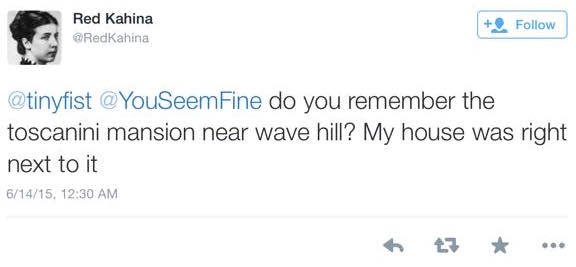
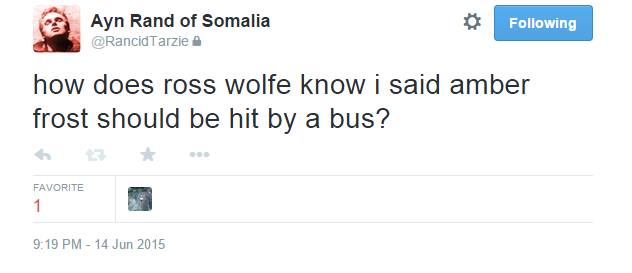
Queen tankie Molly Klein — a fabulously rich heiress who grew up next to the Toscanini mansion on Wave Hill, daughter of the dude who invented PlayboyTV — routinely smears anyone who crosses her as “racist,” including the young black DSA member, Douglas Williams. Klein, alias RedKahina and numerous other sock-puppet accounts and anonymous online handles, has charged me on multiple occasions with antisemitism and antiziganism, despite my own Jewish and Roma ancestry. Now that Amber dared to make fun of her paranoiac panel from last year, accusing the Slovenian philosopher Slavoj Žižek of being a CIA plant and psyop, they’ve begun making borderline misogynist remarks like “Amber Frost has to be a porn name” and “yuk, Frost wanders through the Left Forum like a dog with her tongue out thinking ‘whose leg can I hump?’.” Tarzie, the self-described “rancid honeytrap,” hoped that Amber would be hit by a bus. Charming lot, truly. Continue reading

About Two Squares: El Lissitzky’s 1922 suprematist picture book for kids

Originally published in the
Cambridge Literary Review
.

Most children’s books do not come with instructions for how to read them. El Lissitzky’s About Two Squares is not most children’s books.

Lissitzky first announced his plan to write a “suprematist tale”[1] about two intergalactic squares while teaching graphic arts and printmaking at the Vitebsk Institute of Popular Art in 1920. Traces of the idea can be detected as early as September 1919, however, shortly after he arrived in the city. Initially a disciple of the Jewish folk painter Marc Chagall, Lissitzky soon came under the spell of the charismatic avant-garde pioneer Kazimir Malevich (who usurped Chagall’s role as rector of the Institute that winter). Almost immediately one notices a shift in the form and subject-matter of Lissitzky’s oeuvre, as he abandoned village scenes and stylized conventional figures in favor of planar abstractions and floating rectilinear shapes. Within a matter of months, his entire artistic worldview was transformed.

Part of this transformation involved a change in Lissitzky’s approach to typography and book design. These were fields in which he showed prior interest. He had prepared a songbook for the traditional Passover poem Chad Gadya in 1917, and then again in 1919. Both of these versions clearly demonstrate the abiding influence of Chagall, though by the time the second one was published, suprematist elements already began to enter in. Following the release of the 1919 edition, Lissitzky informed Malevich of his newfound perspective:

It is my belief that the thoughts we drink from the book with our eyes must be poured over every visible shape. The letters and punctuation marks, which introduce order to thoughts, must also be taken into account. Besides that, the way the rows are set corresponds to certain condensations of thought; these should be condensed for the benefit of the eye as well.[2]

Evidently, suprematism for Lissitzky had consequences well beyond the realm of the painted object. It implied a broader reconsideration of the medium of print. Lissitzky was an ardent — if self-trained — bibliologist, and in 1926 he hypothesized what effect modern art might have on the future of the book. “There are today two dimensions to the word,” he maintained in an article for the Gutenberg-Jahrbuch. “As sound, it is a function of time; as exposition, of space. The book of the future must be both.”[3]

Yve-Alain Bois, a Swiss art critic and Lissitzky scholar, has noted that authors only began to take an interest in the visuals of their books toward the end of the nineteenth century.[4] Questions of format, font, and layout generally seemed besides the point. Little attention was paid to the arrangement of text upon the page. With the advent of photography and improved printing technology, however, new possibilities were opened. Citing the development of “facsimile-electrotype (or half-tone blocks),” Lissitzky speculated that this would allow for greater flexibility in the illustration of written materials.[5] Great innovators like F.T. Marinetti likewise had a role to play in Lissitzky’s scheme, discerning the potential of boldface lettering and ALL CAPS to convey emphasis or emotion.[6] Nevertheless, the aesthetics of print continued to lag behind other fields of art until the outbreak of World War I, usually held up as a cultural watershed.

Russia was no exception to this trend. “Before October 1917,” Lissitzky explained in a catalog ten years later, “our artists hardly concerned themselves with typesetting. That matter was left to the printers.” He continued: “After October, many of our premier artists in different fields, hoping to express the new through the specific properties of each medium, took up the task of reinventing the book according to the material of the book itself — i.e., type.”[7] Painters especially participated in this process, starting even before the war, working together with poets to revolutionize the medium.[8] By the 1920s, swept along by the maelstrom of revolution, avant-garde bookmakers were employed in the production of posters as propaganda for the masses. Lissitzky even likened such placards and printed visual displays to single pages ripped from books, magnified and blown up several dozen times.[9]

This new movement, which sought to break down the barrier separating art from life, entailed the “death” of painting as it had hitherto been known. Aleksandr Rodchenko gave up painting in order to pursue photography and agitprop. Varvara Stepanova abandoned the canvas for fabrics and textile patterns. For Lissitzky, the prewar experiments in painting had simply prepared artists for the revolutionary enterprise of construction, an idea charged with meaning at the time. His celebrated PROUN series merely provided the point of departure, being “the way station between art and architecture.”[10] Similarly, the book displaced painting and sculpture as the most monumental art form of revolutionary Russia.[11] It was this fact, in Lissitzky’s view, that sealed the fate of older forms of artistic production. “Once the printed page started to seduce the artist,” he wrote morbidly, “painting slowly died.”[12]

Bois has referred to this rhetorical conceit regarding the death of easel painting as “the cliché of the era.”[13] Was it really nothing more than a cliché, though? Might it not have had a real sociohistoric basis?

Indeed, About Two Squares can be read as a dramatization of this very aspiration, though intended for children. Lissitzky stressed the importance of such literature in the upbringing of the New Man: “We should add to the number of illustrated weeklies the flood of children’s picture-books. Children’s reading teaches them a new plastic language. They grow up with a different relation to image and color, the world and space.”[14] About Two Squares recapitulates Lissitzky’s belief that revolutionary form heralds the arrival of revolutionary content, and that the former must act as a vehicle for the latter.

The book finally appeared in 1922, roughly two years after Lissitzky envisioned it, under the imprimatur of the Scythian press [Skythen Verlag] in Berlin. On the back cover, however, was a symbol indicating its origin in Vitebsk: the UNOVIS logo — a red square set inside a thin black frame, partially circumscribed within a circle. Scythian publishing house was loosely affiliated with the Left Socialist-Revolutionary party in Russia, run mostly by Russian symbolist poets living abroad. In some ways it may be seen as a prototype of later samizdat operations. About Two Squares was among the first modernist publications they put out. Continue reading

Trotsky’s Italian connection: Gramsci or Bordiga?

.
Since the rediscovery of Antonio Gramsci’s Prison Notebooks after World War II, there have been a number of attempts to adapt their heavily-coded theoretical content to various political projects. Particularly during the period of the New Left, Gramsci was interpreted and reinterpreted ad nauseam. Gradualists of a social-democratic stripe tried to fit the (allegedly anti-Leninist) “war of position” to their own frameworks. Figures like Ernesto Laclau and Chantal Mouffe deploy the ubiquitous Gramscian buzzword of “hegemony” for their postmodernist, post-Marxist populism. Finally, theorists such as Christine Buci-Glucksmann and Peter D. Thomas have sought to reconcile Gramsci with a more classically Leninist program in light of critiques by Louis Althusser in France and Perry Anderson in England.

Gramsci = Trotsky?

.
Trotskyists during the 1960s down to the present have followed suit. Even the Spartacist League, known for their strict orthodoxy, nodded approvingly toward a document by Cliff Slaughter from 1960 in which he relied heavily on Gramsci’s The Modern Prince. Just how compatible are Trotsky’s politics with those of Gramsci, though? Certainly during their political careers, they found themselves on opposite ends of the spectrum within international communism. Not only did Gramsci support Trotsky’s expulsion from the Russian party in 1925 and 1926, but he continued to lambaste Bronshtein during the period of his imprisonment. Paolo Casciola, an Italian Trotskyist, explains the continued differences between Gramsci and Trotsky from 1926 up through the 1930s in his rebuttal to the “turncoat” Alfonso Leonetti:

Gramsci or Trotsky?

[I]t would be useful to pause for a while on the fable of the “identity of views” between Trotsky and Gramsci. Such a fable is based on the fact that Gramsci “broke” with Stalinism during his prison years, after the “turn of 1930” — a turn which Leonetti had continuously championed. This is a question with which we shall deal in future. What we want to emphasize here is that Leonetti used such an ostensible “identity” as a voucher to justify politically his adherence to Gramscism and Togliattism. It was a rather dubious historico-political operation which was made easier by the cooperation of a series of “Trotskyist” intellectuals and unscrupulous “historians of the workers’ movement.” As a matter of fact, Gramsci’s “moral break” with Stalinism was only a temporary disagreement with the “Third Period” policy, and he was reabsorbed after the Popular Front counter-turn of 1935. If this be the case, then certain things said in the article which Tresso wrote after Gramsci’s death seem somewhat rash. But whereas Tresso could not know anything about Gramsci’s evolution during the 11 years of his imprisonment, Leonetti was able to read several testimonies on that period. But he used them in his own unfortunate way.

To Leonetti, the “identity of views” of Gramsci and Trotsky lies above all in their ostensibly identical assessment of the “period of transition” from Fascism to Communism, as well as in the fact that they both raised the slogan of a constituent assembly for Italy. But this is a superficial and utterly false equation. As a matter of fact, whereas Trotsky emphasized that the “democratic transition” was only one possible variant of the post-Fascist development — linked to and dependent upon the revolutionary awakening of the working class — Gramsci saw such an event as “the most likely one,” and, on this basis, put forward the slogan of a constituent assembly within the framework of a gradualist, Menshevik, Popular Front perspective. It is not by chance that, a few days before his death, Gramsci let the PCd’I know that “the Popular Front in Italy is the constituent assembly.” The Stalinist continuity between Gramsci and Togliatti was thus re-established, after the interlude of the “Third Period.” On the other hand, the lack of identity between the views of Trotsky and Gramsci is shown by several other bits of evidence. According to the testimony of Bruno Tosin, whilst opposing the “turn of 1930” not only did Gramsci hold that the party had been right to expel the Trotskyist oppositionists, but in his Prison Notebooks he criticizes Trotsky every time he mentions him, ever inclined to legitimize the continuity from Lenin to Stalin.

I don’t irrationally hate Gramsci. For the most part I prefer his “liberal” Marxist phase from 1916-1920, when he was closer to Gobetti, and then his early Leninism in alliance with Bordiga. After 1923, Gramsci basically took his orders from Moscow, following all the zigzags coming out of the Kremlin. Had he not been imprisoned, I suspect he would have eventually become a more theoretically sophisticated version of Togliatti. Some of his historical and philosophical reflections are interesting, but politically he’s the pits.

Personally, it’s my opinion that the effort to sanitize Gramsci’s Dmitrovian popfrontism, in order to render them compatible with Trotsky’s views, owes to the intellectual celebrity of the former after World War II. And this celebrity is in turn largely a product of the PCI’s nonstop promotion of Gramsci since 1945. The definitive study of this historiographical shift is John Chiaradia’s “Amadeo Bordiga and the Myth of Antonio Gramsci.” Chiaradia contends that many of the same tactics that were used to oust Trotsky from the Russian party were used to oust Bordiga from the Italian party.

This seems to be borne out by the documentary evidence. If you read anything written by communists about the Italian party before 1945, Gramsci’s name barely even appears. By contrast, Bordiga’s name appears repeatedly. In Franz Borkenau’s World Communism, Trotsky’s writings, Arthur Rosenberg’s books, Victor Serge’s Memoirs of a Revolutionary, Ignazio Silone’s section of The God that Failed, Bordiga is mentioned over and over. Like I said, after WWII he was mostly just known as Gramsci’s justly vanquished opponent.

Trotsky on Bordiga

.
In all his published works and correspondence, the only reference Trotsky made to Gramsci came in Fascism: What It Is and How to Fight it, published in 1931. He explained that Italian comrades informed him that “with the sole exception of Gramsci, the Communist Party would not even allow for the possibility of the fascists’ seizing power.” Appreciative enough, I suppose. The source of this information, the “Italian comrades” to which Trotsky alluded, can be easily guessed, however. Leonetti, the erstwhile Left Oppositionist who later defected to Stalinism — dealt with above by Casciola — corresponded with Bronshtein about Italian fascism frequently during those years. He remained a loyal Gramscian throughout every phase of his career, and was one of the few prior to 1945 who recalled Gramsci’s name. Deeply resentful toward Bordiga, Leonetti even wrote an article trying to convince Trotsky that the source of Stalin’s Third Period doctrine of “social fascism” was the communist left. From the reply Trotsky sent to Souzo (pen name of Leonetti), it would seem the former was briefly swayed:

February 14, 1932

Dear Comrade Souzo:

I have received your article on the Bordigists, which I find very good and extremely useful, especially the paragraph that shows Bordiga to be the father of the theory of social fascism.

Apart from this, Trotsky was overwhelmingly positive regarding Bordiga’s role within the Italian party. In 1929, he wrote a letter to the editorial board of the journal Prometeo, in which he praised “the living, muscular, and full-blooded revolutionary thought of Amadeo Bordiga.” He underscored his longstanding respect for and personal acquaintance with the man who had inspired their movement: “I have become acquainted with the pamphlet ‘Platform of the Left,’ which you issued back in 1926 but which has only just now reached me. Similarly, I have read the letter you addressed to me in issue number 20 of Prometeo and some of the leading articles in your paper, which enabled me to renew, after a long interruption, my fairly good knowledge of the Italian language. These documents, along with my acquaintance with the articles and speeches of Comrade Bordiga — not to mention my personal acquaintance with him — permit me to judge to a certain extent your basic views as well as the degree of agreement there is between us.” Continue reading

The works of Leon Trotsky

.
This post has been a long time coming. Not only because it’s taken time to track down and convert some of these massive files into manageable sizes, though that also. Rather, it is more that I’ve been busy reassessing my own relationship to Trotsky’s works. Some reflections on his career, in thought and in deed, follow the documents posted below. For now, here are all fourteen volumes of his Writings during his last exile, from 1929 to 1940, along with his three-volume History of the Russian Revolution, his biographical works (his autobiography, biography of Lenin, and incomplete biography of Stalin), along with some of his earlier works (Results and Prospects, Terrorism and CommunismAn Appeal to the Toiling, Oppressed, Exhausted Peoples of Europe, The Permanent Revolution, Problems of Everyday Life, Literature and Revolution, and Lessons of October).

Assorted Writings
.

  1. Leon Trotsky, Permanent Revolution (1920) and Results and Prospects (1906)
  2. Leon Trotsky, An Appeal to the Toiling, Oppressed, and Exhausted Peoples of Europe (1915)
  3. Leon Trotsky, Dictatorship vs. Democracy: A reply to Karl Kautsky on Terrorism and Communism (1919)
  4. Leon Trotsky, Problems of Everyday Life: Creating the Foundations for a New Society in Revolutionary Russia (1922)
  5. Leon Trotsky, Literature and Revolution (1923)
  6. Leon Trotsky, Lessons of October (1924)
  7. Leon Trotsky, The Third International After Lenin (1928)
  8. Leon Trotsky, My Life (1928)
  9. Leon Trotsky, The Revolution Betrayed: What is the Soviet Union and Where is it Going? (1933)
  10. Leon Trotsky, Writings on Literature and Art (1905-1940)
  11. Leon Trotsky, Diary in Exile, 1935
  12. Leon Trotsky, Stalin: An Appraisal of the Man and His Influence (1940)

History of the Russian Revolution
.

  1. Leon Trotsky, History of the Russian Revolution, Volume 1: The Overthrow of Tsarism
  2. Leon Trotsky, History of the Russian Revolution, Volume 2: Attempt at Counterrevolution
  3. Leon Trotsky, History of the Russian Revolution, Volume 3: The Triumph of the Soviets

Writings, 1929-1940
.

  1. Leon Trotsky, Collected Writings, 1929
  2. Leon Trotsky, Collected Writings, 1930
  3. Leon Trotsky, Collected Writings, 1930-1931
  4. Leon Trotsky, Collected Writings, 1932
  5. Leon Trotsky, Collected Writings, 1932-1933
  6. Leon Trotsky, Collected Writings, 1933-1934
  7. Leon Trotsky, Collected Writings, 1934-1935
  8. Leon Trotsky, Collected Writings, 1935-1936
  9. Leon Trotsky, Collected Writings, 1936-1937
  10. Leon Trotsky, Collected Writings, 1937-1938
  11. Leon Trotsky, Collected Writings, 1938-1939
  12. Leon Trotsky, Collected Writings, 1939-1940
  13. Leon Trotsky, Collected Writings, Supplement (1929-1933)
  14. Leon Trotsky, Collected Writings, Supplement (1934-1940)

Enjoy. If you like this post and are looking for some other free downloads, check out my past entries dedicated to the works of Marx and Engels as well as those of Roland Barthes.

Leon Trotsky drawing

My reevaluation of the legacy of Leon Trotsky is largely due to my belated exposure to the left communist tradition. Or, more specifically, the writings of the Italian left communist Amadeo Bordiga. To be more specific still, Bordiga’s early writings — from 1919 to 1926 — have left a deep impression on me. As will become clear, I’d hardly endorse his entire corpus. Particularly his later stuff tends to be more hit or miss, though there’s still quite a bit to be learned from his undying (invariant) Bolshevism. His article “Against Activism” is an instant classic, and his longer essay on “The Factors of Race and Nation in Marxist Theory” is epic as well.

Council communism is a tradition I’m decidedly less keen upon. Early on, in the 1920s, when the Dutch councilists Herman Gorter and Anton Pannekoek hadn’t yet completely forsaken the role of the party, there was perhaps a little more substance to their arguments. Later, when Otto Rühle and Paul Mattick took up the mantle of council communism, their politics tended to devolve into empty moralizing and a quasi-religious faith in the spontaneity of the masses. Nevertheless, Mattick’s various articles on economic theory and his critique of nationalism are excellent. They almost cannot be recommended highly enough. Karl Korsch intersects with this milieu in his flight from Leninism, but only to his detriment.

One final factor has been decisive in this process of reevaluation: the critical and theoretical edifice left by Korsch, Georg Lukács, Walter Benjamin, and the Frankfurt School (Max Horkheimer, Theodor Adorno, Herbert Marcuse, Erich Fromm). Unlike Bordigism or council communism, I have been thoroughly acquainted with this body of literature for some time now. It has informed my own writings and opinions since college. Still, in reviewing Trotsky’s writings I have focused a bit more on the orientation of these figures vis-à-vis Trotsky and Trotskyism.

With respect to Trotskyism, the innumerable tendencies that lay claim to the theoretical and practical lineage of Bronshtein himself, I am much less enthusiastic. Like his famous biographer, Isaac Deutscher, I even find the founding of the Fourth International somewhat perplexing. Understandable, perhaps, in that his friends in the Left Opposition abroad were defecting, or else being tortured and shot, but perplexing nevertheless. It was a non-starter from the word “go.” Trotsky still put out some great essays and texts during this period, and some of his squabbles with Shachtman, Eastman, Burnham, and Rivera are entertaining, if not all that enlightening. Cannon was certainly a great organizer, but was a piss-poor theorist. Only orthodox Trotskyism has anything redeeming to say after the 1950s and 1960s, especially James Robertson and the Sparts. Today, I suppose I retain some respect for Alan Wood of the IMT, ignoring his Bolivarian boosterism, the Spart-lite star-brights in the IBT, and the polemical pricks in the League for the Revolutionary Party. But that’s it.

[scribd id=265938279 key=key-9u7YanIRvyiXUrkDctrK mode=scroll]

.
The International Socialist Organization is a hodgepodge of brainless Cliffite heterodoxy, academic jargon (mostly in and through their publishing house, Haymarket Books), and the latest in trendy activism (intersectionality, “x lives matter” hashtags, and so on). I’d almost say they’re unworthy of the name. Anyone who is interested in Trot genealogies, check out this. The author is a social democrat, basically, but his sprglord game is tight and so he can be relied upon for encyclopedic information.

Robert Alexander, International Trotskyism, 1929-1985: A Documentary Analysis of the Movement (1990)

In a series of upcoming posts, I will try to briefly summarize my thoughts regarding each of these camps or schools. Spoiler alert: Trotsky belongs to a bygone era of revolutionary politics. A gulf divides his work from the present. Even within his own epoch, some of his positions seem to have been ill-advised. But perhaps this is the wisdom of retrospect, as the line he took on anti-imperialist “national liberation” was made in the context of approaching war (on the eve of each world war). The “united front” tactic is not as universally applicable as Trotskyists would like to believe; nor is it as universally inapplicable as Bordigists believes. Nevertheless, in every instance, Trotsky the man is far more salvageable than contemporary Trotskyism.

P.S. — I am of course fully aware that the headpiece used for this post is a malicious representation of Trotsky, taken from a Polish anti-bolshevik propaganda poster from 1919. Nevertheless, I have decided to keep it, because it is fucking metal.

Walter Gropius, Monument to the March Dead (1922)

.
Between 1920 and 1922 a monument in honor of the workers who lost their lives during the Kapp Putsch was erected in the Weimar central cemetery. It was commissioned by the Union Cartel of Weimar and built according to plans submitted to a competition by the architectural office of Walter Gropius. Although Gropius maintained that the Bauhaus should remain politically neutral, he ultimately agreed to participate in the competition staged among Weimar artists at the end of 1920. The monument was arranged around an inner space, in which visitors could stand, the repeatedly fractured and highly angular memorial rose up on three sides as if thrust up from or rammed into the earth.

In February 1936, the Nazis destroyed the monument due to its political overtones, and considered its design to fall under the category of degenerate art. Underneath the images posted immediately below, you can read an account of the event written by the German left communist Arthur Rosenberg.

il_fullxfull.330003812

The Kapp Putsch

Arthur Rosenberg
History of the German
Republic (1936)
.

On 14 June 1919, Wissell, then Reich Minister for Economy, said at the Socialist Party meeting in Weimar:

Despite the revolution, the nation feels that its hopes have been disappointed. Those things which the people expected of the government have not come to pass. We have further consolidated political democracy in a formal sense; true. But we have not yet done anything but carry on the program which had already been begun by the Imperial German government of Prince Max of Baden. The constitution has been prepared without any real and active participation on the part of the people. We have not been able to satisfy the dull resentment with which the masses are imbued because we have had no real program.

Essentially we have governed according to the old forms of our state life. We have only succeeded in breathing very little fresh life into these forms. We have not been able so to influence the revolution that Germany seemed filled with a new spirit. The inner structure of German civilization, of social life, appears little altered. And even so, not for the better. The nation believes that the achievements of the revolution are simply negative in character, that in place of one form of military and bureaucratic government by individuals another has been introduced, and that the principles of government do not differ essentially from those of the old regime… I believe that the verdict of history upon both the National Assembly and ourselves will be severe and bitter.

It must be admitted that Wissell saw very clearly the state of affairs in Germany at that time. In every way the minutes of this first party meeting held by the Majority Socialists after the revolution is a document as affecting as it is instructive. On the one side stood the opposition minority, among whom Wissell must actually be reckoned, which recognized the fatal nature of the path that the German Revolution was treading. On the other side was the majority, which was grouped about the party leaders and the government, and which strove convulsively after optimism. The motions put forward by the opposition organizations show the temper then prevailing among millions of workmen. The motions demanded over and over again that efforts should be made to restore peace with the USPD, even if discredited leaders had to be sacrificed. The Münster organization demanded: “The Reichswehr Minister Noske shall be expelled from the party.” Frankfurt-on-the-Main demanded:

The Social Democratic group in the Constituent National Assembly shall be ordered to do all in its power to ensure the rapid disbanding of the volunteer corps and the formation of a national defense upon democratic foundations.

Hamburg said:

The meeting of the delegates of the Social Democratic Party of Hamburg regards the volunteer army as constituting a serious danger to the achievements of the revolution. Its delegates to the party meeting are therefore under the obligation to demand the creation of a national army according to the provisions of the Erfurt Program.

Other motions advocated the councils, nationalization, the democratization of the administration, the abolition of the old bureaucracy. To these were added the wails of delegates from rural districts, who felt that they had been abandoned, and complained that since the lapse of the workers’ councils they had been delivered over to the old powers again. The majority at the party meeting undoubtedly felt equally strongly the grievances that were raised. But in view of the course hitherto taken by the revolution they saw no way out and voted down the opposition’s motions.

kapp-putsch-germany-march-1920-chaos-first-world-war-instablity Kapp-Putsch_Marine-Brigade_Erhardt Kapp-Putsch, Posten am Spittelmarkt, Berlin

The exodus of the workmen from the SPD to the USPD became increasingly rapid. And the embitterment of the radical masses was greatly increased by the sanguinary events that took place in Berlin on 13 January 1920. The Reichstag was at that time discussing a government measure for the establishment of industrial councils. Its purpose was to confine the activity of these councils essentially to the sphere of social welfare. The opposition among the working classes regarded the proposed law as inadequate. The USPD organized a mass demonstration in front of the Reichstag, against the government bill and in favor of wider powers for the councils. The Communists joined in the demonstration. The demonstrators were perfectly peaceful. Nobody had any idea of storming the Reichstag, or of attempting a coup. Various working-class leaders made speeches to the assembled masses in front of the Reichstag. The technical mistake was indeed made of keeping the masses assembled before the Reichstag for too long a time. Slight brushes occurred between the workmen and the police who had been called up in case of emergency. At length the police came to the conclusion that there was reason to fear an attack upon the Reichstag, and machine-guns were turned on the unarmed demonstrators. The crowd was dispersed. Forty-two workmen were killed. The political responsibility for the attitude of the police on 13 January was borne by the Prussian Minister for the Interior, Wolfgang Heine.

At the very time when the SPD was losing a large part of its adherents, the great majority of the middle classes openly turned against the republic. The urban and rural middle classes had been perfectly prepared after 9 November to accept the new order, and to cooperate in building up the republic on democratic lines. Out of consideration for the middle classes the government had believed it necessary to proceed with the utmost caution. Yet it was the hesitancy of the republican leaders that alienated the middle classes. If great and decisive action had been taken, such as, for example, the expropriation of great landowners and the nationalization of mines, and if the government had shown the people that a new era had really dawned, then the government would also have carried the middle classes along with it. Since, however, everything was obviously going to remain unchanged, enthusiasm for the revolution evaporated and the republic and democracy were blamed for all the trials of daily life. Continue reading

Nikolai Bukharin on the criterion of practice in epistemology

.
Below appears an excellent chapter from Nikolai Bukharin’s book, unpublished in his lifetime, Philosophical Arabesques (1937-1938). The whole collection is really quite good, but this portion on epistemology is particularly superlative. Lately I’ve been reading up on Marxism and the problem of truth: the way it involves the relation of subject to object, as well as theory to practice. I have to admit, Bukharin’s competence in treating difficult questions of philosophy surprised me a little. Not just because I’d read his short 1921 textbook on Historical Materialism — which, while insightful at times, is on the whole very mediocre — but because of Lenin’s low estimation of Bukharin as a philosopher. Shortly before his death, the Bolshevik leader recorded in his “Testament” that

Bukharin is not only a most valuable and major theorist of the Party; he is also rightly considered the favorite of the whole Party. His theoretical views can be classified as fully Marxist only with great reserve, however, for there is something scholastic about him (he has never made a study of dialectics and, I think, never fully understood it).

Karl Korsch and Georg Lukács, whose studies of the philosophical legacy in Marx’s thought remain unparalleled, took Bukharin to task for this theoretical deficit. “For one faction (typified by Bukharin’s book The Theory of Historical Materialism),” wrote the former, “the whole of ‘philosophy’ has fundamentally already reached a point that in reality it was to reach only in the second phase of Communist society after the full victory of the pro­letarian revolution, viz. the transcended standpoint of an unenlightened past.” Lukács wrote that “Bukharin attributes to technology a far too determinant position, which completely misses the spirit of dialectical materialism.”

http://www.youtube.com/watch?v=2Fgp7XuYG9c

http://www.youtube.com/watch?v=zWp6GsMwKx0

.
At first, Bukharin sided with the “mechanist” faction of communist interpreters of Marx. Other notable adherents included Abram Deborin and László Rudas, bêtes noires of both Korsch and Lukács, who admonished them for their Hegelianism. This sensibility was rather in line with Bukharin’s training as an economist and his enthusiasm for the natural sciences. During the 1930s, though, he made a renewed study of German classical philosophy. Following his imprisonment in 1937 at the hand of his onetime ally Stalin, Bukharin finally got around to writing a treatise on philosophy. He was adamant that it be published, whatever his fate:

The most important thing is that the philosophical work not be lost. I worked on it for a long time and put a great deal into it; it is a very mature work in comparison to my earlier writings, and, in contrast to them, dialectical from beginning to end.

Unsurprisingly, his wishes were not honored. These manuscripts only surfaced after the Soviet Union’s fall in 1991. You can download the translation by clicking on the link above or read the chapter on practice below the photographs underneath. Additional works by Bukharin are available here as well:

Practice in general and the place of practice in the theory of knowledge

Nikolai Bukharin
Philosophical Arabesques
September 1937
.

Earlier, we dealt with the naïve claim of the agnostics to be reasoning on the basis of their sense perceptions alone, and thus to be able to demonstrate the unreality or incognizability of the external world.

This claim proved to be baseless and comic. From this we may conclude that any philosophical reasoning, since it operates with concepts, which are a social product, the product of thousands of years of mental work, must because of this very fact operate on the broad basis of all the achievements of science, leaving behind all the fuss and bother of foolish subjectivists.

Science, however, tells us that in historical terms, the starting point was the active, practical relationship between humanity and nature. Not contemplation, and not theory, but practice; not passive perception, but action. In this sense Goethe’s dictum “In the beginning was the deed,” when counterposed to the evangelical-Platonic-Gnostic dictum “In the beginning was the word” — that is, logos, or reason — furnishes us with a precise expression of historical reality. Marx noted this repeatedly: in his notes on the book by Adolf Wagner, in which he heaps scorn on the closeted professorial view according to which objects are passively “given” to humanity; in his Holy Family; in his Theses on Feuerbach; throughout the whole text of Capital; and together with Engels, in the brilliant pages of The German Ideology.

Contrary to the ravings of idealist philosophy to the effect that thought makes worlds, and that even matter is the creation of spirit (for example, the world-positing “I” of Fichte), it is human practice that creates a new world, actually transforming the “substance of nature” in line with human wishes. Historically, it was social humanity, the social-historical human being, and not an abstraction of the intellectual side of humanity, personified by philosophers as the subject, that above all produced, ate, and drank. It was only later, through the division of labor, that theoretical activity became separated off and isolated as an independent (or relatively independent) function, becoming restricted to particular categories of people, “mental workers,” with the various social and class modifications of this category. Theoretical cognition arose out of practice as well. The active, practical relationship to the external world, the process of material production, which, as Marx put it, conditions the “exchange of substances” between humanity and nature, is the basis for the reproduction of the entire life of social humanity. The chattering of the high priests of the so-called philosophy of life [Lebensphilosophie], including Nietzsche and a series of present-day biological-mystical hysterics, bypasses this fundamental fact, just as numerous representatives of classical idealist philosophy also bypassed it. Of course! After all, from the point of view of Kant the simple acts of sawing wood, smelting iron, or making liquid oxygen constitute a breakthrough into the “transcendental,” that fearful transgression which is “impossible”! What a mess the “practical” bull creates in this china shop full of unknowably subtle statuettes!

In fairness to Hegel, that “colossal old fellow,” as Engels affectionately called him, it should be acknowledged that although Marx and Engels had to wage a desperate, impassioned, and ultimately victorious struggle against the “drunken speculation” of Hegelian idealism, Hegel did have an understanding of practice, of labor and its tools. Moreover, the embryo of historical materialism, in the form of brilliant conceptions, was present in his works. We shall have cause to be convinced of this subsequently… Continue reading

Cartoon commies

.
For as long as there have been communists, so also have there been cartoonists. At times, cartoonists and communists have been one and the same. The young Friedrich Engels observed this in a letter written to his friend Karl Marx in October 1844:

I have been in Elberfeld, where I once again came across several communists I had never heard of before. Turn where you will, go where you may, you’ll stumble on a communist. A very impassioned communist, a cartoonist, and aspiring historical painter by the name of Seel will be going to Paris in two months’ time. I’ll direct him to you…[H]e may very well come in useful as a cartoonist.

Engels was something of a cartoonist himself. His caricatures of the Young Hegelians in »Die Berliner Freien« and of the anarchist Max Stirner have been reproduced down to the present. On the back of E. Voswinkel’s letter to Marx from January 1849, Engels drew a cartoon of Frederick William IV and the Prussian bourgeoisie apropos the elections to the Prussian Diet. Marx tried to get it published in the Brüsseler-Zeitung.

Engels' caricature of "The Free," the Berlin group of Young Hegelians (Words in the drawing, Ruge, Buhl, Nauwerck, Bauer, Wigand, Edgar [Bauer], Stirner, Meyen, stranger, Koppen the Lieutenant. The squirrel is the Prussian Minister Eichhorn

Lenin appreciated the odd cartoon here and there as well. Yelena Stasova sent him a cartoon in honor of his fiftieth birthday, which depicted the Marxists as children who came to congratulate the Narodnik Mikhailovsky on his fiftieth birthday in 1900. Stasova wrote that at the time of Mikhailovsky’s birthday the RSDLP had been in its childhood, whereas it had since matured. “This is the result of your work, your mind and talent,” she explained.

Upon receiving it, the Bolshevik leader decided to share it with his fellow celebrants and guests:

Comrades, I must naturally begin by thanking you for two things: firstly, for the congratulations addressed to me today, and secondly, even more for having spared me congratulatory speeches (Applause.) I think that perhaps in this way we may gradually, not all at once, of course, devise a more suitable method of celebrating anniversaries than the one hitherto in vogue, which has sometimes formed the subject of remarkably good cartoons. Here is one such cartoon drawn by a prominent artist in celebration of such a jubilee. I received it today with an extremely cordial letter. And as the comrades have been kind enough to spare me congratulatory speeches, I will hand this cartoon round for all to see, so as to save us in future from such jubilee celebrations altogether.

Nikolai Bukharin — the party’s favorite, and its leading economist — was also a quite talented caricaturist. Zinoviev, Lenin, and Dzerzhinsky all show up in his sketches. Bukharin made a few drawings of Stalin, the man who would later send him to be executed, during their brief alliance in the 1920s. Krzhizhanovsky and Mezhiauk contribute a few doodles as well. Have a look.

Cartoons are primarily illustrative. That is to say, they convey their meaning by means of pictures and not words. But text often accompanies cartoons and comic strips, either as a description of that which is depicted or as dialogue (the speech bubble between characters or the thought bubble for internal monologue). Continue reading