No tears for tankies

.
.
Amber A’Lee Frost had an article published on The Baffler yesterday, “Flakes alive! On not attending the Left Forum.” It is, among other things, a hilarious send-up of the weird, wacky, and hopelessly insular world of fringe leftist subcultures. Plus, it’s extremely well written, so I highly recommend that everyone read it.

Not everyone was pleased by Frost’s various jabs at “tankies, truthers, and tofu,” however. Unsurprisingly, her piece managed to ruffle a few feathers.  Some of the responses have been a bit more measured. Others, who were the butt of her jokes, were predictably a little less kind. But nowhere has the backlash been worse than on Stalinist Twitter: a peculiar mélange of social justice paraphernalia, Komsomol Manga, and Red Army porn. Edgy conspiracy theories — debunking the misinformation spread by the “mainstream media,” exposing government infiltrators and agents provocateurs, flagging “false flag” operations by imperialist powers — are also common in this milieu.

I know what you’re thinking. “Stalinist Twitter?” you’ll ask yourself, incredulously. “That can’t be real.”

Were that it wasn’t. Yes, it’s a real thing. And to those of you who don’t believe me, I invite you to dip your toe into the tepid kiddie-pool that is the tankie Twitterverse. For most reasonably well-adjusted people, it’s “an absolute shitshow of nerds and social rejects,” as Amber accurately put it. Reader discretion is advised, however. It’s not exactly the most enlightening experience out there, but at the very least it makes for some good entertainment. Welcome to the leper colony that is the contemporary Left.

Briefly, a word on the provenance and history of the term “tankie,” for the uninitiated. Amber’s definition — “slang for Soviet apologist, or actual Stalinist” — is serviceable, but rather imprecise. “Tankie” was an epithet coined on the British left several decades ago to denote anyone who still supported the Kremlin line after the Soviet invasion of Hungary in 1956. Khrushchev had delivered his so-called “secret speech” on Stalin’s cult of personality and its consequences earlier in the year, but the tanks rolling into Budapest signaled a quite obvious return to form.

So to be clear, the term isn’t necessarily anti-Marxist or anti-communist: it’s anti-Stalinist, and anti-Maoist insofar as Mao continued to defend and draw upon Stalin’s legacy. For Marxists like me, or indeed anyone of a more Trotskyist or left communist persuasion, the term is inoffensive. The same goes for nondenominational socialists like Amber, whose membership in the DSA is openly admitted in her article (though Frost’s critics continue to point this out as if it’s some earth-shattering revelation). Personally, I have my issues with the DSA’s mild-mannered Menshevism and tailing of Bernie Sanders. But compared to the old guard Stalinists in the CP-USA, who’ve backed the Democrats in every major national election since the seventies, DSA cadre end up looking like urban guerrillas. Don’t forget that Lenin, too, was for most of his political career a Social Democrat.

Sarcophhaguspg144

I feel it is necessary to point this out, since some self-proclaimed Stalinists have expressed consternation and confusion over the “tankie” label. One young member of the Stalinist Twitter crowd has even gone so far as to suggest that the term “increasingly [just] means ‘principled anti-imperialist’.” Maybe so, if anti-imperialism means mindlessly boosting Putin, Assad, and the late Colonel Gaddafi against local insurrections of various ideological flavors. But I’ve opposed every U.S. military intervention during my lifetime, without at the same time lending support to tin-pot dictators and their henchmen who proclaim themselves “anti-imperialists.” So what would I know about anti-imperialism?

Anyway, it’s not as if they don’t resort to petty name-calling themselves. The Twitter Stalinists seem to oscillate wildly between Third Period-style accusations of “social fascism” (whereby any socialist or communist who disagrees with them is immediately branded “no better” than fascists) and Dmitrov-era popfront calls for unity and discipline (so as to keep up comradely appearances, or else rationalize coalitions with reactionary religious groups). Moreover, it’s hard not to laugh at all the tankie tears shed about being “purged,” considering their continued outspoken admiration for Stalin, who had more communists killed and imprisoned than any right-wing, red-baiting American politician. And when these Twitter Stalinists worry about being “purged,” what they really mean is they fear their panels won’t pass muster and be accepted. Not purged in the time-tested tankie sense of a show trial in front of Yezhov or Beria, followed by either an NKVD bullet to the back of the head or decades of frostbitten exile in some remote corner of the GULag archipelago.

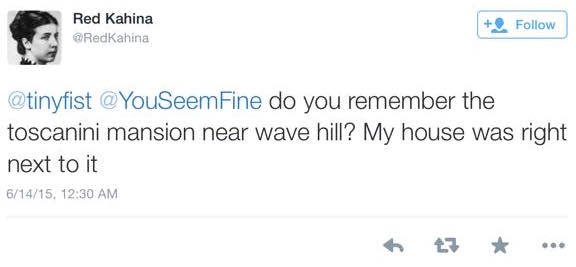
Queen tankie Molly Klein — a fabulously rich heiress who grew up next to the Toscanini mansion on Wave Hill, daughter of the dude who invented PlayboyTV — routinely smears anyone who crosses her as “racist,” including the young black DSA member, Douglas Williams. Klein, alias RedKahina and numerous other sock-puppet accounts and anonymous online handles, has charged me on multiple occasions with antisemitism and antiziganism, despite my own Jewish and Roma ancestry. Now that Amber dared to make fun of her paranoiac panel from last year, accusing the Slovenian philosopher Slavoj Žižek of being a CIA plant and psyop, they’ve begun making borderline misogynist remarks like “Amber Frost has to be a porn name” and “yuk, Frost wanders through the Left Forum like a dog with her tongue out thinking ‘whose leg can I hump?’.” Tarzie, the self-described “rancid honeytrap,” hoped that Amber would be hit by a bus. Charming lot, truly. Continue reading

About Two Squares: El Lissitzky’s 1922 suprematist picture book for kids

Originally published in the
Cambridge Literary Review
.

Most children’s books do not come with instructions for how to read them. El Lissitzky’s About Two Squares is not most children’s books.

Lissitzky first announced his plan to write a “suprematist tale”[1] about two intergalactic squares while teaching graphic arts and printmaking at the Vitebsk Institute of Popular Art in 1920. Traces of the idea can be detected as early as September 1919, however, shortly after he arrived in the city. Initially a disciple of the Jewish folk painter Marc Chagall, Lissitzky soon came under the spell of the charismatic avant-garde pioneer Kazimir Malevich (who usurped Chagall’s role as rector of the Institute that winter). Almost immediately one notices a shift in the form and subject-matter of Lissitzky’s oeuvre, as he abandoned village scenes and stylized conventional figures in favor of planar abstractions and floating rectilinear shapes. Within a matter of months, his entire artistic worldview was transformed.

Part of this transformation involved a change in Lissitzky’s approach to typography and book design. These were fields in which he showed prior interest. He had prepared a songbook for the traditional Passover poem Chad Gadya in 1917, and then again in 1919. Both of these versions clearly demonstrate the abiding influence of Chagall, though by the time the second one was published, suprematist elements already began to enter in. Following the release of the 1919 edition, Lissitzky informed Malevich of his newfound perspective:

It is my belief that the thoughts we drink from the book with our eyes must be poured over every visible shape. The letters and punctuation marks, which introduce order to thoughts, must also be taken into account. Besides that, the way the rows are set corresponds to certain condensations of thought; these should be condensed for the benefit of the eye as well.[2]

Evidently, suprematism for Lissitzky had consequences well beyond the realm of the painted object. It implied a broader reconsideration of the medium of print. Lissitzky was an ardent — if self-trained — bibliologist, and in 1926 he hypothesized what effect modern art might have on the future of the book. “There are today two dimensions to the word,” he maintained in an article for the Gutenberg-Jahrbuch. “As sound, it is a function of time; as exposition, of space. The book of the future must be both.”[3]

Yve-Alain Bois, a Swiss art critic and Lissitzky scholar, has noted that authors only began to take an interest in the visuals of their books toward the end of the nineteenth century.[4] Questions of format, font, and layout generally seemed besides the point. Little attention was paid to the arrangement of text upon the page. With the advent of photography and improved printing technology, however, new possibilities were opened. Citing the development of “facsimile-electrotype (or half-tone blocks),” Lissitzky speculated that this would allow for greater flexibility in the illustration of written materials.[5] Great innovators like F.T. Marinetti likewise had a role to play in Lissitzky’s scheme, discerning the potential of boldface lettering and ALL CAPS to convey emphasis or emotion.[6] Nevertheless, the aesthetics of print continued to lag behind other fields of art until the outbreak of World War I, usually held up as a cultural watershed.

Russia was no exception to this trend. “Before October 1917,” Lissitzky explained in a catalog ten years later, “our artists hardly concerned themselves with typesetting. That matter was left to the printers.” He continued: “After October, many of our premier artists in different fields, hoping to express the new through the specific properties of each medium, took up the task of reinventing the book according to the material of the book itself — i.e., type.”[7] Painters especially participated in this process, starting even before the war, working together with poets to revolutionize the medium.[8] By the 1920s, swept along by the maelstrom of revolution, avant-garde bookmakers were employed in the production of posters as propaganda for the masses. Lissitzky even likened such placards and printed visual displays to single pages ripped from books, magnified and blown up several dozen times.[9]

This new movement, which sought to break down the barrier separating art from life, entailed the “death” of painting as it had hitherto been known. Aleksandr Rodchenko gave up painting in order to pursue photography and agitprop. Varvara Stepanova abandoned the canvas for fabrics and textile patterns. For Lissitzky, the prewar experiments in painting had simply prepared artists for the revolutionary enterprise of construction, an idea charged with meaning at the time. His celebrated PROUN series merely provided the point of departure, being “the way station between art and architecture.”[10] Similarly, the book displaced painting and sculpture as the most monumental art form of revolutionary Russia.[11] It was this fact, in Lissitzky’s view, that sealed the fate of older forms of artistic production. “Once the printed page started to seduce the artist,” he wrote morbidly, “painting slowly died.”[12]

Bois has referred to this rhetorical conceit regarding the death of easel painting as “the cliché of the era.”[13] Was it really nothing more than a cliché, though? Might it not have had a real sociohistoric basis?

Indeed, About Two Squares can be read as a dramatization of this very aspiration, though intended for children. Lissitzky stressed the importance of such literature in the upbringing of the New Man: “We should add to the number of illustrated weeklies the flood of children’s picture-books. Children’s reading teaches them a new plastic language. They grow up with a different relation to image and color, the world and space.”[14] About Two Squares recapitulates Lissitzky’s belief that revolutionary form heralds the arrival of revolutionary content, and that the former must act as a vehicle for the latter.

The book finally appeared in 1922, roughly two years after Lissitzky envisioned it, under the imprimatur of the Scythian press [Skythen Verlag] in Berlin. On the back cover, however, was a symbol indicating its origin in Vitebsk: the UNOVIS logo — a red square set inside a thin black frame, partially circumscribed within a circle. Scythian publishing house was loosely affiliated with the Left Socialist-Revolutionary party in Russia, run mostly by Russian symbolist poets living abroad. In some ways it may be seen as a prototype of later samizdat operations. About Two Squares was among the first modernist publications they put out. Continue reading

Trotsky’s Italian connection: Gramsci or Bordiga?

.
Since the rediscovery of Antonio Gramsci’s Prison Notebooks after World War II, there have been a number of attempts to adapt their heavily-coded theoretical content to various political projects. Particularly during the period of the New Left, Gramsci was interpreted and reinterpreted ad nauseam. Gradualists of a social-democratic stripe tried to fit the (allegedly anti-Leninist) “war of position” to their own frameworks. Figures like Ernesto Laclau and Chantal Mouffe deploy the ubiquitous Gramscian buzzword of “hegemony” for their postmodernist, post-Marxist populism. Finally, theorists such as Christine Buci-Glucksmann and Peter D. Thomas have sought to reconcile Gramsci with a more classically Leninist program in light of critiques by Louis Althusser in France and Perry Anderson in England.

Gramsci = Trotsky?

.
Trotskyists during the 1960s down to the present have followed suit. Even the Spartacist League, known for their strict orthodoxy, nodded approvingly toward a document by Cliff Slaughter from 1960 in which he relied heavily on Gramsci’s The Modern Prince. Just how compatible are Trotsky’s politics with those of Gramsci, though? Certainly during their political careers, they found themselves on opposite ends of the spectrum within international communism. Not only did Gramsci support Trotsky’s expulsion from the Russian party in 1925 and 1926, but he continued to lambaste Bronshtein during the period of his imprisonment. Paolo Casciola, an Italian Trotskyist, explains the continued differences between Gramsci and Trotsky from 1926 up through the 1930s in his rebuttal to the “turncoat” Alfonso Leonetti:

Gramsci or Trotsky?

[I]t would be useful to pause for a while on the fable of the “identity of views” between Trotsky and Gramsci. Such a fable is based on the fact that Gramsci “broke” with Stalinism during his prison years, after the “turn of 1930” — a turn which Leonetti had continuously championed. This is a question with which we shall deal in future. What we want to emphasize here is that Leonetti used such an ostensible “identity” as a voucher to justify politically his adherence to Gramscism and Togliattism. It was a rather dubious historico-political operation which was made easier by the cooperation of a series of “Trotskyist” intellectuals and unscrupulous “historians of the workers’ movement.” As a matter of fact, Gramsci’s “moral break” with Stalinism was only a temporary disagreement with the “Third Period” policy, and he was reabsorbed after the Popular Front counter-turn of 1935. If this be the case, then certain things said in the article which Tresso wrote after Gramsci’s death seem somewhat rash. But whereas Tresso could not know anything about Gramsci’s evolution during the 11 years of his imprisonment, Leonetti was able to read several testimonies on that period. But he used them in his own unfortunate way.

To Leonetti, the “identity of views” of Gramsci and Trotsky lies above all in their ostensibly identical assessment of the “period of transition” from Fascism to Communism, as well as in the fact that they both raised the slogan of a constituent assembly for Italy. But this is a superficial and utterly false equation. As a matter of fact, whereas Trotsky emphasized that the “democratic transition” was only one possible variant of the post-Fascist development — linked to and dependent upon the revolutionary awakening of the working class — Gramsci saw such an event as “the most likely one,” and, on this basis, put forward the slogan of a constituent assembly within the framework of a gradualist, Menshevik, Popular Front perspective. It is not by chance that, a few days before his death, Gramsci let the PCd’I know that “the Popular Front in Italy is the constituent assembly.” The Stalinist continuity between Gramsci and Togliatti was thus re-established, after the interlude of the “Third Period.” On the other hand, the lack of identity between the views of Trotsky and Gramsci is shown by several other bits of evidence. According to the testimony of Bruno Tosin, whilst opposing the “turn of 1930” not only did Gramsci hold that the party had been right to expel the Trotskyist oppositionists, but in his Prison Notebooks he criticizes Trotsky every time he mentions him, ever inclined to legitimize the continuity from Lenin to Stalin.

I don’t irrationally hate Gramsci. For the most part I prefer his “liberal” Marxist phase from 1916-1920, when he was closer to Gobetti, and then his early Leninism in alliance with Bordiga. After 1923, Gramsci basically took his orders from Moscow, following all the zigzags coming out of the Kremlin. Had he not been imprisoned, I suspect he would have eventually become a more theoretically sophisticated version of Togliatti. Some of his historical and philosophical reflections are interesting, but politically he’s the pits.

Personally, it’s my opinion that the effort to sanitize Gramsci’s Dmitrovian popfrontism, in order to render them compatible with Trotsky’s views, owes to the intellectual celebrity of the former after World War II. And this celebrity is in turn largely a product of the PCI’s nonstop promotion of Gramsci since 1945. The definitive study of this historiographical shift is John Chiaradia’s “Amadeo Bordiga and the Myth of Antonio Gramsci.” Chiaradia contends that many of the same tactics that were used to oust Trotsky from the Russian party were used to oust Bordiga from the Italian party.

This seems to be borne out by the documentary evidence. If you read anything written by communists about the Italian party before 1945, Gramsci’s name barely even appears. By contrast, Bordiga’s name appears repeatedly. In Franz Borkenau’s World Communism, Trotsky’s writings, Arthur Rosenberg’s books, Victor Serge’s Memoirs of a Revolutionary, Ignazio Silone’s section of The God that Failed, Bordiga is mentioned over and over. Like I said, after WWII he was mostly just known as Gramsci’s justly vanquished opponent.

Trotsky on Bordiga

.
In all his published works and correspondence, the only reference Trotsky made to Gramsci came in Fascism: What It Is and How to Fight it, published in 1931. He explained that Italian comrades informed him that “with the sole exception of Gramsci, the Communist Party would not even allow for the possibility of the fascists’ seizing power.” Appreciative enough, I suppose. The source of this information, the “Italian comrades” to which Trotsky alluded, can be easily guessed, however. Leonetti, the erstwhile Left Oppositionist who later defected to Stalinism — dealt with above by Casciola — corresponded with Bronshtein about Italian fascism frequently during those years. He remained a loyal Gramscian throughout every phase of his career, and was one of the few prior to 1945 who recalled Gramsci’s name. Deeply resentful toward Bordiga, Leonetti even wrote an article trying to convince Trotsky that the source of Stalin’s Third Period doctrine of “social fascism” was the communist left. From the reply Trotsky sent to Souzo (pen name of Leonetti), it would seem the former was briefly swayed:

February 14, 1932

Dear Comrade Souzo:

I have received your article on the Bordigists, which I find very good and extremely useful, especially the paragraph that shows Bordiga to be the father of the theory of social fascism.

Apart from this, Trotsky was overwhelmingly positive regarding Bordiga’s role within the Italian party. In 1929, he wrote a letter to the editorial board of the journal Prometeo, in which he praised “the living, muscular, and full-blooded revolutionary thought of Amadeo Bordiga.” He underscored his longstanding respect for and personal acquaintance with the man who had inspired their movement: “I have become acquainted with the pamphlet ‘Platform of the Left,’ which you issued back in 1926 but which has only just now reached me. Similarly, I have read the letter you addressed to me in issue number 20 of Prometeo and some of the leading articles in your paper, which enabled me to renew, after a long interruption, my fairly good knowledge of the Italian language. These documents, along with my acquaintance with the articles and speeches of Comrade Bordiga — not to mention my personal acquaintance with him — permit me to judge to a certain extent your basic views as well as the degree of agreement there is between us.” Continue reading

Walter Gropius, Monument to the March Dead (1922)

.
Between 1920 and 1922 a monument in honor of the workers who lost their lives during the Kapp Putsch was erected in the Weimar central cemetery. It was commissioned by the Union Cartel of Weimar and built according to plans submitted to a competition by the architectural office of Walter Gropius. Although Gropius maintained that the Bauhaus should remain politically neutral, he ultimately agreed to participate in the competition staged among Weimar artists at the end of 1920. The monument was arranged around an inner space, in which visitors could stand, the repeatedly fractured and highly angular memorial rose up on three sides as if thrust up from or rammed into the earth.

In February 1936, the Nazis destroyed the monument due to its political overtones, and considered its design to fall under the category of degenerate art. Underneath the images posted immediately below, you can read an account of the event written by the German left communist Arthur Rosenberg.

il_fullxfull.330003812

The Kapp Putsch

Arthur Rosenberg
History of the German
Republic (1936)
.

On 14 June 1919, Wissell, then Reich Minister for Economy, said at the Socialist Party meeting in Weimar:

Despite the revolution, the nation feels that its hopes have been disappointed. Those things which the people expected of the government have not come to pass. We have further consolidated political democracy in a formal sense; true. But we have not yet done anything but carry on the program which had already been begun by the Imperial German government of Prince Max of Baden. The constitution has been prepared without any real and active participation on the part of the people. We have not been able to satisfy the dull resentment with which the masses are imbued because we have had no real program.

Essentially we have governed according to the old forms of our state life. We have only succeeded in breathing very little fresh life into these forms. We have not been able so to influence the revolution that Germany seemed filled with a new spirit. The inner structure of German civilization, of social life, appears little altered. And even so, not for the better. The nation believes that the achievements of the revolution are simply negative in character, that in place of one form of military and bureaucratic government by individuals another has been introduced, and that the principles of government do not differ essentially from those of the old regime… I believe that the verdict of history upon both the National Assembly and ourselves will be severe and bitter.

It must be admitted that Wissell saw very clearly the state of affairs in Germany at that time. In every way the minutes of this first party meeting held by the Majority Socialists after the revolution is a document as affecting as it is instructive. On the one side stood the opposition minority, among whom Wissell must actually be reckoned, which recognized the fatal nature of the path that the German Revolution was treading. On the other side was the majority, which was grouped about the party leaders and the government, and which strove convulsively after optimism. The motions put forward by the opposition organizations show the temper then prevailing among millions of workmen. The motions demanded over and over again that efforts should be made to restore peace with the USPD, even if discredited leaders had to be sacrificed. The Münster organization demanded: “The Reichswehr Minister Noske shall be expelled from the party.” Frankfurt-on-the-Main demanded:

The Social Democratic group in the Constituent National Assembly shall be ordered to do all in its power to ensure the rapid disbanding of the volunteer corps and the formation of a national defense upon democratic foundations.

Hamburg said:

The meeting of the delegates of the Social Democratic Party of Hamburg regards the volunteer army as constituting a serious danger to the achievements of the revolution. Its delegates to the party meeting are therefore under the obligation to demand the creation of a national army according to the provisions of the Erfurt Program.

Other motions advocated the councils, nationalization, the democratization of the administration, the abolition of the old bureaucracy. To these were added the wails of delegates from rural districts, who felt that they had been abandoned, and complained that since the lapse of the workers’ councils they had been delivered over to the old powers again. The majority at the party meeting undoubtedly felt equally strongly the grievances that were raised. But in view of the course hitherto taken by the revolution they saw no way out and voted down the opposition’s motions.

kapp-putsch-germany-march-1920-chaos-first-world-war-instablity Kapp-Putsch_Marine-Brigade_Erhardt Kapp-Putsch, Posten am Spittelmarkt, Berlin

The exodus of the workmen from the SPD to the USPD became increasingly rapid. And the embitterment of the radical masses was greatly increased by the sanguinary events that took place in Berlin on 13 January 1920. The Reichstag was at that time discussing a government measure for the establishment of industrial councils. Its purpose was to confine the activity of these councils essentially to the sphere of social welfare. The opposition among the working classes regarded the proposed law as inadequate. The USPD organized a mass demonstration in front of the Reichstag, against the government bill and in favor of wider powers for the councils. The Communists joined in the demonstration. The demonstrators were perfectly peaceful. Nobody had any idea of storming the Reichstag, or of attempting a coup. Various working-class leaders made speeches to the assembled masses in front of the Reichstag. The technical mistake was indeed made of keeping the masses assembled before the Reichstag for too long a time. Slight brushes occurred between the workmen and the police who had been called up in case of emergency. At length the police came to the conclusion that there was reason to fear an attack upon the Reichstag, and machine-guns were turned on the unarmed demonstrators. The crowd was dispersed. Forty-two workmen were killed. The political responsibility for the attitude of the police on 13 January was borne by the Prussian Minister for the Interior, Wolfgang Heine.

At the very time when the SPD was losing a large part of its adherents, the great majority of the middle classes openly turned against the republic. The urban and rural middle classes had been perfectly prepared after 9 November to accept the new order, and to cooperate in building up the republic on democratic lines. Out of consideration for the middle classes the government had believed it necessary to proceed with the utmost caution. Yet it was the hesitancy of the republican leaders that alienated the middle classes. If great and decisive action had been taken, such as, for example, the expropriation of great landowners and the nationalization of mines, and if the government had shown the people that a new era had really dawned, then the government would also have carried the middle classes along with it. Since, however, everything was obviously going to remain unchanged, enthusiasm for the revolution evaporated and the republic and democracy were blamed for all the trials of daily life. Continue reading

Adorno’s Leninism

.
Lenin and Adorno are not often placed side by side, conceptually or historically. More often than not they are counterposed — the former was a revolutionary man of action, while the latter ruminated most of his life on a revolution that never came to pass. It therefore came as a surprise to many when it came to light that Adorno insisted on “a strictly Leninist manifesto” in 1956, during his recorded conversation with Horkheimer. Even Martin Jay, who long sought to distance Frankfurt School critical theory from Leninism, was forced to acknowledge this passing remark, though it was immediately downplayed as an uncharacteristic bit of exuberance (“a brief paroxysm of enthusiasm”). Other critics, such as Todd Cronan, held that Adorno regressed behind Marx in following Lenin, since being determines consciousness and not the other way around. Chris Cutrone, my old mentor/nemesis of Platypus fame, has already criticized this view, so I won’t reprise his comments here.

The majority of Adorno’s public pronouncements regarding Lenin were deprecatory, if appreciative, playing coy with his authority on questions of materialist epistemology. Brecht had wondered why Adorno would bother reexamining philosophers like Mach or Husserl, especially since Lenin had dealt with them so roughly in Materialism and Empiricriticism (1908). Adorno objected that Lenin’s critique of empiriocriticism remained purely transcendental — i.e. rejecting it on the basis of false premises rather than provisionally accepting these false premises and immanently working through them. “When Lenin, rather than go in for epistemology, opposed it in compulsively reiterated avowals of the noumenality of cognitive objects, he meant to demonstrate that subjective positivism is conspiring with the powers that be,” wrote Adorno. “His political requirements turned him against the goal of theoretical cognition. A transcendent argumentation disposes of things on the basis of its claim to power, and with disastrous results: the unpenetrated target of criticism remains undisturbed as it is, and not being hit at all, it can be resurrected at will in changed constellations of power.”

“[D]ialectics as critique implies the criticism of any hypostasization of the mind as the primary thing, the thing that underpins everything else,” he recalled in his 1966 Lectures on Negative Dialectics. “I remember how I once explained all this to Brecht when we were together in exile. Brecht reacted by saying that these matters had all been settled long since — and what he had in mind was the materialist dialectic — and that there was no point in harking back to a controversy that had been superseded by the unreal course of history. I am unable to agree with this. On the one hand, it seems to me that the book whose authority he relied on, Lenin’s book on empiriocriticism, in no way succeeds in delivering what it undertakes to perform, namely a philosophical critique of the hypostasization of the mind or of idealism. It remains a thoroughly dogmatic work which simply presents a specific thesis with a torrent of abuse and in endless variations, without at all attempting a fundamental explanation.”

Just going on these statements, Adorno would seem to be lukewarm toward Lenin at best. Yet Adorno’s references to Lenin made in private, repeatedly in his letters from the 1930s and then again in his taped conversation two decades later, paint a different picture. There are several likely reasons for this. Lars Quadfasel speculates that public mention of Lenin during the 1930s, particularly after the Nazi seizure of power, would have been extremely unwise unless one was heaping scorn upon the Bolshevik leader’s memory. Similarly, after World War II, it was illegal for anyone living in West Germany to belong to the communist party. Moreover, since Lenin’s successors had transformed his teachings, along with those of Marx, into an unmoving set of dogmas collectively referred to as “DiaMat,” it is understandable that Adorno would hesitate to invoke the great revolutionary.

Detlev Claussen’s 2003 biography of Adorno, One Last Genius, perhaps provides the richest picture of Lenin’s enduring influence on Adorno. Claussen writes:

It was [Adorno’s] collaboration with Horkheimer [during the 1930s] that enabled him to shed these intellectual infantile disorders. His letters are full of bizarre references to Lenin, as if he wanted to outdo the “orthodox Marxism” advocated in Lukács’s History and Class Consciousness. Adorno’s original politicization took place when he was still very young, evidently in the course of his readings with Kracauer. This supplied him with key terms that expanded his horizon beyond his artistic and aesthetic concerns. This habit of thinking in keywords recurs in the taped records of the 1950s, when he would refer to Lenin, in the middle of the cold war, at a time when the Communist Party was banned and even party members scarcely dared to mention his name. It was at this time that he proposed to Horkheimer that they should produce a reworked Communist Manifesto that would be “strictly Leninist.” Behind the closed doors of the Institute, Adorno’s aim in 1956 was not to go back to Marx, but to go beyond him. He told Horkheimer that “I always wanted to try to produce a theory that would be faithful to Marx, Engels and Lenin, while not lagging behind the achievements of the most advanced culture.” Paradoxically, summing up the course of his life to that point in 1956, Adorno mentions his road toward politicization. He had arrived at Lenin, he claimed, via music. Using one of his key ideas, the idea that all knowledge is socially mediated, Adorno once again confirmed the importance of Lenin: “Marx was too harmless; he probably imagined quite naïvely that human beings are basically the same in all essentials and will remain so. It would be a good idea, therefore, to deprive them of their second nature. He was not concerned with their subjectivity; he probably didn’t look into that too closely. The idea that human beings are the products of society down to their innermost core is an idea that he would have rejected as a milieu theory. Lenin was the first person to assert this.”

In reality it was only Lenin’s contemporary Freud who noticed people’s subjectivity. Horkheimer and Adorno’s original idea of writing something jointly, the original seed of Dialectic of Enlightenment, was concerned with a critique of the individual. It was the attitude toward psychoanalysis that revealed the split in the material which produced critical theory, on the one hand, and revisionist psychoanalysis, as pioneered by Erich Fromm, on the other. The directness of the political vocabulary that was retained until well into the fifties becomes clear from a letter of Adorno’s to Horkheimer dated 21 March 1936. Adorno complains that Fromm has placed him in the “paradoxical situation of having to defend Freud. He is both sentimental and false, a combination of social democracy and anarchism; above all, there is a painful absence of dialectical thinking. He takes far too simple a view of authority, without which, after all, neither Lenin’s vanguard nor his dictatorship is conceivable. I would urgently advise him to read Lenin.”

Below are two long articles, each titled “Adorno’s Leninism.” The first, by Cutrone, presents a number of parallels between Lenin, Trotsky, and Adorno, some passages being virtual paraphrases. It’s a bit quote-heavy, in that almost Benjaminian style that presents long blocks of quoted texts followed by brief commentary, but it’s quite good. After that, there’s an article by Quadfasel in German (“Adornos Leninismus”) where he touches on several of the matters discussed in this introduction, as well as ongoing textual controversies about the compatibility or incompatibility of Adornian theory with Leninist practice — again, mostly in German. Quadfasel’s article includes a rather long fragment by Adorno from 1935 titled “The Fulcrum,” which I’ve attempted to translate below. Claudia Dallek assisted in the translation:

To learn from Lenin: Shouldn’t that really mean more than taking over methods of illegal work that were appropriate for the police state of Prussia? Such methods are not appropriate for a dictatorship whose power to rule [Herrschgewalt] strikes with even greater precision (insofar as it is able to con people, not based on democracy, but on a population of willing servants, informants, and pimps). Instead of sacrificing our best workers in the distribution of flyers — which publish about revolutionary developments that are simultaneously hindered by the arrest of these very same agitators — it is preferable to study Lenin’s attitude toward the revolution of Kerensky [in February 1917]: his ability to discover and use the fulcrum [Hebelpunkt, leverage point] of society to lift the measureless weight of the state with minimal energy. The proletariat was too weak to take on tsarist state authority; only the bourgeoisie could do that, by hastily bringing in the harvest of its revolutionary century. But this late bourgeoisie was like the bourgeoisie of other countries, sworn to war and therefore unable to keep its mass basis [Massenbasis] in a subordinate state. It was numerically spread too thin to fill the sphere of power and too ideologically divided to shape it, so it had to yield to the push that was made in the name of peace. To deliberately intervene in the concatenation of all these was necessary on Lenin’s part. He could have never defeated the autocracy, but certainly [could defeat] the democracy of the Brusilov offensive [the government that took over following the disastrous “June advance” of 1916]. He was able to recognize this beforehand and managed to master this blind violence by planning for it, the way cunning defeats the monster in fairy tales. That’s what made the immortal dialectical moment of his act the starting point and the prototype of every genuine communist state and revolution. The fate of the German working class, maybe that of humankind, depends on finding such a point, if it’s still indeed possible to find. There is no other hope to avoid war than this. Those who prophesy communism as the certain end of war, and therefore let things take their course, should remember that nobody knows (let alone the generals) what productive forces and means of production will be left to begin establishing the world.

Another friend, Sebastian Vetter, tells me that Adorno’s student Helmut Dahmer is preparing an essay on the influence of Leon Trotsky on Walter Benjamin. Dahmer is a specialist in psychoanalysis and critical theory, who hasn’t had much of his work translated into English since the 1970s, so I’m hoping it comes out soon and is good enough to merit a wider, Anglophone readership.

Adorno in 1935

Adorno’s Leninism

Chris Cutrone
Platypus Review
April 21, 2010
.

.
Adorno’s political relevance

.
Theodor W. Adorno, who was born in 1903 and lived until 1969, has a continuing purchase on problems of politics on the Left by virtue of his critical engagement with two crucial periods in the history of the Left: the 1930s “Old” Left and the 1960s “New Left.” Adorno’s critical theory, spanning this historical interval of the mid-20th century, can help make sense of the problems of the combined and ramified legacy of both periods.

Adorno is the key thinker for understanding 20th century Marxism and its discontents. As T.J. Clark has put it (in “Should Benjamin Have Read Marx?,” 2003), Adorno “[spent a lifetime] building ever more elaborate conceptual trenches to outflank the Third International.” The period of Adorno’s life, coming of age in the 1920s, in the wake of the failed international anticapitalist revolution that had opened in Russia in 1917 and continued but was defeated in Germany, Hungary and Italy in 1919, and living through the darkest periods of fascism and war in the mid-20th century to the end of the 1960s, profoundly informed his critical theory. As he put it in the introduction to the last collection of his essays he edited for publication before he died, he sought to bring together “philosophical speculation and drastic experience.” Adorno reflected on his “drastic” historical experience through the immanent critique, the critique from within, of Marxism. Adorno thought Marxism had failed as an emancipatory politics but still demanded redemption, and that this could be achieved only on the basis of Marxism itself. Adorno’s critical theory was a Marxist critique of Marxism, and as such reveals key aspects of Marxism that had otherwise become buried, as a function of the degenerations Marxism suffered from the 1930s through the 1960s. Several of Adorno’s writings, from the 1930s-1940s and the 1960s, illustrate the abiding concerns of his critical theory throughout this period. Continue reading

Современная архитектура: Organ of architectural modernism in the Soviet Union, 1926-1930

 
Sovremennaia arkhitektura
[Modern Architecture, or SA] was published every other month by the Society of Modern Architects [OSA] from 1926 to 1930. In all, the magazine ran for thirty issues, counting double-issues as two. A few years ago I uploaded some crude photographs of individual pages from originals stored in Columbia’s Avery Library. Tatlin has since republished the iconic journal, however, so anyone with the money and means to scan them could upload much higher-quality versions. For now, here are some that have been digitized for the Russian website Techne, which I’ve taken the liberty of running through ABBYY FineReader:

Moisei Ginzburg served as SA’s chief editor from its inaugural issue through to the end of 1928. Victor, Aleksandr, and Leonid Vesnin also helped organize it and solicit articles. The journal was intended to function primarily as a theoretical organ for constructivist architecture, providing a forum for debate and a platform for the promotion of avant-garde ideas about building methods and design. It was formatted by Aleksei Gan, author of the 1922 treatise Konstruktivizm, who sought to systematize the constructive principles of Tatlin and Rodchenko. Nevertheless, this continuity in terms of personnel should not blind us to the fact that architectural constructivism was distinct from constructivism in art. By 1926, SA’s various editors and contributors had absorbed the influence of Le Corbusier in France, JJP Oud in Holland, as well as Walter Gropius and the Bauhaus school in Germany. Ginzburg and the Vesnins regarded Tatlin’s old proposal for a monument to the Third International as a bit of impracticable symbolism. El Lissitzky explained in 1928 that “[t]he present ‘constructivist’ generation of professional architects looks upon this work [by Tatlin] as formalistic or even ‘symbolic’.”

first OSA conference 1928OSA members

In addition to its own articles, SA also translated texts from prominent European and American modernists such as Bruno Taut, Frank Lloyd Wright, and Le Corbusier. Journalistic coverage of international events, like the Stuttgart-Weißenhof exhibition in 1927, also appeared in its pages. Occasionally polemics were written, usually against the older, academic forms of architecture, but also against rival avant-garde tendencies such as VOPRA and ASNOVA. Toward the end of its run, under Roman Khiger’s editorship, there was an editorial dispute over the question of cities, as many wondered whether urban agglomerations would endure the abolition of the town and country divide. Some — like Ginzburg, Barsch, and Pasternak — sided with the sociologist Mikhail Okhitovich, embracing his “disurbanist” vision of ribbon cities and decentralized dwelling spaces. Others — the Vesnins, Krasil’nikov, and Burov — sided with the economist Leonid Sabsovich, advocating his “urbanist” proposals for mid-sized concentric cities of about 50,000 a pop. In 1931, however, the magazine was dissolved into Sovetskaia arkhitektura [Soviet Architecture], and included representatives of other schools of architectural thought besides constructivism.

Below are some of the page scans, which you can enlarge by clicking on them. You can also read an uncharacteristically favorable review by the Dutch modernist and De Stijl founder Theo van Doesburg, where he discusses SA in the context of Russia and the international style.

d181d0bed0b2d0b0d180d185

The capital vs. the countryside:

             OSA’s propaganda for a modern communist architecture

Theo van Doesburg
Het Bouwbedrijf
February 1929
.

Translated by Charlotte I. Loeb and Arthur L. Loeb.
On European Architecture: Complete Essays from
Het Bouwbedrijf. (Bïrkhauser, Berlin: 1990)

 
Without any doubt a small country will succeed faster in the realization of its cultural potential than will such an immensely vast country as Russia. Did they not recently discover a city of around 60,000 inhabitants there, in which the population was still living completely according to the notions of the 18th century? These people are totally ignorant, lived in the most primitive way, lacked the simplest modern lighting fixtures, etc., and were completely unaware of the events in Europe, the war, and the Russian Revolution.

How will the Russian authorities, no matter of which persuasion, ever be able to “electrify,” as Lenin called it, not only the cities, but the countryside as well? Such a country, the size of half a continent, should be measured by a different standard, and doubtlessly it is beyond the Russian mentality to initiate a well-balanced cultural development, comparable to that in other European counties. In the latter, even the most remote province has a cultural nucleus from where the countryside can be culturally controlled. Formerly, religion used to constitute this cultural nucleus, and construction served religion. In Russia, however, culture is concentrated between Moscow and Leningrad. In this zone new architecture has potential for realization. Russia totally lacks the neutralization of the cultural factors across the whole country, which is beneficial to the development of construction. Holland and Germany are in this favorable position, and this is the cause of the prominence which these countries have achieved in the field of architecture.

Partial view of the lateral façade of the Rusakov Club, Moscow, 1929 or later

In Russia, everything is grandiose…in conception, architecture, and the freely creative arts as well, but in the long run everything gets lost in detail, in vapidities, before being finally crushed by the country’s enormous size. Although architecture is primarily the functional control of space, for the new generation in Russia as well, it is secondly the organization of required materials, and finally, in its completion, a life structure. These are the three fundamental tasks to be fulfilled by the new Russian architecture…but they will, alas, never be fulfilled, in the first place because of the immeasurable space, secondly because of the lack of materials, and finally because of the total lack of every notion of method and the chaotic character of the form of life.

If we proceed very objectively and take the time to study the essential causes of the beneficial factors for construction as a primary cultural activity in a small country, more or less reliant on its own forces (such as Holland, for example), we shall see that the factors which I touched upon above not only exist there, but that they are correlated. Holland controls its extent and therefore it experiences a healthy architectural development, in contrast to Russia, which will never control its extent and therefore will never achieve an extensive solution to its architectural problems. Germany controls its extent as well, although on a different scale from that in Holland or France, but because of that it is in a more favorable position to push architecture as a primary cultural activity to a very high level: for it has all the factors at its disposal which are necessary for the realization of the architectural tasks dictated by modern life. Continue reading

Tatlin’s tower

Nico Israel has a book out that looks fairly interesting, Spirals: The Whirled Image in Twentieth Century Art and Literature. In it he discusses Wyndham Lewis’ vorticism, Vladimir Tatlin’s monument to the Third International, land Robert Smithson’s Spiral Jetty (among other things). He also relates a few famous lines by Lenin about the spiraling course of the dialectic in history, from his 1915 Granat Encyclopedia entry on Karl Marx:

In our times, the idea of development, of evolution, has almost completely penetrated social consciousness, only in other ways, and not through Hegelian philosophy. Still, this idea, as formulated by Marx and Engels on the basis of Hegel’s philosophy, is far more comprehensive and far richer in content than the current idea of evolution is. A development that repeats, as it were, stages that have already been passed, but repeats them in a different way, on a higher basis (“the negation of the negation”), a development, so to speak, that proceeds in spirals, not in a straight line; a development by leaps, catastrophes, and revolutions; “breaks in continuity”; the transformation of quantity into quality; inner impulses towards development, imparted by the contradiction and conflict of the various forces and tendencies acting on a given body, or within a given phenomenon, or within a given society; the interdependence and the closest and indissoluble connection between all aspects of any phenomenon (history constantly revealing ever new aspects), a connection that provides a uniform, and universal process of motion, one that follows definite laws — these are some of the features of dialectics as a doctrine of development that is richer than the conventional one.

Marx and Engels were not the the first to put dialectical development in the shape of a spiral. As Lenin indicates, Hegel before him visualized it as such. There’s another source of the “whirled image” in Marx’s theory: Jean Charles Léonard de Sismondi. Fredric Jameson pointed out in his recent book, Representing Capital, that “repetition — the selling of labor power week after week, its productive consumption by the capitalist in a cycle Sismondi rightly recharacterized as a spiral — never knew a first time in the first place.”

ia802601.us.archive.org-grerussi00schi_0020

For Marx, the spiral motion first appears as circulating capital:

Exchange-value posited as the unity of commodity and money is capital, and this positing itself appears as the circulation of capital. (Which is, however, a spiral, an expanding curve, not a simple circle)…As the subject predominant [übergreifend] over the different phases of this movement, as value sustaining and multiplying itself in it, as the subject of these metamorphoses proceeding in a circular course — as a spiral, as an expanding circle — capital is circulating capital. Circulating capital is therefore initially not a particular form of capital, but is rather capital itself, in a further developed aspect, as subject of the movement just described, which it, itself, is as its own realization process.

In Capital, Marx explicitly acknowledged his debt to Sismondi in this respect: “Looked at concretely, accumulation can be resolved into the production of capital on a progressively increasing scale. The cycle of simple reproduction alters its form and, to use Sismondi’s expression, changes into a spiral.” Put another way, capital comes to ground this expansive outward movement, in which all sorts of violent jolts, fits, and spasms take place. Capital in history establishes a sort of treadmill pattern of transformation and reconstitution, as the sociologist Moishe Postone put it. Yet without its integral antithesis, class conscious wage-laborers mobilized in opposition to it, capital’s inherent dynamism is itself diminished. Adorno thus astutely observed in his 1965 lectures on History and Freedom: “Without wasting time on the overworked notion of a spiral development in history, it can be said that a direct progress towards freedom cannot be discerned.” (Rodney Livingstone suspected Adorno might have had Toynbee in mind, but I think he was commenting on the old Leninist dictum).

When Tatlin built his monument to the Third Revolution, progress did not seem such an impossibility. Though Europe lay in ruins, a new world seemed to open up. A hundred years on, this possibility seems by now closed. In our present moment, the key to the future resides in the past. Below are a few period pieces reflecting on Tatlin’s tower that express this bygone sensibility. Enjoy.

13063320625_b335c72fbf_o

The monument to the Third International

Nikolai Punin
Iskusstvo kommuny
September 1920

.
In 1919 the Department of Fine Arts within the People’s Commissariat for Enlightenment commissioned the artist V. E. Tatlin to develop a design for a monument to the Third International. The artist Tatlin immediately set to work and produced a design. The artists I.A. Meerzon, M.P. Vinogradov, and T.M. Shapiro formed a “Creative Collective,” then developed the design in detail and constructed a model.

The main idea of the monument is based on an organic synthesis of the principles of architecture, sculpture and painting and was intended to produce a new type of monumental structure, uniting in itself a purely creative form with a utilitarian form. In accordance with this idea, the design of the monument consists of three large glass structures, erected by means of a complex system of vertical struts and spirals. These structures are arranged one above the other and are contained within different, harmoniously related forms. A special type of mechanism would enable them to move at different speeds. The lower structure (A), in the form of a cube, moves on its axis at the speed of one revolution a year and is intended for legislative purposes. Here may be held conferences of the International, meetings of international congresses and other broadly legislative meetings… The next structure (B), in the form of a pyramid, rotates on its axis at the speed of one full revolution a month and is intended for executive functions (the Executive Committee of the International, the secretariat and other administrative and executive  bodies). Finally, the upper cylinder (C), rotating at a speed of one revolution a day, is intended to be a resource center for the following facilities: an information office; a newspaper; the publication of proclamations, brochures and manifestos — in a word, all the various means of broadly informing the international proletariat, and in particular a telegraph, projectors for a large screen located on the axes of a spherical segment (a1-b3), and a radio station, the masts of which rise above the monument. There is no need to point out the enormous possibilities for equipping and organizing these structures. The details of the design have not yet been specified, they can be discussed and worked out (luring subsequent elaboration of the monument’s interior.

1-татлин4

It is necessary to explain that according to the artist Tatlin”s conception, the glass structures should have vacuum walls (a thermos) which will make it easy to maintain a constant temperature within the edifice. The separate parts of the monument will be connected to one another and to the ground by means exclusively of complexly structured electrical elevators, adjusted to the differing rotation speeds of the structures. Such are the technical bases of the project. Continue reading

Art into life

.
Marx once declared, critiquing Hegel, that the historical task confronting humanity was “to make the world philosophical.” Hegel had completed philosophy, effectively brought it to a close. Now all that was left was to make this philosophy real by transforming the world according to its dictates. As he put it:

It is a psychological law that the theoretical mind, once liberated in itself, turns into practical energy, and, leaving the shadowy empire of Amenthes as will, turns itself against the reality of the world existing without it. (From a philosophical point of view, however, it is important to specify these aspects better, since from the specific manner of this turn we can reason back towards the immanent determination and the universal historic character of a philosophy. We see here, as it were, its curriculum vitae narrowed down to its subjective point.) But the practice of philosophy is itself theoretical. It’s the critique that measures the individual existence by the essence, the particular reality by the Idea. But this immediate realization of philosophy is in its deepest essence afflicted with con­tradictions, and this its essence takes form in the appearance and imprints its seal upon it.

When philosophy turns itself as will against the world of appearance, then the system is lowered to an abstract totality, that is, it has become one aspect of the world which opposes another one. Its relationship to the world is that of reflection. Inspired by the urge to realize itself, it enters into tension against the other. The inner self-contentment and completeness has been broken. What was inner light has become consuming flame turning outwards. The result is that as the world becomes philosophical, philosophy also becomes worldly, that its realization is also its loss, that what it struggles against on the outside is its own inner deficiency, that in the very struggle it falls precisely into those defects which it fights as defects in the opposite camp, and that it can only overcome these defects by falling into them. That which opposes it and that which it fights is always the same as itself, only with factors inverted.

Reflecting on these lines nearly a century later, in the aftermath of the stillborn October Revolution, Karl Korsch famously concluded that “[p]hilosophy cannot be abolished without being realized.” In other words, it is vital not to cast philosophy unceremoniously aside simply because its time has passed. One must come to terms with it, and critically engage it, before doing away with it completely. Theodor Adorno’s Negative Dialectics, in many ways a sequel to Korsch’s essay on “Marxism and Philosophy,” thus begins with the sobering observation: “Philosophy, which once seemed obsolete, lives on because the moment to realize it was missed. The summary judgment that it had merely interpreted the world, that resignation in the face of reality had crippled it in itself, becomes a defeatism of reason after the attempt to change the world miscarried.”

Style: "1769395" Style: "1769395" Style: "1769395"

Alfred Sohn-Rethel, who corresponded for decades with Adorno, explained at the outset of his monumental work on Intellectual and Manual Labor, provided a clue as to what this might have meant:

[Work on the present study] began towards the end of the First World War and in its aftermath, at a time when the German proletarian revolution should have occurred and tragically failed. This period led me into personal contact with Ernst Bloch, Walter Benjamin, Max Horkheimer, Siegfried Kracauer, and Theodor W. Adorno, and the writings of Georg Lukács and Herbert Marcuse. Strange though it may sound I do not hesitate to say that the new development of Marxist thought which these people represent evolved as the theoretical and ideological superstructure of the revolution that never happened. In it re-echo the thunder of the gun battle for the Marstall in Berlin at Christmas 1918, and the shooting of the Spartacus rising in the following winter.

Korsch’s insight into this theme from the early thought of Karl Marx, reaffirmed subsequently by Adorno and his best followers, can be extended to encompass art and religion as well. For Hegel, of course, art and religion each provided — in their own, particular way — privileged access to the Absolute. Art reigned supreme in the ancient world, while religion dominated medieval thought (with its “great chain of being”). By the time Hegel was writing, however, these modes of apprehending the Absolute had been surpassed by philosophy, which rationally comprehended the Absolute Idea in its spiritual movement. Intuition and belief had been supplanted by knowledge. Science, or Wissenschaft, had been achieved.

Yet this achievement did not last long. After Hegel’s death, his successors — Left and Right, Young and Old — battled for possession of the master’s system. Only Marx succeeded in carrying it forward, precisely by realizing that philosophy itself must be overcome. The same may perhaps be said for those older forms of life which had the Absolute as their object, art and religion. Feuerbach’s religion of humanity, which read theology as secret anthropology, perhaps found its most revolutionary articulation in the writings of Bogdanov, Gorky, and Lunacharsky, who promoted a project of “God-building” [богостроиетльство]. Lenin rightly scolded them for their excessive, premature exuberance, but they were on the right track. Similarly, the avant-garde project of dissolving art into life, in hopes of bringing about the death of art, can be read as an effort to make the world artistic (“to make the world philosophical”). Or, better, to make the world a work of art.

Continue reading

Stuttgart-Weißenhof, 1927: Modern architecture comes into its own

The significance of the Werkbund exhibition on “Die Wohnung” at Stuttgart-Weißenhof in 1927 is universally attested. Organized by Mies van der Rohe two years prior, it aimed to unite the various strands of modern architecture that had been developed earlier in the decade. Despite its commitment to internationalism, its international character was nevertheless somewhat limited by sheer geographical proximity and the haste with which it was thrown together. As Reyner Banham pointed out, it was a largely Berlin affair:

[I]n spite of these international overtones, Weißenhof was primarily a manifestation of Ring architecture, and apart from…four non-German designers…the remaining eleven were mostly Berliners by professional domicile, birth, or attachment — Mies himself, Gropius, Hilberseimer, the Tauts, Scharoun, Döcker, Behrens, etc. The style to which the foreign designs conformed was the style of Berlin by sheer pressure of numbers. No other city at the time could have mustered, as Berlin could by this date, over a dozen convinced modernists of recognizable talent.

Van Doesburg noted at the time that Corbusier, whose distinctive style was already well known, was strongly influenced by the Neues Bauen architects at the Weißenhof estate. Functionalism was out in full force, and van Doesburg had no illusions about its origin: “Principally this trend came from Russia, and therefore it concurs with the communist philosophy of life.” His intuition wasn’t too far off, and indeed the Nazis would denounce the settlement ten years later for its “Bolshevik depravity.” Wolfram von Eckardt, the architectural historian, recalls that the fascists installed pitched roofs onto the flat terraces in order to render them more palatable. Bombs dropped by Allied planes during World War II destroyed several of the buildings. Restoration since has only been partial.

Schulze strikes a slightly different note in his Critical Biography of Mies. In his view, the functionalism on display at the Stuttgart exhibition was more apparent than it was ever actual, largely an aesthetic effect. “To the extent that functionality was one of the New Architecture’s objectives at Stuttgart,” avers Schulze, “it is hard to defend the rapid deterioration of most of the houses — stunningly, within as little as a year or two. In short, Weißenhof was never a triumph of Sachlichkeit and functionalism, but of the image of modernism.”

Below you can read a selection of articles in translation about the exhibit at the time.

15145575822_5dd8cbe582_b

Stuttgart-Weißenhof, 1927: The famous Werkbund exhibition on “the dwelling”

Theo van Doesburg
Het Bouwbedrijf
November 1927

I

.
Some remarks about the prehistory. The demonstrative architectural exhibition, being held in Stuttgart from July 23 on, means the realization of an idea which has existed for years in the minds of the younger generation grouped around the periodical G (Gestaltung). This notion can be worded thus: since all exhibitions, whether of art objects or of architecture or technology, only show separate portions of an entity, Einzelstücke, and because on the other hand in our modern time the Gesamtarbeit, the unity of a collective stylistic purpose, is the only thing that counts, it must be clear to everyone that the exhibition of separate works of art, architectural models and designs lacking an inner coherence is pointless and passé. On the contrary, the requirement should be the following: demonstration of an entity in which all parts (meaning: color, furniture, utensils etc.) are organically combined. With the regular manner of exhibiting: the placing and hanging of loose objects next to, or on top of, each other, this was of course impossible, because that would be too much of a strain on the imaginative powers of the masses. They wanted to place the visitor within, instead of opposite, the new environment and make him “experience” it, instead of “looking at” it. This new requirement to demonstrate instead of exhibit was put into words for the first time in 1922, at the international artists’ congress in Dusseldorf, by the constructivists: “Stop holding exhibitions. Instead: space for demonstrations of collective work.” And under point 4: “Stop separating art from life. Art becomes life.”[1]

In fact, as everybody will remember, the aim to achieve a Gesamtarbeit formed the basis of the modern art movement in Holland, which around 1916 propagated its ideas in the modest periodical De Stijl and took up the defense for a collective rendering as opposed to an individualistic one. Then, in the midst of the war, no trace of this zeal was to be discerned in other countries, and this is understandable when we realize that this new tendency postulated an international orientation.

56707 11b7025408b3a7d2de34e894a171849f

The periodical G, in which the functionalists started publishing their views on architecture in 1923, was primarily based on the ideas of the Dutch and Russian artists, the former of which were becoming more and more the aorta of the new direction in Europe. It is because of the initiative of the architect Mies van der Rohe, by far the strongest personality of the group of German constructivists, the core of the circle around G (only five issues of this periodical were ever published), that the common ideal of a demonstrative architecture exhibition was almost completely realized. Not only is the Siedlung Weißenhof Mies van der Rohe’s work with respect to grouping etc., but the stands of construction materials and ingredients in the Gewerbehalle [Trade Hall] and the Plan- und Modellausstellung [exhibit of plans and models] — all of which are of great importance for the entire planning of the exhibition — can be considered his mental property as well. Neither should we forget the Versuchsgelände [testing area], located next to the Weißenhofsiedlung, where the visitor can get acquainted with the construction and building method and the materials used here. Various kinds of solutions for roof covering of flat roofs, sound proof walls etc. are displayed here. Certainly nobody will be surprised that the realization of this wide-ranging demonstration required enormous energy, all the more because unexpected difficulties, prejudices and even political complications had to be overcome; not to speak even of the financial difficulties, resulting from the tight budget with which the organizers had to work. We have to credit the architect Mies van der Rohe, vice president of the Werkbund for having tackled the majority of these problems, assisted by the 15 collaborating architects as well as by his faithful supporters Werner Gräff, Willi Baumeister, Hilberseimer, Döcker etc.; the latter undertook the supervision of the execution of the work.

It is not premature to state that — leaving the quality of the architectural products themselves aside for the moment — this undertaking of a demonstrative exhibition is the product of a modern necessity, not only putting the traditional way of exhibiting in the shadow, but surpassing it, and rendering it obsolete for future use. Those who have visited the exhibition held in Paris in 1925 and compare it to this exhibition, will have to acknowledge that the former sinks into insignificance compared to the construction manifest in Stuttgart. The latter contrasts sharply with the exhibition in Paris, with respect to organization as well as to the exterior aspect.

Robert Bothner, Stuttgart- Blick vom Turm des Höhenrestaurants auf die Weißenhofsiedlung 1931

II

.
Impressions of the exhibition. — When we, after visiting the Weißenhofsiedlung, come to the glass display in the Gewerbehalle, we find ourselves, without preparation, in the best and purest presentation of this exhibition in the field of interior architecture (if these words are not a misnomer!). This glass hall, also executed after a design of Mies van der Rohe, owes its creation to the unequivocal task of displaying fragile material (semi-transparent and opaque glass of different colors) in such a way that it would be shown to full advantage. This was realized best by raising glass plates of enormous dimensions straight in the free space as walls, unprotected from top of bottom, without base board, profile or ornament. These glass plates are mounted in narrow, flat frames of nickel-coated steel. The problem was a sober one, but the solution reached the highest point that blessed, inspired visual artists can attain, and that only in very special moments: conquering the material with all of its faults, such as weightiness, resistance and transience, with the maximum of the energy force of the material itself.

Every material has its own energy force, and the challenge is to enhance this energy force to its maximum by proper application. The opposite is: violation of the material by wrong application, whereby a relatively large percentage of the energy force is lost. Weighing one material against another in respect to their energy and character, and proportioning them well, most certainly belongs to the essence of the new architecture. Only in this way can modern architecture bring to realization what it has to offer in involuntary beauty.

Only when iron concrete was, for the first time, applied in the right way (I believe this was done by Wright), were the character of the tension and the energy of the iron concrete shown off to such an advantage that architecture attained a new beauty, involuntarily, without a preconceived aesthetic intention. The same is true for plate glass, seamless floors, and other unjointed surfaces of materials, which by their purity, simplicity and their Gespanntheit [surface tension] are in keeping with the modern mentality.

It is my utter conviction, formed in practice, that only the ultimate surface is decisive in architecture. “How so? and what about the construction, the mechanism?”

The answer to this question is: “The ultimate surface is in itself the result of the construction. The latter expresses itself in the ultimate surface. Bad construction leads to a bad surface. Good construction produces a sound surface with tension.” Indeed, the finishing touch of architecture is in the finish of the surface, interior as well as exterior. The development of the ultimate surface is essential, from the first stone to the last stroke of paint. Every architect having a visual sense for construction knows this, and with this glass display Mies van der Rohe proved to be on top of this new problem.

Continue reading

Balázs and Eisenstein, an exchange on the future of cinema (1926)

.
What follows is a translation of three articles. One is by the Hungarian critic, screenwriter, and film theorist Béla Balázs, while the other two were written by the legendary director and master of Soviet cinema, Sergei Eisenstein. Both men considered themselves Marxists. The former, Balázs, was of a slightly more heterodox cast, comparable perhaps to the position of the young Georg Lukács, his fellow countryman and longtime friend. Eisenstein, by contrast, drifted from the harsh engineering aesthetic associated with constructivism early in his career to the monumental Stalinist style toward the end of his life. At the time of his first exchange with Balázs, Eisenstein’s Battleship Potemkin (1925) was making waves in Western Europe and October: Ten Days that Shook the World (1927) was about to be released. He explained in 1928 to the visiting curator Alfred Barr, future founder of the MoMA, that

I am a civil Engineer and mathematician by training. I approach the making of a film in much the same way as I would the equipment of a poultry farm or the installation of a water system. My point of view is thoroughly materialist…

Despite their respectful disagreement in the proceeding debate, Balázs and Eisenstein would go on to collaborate quite closely in subsequent years. Balázs wrote the screenplay to The Old and the New, alternately titled The General Line. This film, which featured buildings and set designs by the constructivist architect Andrei Burov (in consultation with Le Corbusier), was shot mostly in 1928 but shelved until 1930 for ideological reasons. In the interim, much had changed: the avant-garde emphasis of the 1920s on collectivism, technology, and the masses had receded somewhat, making way for the pompous heroism of the 1930s. Not long thereafter, Balázs fled Vienna in 1933 to escape Austrofascist persecution — he was a communist, a foreigner, and a Jew — settling in Moscow, where he taught film aesthetics until the close of World War II. Just as Lukács had been harshly criticized by Party dogmatists in the 1920s, so too was Balázs in the 1930s. Such was the changed climate of Soviet discourse during this period.

Eisenstein died of a heart attack in Moscow in 1948; Balázs died the next year in Budapest. You can download a selection of their translated works below. If anyone has retail PDFs of the Richard Taylor translations, please e-mail them to me.

Béla Balázs

Sergei Eisenstein

phpThumb_generated_thumbnailnoi

The future of film

Béla Balázs
Kinogazeta
July 6, 1926
.

.
Film can become a work of art only when photography itself ceases to be mere reproduction and becomes the work itself. When the work, the decisive creative expression of the emotions and the spirit, is realized not in staging and acting but through the mediation of the photograph in actual shots.

When the cameraman who does in fact make the picture also becomes its author, the poet of the work, the real film artist for whom acting and staging are the mere “occasion” to which he relates, like a painter to a landscape (preferably the most beautiful one!), to a life only through his brush in a work of art, in the expression of his spirit. As long as the cameraman is last in line, cinema will remain the last of the arts. But the reverse is also true!

In insisting on the artistic integrity of the photograph itself I by no means have in mind the decorative beauty of the shot which, incidentally, you encounter very often and which is not infrequently accorded much greater significance than it deserves. The decorative charm of individual shots gives them something that is statically pictorial, immobile and wrapped up in itself: their “beauty,” as if petrified, is killed by a headlong rush of events in the form of a series of “living pictures” through which the film as a whole staggers staccato fashion from one pictorial shot to another. Whereas the whole essence of cinema lies in the scope of the general rhythm of the passing events of real life.

No! I have in mind the hidden symbolic expressiveness, the poetic significance of the shot that has nothing to do with “decorativeness” or “beauty,” that is not produced either by play or by the object (subject) of the photograph but is created exclusively by the methods and possibilities of photography.

I want to explain this through two recent examples, two wonderful shots from Battleship Potemkin.

http://www.youtube.com/watch?v=UNT6xyopdBs

.
The enthusiasm of the population of Odessa is shown by the increasing rhythm of the groupings of the enthusiastic masses and you begin to wonder: where do we go now? How can they possibly show more enthusiasm, joy, or ecstasy?

Suddenly you see a sumptuous picture. Like a hymn of ecstasy that resoundingly interrupts what has gone before you see the skiffs sailing to meet the battleship. According to the plot they are carrying foodstuffs to the mutinous sailors. In the film it seems as if they are hurrying towards them with millions of hearts.

This delicate winged flight of hundreds of billowing sails evokes an image of the collective display of enthusiasm, joy, love, and hope that no single face, even that of the greatest artiste, could express. It is not the plot motif but the photograph, the photograph itself taken beyond the bounds of the greatest lyricism and of such powerful figurative and poetic force that you can scarcely compare poetry itself with it!

It is in this hidden figurative quality of the shot, that has nothing in common with “decorative” beauty, that the creative poetic opportunities for the cameraman lie concealed.

Then we see the sailing-vessels filmed from the deck. As if by some command they all lower their sails at once. The logical “content” is that the boats have stopped near the battleship. The action of the picture suggests that a hundred sails, a hundred banners have been lowered before the hero. It is this figurative quality of the pictures that contains their original poetry, something that can occur only in a film, only through photography.

For two photographs on the same subject would be deprived of any symbolic or poetic expressiveness if they were merely part of a vast landscape. Then they would not define the expression or physiognomy of the shot.

It is only through an undoubtedly conscious design that crams the whole shot full to its very edges with sails that these photographs acquire the unity of mimic expression and the significance of gesture that become the depth of experience and the sense of the film. There is not even any room for argument here: the poetic expressiveness of the scene is created not by the motif but by the photography.

But this is the only way that can help cinema to stop being a servant of art and become an independent art.

People say to me: both the camera positions in Potemkin that you have described were determined by the director and were not the original and independent ideas of the cameraman.

So be it. It does not matter in this context who is in charge of the photography. It makes no difference whether the director or the cameraman is the creator of such a work of art. The decisive factor is that cinema art of this kind emerges only through the lens; it can only be produced through photography.

2061-Andre-Kertesz-EISENSTEIN--PARIS

On the position of Béla Balázs

Sergei Eisenstein
Kinogazeta
July 20, 1926
.

.
Balázs’ article will surprise some people. Without its concluding stipulation: “The cameraman is the alpha and omega of film.”

We have such respect for foreigners that we might consider this a “blessing.” The idiots on the Moscow evening paper who accorded recognition to the exercises by young Frenchmen that Ehrenburg brought from Paris have declared it to be a “revelation.” These are sheer enfantillages — “children’s playthings” — based on the photographic possibilities of the photographic apparatus. I am not exaggerating when I say that: if we have these “children’s playthings” today, tomorrow they will be used to refurbish the formal methods of a whole branch of art (for instance, the “absolute’: the plotless film of Picabia, Léger, or Chomette).

Continue reading