New York Trotskyism in the 1930s

The Trotskyists

Geoffrey Hellman
The New Yorker
December 16, 1939
.

The political group familiarly known either as the Trotskyists of the Trotskyites is officially called the Socialist Workers Party. A lot of its members feel this name is confusing, since the Party has just about as little patience with the Socialists as it has with the Stalinists, the Lovestonites, President Roosevelt, and Father Coughlin, all of whom the Trotskyists would like to blow up. It regards itself as the orthodox Marxist Party and it looks upon the regular Communist Party as at best a rather contemptible reformist group. During the eleven years of its existence it has consistently maintained direct contact with Trotsky and an uncompromising policy of world revolution against all existing forms of government, every one of which it considers too far to the right. Despite the amount of noise which its members make and the frequency with which they come up in conversation, there are only some two thousand Trotskyists in the country, of whom around six hundred are in New York.

The Trotskyists, who prefer this term to “Trotskyites,” came into being on October 27, 1928, when three members of the Central Committee of the Communist Party in New York — James P. Cannon, Martin Abern, and Max Shachtman — were expelled for spreading Trotsky’s doctrines instead of Stalin’s. Trotsky was advocating worldwide revolution while Stalin was insisting on confining the revolution to Russia for the time being. Trotsky had been banished to Turkestan the year before for holding the views he did and was subsequently expelled from the Party. In July, 1928, when the Sixth World Congress of the Communist Party was held in Moscow, Trotsky, still in Turkestan, prepared a detailed criticism of Stalin’s national political program. Translated into the various languages of the delegates attending the Congress, copies of this were distributed by the Party to the twenty-odd members of the Congress’s Program Commission, one of whom was Cannon. Although his copy was plainly marked “confidential” and was to be returned to the convention officials, Cannon was so impressed by it that he not only failed to give it back, a gross breach of Party etiquette, but smuggled it into this country and showed it to his friends, including Abern and Shachtman. These men also concluded that Trotsky’s plumping for universal revolution was a sounder idea than Stalin’s plan of concentrating on Russia itself, and they sought to bring other American Party members around to their point of view. Expelled, after a trial, by Jay Lovestone, then head of the Communist Party in America, the three rebels formed a Trotskyist group, known first as the Communist League of America. Lovestone himself was expelled from the Party six months later, for objecting to Russia’s domination of Communist policies in other countries, and founded the Independent Labor League of America, which opposes both Trotsky and Stalin. As the Cannon-Abern-Shachtman offshoot grew in size and began to win over many Stalinists, the hostility of the mother Communist Party toward it became increasingly bitter. In 1934, the League, by then an affair of several hundred members, changed its name to the Workers Party of the US. In 1936 and 1937 it enjoyed an extended flirtation with the left wing of Norman Thomas’s Socialists. It joined the Socialist Party, took over the left-wing Socialist magazine, the Appeal, and called itself the Appeal Group of the Socialist Party. At the end of 1937 the Socialists kicked out the group because they considered it too radical. With it went a good many regular Socialists. The group then adopted its present name, the Socialist Workers Party [SWP].

The Trotskyists and the Stalinists have been calling each other reptiles, jackals, and general no-goods for so many years in their papers, magazines, and speeches that when the Soviet-Nazi [Molotov-Ribbentrop] pact was signed a couple of months ago I supposed the Socialist Workers, pleased at the discomfiture of the American communists, would be going around with broad grins and a great I-told-you-so air. To check up on this and find out about the party in general, I got in touch with a college classmate of mine who is now a leading Socialist Worker intellectual and a regular contributor to the Socialist Appeal and the New International, respectively the Socialist Workers’ semi-weekly newspaper and monthly magazine. To help me gain the proper perspective, he took me to the party’s headquarters at Thirteenth Street and University Place, the street entrance to which is marked by a discreet sign reading, “Labor bookshop. Books of all publishers. Second floor.” We walked up a rickety flight of wooden stairs and entered a room containing a couple of bare wooden tables, two or three chairs, and seven or eight young men, one of them a Negro, who were arguing violently whether Russia should be regarded as a communist or a fascist country.

My companion disappeared into an adjoining office to arrange for me to meet Mr. Shachtman, and I studied various printed slogans hanging on the walls of the room, among them “The time to apply our action program is now!”, “Every class struggle fighter a two-a-week subscriber!”, “Open the doors to Nazi victims,” and “There is work to be done!” In one corner of the room hung an oil painting showing Trotsky, Lenin, and several other people, with the phrase “Workers of the world, unite!” lettered on the top. While I was looking around, the loud conversation in the room ceased and everyone began to stare at me. A clean-cut young man in a brown tweed suit came up and asked me whom I was looking for, but before I could reply, my guide came out with Shachtman, a shortish, snub-nosed man of thirty-five with a tiny mustache and an air of great jollity. I was struck by his resemblance to one of the figures in the painting, and he informed me that it did indeed represent him and that the picture was the work of Diego Rivera, who had given it to the Party in 1933, when he came here to do the Rockefeller Center mural that was subsequently destroyed. In addition to Trotsky, Lenin, and himself, Shachtman pointed out likenesses of Marx, Engels, Rosa Luxemburg, James P. Cannon, and two or three other people whose names I didn’t catch. I gathered that these persons hadn’t posed together and that the picture was a symbolic one.

We went into another room, which was decorated with a second sign saying “There is work to be done!” and a painting by Rivera, depicting Lenin, Trotsky, and six or seven other people. Shachtman pointed to one of them and said, “That’s the man who took the Winter Palace in 1917.” I found out later that Rivera had, in 1933, been considerably more generous to the Lovestonites than to the Trotskyists, having presented them with twenty-one large murals, most of which portray the history of the United States in a way that would never help anyone pass an examination at Groton. These are located at the Lovestonite headquarters on West Fourteenth Street. Rivera must have been above small Leftist differences, for one of his paintings there shows, among others, Stalin, Trotsky, Lovestone, Cannon, and William Z. Foster. Foster, with Earl Browder, assumed the leadership of the American Communist Party after Lovestone was expelled.

Continue reading

New normal: The Left and the growth of religious reaction

Paul Demarty
Weekly Worker 1046
February 19, 2015

.
There are many stories that can be told about last weekend’s shootings in Copenhagen, of which the most plainly obvious is that it was a copycat attack, inspired by killing sprees in Paris last month.

Though the motives of the suspect, Omar El-Hussein, are still the subject of fevered speculation, it would be a quite remarkable coincidence if he had dreamed up the scheme entirely independently of Amedy Coulibaly and Said and Chérif Kouachi. Like the admittedly much more efficient Paris gunmen, El-Hussein selected as his targets blasphemous artists and Jews, carried out his assaults with automatic weapons, and chose a martyr’s death by forcing a shootout with police.

El-Hussein began his rampage at a café hosting a symposium on free speech and blasphemy, to mark 25 years since the Iranian clerisy’s death sentence against Salman Rushdie. The event saw many militantly irreligious types discussing, in part, the atmosphere in the wake of the Kouachi brothers’ massacre of Charlie Hebdo cartoonists. A Femen activist was speaking when the gunfire began. Film director Finn Nørgaard had stepped outside, and was killed immediately.

The most attractive target was probably Lars Vilks, a Swedish artist who attracted controversy some years ago for his portraits of Mohammed as a human head on a dog’s body. He has been the object of bungled assassination plots originating as far afield as Ireland and the United States, and lives under the protection of the Danish security services, promoting his and others’ freedom to blaspheme. (A foundation in his name awarded Stéphane Charbonnier, the late Charlie Hebdo editor, a “freedom prize” last year.) Al Qa’eda offered a bounty of $100,000 for his murder; Islamic State recently upped the bidding to $150,000. Apparently the noble cause alone is not reward enough.

El-Hussein fled, and traveled by stolen car and taxi to his home neighborhood (two men were later arrested for abetting his attempts to dispose of weapons and evidence), before showing up at an east Copenhagen synagogue after midnight, still open for a young woman’s bat mitzvah. Another shootout ensued, with several injuries and the death of a volunteer security guard. Eventually, cornered in his flat the next day, he opened fire on police and was shot dead.

150217-omar-abdel-hamid-el-hussein-denmark-527a_bcd360804959b250ae38c89fc10d12e2

Tensions

.
If the inspiration for El-Hussein’s rampage is pretty plain, the broader consonances between his case and that of the French gunmen are more significant. While he was a young man, with no apparent history of Islamist activism (as opposed to the hardened jihadis who conducted the Paris attacks with military precision — he appears like them to have become radicalized in prison, and the wider social background is similar.

El-Hussein lived on a deprived estate in the north-west of the city, described by one anonymous resident as a place where “foreign-origin families have all been lumped together…by politicians” (The Guardian, February 16). His biography sounds like that of many dislocated migrant youths across Europe: failure to complete school, apparent activity with hash-dealing gangs, and prison sentences.

Tensions over immigration are running high in Denmark, and anti-Islamic sentiment along with it. The third largest parliamentary fraction belongs to the far-right People’s Party. With such tension, unsurprisingly, comes the attraction of radical Islam. At least 100 Danes have made their way to the Middle East to fight for Islamist insurgent groups, one of the highest per capita figures in Europe. Denmark is also, naturally, in the sights of Islamist militants for the publication of cartoons of Mohammed in the right-wing daily Jyllands Posten in 2006.

Continue reading

Rassenkampf or Klassenkampf?

.
I hate to say it, but what strikes me more than anything in rereading Houria Bouteldja’s article is just how painfully French her entire mode of thought is. Far from being fundamentally “alien” and indecipherable to white leftists in the West, her arguments are Western through and through. She recycles the worst of Frog poststructuralist brainrot, precisely when she insists upon her «altérité radicale».

The really astounding thing about this is the way that so many self-declared Marxists, predominantly white Anglophone males, are rallying to the side of a thinker who can only talk about “class struggle” in scare quotes. Perhaps Marx and Engels were wrong, after all: the history of all hitherto existing society is the history of Rassenkampf, not Klassenkampf.

Bouteldja’s polemics against Enlightenment universalism actually has some precedent in (reactionary) French political thought, moreover. Marx has a bit on this in his 1863 Theories of Surplus Value, hardly a piece of a juvenilia. Sub out “Linguet” for “Bouteldja” and switch around the pronouns, maybe get rid of specifics like “contemporaries” and “that was then beginning,” the statement might well stand today:

Linguet…is not a socialist. His polemics against the bourgeois-liberal ideals of the Enlighteners, his contemporaries, against the dominion of the bourgeoisie that was then beginning, are given — half-seriously, half-ironically — a reactionary appearance. He defends Asiatic despotism against the civilized European forms of despotism; thus he defends slavery against wage-labor.

Of course, most of the romantic anti-capitalist motifs Bouteldja relies upon can be traced back to some reactionary European precursor. Her rants against “gay universalism” are clearly underwritten by notions of Kultur and Gemeinschaft as somehow organic and distinct that go at least as far back as Herder. You can almost smell the Spengler, however, in the accounts of decline and cultural pollution by the homosexual bacillus.

At the end of the day, though, it is the “white left” that uncritically embraces this anti-Marxist nonsense that bears most of the blame for its opportunistic pandering.

“Decolonial” dead-end: Houria Bouteldja and the new indigenism beyond Left and Right

.
Remember back when Jacobin was promoting Vivek Chibber? Interviewing Walter Benn Michaels? Publishing articles by Adolph Reed? When Bhaskar Sunkara first introduced the journal in 2011, he explained that while “Jacobin is not an organ of a political organization nor captive to a single ideology,” its contributors could all generally be considered “proponents of modernity and the unfulfilled project of the Enlightenment.”

How distant those days seem now. Lately, the semi-quarterly periodical has taken more particularist turn. Today, it published a piece by the “decolonial” critics Houria Bouteldja and Malik Tahar Chaouch, representatives the Party of the Republic’s Natives [le Parti des Indigènes de la république] in France. Bouteldja and Chaouch condemned the “vague humanism, paradoxical universalisms, and the old slogans of those who ‘keep the Marxist faith’,” saying that these fail to grasp the new material reality of race’s intertwinement with religion in the West. Essentializing indigenous difference, and blasting the establishment politics of the so-called “white left,” the authors resuscitated the worst of 1960s Maoist rhetoric regarding not only the Third World — this relic of Cold War geopolitics — but also marginalized peoples of Third World descent living in First World nations. (A hyperlink embedded in the article refers readers to a collection of essays by all the usual suspects: liberals and ex-Maoists such as Alain Badiou, Judith Butler, Georges Didi-Huberman, and Jacques Rancière).

Calls for “national unity,” especially of the sort called for by the French state following the Charlie Hebdo massacre, are no doubt reactionary to the core. It is important not to lose sight of this fact when raising criticisms of Bouteldja and Chaouch’s argument. This is not what is at issue. What is at issue here is rather the compatibility or incompatibility of revolutionary Marxism with their decolonial worldview. Framing their activism in terms of a rupture with the status quo, the authors wrote:

Despite its marginalization and relative weakness, political anti-racism has succeeded in giving rise to a significant Palestine solidarity movement, putting Islamophobia at the heart of public debate and building various mobilizations of the descendants of postcolonial immigration. This marked a break with the ruling parties and in particular the white left.

Adolph Reed has already convincingly demonstrated the poverty of anti-racist politics, so I won’t reprise his argument here. More pertinent, at present, is the way Bouteldja and Chaouch characterize their relation to the “white left,” and to the radical Left more broadly. Jacobin, which once saw its mission as bringing about “the next left” (echoing Michael Harrington), presumably provides a platform for leftist discourse and debate — everyone from Marxists to anarchists to left-liberals and market socialists. Do Bouteldja and Chaouch really fall along this end of the political spectrum, however?

Not if you ask them. To her credit, Bouteldja at least harbors no illusions when it comes to her convictions. (One cannot say the same of Jacobin’s editors, who chose to publish her coauthored piece). She rejects the Left-Right distinction, an inheritance of the French Revolution, as a colonial imposition. “My discourse is not Leftist,” Bouteldja declared in an address last year. “It is not Rightist either. However, it is not from outer space. It is decolonial.”

Politics proposing a “third way” — a supposed alternative to the venerable categories of Left and Right — is nothing new, of course. Third Positionism has flourished for over a century now, from fascism to Peronism and beyond. Nevertheless, there is a certain novelty to Bouteldja’s claim that Left and Right are inapplicable to indigenous politics, as a foreign set of values foisted upon them from outside. Indeed, this is a rhetorical gesture several times, with respect to a number of different political and intellectual traditions.

Marxism? Enlightenment? Universalism? Rationality? All inventions of the decadent bourgeois West, apparently. Continue reading

Bauhaus photography

On the present state of photography

Walter Peterhans
Red 5, special issue on
the Bauhaus
(1930)

.
The transformation that is taking place before our eyes in photographic methods and their effects is critical. What does it consist of?

It is striking in the seeming unity and forcefulness of working methods and results. But really it does not exist. The illusion of similarity is based only on a rejection of traditional techniques and pictorial methods and on a turn away from the facile, and thus convincingly boring and accurate likeness of Mr. X. It is based too on a shared avoidance of manual procedures that, after the fact, deny photography’s technical principle — detailed, precise reduction of the image in the film — and in its place substitute mechanical coloring. We fail to recognize the magic of its precision and detailing, thus allowing what we already possessed to disappear — all in an attempt to make it the equal of the graphic arts, which rightly display other qualities arising from their different technical means. Hence we have not even noticed that photography is capable of giving us its own new vision of things and people, a vision of upsetting forcefulness, and that it gives this through its own characteristic selection from among the abundance of existing facts, a selection made possible by the decided individuality of its technique.

Consider a ball on a smooth plane. It presents us with various views according to the illumination and the play of shadows. It is a combination of individual properties that we join out of habit. The combination changes. It is always the ball on the given plane, though our eye does not experience the intense harmony to which it gives rise. This occurs, rather, through understanding, through the concept of the ball; in other words, the combination, for the eye, is fortuitous. With manual procedures it is possible to stress the rudiments of a picture and to allow what is not appropriate to disappear. Through exaggeration, deformation, suppression, and simplification manual procedures effect the selection, the transition from object to picture. This is the process of combination from memories, from fixated portions of various views. The transplantation of this method into photography is called chromolithography and bromoil print. But, whereas there the exploitation of the brush is the technique itself, in the pigment process it interrupts the work of the quantities of light that are active at every point and obliterates the activities appropriate to each of these two different technical methods. Continue reading

Karl Marx: Prometheus and Lucifer

.
From Edmund Wilson’s landmark To the Finland Station (1940). You can download a full-text PDF of the book by clicking on the link above.

.
In the August of 1835, a young German-Jewish boy, a student at the Friedrich-Wilhelm Gymnasium at Trier on the Moselle, composed a theme for his final examination. It was called Reflections of a Young Man on Choosing a Profession, and it was radiant with those lofty ideals which are in order on such occasions and which in the present case have attracted attention only for the reason that the aspiring young man managed to live up to his aspirations. In choosing a profession, said Karl Marx at seventeen, one must be sure that one will not put oneself in the position of acting merely as a servile tool of others: in one’s own sphere one must obtain independence; and one must make sure that one has a field to serve humanity — for though one may otherwise become famous as a scholar or a poet, one can never be a really great man. We shall never be able to fulfill ourselves truly unless we are working for the welfare of our fellows: then only shall our burdens not break us, then only shall our satisfactions not be confined to poor egoistic joys. And so we must be on guard against allowing ourselves to fall victims to that most dangerous of all temptations: the fascination of abstract thought.

One reflection — which the examiner has specially noted — comes to limit the flood of aspiration. “But we cannot always follow the profession to which we feel ourselves to have been called; our relationships in society have already to some extent been formed before we are in a position to determine them. Already our physical nature threateningly bars the way, and her claims may be mocked by none.”

So for the mind of the young Marx the bondage of social relationships already appeared as an impediment to individual self-realization. Was it the conception, now so prevalent since Herder, of the molding of human cultures by physical and geographical conditions? Was it the consciousness of the disabilities which still obstructed the development of the Jews: the terrible special taxes, the special restrictions on movement, the prohibitions against holding public office, against engaging in agriculture or crafts?

Both, no doubt. There had been concentrated in Karl Marx the blood of several lines of Jewish rabbis. There had been rabbis in his mother’s family for at least a century back; and the families of both his father’s parents had produced unbroken successions of rabbis, some of them distinguished teachers of the fifteenth and eighteenth centuries. Karl Marx’s paternal grandfather had been a rabbi in Trier; one of his uncles was a rabbi there. Hirschel Marx, Karl’s father, was evidently the first man of brains in his family decisively to abandon the rabbinate and to make himself a place in the larger community.

The German Jews of the eighteenth century were breaking away from the world of the ghetto, with its social isolation and its closed system of religious culture. It was an incident of the liquidation of medieval institutions and ideas. Moses Mendelssohn, the Jewish philosopher, through his translation of the Bible into German, had brought his people into contact with the culture of the outside German world, and they were already by Karl Marx’s generation beginning to play a role of importance in the literature and thought of the day. But Mendelssohn, who had been the original of Lessing’s Nathan the Wise, produced a result far beyond what he had intended: instead of guiding the Jews as he had hoped to a revivified and purified Judaism, he opened to them the doors of the Enlightenment. For the young Jews, the traditional body of their culture seemed at once to collapse in dust like a corpse in an unsealed tomb. Mendelssohn’s daughters already belonged to a group of sophisticated Jewish women with salons and “philosopher” lovers, who were having themselves baptized Protestants and Catholics. Hirschel Marx was a Kantian free-thinker, who had left Judaism and Jewry behind.

Living in Trier, on the border between Germany and France, he had been nourished on Rousseau and Voltaire as well as on the philosophy of the Germans. Under the influence of the French Revolution, some of the restrictions on the Jews had been relaxed, and it had been possible for him to study law and to make himself a successful career. When the Prussians expelled Napoleon and it became illegal again for Jews to hold office, he changed his name to Heinrich, had his whole family baptized Christians and rose to be Justizrat and head of the Trier bar.

Next door to the Marxes in Trier lived a family named van Westphalen. Baron von Westphalen, though a Prussian official, was also a product of eighteenth-century civilization: his father had been confidential secretary to the liberal Duke Ferdinand of Brunswick, the friend of Winckelmann and Voltaire, and had been ennobled by him. Ludwig von Westphalen read seven languages, loved Shakespeare and knew Homer by heart. He used to take young Karl Marx for walks among the vineyard-covered hills of the Moselle and tell him about the Frenchman, Saint-Simon, who wanted society organized scientifically in the interests of Christian charity: Saint-Simon had made an impression on Herr von Westphalen. The Marxes had their international background of Holland, Poland and Italy and so back through the nations and the ages; Ludwig von Westphalen was half-German, half-Scotch; his mother was of the family of the Dukes of Argyle; he spoke German and English equally well. Both the Westphalens and the Marxes belonged to a small community of Protestant officials — numbering only a scant three hundred among a population of eleven thousand Catholics, and most of them transferred to Trier from other provinces — in that old city, once a stronghold of the Romans, then a bishopric of the Middle Ages, which during the lifetimes of the Westphalens and Marxes had been ruled alternately by the Germans and the French. Their children played together in the Westphalens’ large garden. Karl’s sister and Jenny von Westphalen became one another’s favorite friends. Then Karl fell in love with Jenny. Continue reading

The hammer-and-sickle kitchen-factory in Samara (1931)

.
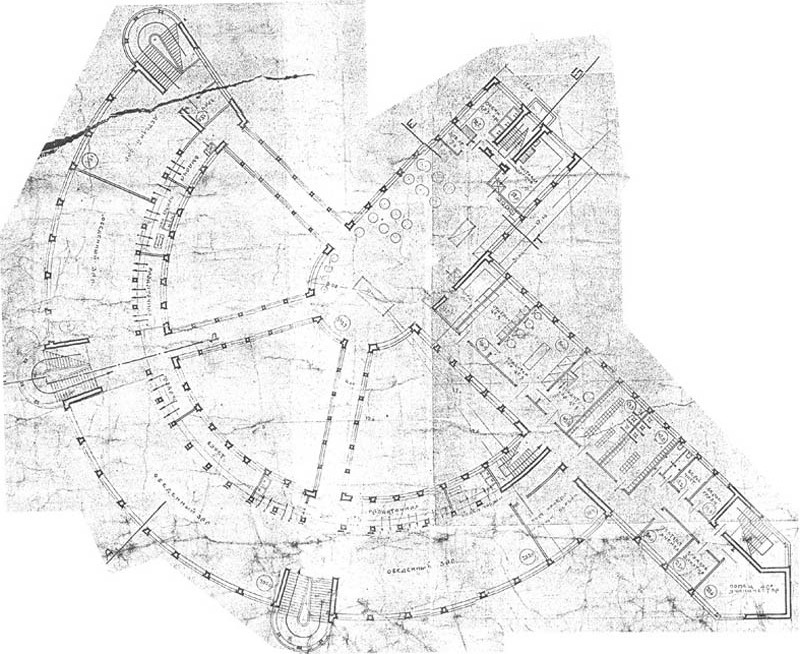
Ekaterina Maximova’s 1931 fabrika-kukhnia [factory kitchen or canteen] on Maslennikov in Samara is a constructivist wonder in the shape of a hammer and sickle. Soviet “factory kitchens” were intended to provide proper nutrition to workers and liberate women from domestic slavery (i.e. the anonymous toil and drudgery of child-rearing and housework). Many such public kitchens were built and opened in the 1920s, but the one designed by Maximova is without a doubt the most spectacular.  As with most constructivist buildings in Russia, however, especially in the hinterlands, strategies to preserve this avant-garde monument have been less than adequate. Or more frequently, entirely absent.

fabrika02 bcc9051c8e95c1943b4120cf26c3d1800bc7e840_544

Archnadzor noted in an article from March 2008 that “if this building had appeared in a capital, it would have been esteemed and entered the textbooks of architectural history long ago.” (Though the sad state of similar constructivist buildings in other parts of the former USSR should call this assumption int0 question, with the exception of Melnikov’s oligarch-sponsored pieces and Kharkov’s polished Gosprom façade). Most of Maximova’s original design — both the interior and exterior — has unfortunately been destroyed in the course of the extensive reconstructions and modifications it underwent over the 20th century.

In an effort comparable to many countries’ pre- and post-WWII preservation measures, the factory had already been extensively refurbished by 1944. The entire front façade was remade, and covered the face of the building like a sarcophagus built in the classical style. Some internal changes and coverings were also made. In 1998-99 the building was once again transformed, this time into a shopping center. Threatened by demolition several times since, the building now houses stray dogs and the homeless.

fabrika01Samara01

Its function and purpose highlight several aspects of the era’s industrial art. These architectural concepts were ideally employed for factories, workers’ clubs, canteens, garages and modern working-class housing projects, airy and sunlit, and even in Moscow a quarter built purposely to maximize sunlight exposure in all the flats; art became a practicality, industrialized, and intended to serve or otherwise stimulate the masses. Housing projects were designed as a vessel to attune Soviet citizens to the perks of communal living.

The hammer and sickle layout must seem an ideological extravagance, a symbolic excess, but similar projects were realized in Moscow and Leningrad: a school in a vaguely similar hammer and sickle shape, or a Red Army theater in the shape of a star. Maximova’s building thus “demonstrated the progressive aesthetic, engineering, and ethical ideas of the Soviet avant-garde.” It was also one of the first buildings in the Volga area with concrete lift slabs/floor structure, a showcase of modern, creative technology.

c92b1af605d5 68_big3B2C35AE-RAQwBDEEQA,525,,,393

The factory kitchen itself was located in the hammer, from which three conveyor belts brought the food to the canteen in the sickle. There were two floors, with airy mezzanines and staircases, and the building also housed a sports facility, reading room as well as the kitchen’s administration. The interior and plan design formed an integral, dynamic part of the building’s aesthetic impact; however, these aspects are rarely considered by the city council when it comes time for renovations, considering their lack of expertise.

In the TV-program Dostoianie respublika, it is mentioned that neither federal nor local government is willing to lend aid to these decaying structures. Another tragic example of this is Moisei Ginzburg’s Narkomfin building in Moscow, which appears on the UNESCO list of endangered buildings, while it is literally falling apart (often with people inside, as Owen Hatherley observed during a recent Moscow excursion). Back in 2008 there were again plans of transforming the Samara kitchen-factory, this time into an office center, but by February 2010 the restoration plans stagnated. Today the building faces destruction once more.

factory_kitchen_4b cw 0_2c6b9_5d78ab24_orig

Natan Altman’s proletarian futurism

Pages from Bolshevik Festivals, 1917-1920 Natan Altman, monument for the anniversary of the October Revolution 1918a

“Futurism” and proletarian art

Natan Al’tman
Iskusstvo kommuny
October 1918
.

Certain art circles and private individuals who not so long ago abused us in various “cultural publications” for working with the Soviet government and who knew no other name for us than “bureaucrats” and “perfunctory artists” would now rather like to take our place.

And so a campaign has begun against futurism, which, they say, is a millstone around the worker’s neck and whose claims to “being the art of the proletariat” are “ridiculous,” etc.…

But are they so ridiculous?

Why did it need a whole year of proletarian government and a revolution that encompassed half the world for the “silent to speak up”?

Why did only revolutionary futurism march in step with the October Revolution?

Is it just a question of outward revolutionary fervor, just a mutual aversion to the old forms, that joins futurism with the proletariat?

Not even they deny that futurism is a revolutionary art that is breaking all the old bonds and in this sense is bringing art closer to the proletariat.

00401.jpg~original

We maintain that there is a deeper link between futurism and proletarian creation.

People naïve in matters of art are inclined to regard any sketch done by a worker, any poster on which a worker is depicted, as a work of proletarian art.

A worker’s figure in heroic pose with a red flag and an appropriate slogan — how temptingly intelligible that is to a person unversed in art and how terribly we need to fight against this pernicious intelligibility.

Art that depicts the proletariat is as much proletarian art as the Chernosotenets who has gotten into the Party and can show his membership card is a Communist.

Just like anything the proletariat creates, proletarian art will be collective:

The principle that distinguishes the proletariat as a class from all other classes.

We understand this, not in the sense that one work of art will be made by many artists, but in the sense that while executed by one creator, the work itself will be constructed on collectivist bases.

the-arch-of-the-general-staff-1920 131933911QL40-1F54

Take any work of revolutionary, futurist art. People who are used to seeing a depiction of individual objects or phenomena in a picture are bewildered.

You cannot make anything out. And indeed, if you take out any one part from a futurist picture, it then represents an absurdity. Because each part of a futurist picture acquires meaning only through the interaction of all the other parts; only in conjunction with them does it acquire the meaning with which the artist imbued it.

A futurist picture lives a collective life:

By the same principle on which the proletariat’s whole creation is constructed.

Try to distinguish an individual face in a proletarian procession.

Try to understand it as individual persons — absurd.

Only in conjunction do they acquire all their strength, all their meaning.

How is a work of the old art constructed — the art depicting reality around us?

Natan Altman, The Alexander Column Lit Up at Night, Crayons and chalk on paper, The Tretyakov Gallery, Moscow Uritzky-square-general-view-design-sketch-for-the-celebration-of-the-first-anniversary-of-1918

Does every object exist in its own right? They are united only by extrinsic literary content or some other such content. And so cut out any part of an old picture, and it won’t change at all as a result. A cup remains the same cup, a figure will be dancing or sitting pensively, just as it was doing before it was cut out.

The link between the individual parts of a work of the old art is the same as between people on Nevsky Prospekt. They have come together by chance, prompted by an external cause, only to go their own ways as soon as possible. Each one for himself, each one wants to be distinguished.

Like the old world, the capitalist world, works of the old art live an individualistic life.

Only futurist art is constructed on collective bases.

Only futurist art is right now the art of the proletariat.

russian-revolution-34 natan-altman1 Nathan-Altman

Against religious fanaticism, against the state

Mouvement Communiste and
Kolektivně proti kapitálu on
irrationalism and the caliphate

.

Neither God nor master! [Ni dieu ni maître!]

— Auguste Blanqui

Communism begins from the outset with atheism; but atheism is at first far from being communism; indeed, that atheism is still mostly an abstraction.

— Karl Marx

Whatever were the aims of those responsible for the massacre at Charlie Hebdo, the consequence was to terrorize the whole population. To terrorize so as to prevent understanding, so as to set up even higher artificial barriers between people on the basis of religious belief. Religion has become a veritable arm of political Islam everywhere in the world. In France this is opposed by the religion of state, said to be secular and republican. In presenting itself as the guardian of civil peace, the state calls for national unity around itself. It demands that the population delegates to it the defense of freedom and democracy. It’s a defense which comes at the price of the preventive restriction of individual and collective liberties and an increased repression of all anti-state dissent. For the defenders of “white identity” like the Front Nationale the attack confirmed that “civil war has already started” against an already identified enemy — the Muslims. All Muslims: whether they share the views of the fanatics, whether they fight them, or whether they simply silently submit to them. The foreigner, “the other” from here or wherever, is the target for the fanatics on all sides. The despicable attack on Charlie Hebdo plays the game of the state and weakens the only class, the working class, which can concretely fight religious fanaticism where it is rooted, where it seeks searches for its potential soldiers, in working class neighborhoods and in workplaces. This fight is indispensable if we are not to give up the asserting the need for the exploited and oppressed to organize themselves independently against the state, against all states. As for violent political Islam, its objective is to force Muslims to isolate themselves and to serve as cattle to be sacrificed in Syria, or even right here. What matters is to understand this phenomenon so as to be able to fight it without mercy, and without becoming bound hand and foot to the state.

Irrationalism and the caliphate

.
Political Islam has become a global subject of debate and of polarization of civil society into illusory opposed communities. Each one of these illusory communities claims to fight in the name of a certain idea of civilization, only being able to fully express itself in the complete defeat of the other, identified as the enemy because of the faith it professes, including the faith in secularism and the state. In the name of such and such a belief in the supernatural, almost anything can be ignored: the question of the millennia-old oppression of women; the family; international migration; jobs; housing; food, etc.

The deforming and mystifying prism of religion becomes the supposed justification for irrationality, rejection of the reality-principle, and more generally the denial of the humanity to enemies of the faith. This specific mystification of social relations penetrates deeply into the heads of numerous proletarians here, in the advanced capitalist countries, as well as into those of their brothers and sisters on the periphery of the most developed capitalist world.

Because of their incontestable success, these reactionary fideist ideas become a powerful material force adding to those that already shape the surface of the capitalist globe. The extension of fideism in all its forms overturns priorities and redefines capitalist camps in all regions of the planet. But, like every ideology, this long wave of obscurantism is not able to hold back the determinism of matter and the social relations which the ideology claims to replace. Capitalism is not threatened by faith any more than the class societies which preceded it. Fideism is nothing other than a particular ideological expression of class submission.

Fideism is a Catholic theological term, linked to traditionalism. According to it the truth can only be known by tradition, not by reason. All knowledge is founded on a primitive revelation that prolongs and enriches Christian revelation. Only faith, the illuminating intelligence (itself intuitive, thus distinct from reason, which is analytical), makes us know the basis of things, that is to say, spiritual realities. More precisely, fideism excludes the possibility that the truths of faith can consist of rational preambles, resting on proof, including a kernel of rationality which could be absorbed into an autonomous philosophy. In another sense, also theological, fideism makes faith consist of trust in God, not in adhesion to dogmas. In all cases, the term fideism implies a defiance of reason; that’s why it had a pejorative flavor to it. In the same way that rationalism tends to overestimate reason to the point of professing that science is the only source of truth (so rejecting in advance any belief), fideism tends to overestimate faith to the point of professing that revelation is the only guarantee of truth (so discrediting the efforts of all rational activity).1

The revolutionary proletariat must first of all fight fideism in itself and treat it as what it is: an instrument of class division which reinforces the dictatorship of capital and states and which is used to recruit the exploited and oppressed into new wars which benefit the dominant classes. In particular, the fideism of the Book (Bible) — but also that of Hinduism along with the vast majority of religious beliefs — is dedicated to God, patriarchy and family. The caliphate, the reactionary fideist ideology which seems to be achieving the greatest success right now, is worthy of our attention particularly as it drapes itself in the colors of anti-capitalism and anti-imperialism and, above all, constitutes a central element of the aggravation of the geostrategic crisis of the Middle East. This is why we’re devoting a specific text to it, composed of four points.

First point

.
The partisans of the caliphate try to establish an order which will be favorable to them in regions where capitalism rules but where it has not (or very little) dissolved the social relations inherited from the class societies which preceded it. Some 10,000 Sunni tribes in Iraq are the clearest example of it. The archaic tribal social structure has survived on the margins of modern capital, feeding itself from oil rent and petty commodity trading, often illegal. The Iraqi Sunni tribe has been transformed by the extension of the domination of capital but the ancestral patriarchal ties have not been broken. The tribe administers its territory. It is a little world closed towards the exterior and the interior, except when it has to accumulate means of survival by clientelism and haggling. Today, a large number of Sunni tribes in Iraq pledge allegiance to the IS.2 This bloody group guarantees the permanence of the tribal structure. More than that, the self-proclaimed caliphate sanctifies them.

The other face of the present caliphate is represented by people like Mokhtar Belmokthar, known as “one eye,” a Salafist from the beginning who became celebrated from 2013 because of his attack on the refinery at Amenas in Algeria. Also known as “Mister Marlboro,” this sinister character is also at the head of a vast traffic in cigarettes amounting to around a billion US dollars per year in the whole of Saharan Africa. It’s a traffic which has been able to develop thanks to the blood ties with the Tuareg tribes. Smugglers, day-to-day chicken thieves, traders in human beings (prostitution, trafficking of migrants), drug dealers, all these participants in illegal business find in the caliphate a means of consolidating their lucrative activities and a way to develop others, “whitewashed” by adherence to the faith.

IS itself is an important commercial enterprise in Syria and Iraq which trades in oil, women and consumer goods. Its program can be summarized as “who has weapons has bread and women.” This gang presents no danger for capitalism, which can perfectly well accommodate rentiers and traffickers, and, what’s more, creates them. Boko Haram in Nigeria, the Cameroons and Niger, Al-Shabab in Somalia, Al-Qaida in the Islamic Maghreb (AQIM) in Sahel, Al-Qaida in the Arab peninsula (AQAP) in Yemen and Saudi Arabia, the Talibans in Afghanistan and Pakistan along with Abu Sayyaf in the Philippines, Indonesia and Malaysia — and those are just the best known ones — replicate the same social relations expressed by IS.

These considerations don’t apply to Shi’a Islam, whose centralized internal organization, similar to fascism, has allowed it to adapt to modern capitalism. Not unlike the Catholic Church.

Second point

.
IS was born from the rubble of an Arab nationalism founded on the model of previous popular democracies based on an alliance between a single party (Ba’athist in the cases of Iraq and Syria), the army and a single union. This model aimed at creating modern postcolonial economies, equipped with strong industry, a unified internal market and an effective secular state. This project was smashed from the outside by the progressive collapse of the Russian bloc, and internally by the emergence from the ruins of national liberation of a parasitic ruling caste, corrupt, despotic, and inefficient.

On this basis, the caliphate of IS is in perfect continuity with the Arab regimes which it claims to oppose. Its sources of survival are trade and plunder; its organization is clientelist and stuffed with incompetents. The IS diverges from the Sunni regimes only in terms of geostrategic positioning. And this is from the simple fact that its regime tries to impose itself on the other states of the region, including those for which Sunni fideism is the official religion.

The US has benefited from the fall of the Russian empire and extended its influence over the Arab regimes whose vague desires for capitalist development have been seriously revised over the last few decades. An important new stage was reached by Washington with the active support for the Taliban in the war against Russia in Afghanistan and then with the first Iraq war. These two episodes marked the adoption by the US administration of an aggressive diplomacy in this area, so as to make the US once again into a power to be reckoned with in the Middle East. The Arab Spring gave Washington the opportunity to also occupy a leading role in the whole of North Africa. The attempt has still not produced a conclusive result.

Continue reading

Je suis Bezbozhnik

.
Just over a week ago, I published a series of antireligious images from the early Bolshevik journal Bezbozhnik u stanka along with an article by Leon Trotsky from 1925 on the subject of atheistic propaganda. In it, he praised “the satirical journal Godless, where there are a great many cartoons, sometimes quite effective ones, by some of our best cartoonists…Issue after issue one finds in its pages an ongoing, tireless duel being conducted with Jehovah, Christ, and Allah, hand-to-hand combat between the talented artist [Dmitrii] Moor and God. Of course, we are to a man on Moor’s side completely.” Many of the images are every bit as offensive as the ones printed by the French satirical journal Charlie Hebdo, the offices of which were recently the target of a brutal assault by reactionary Islamists. Eleven were killed that day, executioner-style. Several hostages at a printing house and a kosher market in Paris were murdered along with the gunmen in the standoff a few days later.

There was obviously no way of knowing this tragedy would take place when I uploaded the aforementioned post. Like everyone else, I followed the drama that unfolded and watched with dismay the flailing attempts by various leftists to spin the story to fit their own preexisting narratives. Richard Seymour’s article over at Jacobin, which largely framed subsequent debate, was exemplary in this respect. While he condemned violence against civilians, he nevertheless felt it necessary to add that “there’s a critical difference between solidarity with the journalists who were attacked, refusing to concede anything to the idea that [they] are somehow ‘legitimate targets,’ and solidarity with what is frankly a racist publication.” Appended to this was the condescending suggestion: “If you need to be convinced of this, then I suggest you do your research, beginning with Edward Said’s Orientalism as well as some basic introductory texts on Islamophobia.”

Der Stürmer, Sonderausgabe 1934

Islamophobia has been Seymour’s main concern for some time now. Other issues occasionally show up, such as austerity and intersectionality, but these are few and far between. Wasn’t always so: back in 2004 you could still find him defending revolutionary universalism against the idiocy of left-liberal multiculturalism. Take this entry, “Jihad Chic,” from 2004 (back when Seymour was just a poor man’s Christopher Hitchens). Anyway, going from his description of Charlie Hebdo above — i.e., “frankly a racist publication” — one could easily get the mistaken impression that it’s some latter-day Der Stürmer. Surprisingly, Seymour seems totally oblivious to the context in which this imagery appears. His old buddy Sebastian Budgen, on whom he relies for most of his gossip about the French Left, came much closer to getting this right:

There is a silly debate about whether Charlie Hebdo is a “racist” publication or not. Clearly not, in the sense of its origins lying in a left-wing, post-′68, highly transgressive vulgarity and its opposition to the far Right. It is part of the mental furniture of much of the French Left, radical included (think of a mash-up between Private Eye, Viz, Oz, Ben Elton, and The Young Ones), and most people will have affectionate memories of it prior to the 2000s. Charb himself illustrated Daniel Bensaïd’s Marx for Beginners books not so long ago.

Not just that, either. Cabu, one of the staff cartoonists, got his start as a kind of avant la lettre Oliver North. He’d served as a colonial soldier in Algeria, but later publicly lampooned French militarism in numerous comic strips. Virtually everyone involved in the magazine had campaigned on behalf of immigrants and mocked right-wing nationalists like Marine Le Pen. (There is cruel irony in the fact that she’s now cynically using their memory for political gain). Regardless, Seymour’s brief characterization is highly misleading. Perhaps certain cartoons in the magazine could be construed as racist or antisemitic, and several clearly are, but to smear the entire project and those involved in it as virulent racists is grossly unfair. One comrade even went so far as to compare the victims of the attack to “Nazbols.”

Bob from Brockley posted a response to Seymour written by Contested Terrain on his blog. The rest of Seymour’s argument is boilerplate; Contested Terrain parries its thrusts with relative ease. Seymour, he contends, “portrays the attacks in an extremely general way, as if they are somehow a natural (though too violent) response to anti-Muslim racism in France and Europe, rather than being the specific strategic actions taken by specific actors.” This weakness is compounded by an overall reticence to entertain that it might have origins in Islamist ideology. “In [Seymour’s] account, even pointing out the specific radical Islam linkages behind this amounts to supporting state repression against Muslims in general.” He’s since posted a rejoinder to the criticisms he’s received, which more or less states that he thought some things went without saying. Continue reading