Stalinism and Bolshevism

Leon Trotsky
Socialist Review

(August 1937)

.
Reactionary epochs like ours not only disintegrate and weaken the working class and isolate its vanguard but also lower the general ideological level of the movement and throw political thinking back to stages long since passed through. In these conditions the task of the vanguard is, above all, not to let itself be carried along by the backward flow: it must swim against the current. If an unfavorable relation of forces prevents it from holding political positions it has won, it must at least retain its ideological positions, because in them is expressed the dearly paid experience of the past. Fools will consider this policy “sectarian.” Actually it is the only means of preparing for a new tremendous surge forward with the coming historical tide.

The reaction against Marxism and Bolshevism

.
Great political defeats provoke a reconsideration of values, generally occurring in two directions. On the one hand the true vanguard, enriched by the experience of defeat, defends with tooth and nail the heritage of revolutionary thought and on this basis strives to educate new cadres for the mass struggle to come. On the other hand the routinists, centrists and dilettantes, frightened by defeat, do their best to destroy the authority of the revolutionary tradition and go backwards in their search for a “New World.”

One could indicate a great many examples of ideological reaction, most often taking the form of prostration. All the literature if the Second and Third Internationals, as well as of their satellites of the London Bureau, consists essentially of such examples. Not a suggestion of Marxist analysis. Not a single serious attempt to explain the causes of defeat, About the future, not one fresh word. Nothing but clichés, conformity, lies and above all solicitude for their own bureaucratic self-preservation. It is enough to smell 10 words from some Hilferding or Otto Bauer to know this rottenness. The theoreticians of the Comintern are not even worth mentioning. The famous Dimitrov is as ignorant and commonplace as a shopkeeper over a mug of beer. The minds of these people are too lazy to renounce Marxism: they prostitute it. But it is not they that interest us now. Let us turn to the “innovators.”

Vanishing commissars 1.

The former Austrian communist, Willi Schlamm, has devoted a small book to the Moscow trials, under the expressive title, The Dictatorship of the Lie. Schlamm is a gifted journalist, chiefly interested in current affairs. His criticism of the Moscow frame-up, and his exposure of the psychological mechanism of the “voluntary confessions,” are excellent. However, he does not confine himself to this: he wants to create a new theory of socialism that would insure us against defeats and frame-ups in the future. But since Schlamm is by no means a theoretician and is apparently not well acquainted with the history of the development of socialism, he returns entirely to pre-Marxist socialism, and notably to its German, that is to its most backward, sentimental and mawkish variety. Schlamm denounces dialectics and the class struggle, not to mention the dictatorship of the proletariat. The problem of transforming society is reduced for him to the realisation of certain “eternal” moral truths with which he would imbue mankind, even under capitalism. Willi Schlamm’s attempts to save socialism by the insertion of the moral gland is greeted with joy and pride in Kerensky’s review, Novaia Rossia (an old provincial Russian review now published in Paris); as the editors justifiably conclude, Schlamm has arrived at the principles of true Russian socialism, which a long time ago opposed the holy precepts of faith, hope and charity to the austerity and harshness of the class struggle. The “novel” doctrine of the Russian “Social Revolutionaries” represents, in its “theoretical” premises, only a return to the pre-March (1848!) Germany. However, it would be unfair to demand a more intimate knowledge of the history of ideas from Kerensky than from Schlamm. Far more important is the fact that Kerensky, who is in solidarity with Schlamm, was, while head of the government, the instigator of persecutions against the Bolsheviks as agents of the German general staff: organised, that is, the same frame-ups against which Schlamm now mobilises his moth-eaten metaphysical absolutes.

The psychological mechanism of the ideological reaction of Schlamm and his like, is not at all complicated. For a while these people took part in a political movement that swore by the class struggle and appeared, in word if not in thought, to dialectical materialism. In both Austria and Germany the affair ended in a catastrophe. Schlamm draws the wholesale conclusion: this is the result of dialectics and the class struggle! And since the choice of revelations is limited by historical experience and…by personal knowledge, our reformer in his search for the word falls on a bundle of old rags which he valiantly opposes not only to Bolshevism but to Marxism as well.

At first glance Schlamm’s brand of ideological reaction seems too primitive (from Marx…to Kerensky!) to pause over. But actually it is very instructive: precisely in its primitiveness it represents the common denominator of all other forms of reaction, particularly of those expressed by wholesale denunciation of Bolshevism.

“Back to Marxism”?

.
Marxism found its highest historical expression in Bolshevism. Under the banner of Bolshevism the first victory of the proletariat was achieved and the first workers’ state established. No force can now erase these facts from history. But since the October Revolution has led to the present stage of the triumph of the bureaucracy, with its system of repression, plunder and falsification — the “dictatorship of the lie,” to use Schlamm’s happy expression — many formalistic and superficial minds jump to a summary conclusion: one cannot struggle against Stalinism without renouncing Bolshevism. Schlamm, as we already know, goes further: Bolshevism, which degenerated into Stalinism, itself grew out of Marxism; consequently one cannot fight Stalinism while remaining on the foundation of Marxism. There are others, less consistent but more numerous, who say on the contrary: “We must return Bolshevism to Marxism.” How? To what Marxism? Before Marxism became “bankrupt” in the form of Bolshevism it has already broken down in the form of social democracy, Does the slogan “Back to Marxism” then mean a leap over the periods of the Second and Third Internationals…to the First International? But it too broke down in its time. Thus in the last analysis it is a question of returning to the collected works of Marx and Engels. One can accomplish this historic leap without leaving one’s study and even without taking off one’s slippers. But how are we going to go from our classics (Marx died in 1883, Engels in 1895) to the tasks of a new epoch, omitting several decades of theoretical and political struggles, among them Bolshevism and the October revolution? None of those who propose to renounce Bolshevism as an historically bankrupt tendency has indicated any other course. So the question is reduced to the simple advice to study Capital. We can hardly object. But the Bolsheviks, too, studied Capital, and not badly either. This did not however prevent the degeneration of the Soviet state and the staging of the Moscow trials. So what is to be done? Continue reading

Narkomfin — A web documentary by Luciano Spinelli and Natalia Melikova

.
Natalia Melikova, the mastermind behind The Constructivist Project, is collaborating with Luciano Spinelli and others from Ogino Knauss on a new web documentary about Ginzburg’s Narkomfin building in Moscow. This comes not too long after Isabella Willinger’s excellent documentary Away from All Suns, released late last year.

Their description of the project is reproduced below. For further information on Dom Narkomfin, consider the following:

.
NARKOMFIN — A web documentary

.
Project in progress — expected completion spring 2014.

Authors: Luciano Spinelli and Natalia Melikova, with Inna Erosh and Stepa Dobrov.

Summary: NARKOMFIN is a web documentary project that captures the atmosphere of current life in 2013 in this historic constructivist building located in Moscow, Russia. The virtual platform of the project invites the viewer to explore the hallways, knock on doors, and get to know some of the inhabitants. A variety of possibilities for interaction with the space and people of Narkomfin allows for a subjective experience for each visitor. By entering some of the apartments, one will have a chance to listen to the residents tell about who they are, what kind of work they do, how the communal architecture influences their everyday life and why they live in this particular building.

Why: The architectural significance and the various circumstances surrounding the fate of the building are widely discussed. However, few can freely visit Narkomfin because of its limited access, therefore little is known about what it is actually like to live there. After having the opportunity to live there for a couple weeks, we wanted to know more about how people appropriated and interpreted their space inside this famous building. This project takes a closer look at the homes and people hidden behind the ribbon windows.

How: In our project, we applied a photo-ethnographic approach of the space, perceiving the long corridors through the viewfinder and meeting new people with our cameras in hand. Progressing from casual conversations, we then asked each of the participants identical questions. In this way, we were able to acquire general information as well as giving the residents an opportunity to share their opinions. More than just a subject in front of our lens, their participation influenced the development of the project. Those that did not want to partake, did not. Those that did, they opened up their worlds to us, shared their homes, their stories, and their talents.

When: 2013 (majority of material capture in May 2013, additional capture summer 2013).

Content: images, video, stop motion, audio, text.

Languages: English / Russian

Special thanks to the people that opened up their doors to our project and shared with us their stories! Continue reading

Moisei Ginzburg, competition entry for the Palace of the Soviets (1931)

.
In previous posts, I’ve tried to give some sense of the magnitude of the international competition for the Palace of the Soviets project in Moscow. So far I’ve dealt with some of the entries by German architects such as Walter Gropius, Hannes Meyer, Erich Mendelsohn, and Hans Poelzig, as well as the Swiss architect Le Corbusier’s famous entry. This would turn out to be one of the last major Soviet competitions in which modernist proposals featured prominently. (Another competition, for the Commissariat of Heavy Industry [Наркомтяжпром], took place in Moscow around 1933-1934, but only submissions from Soviet architects were considered).

Moisei Ginzburg was the chief theoretician and, besides the Vesnin brothers, probably the most accomplished practitioner of architectural constructivism in the Soviet Union. His project for the Palace of the Soviets, jointly carried out with A. Gassenpfliug and S. Lisagor under the supervision of A.F. Loleita, a specialist in matters of construction, and S.Ia. Lifshits, an acoustic technician. It was without a doubt one of his most futuristic proposals to date, almost resembling a landed spaceship faced toward the Kremlin.

One might perhaps compare it with his earlier submission to the 1922-1923 Palace of Labor competition, in terms of its scale and purpose, as the architectural historian Selim Khan-Magomedov has done. But formally, Ginzburg’s vision for the Palace of the Soviets was much more advanced. The multi-tiered central building was designed with stepped storeys parabolically curved upward toward a skylight crowning the dome. His scheme for its main thoroughfares and points of access would have accommodated huge crowds of visitors and personnel, with a series of platforms, ramps, and stairs expediting circulation into and out of the Palace.

Courtyards and terraces were to surround the different structures in the ensemble, with covered walkways connecting them to one another. Not only with respect to its internal composition was the Palace of the Soviets meant to be broadly accessible, either, as the building was easily open to approach from without. The variety of volumes included in Ginzburg’s plan may have clashed stylistically with the preexisting urban fabric of Moscow, but it would have been spatially integrated rather elegantly.

A few paragraphs pertaining to Ginzburg’s Palace of the Soviets appear below in the original Russian, extracted  from Khan-Magomedov’s book on Moisei Ginzburg. See also his excellent Narkomfin building.

Поиски новых типов общественных зданий в первом периоде творчества Гинзбурга завершаются конкурсным проектом Дворца Советов (1932 г.), который выполнялся им совместно с А. Гассенпфлюгом и С. Лисагором при консультации А.Ф. Лолейта (конструкция) и С.Я. Лифшица (акустика). По масштабу и роли в ансамбле центра Москвы Дворец Советов сравним с Дворцом труда (конкурс 1922-1923 гг.). Близка даже в какой-то мере и программа этих зданий (большой и малый залы и т. д.). Сравнивая выполненные Гинзбургом проекты Дворца труда и Дворца Советов, разделенные всего девятью годами видно, какой большой и сложный творческий путь прошел их автор. Объемно-пространственная композиция Дворца Советов необычна по трактовке для предыдущего творчества Гинзбурга. Как правило, в более ранних проектах он использовал два композиционных приема: членение здания на отдельные корпуса, соединенные крытыми переходами (павильонный тип), или создание сложной композиции из соединенных между собой различных по форме и величине объемов. Continue reading

Rousseau, Kant, and Hegel

Chris Cutrone
Platypus Review 61
November 2013
.

.
Originally published in the Platypus Review.

On June 9, 2013, the Platypus Affiliated Society organized a panel discussion on “Revolution without Marx? Rousseau and his followers for the Left” for the 2013 Left Forum at Pace University, New York. What follows is the edited version of the first of the prepared opening remarks. A full recording of the event is available online.
.

Introduction

.
Bourgeois society came into full recognition with Rousseau, who in the Discourse on the Origin of Inequality and On the Social Contract, opened its radical critique. Hegel wrote: “The principle of freedom dawned on the world in Rousseau.”

Marx quoted Rousseau favorably that “Whoever dares undertake to establish a people’s institutions must feel himself capable of changing, as it were, human nature…to take from man his own powers, and give him in exchange alien powers which he cannot employ without the help of other men.”

Rousseau posed the question of society, which Adorno wrote is a “concept of the Third Estate.”

Marx recognized the crisis of bourgeois society in the Industrial Revolution and workers’ call for socialism. But proletarian socialism is no longer the rising force it was in Marx’s time. So what remains of thinking the unrealized radicalism of bourgeois society without Marx? Kant stated that if the potential of bourgeois society was not fully achieved as the “mid-point” of freedom then Rousseau may have been right to prefer savagery against civilization’s “glittering misery.” Nietzsche warned that we might continue to be “living at the expense of the future:” “Perhaps more comfortably, less dangerously, but at the same time in a meaner style, more basely.”[1] How have thinkers of the revolutionary epoch after Rousseau, Adam Smith, Kant, Hegel, Benjamin Constant, and Nietzsche himself, contributed to the possibility of emancipation in a world after Marxism?

Karl Marx, photographed in 1870

Marx and Rousseau

.
Marx’s favorite quotation of Rousseau, from On the Social Contract, goes as follows:

Whoever dares undertake to establish a people’s institutions must feel himself capable of changing, as it were, human nature, of transforming each individual, who by himself is a complete and solitary whole, into a part of a larger whole, from which, in a sense, the individual receives his life and his being, of substituting a limited and mental existence for the physical and independent existence. He has to take from man his own powers, and give him in exchange alien powers which he cannot employ without the help of other men.[2]

Marx wrote that this was “well formulated,” but only as “the abstract notion of political man,” concluding that,

Human emancipation will only be complete when the real, individual man has absorbed into himself the abstract citizen; when as an individual man, in his everyday life, in his work, and in his relationships, he has become a species-being; and when he has recognized and organized his own powers as social powers so that he no longer separates this social power from himself as political power.[3]

What did Marx mean by “social powers” as opposed to the “political power” from which it has been “separated?” Continue reading

In memoriam: Lebbeus Woods one year after his death

.
A little over a year ago the visionary architect Lebbeus Woods died. I never got around to writing up a reflection on his passing, something commemorating and celebrating his lifework. Thankfully, many whose opinions and insight I respect did.

What follows is thus a pastiche of images by Woods and text from two articles — one by Sammy Medina (then at Architizer), with whom I’ve collaborated in the past, the other by Kelly Chan (then at ArtInfo), a fantastically overproductive architecture critic who I know through Sammy — as well as a quote from the British author Douglas Murphy on Woods’ oeuvre.

Early drawings

Not much I can really add to their comments, really, except to point out a few intersecting themes that unite them (for good reason, too, as I think they hit upon something):

  • First, there is the contrast of Woods’ career with those of his contemporaries Daniel Libeskind and Zaha Hadid, both of whom transitioned from speculative architectural drawing in the late 1970s and 1980s to become “starchitects” by the mid-1990s. Douglas, Sammy, and Kelly all stress Woods’ disappointment with the naked careerism of his former peers.
  • Second, related to the first point, there was Woods’ refusal to capitulate to the imperative to build in a reactionary age. This wasn’t an act of simple asceticism, I don’t think, but rather a recognition of historical reality.
  • Finally, there is the comparison that both Sammy and Kelly made of Woods to the pioneering Italian draughtsman Piranesi — whose work, according to Manfredo Tafuri, prefigured that of the twentieth century avant-garde. Piranesi, like Woods, built very little during his lifetime. Both are instead remembered for their resolute commitment to “paper architecture,” whose unsettlingly speculative content served to disenchant the triumphant conservatism that had overtaken architecture in their time.

With that, I’ll conclude. Enjoy.

Lebbeus Woods, Makeshift House (1990s)

Lebbeus Woods, Makeshift House (1990s)

On the passing of Lebbeus Woods

Douglas Murphy
Guardian

.
Guardian quotes Douglas Murphy as follows:

Around the end of the 1980s Lebbeus Woods was just one of a number of radical architects making their name through the production of imaginary projects; elaborate drawings and paintings occupying a milieu somewhere between fine art and architecture, which allowed many to interrogate the conventions of their discipline. Open a book on the experimental architecture of that period and Woods’ heartfelt and haunting drawings regarding the siege of Sarajevo share space with early works from the likes of Daniel Libeskind and Zaha Hadid. But unlike so many of that generation who eventually made the career transition from avant-garde upstarts to global superstars, Lebbeus Woods never got rich by building rubbish. Continue reading

Internationalism fails

Chris Cutrone

.
This article is reposted from Platypus Review no. 60. Generally, I agree with its assertions about “anti-imperialist” politics in the present. Nevertheless, this should not be taken to mean that I support US military aggression overseas (not that I have any say in the matter). On Facebook, a heated exchange between James Heartfield, Chris Cutrone, Spencer Leonard, and Reid Kotlas followed. If they don’t mind, I might repost snippets of that argument as a supplement.

The “anti-imperialist Left” considers itself opposed to all U.S. government action as “imperialist” on principle. But, as Trotsky wrote to his followers in 1938, “Learn to think!” while one may oppose the government politically, to oppose the government putting out a fire, especially when there is no alternative agency for doing so, is nonsense. But the “Left” today is not the inheritor of Trotsky, but rather of what he pitilessly assailed, the policy of the Stalinist “Popular Front Against War and Fascism” of the 1930s, for which the shibboleth was, “Which side are you on?”

The idea is that the defeat of imperialist policy creates possibility for an alternative, and therefore one must always be against imperialism to be on the side of an alternative to it. Historically, Marxists have understood such a strategy in terms of either “revolutionary defeatism” or “revolutionary defensism.” Simply put, the defeat of an imperialist power is seen as providing the possibility for a political alternative to the government of the imperialist country; whereas the defense of a country against imperialist attack is seen as providing the possibility for a political alternative in the subaltern country. Importantly, these are not pacifist positions against war, but rather political military strategies in time of war, moreover with the aim of revolution.

Pivertistes, Mai 1938: Royan, Daniel Guérin

Pivertistes, Mai 1938: Royan, Daniel Guérin

Historically, there are two examples of success of these strategies of revolutionary defeatism and revolutionary defensism: the role of the Bolsheviks in the Russian Revolution is regarded as a success of revolutionary defeatism, in which the defeat of the Tsarist Russian Empire undermined the government and gave rise to political and social revolution; and Mao’s Communists in the Chinese Revolution, in which the defense of China against Japanese imperialist attack undermined the nationalist Kuomintang and allowed for Communist-led revolution. Continue reading

They still radiate the future

Introduction

.
Last night I went to see a preliminary screening of Isabella Willinger’s newly-released documentary Away from all suns. Sammy Medina of FastCo, with whom I frequently collaborate, and Anna Kats of ArtInfo were also in attendance. 
The movie was being shown as part of  Tribeca Cinema’s “Architecture and Design Week,” an event sponsored by Archtober and a host of other companies/publications (far too numerous to name). Her film focuses on three contemporary individuals whose lives are somehow connected to utopian modernist buildings slowly decaying in Moscow. One building, Ivan Nikolaev’s student commune (1929), is currently being renovated. Another, El Lissitzky’s printing factory, is in danger of being torn down. Yet another, Moisei Ginzburg and Ignatii Milinis’ Dom Narkomfin, is left in a general state of disrepair. Stunning archival footage is mobilized to juxtapose these buildings’ original state against their current dilapidation.

Hopefully I’ll be writing up a review of the film and pitching it to Art Margins or Calvert Journal, so I’ll spare the reader any further thoughts of my own. What follows is an interview with the director Isa Willinger conducted by Boris Schumatsky. It’s being reposted here from the film’s official website. Willinger expresses some sentiments in this exchange that more or less approximate statements that writers like Owen Hatherley, Douglas Murphy, Agata Pyzik, and myself have voiced in the past, independently of or in close dialogue with one another — nostalgia for an age we never knew, awe before the ruins of a past seemingly more futuristic than our own, hope against hope that radical transformation might yet be possible. The line from Willinger I paraphrased for the title of this entry runs as follows: “Many of [these Constructivist buildings in Moscow] are quite run down today, yet they still radiate their futuristic visions.” It recalls, consciously or not, something Owen Hatherley wrote about Il’ia Golosov’s Zuev Club nearby:

The windows might be infilled, the balconies long since disappeared ⎯ what all this damage proves is that buildings with this much power and conviction can still carry you away with them. Or it carries me, anyway. I look at this and I can still feel radiating off the bloody thing the promise of a better society.

Below you can watch a trailer of the film, followed by the edited transcript of the interview.

Away from all suns (2013)

Isa Willinger interviewed
by Boris Schumatsky

.
Boris Schumatsky:
 Your film is about people living in buildings of the Russian avant-garde and about the buildings themselves. You seem to be just as fascinated by the buildings as by your protagonists. What is it that struck you about the Constructivist buildings?

Isa Willinger: To me the buildings seem like ruins from another future. I spent some time in Moscow some years ago and on my walks through the city I discovered these exceptional buildings. They really stick out from the rest of Moscow’s city landscape. Many of them are quite run down today, yet they still radiate their futuristic visions. This, of course, is a stunning paradox: Something is from the past and at the same time it seems from the future.

Boris Schumatsky: Can you tell us about the background of Constructivism?

Isa Willinger: The term was first applied to the abstract works of art by Tatlin, Malevich, Popova, Stepanova, El Lissitzky, and others in the 1910s and 1920s. Soon, the artists’ works transgressed the boundary between geometrical shapes on paper or canvas and architectural drawings toying with those shapes. The first Constructivist buildings were built in the mid 20s only, due to a lack of resources in early Soviet Russia. The Constructivist movement was infused with the hopes of socialist revolution, overcoming a repressive tsarist regime, and building a better, more modern society. Continue reading

Burying Lenin

The revolution entombed

.
The Lenin Mausoleum in Moscow was first designed by the architect Aleksei Shchusev in 1924. Even outside of Russia, its image is fairly familiar: some kind of cross between geometric modernism and a primeval ziggurat. What is seldom remembered today, however, is that Shchusev had to design and redesign the building more than once. Of course, the public display of Ulianov’s corpse was originally intended to only last a few weeks.

An exceptionally cold winter (Lenin died in January) helped preserve the Bolshevik leader’s remains longer than expected. Despite Lenin’s explicit request that his body be cremated and buried next to that of his mother, the new Soviet administration began making more permanent arrangements.

Soviet architect Aleksei Shchusev

Vladimir Paperny offered a fairly memorable explanation for this fact in his book Culture Two: Architecture in the Age of Stalin. He suggested that a transition was then underway between the two dominant cultural attitudes that define Russian-Soviet history:

Culture One [Bolshevik, avant-garde culture] wanted to burn its limbs [Shklovskii (1919)], wash memory from its soul, kill its old [Maiakovskii (1915)], and eat its children — all this as an attempt to free itself from the ballast that was interfering with its surge into the future. In Culture Two [Stalinist, realist culture], the future was postponed indefinitely. The future became even more beautiful and desirable [the architect Krasin (1937)], and the movement forward was even more joyous [state prosecutor Vyshinskii (1938)], but there did not seem to be an end in sight to that movement — the movement had become an end in itself.

[Stalinism’s] movement “forward, ever forward” changed nothing: The…goal was still the same; therefore, there was no way to determine whether this was movement or rest…Movement in Culture Two became tantamount to immobility, and the future to eternity…The history of the building of the Lenin Mausoleum is a good example of how culture’s idea of the longevity…changed. In Culture One, the idea of a mausoleum evoked a temporary structure, one that was needed “in order to grant all those who wish to, and who cannot come to Moscow for the day of the funeral, a chance to bid farewell to their beloved leader.” Culture Two had no intention of bidding farewell to the beloved leader. The temporary wooden mausoleum erected in 1924 was replaced first by a more solid wooden structure [six months later], and then, in 1930, by one of stone built to last.

Clearly, the different materials implemented in the construction of each version reflect different anticipated durations. The first was to be fleeting, the second durable, the third eternal. While the second is still, like the first, only made of wood, its form already appealed to eternity. Planks and crossbeams combined into regular geometric slabs, beyond real space and time. The upper half meanwhile ascends in pyramidal fashion, evoking that same mute permanence one feels before the ancient pharaohs’ tombs.

Lenin’s memory still haunts today’s Left. Just as the post-1991 Restoration in Moscow could not bring itself to finally lay his corpse to rest, neither can the contemporary Left bring itself to discard the legacy of October 1917. Even in rejecting Lenin or Leninism — whatever this might be thought to entail, be it democratic centralism, vanguardism, totalitarianism — it is forced to confront such associations. This is to say nothing of those who seek to take up Lenin’s mantle, with all the competing interpretations and conflicting points of emphasis. Continue reading

Dialectics and historical reality

.
Dialectics is not some sort of thought-trick or rhetorical sleight-of-hand, let alone the so-called “epistemological magic-key to revolutionary tactics or theory.” Of course, I don’t doubt that more than a handful of people (ab)use dialectics in this way. But this is true of practically every discourse, some more than others. There’s literally almost no end to jargon and the obfuscatory use of concepts. But where a feeble mind like Eugen Dühring dismissed Marx as someone “deeply bitten with the Hegelian pestilence,” seeing his dialectics as mere “verbal jugglery,” closer inspection would have revealed an actual content to what Marx was saying. More attention still would have disclosed a rationale as well behind his way of saying it.

Honestly, I’m not even sure something like epistemology is useful to politics, since arguably we’re only able to know the world insofar as we’re able to change it. Joseph Dietzgen, Theodor Adorno, and Alfred Sohn-Rethel critiqued epistemology along precisely these lines. Marx’s own Theses on Feuerbach (1845) set out to articulate this peculiar epistemological quandary and the conditions for its historical supersession. Turning prior materialist philosophies on their head, Marx wrote:

I. The chief defect of all hitherto existing materialism — that of Feuerbach included — is that the thing, reality, sensuousness, is conceived only in the form of the object of contemplation, but not as sensuous human activity, practice, not subjectively. Hence, in contradistinction to materialism, the active side was developed abstractly by idealism — which, of course, does not know real, sensuous activity as such.

II. The question whether objective truth can be attributed to human thinking is not a question of theory but is a practical question. Man must prove the truth — i.e. the reality and power, the this-sidedness of his thinking in practice.

This provides the basis for Marxism’s dialectical methodology. “Truth” is not a matter of passive consumption, whether intuited sensuously or conceptualized contemplatively. Rather, objective truth can only be attained only through humanity’s active participation in its own self-transformation.  Continue reading

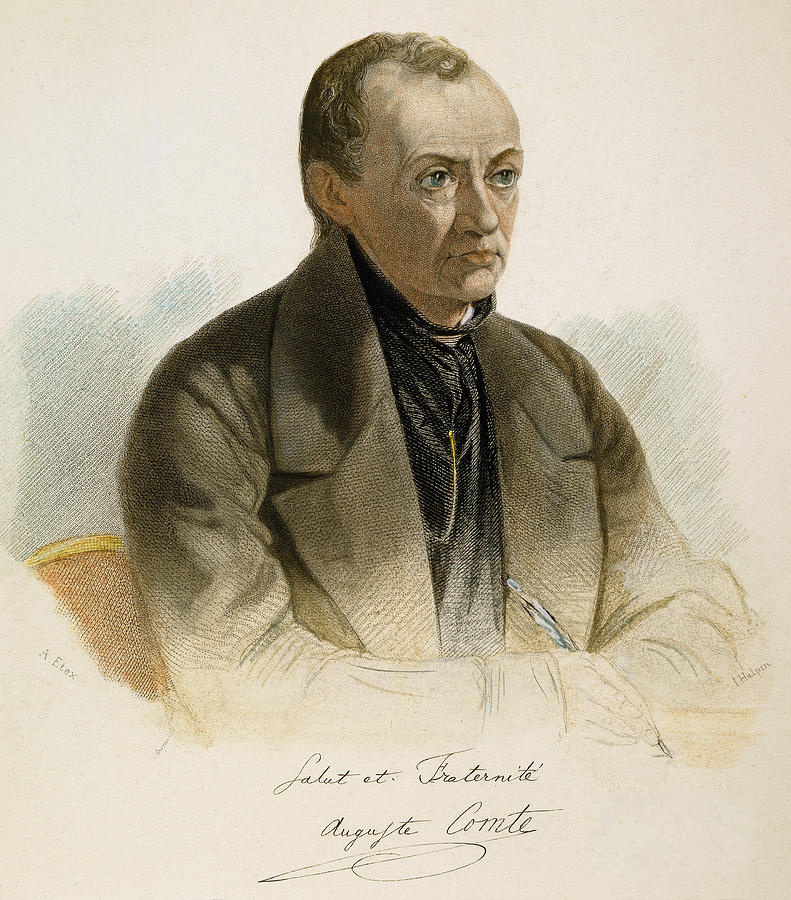
Contra Comte

In Aspects of Sociology, a primer in social theory released by the Institute for Social Research (often referred to as the Frankfurt School), Theodor Adorno and Max Horkheimer explain the bastard etymology of the term “sociology” and its origin in the positive philosophy of Auguste Comte:

The word “sociology” — science of society — is a malformation, half Latin, half Greek. The arbitrariness and artificiality of the term point to the recent character of the discipline. It cannot be found as a separate discipline within the traditional edifice of science. The term itself was originated by Auguste Comte, who is generally regarded as the founder of sociology. His main sociological work, Cours de philosophie positive, appeared in 1830-1842.The word “positive” puts precisely that stress which sociology, as a science in the specific sense, has borne ever since. It is a child of positivism, which has made it its aim to free knowledge from religious belief and metaphysical speculation. By keeping rigorously to the facts, it was hoped that on the model of the natural sciences, mathematical on the one hand, empirical on the other, objectivity could be attained. According to Comte, the doctrine of society had lagged far behind this ideal. He sought to raise it to a scientific level. Sociology was to fulfill and to realize what philosophy had striven for from its earliest origins. (Aspects of Sociology, pg. 1)

Somewhere I remember hearing the quip that the term “sociology” was such an ugly combination that only a Frenchman could have concocted it. Not sure who was supposed to have said it, or if it factually took place, but there seems to be a ring of truth to the assertion. Anyway, Adorno points out in his lecture course Introduction to Sociology that “Marx had a violent aversion to the word ‘sociology,’ an aversion that may have been connected to his very justified distaste for Auguste Comte, on whom he pronounced the most annihilating judgment” (Introduction to Sociology, pg. 143). Continue reading