MEGA [Marx-Engels-Gesamtausgabe] on MEGA

.
Back in the 1920s, the Russian revolutionary and Marxist scholar David Riazanov began to compile a new, more complete edition of the works of Karl Marx and Friedrich Engels. He was, unfortunately, purged during the 1930s for supposed involvement in an anti-Soviet conspiracy. Riazanov was thus unable to see this project through to the end. Nevertheless, he set the wheels in motion for future Marxologists and exegetes like Maximilien Rubel, Roman Rosdolski, and Michael Heinrich. Work on the Marx-Engels-Gesamtausgabe [MEGA] continues today.

Anyway, I recently happened across a trove of full-text PDFs of the MEGA stored on the New Zealand cloud service known as MEGA, appropriately enough. You can download the files as a .zip file by clicking here. Quietly amused that this arrived to me indirectly via a certain oversharing Francophile lefty editor type. Makes me wonder what all his posturing over “pirate scab PDFs” was really about.

Riazanov.jpg

Speaking of which, Budgen — Lars Ulrich of the online left — is apparently upset with me yet again. Class act that he is, Sebastian associated me with the disgusting rape advocate Roosh V. (an antisemitic conspiracy theorist and extreme misogynist) and the disgusting pharmaceutical CEO Martin Shrkeli (who jacked up the price of vital medicines once he’d secured exclusive rights over the drugs). If anyone resembles a douchebag who sells stuff he didn’t develop himself for obscenely inflated prices while monopolizing said product… you would think it was Budgen. Especially considering the company he keeps: people who make fun of others with physical deformities or who have a darker complexion on account of their ethnic background. Roosh V. and Simon Weston are reactionaries, to be sure, but that should hardly be seen as giving one license to make racist or ableist comments about them. Continue reading

Walter Benjamin’s writings in German and in English

.
Besides studying Soviet history, reading Walter Benjamin was what got me hooked on all this commie crap. It was probably “On the Concept of History” that first did it. Enigmatic, baffling, simple yet sophisticated — these were my initial impressions of it. The rest is history, or a storm blowing in from the Absolute.

Of course, I was fortunate to be introduced to Benjamin the way I did. Following a few of his texts in Illuminations, I started in on Adorno and read Gershom Scholem’s Story of a Friendship. At least to some extent this immunized me to the different “readings” offered over the years by postmodernists, poststructuralists, hermeneuticists, and beyond. No one can pretend to be surprised that the secondary literature on Benjamin has become so voluminous, or all the uses to which his thought has been put. Because the Marxist component of his writing is muted, or methodologically opaque, theorists have been able to sidestep or otherwise evade critical engagement with Benjamin’s Marxism.

He was not a political writer. And many of his references are esoteric or willfully obscure. From this derives the denseness of so many of his texts. Jewish mysticism certainly figures into Benjamin’s conceptual and theoretical apparatus, largely nourished by his friendship with Scholem. Still, I despise nothing more than interpretations which seek to make Benjamin into some sort of communist rabbi, à la Moses Hess (Marx used to disparagingly refer to the proto-Zionist Hegelian in this manner, before Engels cuckolded the man’s wife). Reading his notes and correspondence it is clear that the allusions to Jewish mysticism in his writings are metaphorical or allegorical, and possess no religious content.

You can download all of Benjamin’s work in German and in English below, along with some biographies and introductions to his work. Beneath the picture gallery I’ve reposted an article Michael Löwy wrote for the Platypus Review ages ago. Enjoy.

German
.

  1. Walter Benjamin, Gesammelte Schriften I
  2. Walter Benjamin, Gesammelte Schriften II
  3. Walter Benjamin, Gesammelte Schriften III
  4. Walter Benjamin, Gesammelte Schriften IV
  5. Walter Benjamin, Gesammelte Schriften V
  6. Walter Benjamin, Gesammelte Schriften VI
  7. Walter Benjamin, Gesammelte Schriften VII
  8. Walter Benjamin, Gesammelte Briefe, 6 Bände

English
.

  1. Walter Benjamin, Early Writings, 1910-1917
  2. Walter Benjamin, Selected Writings, Volume 1: 1913-1926
  3. Walter Benjamin, Selected Writings, Volume 2: Part 1, 1927-1930
  4. Walter Benjamin, Selected Writings, Volume 2: Part 2, 1931-1934
  5. Walter Benjamin, Selected Writings, Volume 3: 1935-1938
  6. Walter Benjamin, Selected Writings, Volume 4: 1938-1940
  7. Walter Benjamin, Correspondence, 1910-1940
  8. Walter Benjamin, Correspondence with Gershom Scholem, 1932-1940
  9. Walter Benjamin, Understanding Brecht
  10. Walter Benjamin, The Writer of Modern Life: Essays on Charles Baudelaire
  11. Walter Benjamin, The Work of Art in the Age of Its Technological Reproducibility and Other Writings on Media
  12. Walter Benjamin, Radio Benjamin
  13. Walter Benjamin, Moscow Diary
  14. Walter Benjamin, One-Way Street and Other Writings
  15. Walter Benjamin, The Arcades Project

Secondary sources
.

  1. Esther Leslie, Walter Benjamin
  2. Howard Eiland, Walter Benjamin: A Critical Life
  3. Esther Leslie, Walter Benjamin: Overpowering Conformism
  4. Uwe Steiner, Walter Benjamin: An Introduction to His Work
  5. György Markus, “Walter Benjamin, or, The Commodity as Phantasmagoria”
  6. Fredric Jameson, “Walter Benjamin, or Nostalgia”
  7. Georg Lukács, “On Walter Benjamin”
  8. Eli Friedlander, Walter Benjamin: A Philosophical Portrait
  9. Ferenc Feher, “Lukács and Benjamin: Parallels and Contrasts”
  10. Howard Caygill, Walter Benjamin: The Color of Experience
  11. Susan Buck-Morss, The Dialectics of Seeing: Walter Benjamin and the Arcades Project

Walter Benjamin

Michael Löwy

Platypus Review 5
May-July 2008

.
Walter Benjamin occupies a unique place in the history of modern revolutionary thought: he is the first Marxist to break radically with the ideology of progress. His thinking has therefore a distinct critical quality, which sets him apart from the dominant and “official” forms of historical materialism, and gives him a formidable methodological superiority.

This peculiarity has to do with his ability to incorporate into the body of Marxist revolutionary theory insights from the Romantic critique of civilization and from the Jewish messianic tradition. Both elements are present in his early writings, particularly in “The Life of the Students” (1915), where he already rejects “a conception of history, whose confidence in the infinity of time only distinguishes the speed by which men and epochs roll, quicker or slower, along the track of progress” — a conception characterized by the “inconsistency, the lack of precision and force of the demands it addresses at the present” — opposing it to utopian images such as the messianic kingdom or the French Revolution.

Benjamin’s first reference to communism appears in 1921, in his “Critique of Violence,” where he celebrates the “devastating and on the whole justified” critique of the Parliament by the Bolsheviks and the anarcho-syndicalists. This link between communism and anarchism will be an important aspect of his political evolution: his Marxism will to a large extent take a libertarian color.

Continue reading

Federici versus Marx

Gilles Dauvé
Troploin
Fall 2015
.
.

..

Note: Dauvé’s piece is not without its problems. Some lines are simply offensive — e.g., “Federici feminizes Marxism; that’s probably what has made her popular,” “the ‘reproductive labor’ theme is not a woman’s theory, only a housewife’s theory.” Others are beside the point, like the superfluous aside on Carla Lonzi, which I feel is grossly unfair to her body of work. But the point about the incompatibility of Federici’s account of primitive accumulation and Marx’s in Capital is extremely important, as is the point about the different priorities that these differing accounts reveal. He even lets her off somewhat light regarding the more outrageous claims of Caliban & the Witch. For example, the completely unsubstantiated figure of “five to six million” women killed during the witch-hunts in Europe during the period she covers. Anyway, many of the criticisms are perfectly valid and lay bare the practical poverty and theoretical misunderstandings that underwrite autonomist Marxism in general, as well as the “wages for housework” movement (which insisted on attaching a moral dimension to the purely economic category of “productive labor”).

One criticism I would raise that Dauvé does not regards the parallels between her presentation of the post-feudal transition and that of world “systems” theory. Federici’s account of primitive accumulation owes a lot to dependency theory, especially as articulated by Andre Gunder Frank, Samir Amin, and Immanuel Wallerstein. These theorists analyzed the emerging economic world system in terms of core-periphery relations, whereby the overdeveloped core is sustains its development at the expense of the underdeveloped periphery in an ongoing process of “unequal exchange.” In Caliban & the Witch, Federici makes an analogous argument regarding the reproductive sphere and the productive sphere, with the latter profiting at the expense of the former. She openly admits to the ismorphism between her argument and that of the world systems theorists. As a moderate Brennerite, I find this interpretation of the historic transition to capitalism untenable. Her focus on extra-economic forms of compulsion not only during the formation of capitalism, but down through to the present, has a lot to do with this.Moreover, many of Federici’s political positions seem to approximate a kind of Third Worldist narrative, which falls into all the communitarian traps that theorists of “the commons” often do.
.
.

.
.
.
.
.
…rough magic I here abjure…

William Shakespeare
The Tempest (1610)

.
.
Caliban & the Witch
is of undeniable interest for our understanding of social movements at the critical juncture between medieval and modern times, of the advent of capitalism, its sexual dimension, the treatment of women and the conversion of female and male bodies into a work-machine, among other things. But the book also sets forth a vision of past and present which is as questionable as the political perspective that this vision entails.1

Primitive accumulation according to Silvia Federici

.
Federici claims to be writing “against Marxist orthodoxy” (p. 6), and Caliban & the Witch is commonly read as a complement (or for some readers, as an alternative) to Marx’s Capital, especially Part VIII. Federici writes:

…my description of primitive accumulation includes a set of historical phenomena that are absent in Marx, and yet have been extremely important for capitalist accumulation. They include: 1) the development of a new sexual division of labor subjugating women’s labor and women’s reproductive function to the reproduction of the work-force; 2) the construction of a new patriarchal order, based upon the exclusion of women from waged-work and their subordination to men; 3) the mechanization of the proletarian body and its transformation, in the case of women, into a machine for the production of new workers.” (p. 11)

So we expect to read what was missing in the accepted master narrative, especially as history suffers from a long tradition of writing women off. The question is, where does a counter-hegemonic history lead us? In Federici’s case, the author is not merely filling in gaps: her analysis of primitive accumulation amounts to nothing less than a conception of capitalism not just different from Marx’s but indeed opposed to it.

In order to understand the birth of capitalism, she emphasizes the specific oppression that social groups, women in particular, were subjected to. That is what she is targeting, and her approach prioritizes certain factors and downplays others.

The question is, what tipped the historical scales? Continue reading

No scabs

.
In the history of modern class struggle, those who cross picket lines to fill jobs temporarily vacated by workers on strike are known as “scabs.” Scabs are thus low-cost replacement workers, whose willingness to work for less allows employers to starve out the more organized regular workforce. They are therefore looked down upon, understandably, and treated with disdain. Not all strikebreakers are scabs, however. Company muscle, whether made up of mafiosos or Pinkerton men, are typically deployed in order to clear pickets and escort scabs into work.

Many today on the Left, either unaccustomed to labor disputes or unschooled in their past, are confused by the term “scab.” For example, Sebastian Budgen — an editor for Verso, New Left Review, and Historical Materialism, formerly a member of the SWP in Britain — has written frothy diatribes against anyone who illegally downloads books published by his company (er, I mean “counterhegemonic apparatus”). He bravely denounced the “petit-bourgeois individualist swine” and “loudmouthed freeloading scum” who dared to download “pirate scab versions.”

Thank fuck his series co-editor Peter Thomas stepped in at this point, though apparently for the umpteenth time, to remind him that “scabs” refer exclusively to workers who cross picket lines during a strike. I thought it pretty sad that a publisher of leftist literature would be so terminologically ignorant. Anyway, a more detailed etymology from the Oxford English Dictionary can be read here. Jack London’s famous excoriation of scab workers, from 1915, follows below.

Ode to a scab

Jack London
Circa 1915
.

After God had finished the rattlesnake, the toad, and the vampire, He had some awful substance left with which He made a scab.

A scab is a two-legged animal with a cork-screw soul, a water-logged brain, a combination backbone of jelly and glue. Where others have hearts, he carries a tumor of rotten principles.

When a scab comes down the street, men turn their backs and angels weep in heaven, and the Devil shuts the gates of Hell to keep him out.

don__t_scab

No man has a right to scab so long as there is a pool of water to drown his carcass in, or a rope long enough to hang his body with. Judas Iscariot was a gentleman compared with a scab. For betraying his master, he had character enough to hang himself. A scab has not.

Esau sold his birthright for a mess of pottage. Judas Iscariot sold his Savior for thirty pieces of silver. Benedict Arnold sold his country for a promise of a commission in the British Army. The modern strikebreaker sells his birthright, his country, his wife, his children and his fellow men for an unfulfilled promise from his employer, trust or corporation.

Esau was a traitor to himself; Judas Iscariot was a traitor to his God; Benedict Arnold was a traitor to his country; a strikebreaker is a traitor to his God, his country, his wife, his family and his class.

Copyright controversy over Marx & Engels’ Collected Works

.
The following is a petition that recently appeared over at www.change.org, imploring the book publisher Lawrence & Wishart [L&W] to withdraw its demand that the Marxist Internet Archive [MIA] take down its transcriptions of Marx & Engels ‘Collected Works [MECW]. Like most of the petitions begun on that website, it will almost surely prove ineffectual. Nevertheless, it’s now reposted here for largely symbolic reasons.

I will say in passing, however, that I on’t begrudge L&W the decision to invoke copyright on the MECW, at least not any more than I begrudge any book company to do so. MECW is L&W’s rightful property — that is, property according to bourgeois right. So they are fully justified — from a legal standpoint, anyway — to insist that it be respected. They’re no worse than, say, the “counterhegemonic apparatus” of Verso, New Left Review, and Historical Materialism. Anyone who loudly protests L&W’s invocation of copyright while defending the copyright of his or her own publishing house just as loudly are total hypocrites for protesting L&W’s decision. Especially since the MECW alone is more worth reading than the vast majority of shit, most of it tedious exegesis, that they put out.

However, all things told, it’s pretty pointless to try and enforce this and will doubtless inspire a backlash. Below the petition are some links to a website where someone (I don’t know who it is) has apparently uploaded printers’ PDFs of the first 23 volumes of the MECW. Didn’t even know they existed before someone alerted me to it. And don’t know if any more are set to become available, so don’t ask. In a way, though, they’re preferable to the MIA versions, since they’re proofed and formatted. Not just for citation purposes, either, but because the MECW on MIA was incomplete and often contained clerical transcription errors.

Petition to allow Marx & Engels’ Collected Works to remain in the public domain

.
We are very grateful for the work you have done, along with International Publishers and Progress Publishers, translating into English and publishing the MECW [Marx & Engels Collected Works]. This is an extremely valuable contribution to the workers movement and Marxist scholarship not only in the English-speaking world, but internationally.

MIA [Marxist Internet Archive] has made these works available for free on the web to an even wider public, and they have now become an essential tool for thousands of Marxist scholars and activists around the world.

We fully appreciate the efforts and difficulties that running a small independent publishing house entails. But allowing free access to the MECW on the MIA website does not hinder sales. On the contrary, the publicity it provides increases them, and we would support any attempt to further improve this aspect.

But over and above any commercial considerations, there is a crucial matter of principle at play here. Having been available freely online for ten years, the MECW have become an essential part of the shared knowledge and resources of the international workers’ movement. We cannot take a step backward.

This decision would only damage Lawrence and Wishart’s reputation without bringing any significant economic advantage.

That’s why we call upon you to reconsider this decision and reach an accommodation which keeps these essential resources in the public domain, where they belong.

PDFs of Marx & Engels’ Collected Works

.
Note:
I’m not hosting any of this content, and don’t know who is.

  1. Marx & Engels Collected Works, Volume 1
  2. Marx & Engels Collected Works, Volume 2
  3. Marx & Engels Collected Works, Volume 3
  4. Marx & Engels Collected Works, Volume 4
  5. Marx & Engels Collected Works, Volume 5
  6. Marx & Engels Collected Works, Volume 6
  7. Marx & Engels Collected Works, Volume 7
  8. Marx & Engels Collected Works, Volume 8
  9. Marx & Engels Collected Works, Volume 9
  10. Marx & Engels Collected Works, Volume 10
  11. Marx & Engels Collected Works, Volume 11
  12. Marx & Engels Collected Works, Volume 12
  13. Marx & Engels Collected Works, Volume 13
  14. Marx & Engels Collected Works, Volume 14
  15. Marx & Engels Collected Works, Volume 15
  16. Marx & Engels Collected Works, Volume 16
  17. Marx & Engels Collected Works, Volume 17
  18. Marx & Engels Collected Works, Volume 18
  19. Marx & Engels Collected Works, Volume 19
  20. Marx & Engels Collected Works, Volume 20
  21. Marx & Engels Collected Works, Volume 21
  22. Marx & Engels Collected Works, Volume 22
  23. Marx & Engels Collected Works, Volume 23
  24. Marx & Engels Collected Works, Volume 24
  25. Marx & Engels Collected Works, Volume 25
  26. Marx & Engels Collected Works, Volume 26
  27. Marx & Engels Collected Works, Volume 27
  28. Marx & Engels Collected Works, Volume 28
  29. Marx & Engels Collected Works, Volume 29
  30. Marx & Engels Collected Works, Volume 30
  31. Marx & Engels Collected Works, Volume 31
  32. Marx & Engels Collected Works, Volume 32
  33. Marx & Engels Collected Works, Volume 33
  34. Marx & Engels Collected Works, Volume 34
  35. Marx & Engels Collected Works, Volume 35
  36. Marx & Engels Collected Works, Volume 36
  37. Marx & Engels Collected Works, Volume 37
  38. Marx & Engels Collected Works, Volume 38
  39. Marx & Engels Collected Works, Volume 39
  40. Marx & Engels Collected Works, Volume 40
  41. Marx & Engels Collected Works, Volume 41
  42. Marx & Engels Collected Works, Volume 42
  43. Marx & Engels Collected Works, Volume 43
  44. Marx & Engels Collected Works, Volume 44
  45. Marx & Engels Collected Works, Volume 45
  46. Marx & Engels Collected Works, Volume 46
  47. Marx & Engels Collected Works, Volume 47
  48. Marx & Engels Collected Works, Volume 48
  49. Marx & Engels Collected Works, Volume 49

.
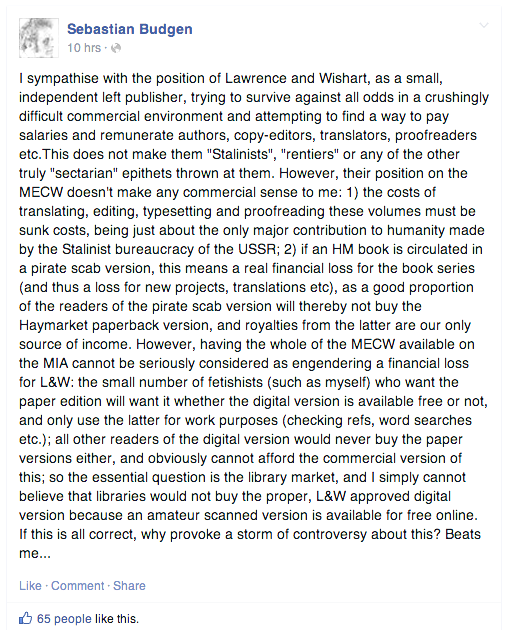
Finally, here is a word from Sebastian Budgen on this. Of course he’s lamely trying to counterbalance his own (very public) condemnation of those who violate copyright for books that he helps put out with the popular public outrage over Lawrence & Wishart demanding the same. He doesn’t fault them in terms of the principle of the matter — nor do I — as I assume he fundamentally agrees with them. Rather, he questions the viability of the demand that the public respect its copyright claim. I agree with him here, but have no clue why he doesn’t apply the same logic to himself.

Sebastian Budgen from Historical Materialism lamely hedges his bets over Lawrence and Wishart

Also, hats off to Doug Henwood for the following hilarious troll. I may have been unfair in characterizing his political stance on electoralism in a previous post; hopefully this maybe forgiven.

Screen shot 2014-04-29 at 3.46.50 PM

Real abstraction: On the use and abuse of an idea

.
The Marxi­an no­tion of “real ab­strac­tion” has garnered a great deal of at­ten­tion in left­ist the­or­et­ic­al circles of late, with some­what mixed res­ults. It was first for­mu­lated and treated sys­tem­at­ic­ally by Al­fred Sohn-Reth­el, an eco­nom­ist as­so­ci­ated with the Frank­furt School of so­cial the­ory. Helmut Reichelt has poin­ted out, however, that the term was used pri­or in a couple in­stances by the Ger­man so­ci­olo­gist Georg Sim­mel (Reichelt, “Marx’s Cri­tique of Eco­nom­ic Cat­egor­ies,” pg. 4). Not­ably, Sim­mel’s us­age oc­curs in con­nec­tion with the “ab­stract value” rep­res­en­ted and meas­ured by money, as that which con­verts qual­it­at­ively in­com­men­sur­able items in­to quant­it­at­ively com­men­sur­able com­mod­it­ies. He writes that “not only the study of the eco­nomy [eco­nom­ics] but the eco­nomy it­self is con­sti­tuted by a real ab­strac­tion from the com­pre­hens­ive real­ity of valu­ations” (Sim­mel, The Philo­sophy of Money, pg. 78).

With Sohn-Reth­el, the ex­pos­i­tion of the concept is much more thor­oughgo­ing. Ac­cord­ing to the defin­i­tion he provides in In­tel­lec­tu­al and Manu­al Labor (1970), “real ab­strac­tion” refers solely to the so­cial re­la­tion­ship of com­mod­ity ex­change, or rather to their ex­change­ab­il­ity as such. The ex­change of com­mod­it­ies, and the ab­stract equi­val­ence on which it is based, does not simply take place with­in the minds of those ex­chan­ging them. It oc­curs at the level of real­ity. Sohn-Reth­el as­serts that “real ab­strac­tion arises in ex­change from the re­cip­roc­al re­la­tion­ship between two com­mod­ity-own­ers and it ap­plies only to this in­ter­re­la­tion­ship” (Sohn-Reth­el, In­tel­lec­tu­al and Manu­al Labor, pg. 69).

Reichelt and oth­ers have noted the im­port­ance of the way this was framed by the crit­ic­al the­or­ist Theodor Ad­orno, one of Sohn-Reth­el’s close friends and cor­res­pond­ents. He re­spon­ded to charges of an overly “ab­stract” con­cep­tu­al­iz­a­tion of so­ci­ety by main­tain­ing that this ab­stract­ness was not in­ven­ted by so­ci­olo­gists, but rather be­longs to the very con­sti­tu­tion of so­cial real­ity. Ad­orno ex­plained:

The ab­strac­tion we are con­cerned with is not one that first came in­to be­ing in the head of a so­ci­olo­gic­al the­or­eti­cian who then offered the some­what flimsy defin­i­tion of so­ci­ety which states that everything relates to everything else. The ab­strac­tion in ques­tion here is really the spe­cif­ic form of the ex­change pro­cess it­self, the un­der­ly­ing so­cial fact through which so­cial­iz­a­tion first comes about. If you want to ex­change two ob­jects and — as is im­plied by the concept of ex­change — if you want to ex­change them in terms of equi­val­ents, and if neither party is to re­ceive more than the oth­er, then the parties must leave aside a cer­tain as­pect of the com­mod­it­ies… In de­veloped so­ci­et­ies… ex­change takes place… through money as the equi­val­ent form. Clas­sic­al [bour­geois] polit­ic­al eco­nomy demon­strated, as did Marx in his turn, that the true unit which stands be­hind money as the equi­val­ent form is the av­er­age ne­ces­sary amount of so­cial labor time, which is mod­i­fied, of course, in keep­ing with the spe­cif­ic so­cial re­la­tion­ships gov­ern­ing the ex­change. In this ex­change in terms of av­er­age so­cial labor time the spe­cif­ic forms of the ob­jects to be ex­changed are ne­ces­sar­ily dis­reg­arded in­stead, they are re­duced to a uni­ver­sal unit. The ab­strac­tion, there­fore, lies not in the thought of the so­ci­olo­gist, but in so­ci­ety it­self. (In­tro­duc­tion to So­ci­ology, pgs. 31-32)

Real ab­strac­tion does not refer to ideo­lo­gies that arise on the basis of ma­ter­i­al ex­change of goods, or the labor pro­cess that al­lows such ex­change in the first place. Of course, Sohn-Reth­el is in­ter­ested in ac­count­ing for “the con­ver­sion of the real ab­strac­tion of ex­change in­to the ideal ab­strac­tion of con­cep­tu­al thought” (Sohn-Reth­el, In­tel­lec­tu­al and Manu­al Labor, pg. 68). But this “con­cep­tu­al ab­strac­tion” or “ideal ab­strac­tion” is clearly de­riv­at­ive, a mir­ror­ing of the ab­strac­tion at work in real­ity it­self at the level of ideas.

For ex­ample, Sohn-Reth­el ex­plains the con­cepts of mod­ern nat­ur­al sci­ence as based upon ideal ab­strac­tions of meas­ur­ab­il­ity and quan­ti­fi­ab­il­ity ap­plied to nature, which them­selves de­rive rather from a so­ci­ety in which a premi­um is already placed upon the meas­ur­ab­il­ity and quan­ti­fi­ab­il­ity of labor. “While the con­cepts of nat­ur­al sci­ence are thought ab­strac­tions,” writes Sohn-Reth­el, “the eco­nom­ic concept of value is a real one” (Sohn-Reth­el, In­tel­lec­tu­al and Manu­al Labor, pg. 20). Even then, however, not every so­cial ideo­logy re­flects this spe­cif­ic real­ity. Nat­ur­al sci­ence is cer­tainly one of the spheres of thought that Sohn-Reth­el seeks to ex­plain with re­course to the real­ity of ab­strac­tion, con­sid­er­ing its fun­da­ment­al con­cepts to be ideal­iz­a­tions of this real­ity. Oth­er ideo­lo­gies cer­tainly can be traced to so­cial and ma­ter­i­al con­di­tions, but not ne­ces­sar­ily to the con­di­tion of real ab­strac­tion.
toscano_fanaticism
.
Al­berto To­scano, a Marxi­an the­or­ist and trans­lat­or of Ba­di­ou, of­fers ex­haust­ive sum­mary of prom­in­ent Marx­ist ac­counts of ab­strac­tion in his art­icle “The Open Secret of Real Ab­strac­tion.” To­scano re­hearses these po­s­i­tions with his usu­al com­pet­ence, but his aims re­main purely ex­eget­ic­al. On the whole, he presents a fairly ser­vice­able ac­count. In his own the­or­et­ic­al work, however, To­scano’s de­ploy­ment of the concept of real ab­strac­tion is rather curi­ous. He in­vokes the concept in his study of Fan­at­icism: On the Uses of an Idea, look­ing to un­der­stand “re­li­gion [it­self] as a real ab­strac­tion” (To­scano, Fan­at­icism, pg. 186). Clearly, if one is op­er­at­ing un­der the defin­i­tion of “real ab­strac­tion” offered above, re­li­gion can­not be con­sidered a real ab­strac­tion since this refers only to ex­change.Some­times To­scano comes a bit closer to the mark, as in his passing re­marks re­gard­ing “Marx’s meth­od­o­lo­gic­al re­volu­tion, his for­mu­la­tion of a his­tor­ic­al-ma­ter­i­al­ist study of so­cial, cul­tur­al, and intellectu­al ab­strac­tions [cor­rect] on the basis of the real ab­strac­tions of the value-form, money, and ab­stract labor” (To­scano, Fan­at­icism, pg. 190). Here the real ab­strac­tion be­longs to ex­change value, money, and ab­stract labor, and not to their ideal re­flec­tions in ideo­logy. But just a few pages pri­or, To­scano states that

Wheth­er we are deal­ing with money or with re­li­gion, the cru­cial er­ror is to treat real ab­strac­tions as mere “ar­bit­rary products” of hu­man re­flec­tion. This was the kind of ex­plan­a­tion fa­vored by the eight­eenth cen­tury: in this way the En­light­en­ment en­deavored…to re­move the ap­pear­ance of strange­ness from the mys­ter­i­ous shapes as­sumed by hu­man re­la­tions whose ori­gins they were un­able to de­cipher.” The strange­ness of re­li­gion can­not be dis­pelled by ascrib­ing it to cler­ic­al con­spir­acies or psy­cho­lo­gic­al de­lu­sions, to be cured through mere ped­agogy. (To­scano, Fan­at­icism, pg. 184)

Go­ing from this, it ap­pears that To­scano groups re­li­gion to­geth­er with money as a form of “real ab­strac­tion.” Money ex­presses real ab­strac­tion in a ma­ter­i­al man­ner by meas­ur­ing the value con­tained in com­mod­it­ies, but re­li­gion does noth­ing re­motely of the sort. To be sure, To­scano is right to in­sist that re­li­gion is not an “ar­bit­rary product of hu­man re­flec­tion.” No ideo­logy is purely ar­bit­rary and ir­ra­tion­al, but is rather based in and ra­tion­ally ex­plic­able through ma­ter­i­al con­di­tions. In oth­er words, the ir­ra­tion­al­ity of re­li­gion is of an ob­ject­ive sort, rooted in ma­ter­i­al con­di­tions that can­not be ex­plained away as mere fantasy or su­per­sti­tion, but which must in­stead be re­vo­lu­tion­ized or ma­ter­i­ally rooted out. Nev­er­the­less, this does not mean that the so­ciohis­tor­ic­ basis on which an ideo­logy arises is ne­ces­sar­ily that of real ab­strac­tion.

This er­ror can be dis­pelled fairly simply, for­tu­nately. Since “real ab­strac­tion” refers ex­clus­ively to the ob­ject­ive real­ity of com­mod­ity ex­change, one can only really speak of ideo­lo­gic­al re­flec­tions of real ab­strac­tion wherever com­mod­ity ex­change has gen­er­ally taken hold. Ideal or con­cep­tu­al ab­strac­tions based on real ab­strac­tion prop­erly ex­ist only in so­ci­et­ies dom­in­ated by the re­la­tion of ex­change. Most will agree that cap­it­al­ism is a re­l­at­ively re­cent phe­nomen­on, dat­ing back only a few cen­tur­ies as a truly glob­al (or glob­al­iz­ing) mode of pro­duc­tion. Re­li­gion, by con­trast, has ex­is­ted for mil­len­nia, since the dawn of hu­man his­tory at least. How could re­li­gion be an ideal­iz­a­tion of real ab­strac­tion, much less a form of real ab­strac­tion it­self, in so­ci­et­ies where com­mod­ity ex­change was not a per­vas­ive real­ity? To­scano’s ac­count of re­li­gion as a “real ab­strac­tion” be­comes in­co­her­ent as soon as one con­cedes these facts.

Per­haps there is some much more ex­pans­ive no­tion of “real ab­strac­tion” de­veloped by Finelli or the oth­er the­or­ists To­scano leans on in Fan­at­icism. But if Sohn-Reth­el’s con­cep­tion is the one he’s work­ing from, his ar­gu­ment doesn’t really work.

Marxism and the unfinished business of philosophy

The Marxist attitude toward philosophy is far more nuanced than Althusser suspects. For the young Marx, the entire goal of historical development was the “immediate realization of philosophy,” or to make the world philosophical. “[A]s the world becomes philosophical,” he explained, “philosophy also becomes worldly.” Philosophy had been consummated in thought with the arrival of Hegel’s philosophy. Now the more pressing task was to bring this philosophy into reality — not by grafting its systematic features onto the world as it is, but by employing its dialectical methodology in order to ruthlessly criticize the world as it is (to invoke Engels’ distinction from Ludwig Feuerbach and the End of Classical German Philosophy). Later Marxists, during the Second International, had very little patience for philosophical questions, preferring to have done with it rather than study its implications. Many of them fell under the sway of fashionable philosophies or intellectual currents from the time, such as Comtean positivism or neo-Kantianism, without even knowing it. Such “eclecticism” was the primary target of Lenin’s 1908 polemic Materialism and Empirio-Criticism, and a decade later the Marxist theorist Georg Lukács would provocatively assert that

[o]rthodox Marxism…does not imply the uncritical acceptance of the results of Marx’s investigations. It is not the “belief” in this or that thesis, nor the exegesis of a “sacred” book. On the contrary, orthodoxy refers exclusively to methodology. It is the scientific conviction that dialectical materialism is the road to truth and that its methods can be developed, expanded and deepened only along the lines laid down by its founders. It is the conviction…that all attempts to surpass or “improve” it have led and must lead to oversimplification, triviality, and eclecticism.

Shortly before his death, Lenin called upon Marxists everywhere to “arrange for the systematic study of Hegelian dialectics from a materialist standpoint, i.e., the dialectics which Marx applied practically in his Capital and in his historical and political works.” This quote soon became the epigraph for Karl Korsch’s Marxism and Philosophy (1923), released the following year. In this work, Korsch argued that Marxists’ general neglect of the philosophical questions that had preoccupied Marx and Engels had allowed a major theoretical conflict brewing within revolutionary Marxism to go unnoticed until it was too late. Lenin was virtually the only exception to this rule. Korsch therefore maintained: “Bourgeois consciousness must be philosophically fought with revolutionary materialistic dialectic, which is the philosophy of the working class. This struggle will only end when the whole of existing society and its economic basis have been totally overthrown in practice, and this consciousness has been totally surpassed and abolished in theory. — ‘Philosophy cannot be abolished without first being realized’.”

Philosophy should have been sublated — simultaneously realized and abolished — during the global conflagration that took place a century ago this year. Because this opportunity came and went without bearing fruit, philosophy lives on in a kind dim afterlife. Or as Adorno put it in Negative Dialectics (1966): “Philosophy, which once seemed obsolete, lives on because the moment to realize it was missed. The summary judgment that it had merely interpreted the world, that resignation in the face of reality had crippled it, becomes a defeatism of reason after the attempt to change the world miscarried.”[1]

Notes


[1] Adorno, Theodor. Negative Dialectics. Translated by E.B. Ashton. (Routledge. New York, NY: 2004). Pg. 3.

A Marxist-feminist critique of intersectionality theory

Eve Mitchell
Unity & Struggle
Sept. 12, 2013

.
Eve Mitchell’s “I Am a Woman and a Human: A Marxist-feminist Critique of Intersectionality Theory” is a rigorous, excellent contribution to the emerging body of leftist literature critical of the sudden adoption of the notion of intersectionality among radicals, cribbed from bourgeois legal theory, postmodern discourse, and Derrick Bell’s critical race theory (CRT). Prior to 2011, intersectonality was seldom addressed, let alone endorsed, by Marxist or socialist theorists. Outside of the academy, the notion had some currency among anarchist and activist circles. (Patricia Hill Collins is a notable exception to this rule). The reasons behind intersectionality’s renewed salience, whether real or imagined, is something I’ve also been interested in lately.

Mitchell’s piece is especially valuable, in my mind, not only in terms of its original argumentation — though she should be praised on this score as well — but in her careful synthesis and application of a number of overlooked theoretical developments that took Marxism, or historical materialism, as a methodological point of departure. For example, Mitchell employs John D’Emilio’s outstanding 1981 article “Capitalism and Gay Identity” to situate identity as a specifically bourgeois category, owing to the rise of the individual as the main economic and political unit of bourgeois subjectivity. D’Emilio’s article is seldom read today, sadly. Second, Mitchell goes over Frantz Fanon’s first major book, Black Skin, White Masks (1952), a work often overshadowed by his later text Wretched of the Earth. A few months ago I posted Sunit Singh’s review of the new translation of this book. Last but not least, she leans on the work of one of the better living Marxist theoreticians, Loren Goldner, a left communist and editor of Insurgent Notes. Goldner appeared on the “Radical Interpretations of the Present Crisis” event in New York, which I moderated.

The one caveat I would perhaps mention is the same as came up in connection with James Heartfield’s piece on “Intersectionality, Or Just Sectarian?” I’ve told James in the past that I disagree with his framing of the humanist/anti-humanist dichotomy, which strikes me as an extremely unhelpful and peculiarly French leftover of debates within Marxism from half a century ago. The proletariat is radical because it takes as its root the self-transformation of humanity itself (“to be radical is to go to the root of things, but for man the root is man”) — a humanity which everywhere remains an ideal and is nowhere yet an accomplished reality. No one is yet human, nor can they be in an inhuman world. Enjoy.
.

I am a woman and a human

.
In the United States, during the late 20th and early 21st centuries, a specific set of politics among the left reigns king. Today, you could go into any university, on any number of liberal-to-left blogs or news websites, and the words “identity” and “intersectionality” will jump out you as the hegemonic theory. But, like all theories, this corresponds to the activity of the working class in response to the current composition of capital. Theory is not some cloud that floats above the class, raining down thoughts and ideas, but, as Raya Dunayevskaya writes,”the actions of the proletariat create the possibility for the intellectual to work out theory” (Marxism and Freedom, 91). Therefore, in order to understand the dominant theories of our age, we must understand the real movement of the class. In this piece, I will look at the history of identity politics and intersectionality theory in effort to construct a Marxist critique of intersectionality theory, and a offer positive Marxist conception of feminism.

Detail of ancient Greek cup with two athletes wrestling, by Epictetos

Detail of ancient Greek cup with two athletes wrestling, by Epictetos

The context for “identity” and “intersectionality theory”

.
In order to understand “identity” and “intersectionality theory,” we must have an understanding of the movement of capital (meaning the total social relations of production in this current mode of production) that led to their development in the 1960s and 1970s in the US. More specifically, since “intersectionality theory” primarily developed in response to second wave feminism, we must look at how gender relations under capitalism developed. In the movement from feudalism to capitalism, the gendered division of labor, and therefore gender relations within the class began to take a new form that corresponded to the needs of capital. Some of these new relations included the following:

(1) The development of the wage. The wage is the capitalist form of coercion. As Maria Mies explains in her book, Patriarchy and Accumulation on a World Scale, the wage replaced serf and slave ownership as the method to coerce alienated labor (meaning labor that the worker does for someone else). Under capitalism, those who produce (workers) do not own the means of production, so they must go to work for those who own the means of production (capitalists). Workers must therefore sell the only thing they own, their ability to labor, or their labor power, to the capitalist. This is key because workers are not paid for their sensuous living labor, the act of producing, but the ability to labor. The labor-labor power split gives rise to the appearance of an equal exchange of value; it appears as though the worker is paid for the amount of value she produces but in essence she is paid only for her ability to labor for a given period of time.

Furthermore, the working day itself is split into two parts: necessary labor time and surplus labor time. Necessary labor time is the time it takes the worker (on average) to produce enough value to buy all the commodities he needs to reproduce himself (everything from his dinner to his iPhone). Surplus labor time is the time the worker works beyond the necessary labor time. Since the going rate for labor power (again, our capacity to labor — not our actual living labor) is the value of all the commodities the worker needs to reproduce herself, surplus labor is value that goes straight into the capitalist’s pocket. For example, let’s say I work in a Furby factory. I get paid $10 a day to work 10 hours, I produce 10 Furbies a day, and a Furby is worth $10 each. The capitalist is only paying me for my ability to work 1 hour each day to produce enough value to reproduce myself (1 Furby = 1 hour’s labor = $10). So my necessary labor time is 1 hour, and the surplus labor time I give to the capitalist is 9 hours (10-1). The wage obscures this fact. Recall that under capitalism, it appears as though we are paid the equivalent value of what we produce. But, in essence, we are paid only for our necessary labor time, or the minimum amount we need to reproduce ourselves. This was different under feudalism when it was very clear how much time humans spent working for themselves, and how much time they spent working for someone else. For example, a serf might spend five hours a week tilling the land to produce food for the feudal lord, and the rest of her time was her own. The development of the wage is key because it enforced a gendered division of labor. Continue reading

Il'ia Chashnik, Kosmos (1925)

Studies on hysterical materialism

Three essays

Untitled.
Image: Il’ia Chashnik,
Kosmos (1925)

untitled2
.

A brief overview of the recent series on hysterical materialism: its etiology, pathology, symptomology. Needless to say, these three studies represent a major contribution to the field of medical Marxism, and should aid in the production of new vaccines, remedies, and prophylactic techniques for the treatment (and prevention) of materialist hysteria.

Also, note well:

Masturbation is to eros what suicide is to thanatos.

Enjoy. Continue reading