The dreamer in the Kremlin

HG Wells interviews Lenin, 1920

.

From Russia in the Shadows (1921)

My chief purpose in going from Petersburg to Moscow was to see and talk to Lenin. I was very curious to see him, and I was disposed to be hostile to him. I encountered a personality entirely different from anything I had expected to meet.

Lenin is not a writer; his published work does not express him. The shrill little pamphlets and papers issued from Moscow in his name, full of misconceptions of the labor psychology of the West and obstinately defensive of the impossible proposition that it is the prophesied Marxist social revolution which has happened in Russia, display hardly anything of the real Lenin mentality as I encountered it. Occasionally there are gleams of an inspired shrewdness, but for the rest these publications do no more than rehearse the set ideas and phrases of doctrinaire Marxism.

Perhaps that is necessary. That may be the only language Communism understands; a break into a new dialect would be disturbing and demoralizing. Left Communism is the backbone of Russia today; unhappily it is a backbone without flexible joints, a backbone that can be bent only with· the utmost difficulty and which must be bent by means of flattery and deference.

Moscow under the bright October sunshine, amidst the fluttering yellow leaves, impressed us as being altogether more lax and animated than Petersburg. There is much more movement of people, more trading, and a comparative plenty of droshkys. Markets are open. There is not the same general ruination of streets and houses. There are, it is true, many traces of the desperate street fighting of early 1918. One of the domes of that absurd cathedral of St. Basil Just outside the Kremlin gate was smashed by a shell and still awaits repair. The tramcars we found were not carrying passengers; they were being used for the transport of supplies of food and fuel. In these matters Petersburg claims no be better prepared than Moscow.

The ten thousand crosses of Moscow still glitter in the afternoon. On one conspicuous pinnacle of the Kremlin the imperial eagles spread their wings; the Bolshevik Government has been too busy. or too indifferent to pull them down. The churches are open, the kissing of ikons is a flourishing industry, and beggars still woo casual charity at the doors. The celebrated miraculous shrine of the Iberian Madonna outside the Redeemer Gate was particularly busy. There were many peasant women, unable to get into the little chapel, kissing the stones outside. Just opposite to it, on a plaster panel on a house front, is that now celebrated inscription put up by one of the early revolutionary administrations in Moscow: “Religion is the Opium.” The effect this inscription produces is greatly reduced by the fact that in Russia the people cannot read.

About that inscription I had a slight but amusing argument with Mr. Vanderlip, the American financier, who was lodged in the same guest house as ourselves. He wanted to have it effaced. I was for retaining it as being historically interesting, and because I think that religious toleration should extend to atheists. But Mr. Vanderlip felt too strongly to see the point of that.

The Moscow Guest House, which we shared with Mr. Vanderlip and an adventurous English artist who had somehow got through to Moscow to execute busts of Lenin and Trotsky, was a big, richly-furnished house upon the Sofiskaia Naberezhnaia (No. 17), directly facing the great wall of the Kremlin and all the clustering domes and pinnacles of that imperial inner city. We felt much less free and more secluded here than in Petersburg.

There were sentinels at the gates to protect us from casual visitors, whereas in Petersburg all sorts of unauthorized persons could and did stray in to talk to me. Mr. Vanderlip had been staying here, I gathered, for some weeks, and proposed to stay some weeks more. He was without valet, secretary, or interpreter. He did not discuss his business with me beyond telling me rather carefully once or twice that it was strictly financial and commercial and in no sense political. I was told that he had brought credentials from Senator Harding to Lenin, but I am temperamentally incurious and I made no attempt whatever to verify this statement or to pry into Mr. Vanderlip’s affairs. I did not even ask how it could be possible to conduct business or financial operations in a Communist State with anyone but the Government, nor how it was possible to deal with a Government upon strictly nonpolitical lines. These were, I admitted, mysteries beyond my understanding. But we ate smoked, drank our coffee and conversed together in an atmosphere of profound discretion. By not mentioning Mr. Vanderlip’s “mission,” we made it a portentous, omnipresent fact.

The arrangements leading up to my meeting with Lenin were tedious and irritating, but at last I found myself under way for the Kremlin in the company of Mr. Rothstein, formerly a figure in London Communist circles, and an American comrade with a large camera who was also, I gathered, an official of the Russian Foreign Office.

The Kremlin as I remembered it in 1914 was a very open place, open much as Windsor Castle is, with a thin trickle of pilgrims and tourists in groups and couples flowing through it. But now it is closed up and difficult of access. There was a great pother with passes and permits before we could get through even the outer gates. And we filtered and inspected through five or six rooms of clerks and sentinels before we got into the presence. This may be necessary for the personal security of Lenin, but it puts him out of reach of Russia, and, what perhaps is more serious, if there is to be an effectual dictatorship, it puts Russia out of his reach. If things must filter up to him, they must also filter down, and they may undergo very considerable changes in the process.

We got to Lenin at last and found him, a little figure at a great desk in a well-lit room that looked out upon palatial spaces. I thought his desk was rather in a litter. I sat down on a chair at a comer of the desk, and the little man — his feet scarcely touch the ground as he sits on the edge of his chair — twisted round to talk to me, putting his arms round and over a pile of papers. He spoke excellent English, but it was, I thought, rather characteristic of the present condition of Russian affairs that Mr. Rothstein chaperoned the conversation, occasionally offering footnotes and other assistance. Meanwhile the American got to work with his camera, and unobtrusively but persistently exposed plates.

The talk, however, was too interesting for that to be an annoyance. One forgot about that clicking and shifting about quite soon.

I had come expecting to struggle with a doctrinaire Marxist. I found nothing of the sort. I had been told that Lenin lectured people; he certainly did not do so on this occasion. Much has been made of his laugh in the descriptions, a laugh which is said to be pleasing at first and afterwards to become cynical. This laugh was not in evidence. His forehead reminded me of someone else — could not remember who it was, until the other evening I saw Mr. Arthur Balfour sitting and talking under a shaded light. It is exactly the same domed, slightly one-sided cranium. Lenin has a pleasant, quick-changing, brownish face, with a lively smile and a habit (due perhaps to some defect in focusing) of screwing up one eye as he pauses in his talk; he is not very like the photographs you see of him because he is one of those people whose change of expression is more important than their features; he gesticulated a little with his hands over the heaped papers as he talked, and he talked quickly, very keen on his subject, without any pose or pretenses or reservations, as a good type of scientific man will talk.

Our talk was threaded throughout and held together by two — what shall I call them — motifs. One was from me to him: “What do you think you are making of Russia? What is the state you are trying to create?” The other was from him to me: ‘Why does not the social revolution begin in England? Why do you not work for the social revolution? Why are you not destroying Capitalism and establishing the Communist State?” These motifs interwove, reacted on each other, illuminated each other. The second brought back the first: “But what are you making of the social revolution? Are you making a success of it?”

And from that we got back to two again with: “To make it a success the Western world must join in.” Continue reading

The Sociohistoric Mission of Modern Architecture

A Platypus teach-in by Ross Wolfe and Sammy Medina meant to explore some issues connected to the “Ruins of Modernity: The failure of revolutionary architecture in the 20th century,” an upcoming panel event at NYU featuring Peter Eisenman, Reinhold Martin, Joan Ockman, and (hopefully) Bernard Tschumi.

This presentation will touch on modernist architecture’s attempt to address problems like the housing shortage, the poor living conditions of the urban proletariat, and the liberation of woman from domestic slavery. Approaches to homelessness past and present: the 1920s-1930s Social-Democratic utopia of the Siedlung vs. the 1990s-2000s anarchist utopia of the Squat. Housing the unemployed and underemployed — the so-called “reserve army of labor” or “surplus population” — from the sotsgorod to Occupy Your Home.

A room, or perhaps a “pod,” of one’s own, and its importance for modern bourgeois subjectivity. Annihilating the antithesis between town and country (Karl Marx, Ebenezer Howard, Mikhail Okhitovich), the absurdity of the nuptial bed (Karel Teige), the city of children (Leonid Sabsovich), and the creation of a hermaphroditic humanity (El Lissitzky).

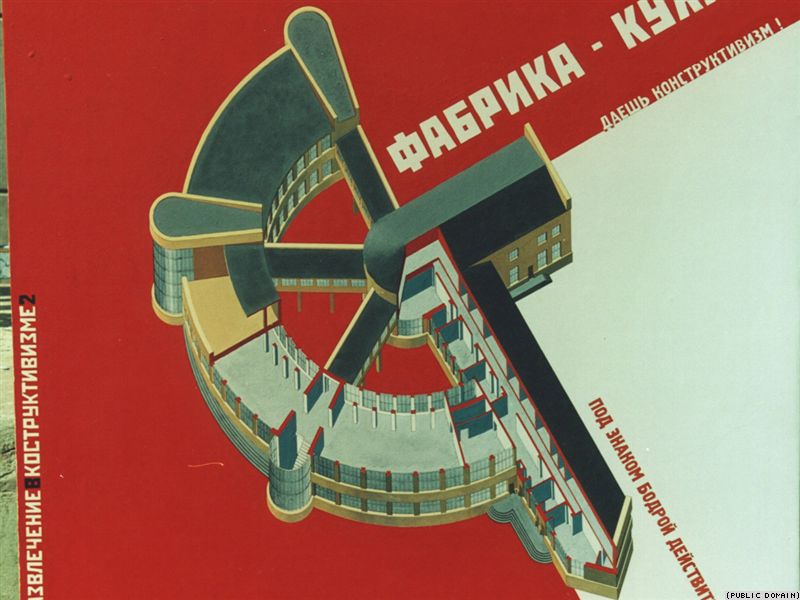
Kitchen factory, 1928

Kitchen factory, 1928

Concluding (un)pedantic post-script

.
So in the follow-up to the little feud concerning my response to his review of Lincoln, Aaron Bady grew quite upset. Now, I’ve been quite up front about the fact that I’m not myself a specialist on nineteenth-century US history. What little I do know has been mostly cobbled together from introductory texts on the subject in high school and college, Lenin’s detailed study comparing the Southern slave system to serfdom in Russia, and then from numerous conversations with friends who actually are studying the subject for their doctoral research. Despite these numerous disclaimers, Bady insisted that I was “hiding behind someone else” and didn’t know what I was talking about.

More specifically, he wrote:

Aaron Bady: [C]alling Abraham Lincoln an abolitionist is wrong; he was against slavery, but he wasn’t an abolitionist. Someone who knew what they were talking about would know the difference.

This tactic is rather old hat, trying to intimidate potential critics by invoking supposedly hard-and-fast technicalities about the correct usage of terms. The takeaway from this lesson is supposed to be “Wow, this guy is obviously a specialist. I’m not; I don’t even know the most basic nomenclature! I’d better lay off, lest I put my foot in my mouth again.”

Just to hammer this point home, Bady took it further by repeating the procedure a second time:

Aaron Bady: Do you literally not know what Abolitionist means? It doesn’t mean “opposed to slavery.” “Moderate abolitionist” isn’t a thing. Like the vast majority of northern whites, Lincoln spent his life adhering to the free labor principles of Henry Clay, a near majority position that was NOT the same thing as abolitionist. To use the word in its actual meaning, abolitionist means abolishing slavery now, which was a minority position.

Turns out I wasn’t the only one who noticed him trying to give me the rhetorical runaround. There was another discussant in the thread who was wise to this schtick, who messaged me writing:

Unnamed Discussant: Wow, this Aaron Bady guy is a knob. Never had a new social historian pull the “I’m an authority on this, peasant” on me before.

I suppose there’s a first time for everything. Continue reading

Against what radicals?

A critical response to Aaron Bady’s
Lincoln review in Jacobin

Abraham Lincoln will take no step backward. His word has gone out over the country and the world, giving joy and gladness to the friends of freedom and progress wherever those words are read, and he will stand by them, and carry them out to the letter.

— Frederick Douglass, “Emancipation Proclaimed” (October 1862)

President Lincoln,

We congratulate the American people upon your re-election by a large majority. If resistance to the Slave Power was the reserved watchword of your first election, the triumphant war cry of your re-election is Death to Slavery.

From the commencement of the titanic American strife the workingmen of Europe felt instinctively that the star-spangled banner carried the destiny of their class. The contest for the territories which opened the dire epopee, was it not to decide whether the virgin soil of immense tracts should be wedded to the labor of the emigrant or prostituted by the tramp of the slave driver?

The workingmen of Europe feel sure that, as the American War of Independence initiated a new era of ascendancy for the middle class, so the American Antislavery War will do for the working classes. They consider it an earnest of the epoch to come that it fell to the lot of Abraham Lincoln, the single-minded son of the working class, to lead his country through the matchless struggle for the rescue of an enchained race and the reconstruction of a social world.

— Karl Marx, “Letter to Abraham Lincoln” (1865)

Marx did not, of course, consider Abraham Lincoln a communist; this did not, however, prevent Marx from entertaining the deepest sympathy for the struggle that Lincoln headed. The First International sent the Civil War president a message of greeting, and Lincoln in his answer greatly appreciated this moral support.

— Leon Trotskii, “Mexico and Imperialism” (1938)

Aaron Bady, a student at UC Berkeley, recently contributed a review of the Spielberg-Kushner blockbuster Lincoln to Jacobin‘s online blog. One of the sad consequences of hanging around people who work extensively on the history of the antebellum US, as well as the Civil War and Reconstruction periods, and the Marxist historiography thereof (the various accounts given it by Marx, Lenin, and the young Genovese, to name a few), is that I can’t help but roll my eyes at the pseudo-radicalism evinced by reviews like this.

They either distort facts about the history or rely on lazy New Left tropes about how it’s all just a plot to aggrandize whitey and reassert the gratitude of the oppressed to their former oppressors, who awoke one morning and beneficently decided to liberate them. It ultimately boils down to this dreary, cloying, and by now insufferable Alltagsgeschichte point about the need to write history “from below” as opposed to history “from above” — a false dichotomy if ever there was one. Even then, the article requires extremely tendentious readings of more serious historians like Eric Foner or Robin Blackburn to sustain it.

Communist Party USA meeting in Chicago, 1939: Even the Stalinists had better historical consciousness

Communist Party USA meeting in Chicago, 1939: Even the Stalinists had better historical consciousness

Despite the not insignificant role of newly-freed blacks serving in the Union military, as well as by slaves taking it upon themselves to cast off the yoke of their masters, general emancipation certainly would not have come about were it not for the bloody, protracted, armed struggle of Northern armies against the forces of the South. The collapse of the plantation system of slavery in the South was hardly inevitable; it cannot be chalked up to the struggle of the enthralled on the basis of any sort of “inherent” freedom or dignity that they had hitherto been denied. Bady does not deny wholesale the historical importance of such acts as the Emancipation Proclamation, but he does seem to suggest that their importance was purely rhetorical or symbolic (i.e., not political). When a Frenchman of Engels’ acquaintance sought to dismiss Lincoln’s address on these grounds, Marx’s reply was brief but devastating:

The fury with which the Southerners are greeting Lincoln’s acts is proof of the importance of these measures. Lincoln’s acts all have the appearance of inflexible, clause-ridden conditions communicated by a lawyer to his opposite number. This does not, however, impair their historical import and does, in actual fact, amuse me when, on the other hand, I consider the drapery in which your Frenchman enwraps the merest trifle.

New Leftism dies hard.

Critics like Bady would like to see a more “representative” sample set, which in the end amounts to nothing more than superficial pandering to ideas about political correctness that may be even more shallow, all accomplished through nauseatingly ostentatious displays of “diversity.” It’s the most disgusting, condescending tokenism dressed up as somehow vaguely radical. In reality, of course, it’s just the old, preening liberal commonplace about the way minorities are underrepresented in Hollywood.

If nothing else, this review provides still more proof that a movie (or work of art, or piece of music, or whatever) can be bad/boring and yet the reviews criticizing it can outdo it in their utter banality.

Alexander Hesler (Springfield, Illinois): Abraham Lincoln; Albumen print, 6.5 x 8.5 inches (1860)

But there’s a deeper political subtext at work in Brady’s review. It comes through in lines like these:

[G]etting the radicals in line is important in the political arena because it allows moderates like Lincoln or Obama to operate through consensus.

As Chris Cutrone has pointed out, Obama’s not a compromiser. Obama doesn’t even have principles to compromise. Nor is he a “moderate,” whatever that might mean today. To contrast:

1. Obama’s a right-wing politician who has to this point failed to implement his right-wing political agenda.
2. Lincoln was a moderate Abolitionist who succeeded in abolishing slavery. 

Yes, Reconstruction failed, and blacks in America were by no means in the clear. But Lincoln built his career in the aftermath of the Dred Scott decision, and was a firm abolitionist throughout. He was often a reluctant actor, and his hand was forced by History itself, but Marx and the First International in general (both socialists and anarchists) were absolutely right to celebrate him.

In terms of “getting the radicals in line,” who does Obama have to “get in line” who’s a radical? Nancy Pelosi? You think he gives a damn about the DSA or the other lite-lefty groups that groveled in support of him around the election? Lincoln had Thaddeus Stevens running the House of Representatives to deal with. Stevens’ radicalism and outright bellicosity would have scared even the most leftish Obamaites of today into reaction. The same goes with Frederick Douglass, who while not a member of government was a public intellectual figure whose standing far exceeds that of any US leftist of recent memory. And that’s to say nothing of Robert Gould Shaw, who led the black regiment portrayed in the film Glory in the charge on Battery Wagner (in which he perished), who was a fanatical supporter of Lincoln. There’s nothing even remotely equivalent for Obama.

Ultimately, viewing Obama as a “compromiser” who has to “get radicals in line” strikes me as the opinion of someone who actually thinks that Obama and the Dems are salvageable. The person who wrote this is simply vying for a place within the Democratic Party — i.e., as one of the so-called “radicals.” If Spielberg and Kushner (neither of whom I exactly like, for the record) wanted to make a misguided comparison of Obama to Lincoln, then the author of this review tacitly accepted this comparison — and tried to elevate himself to the rank of a “radical” opposition member within the President’s party. In other words: someone whose position carries real political weight, whose opinions Obama might actually have to take into consideration before starting his next war.

The “arkhitektons” and “planets” of Suprematism

Kazimir Malevich, Nikolai Suetin,
and Il’ia Chashnik, 
with an
article by Aleksei Gan

Extracts from SA, 1927
(no. 3, pgs. 104-106)

During recent years comrade Malevich has worked exclusively in the field of volumetric Suprematist compositions, on problems of the volumetric and spatial forms of material masses. This is somewhat related to the tasks facing creators of modern architecture.

Malevich works intuitively…His experience is not organized by consciousness…So while volumetric Suprematism does not yield objects of that concrete social utility without which modern architecture is not architecture at all, they have vast importance as abstract research of new form, as such.

Kazimir Malevich does not accept either [Rationalism or Constructivism]. He pursues his own “purely suprematist” path, on the principle of its “primacy” or “superiority” [pervenstvo]. What then is Suprematist architecture? It is “the primacy of volumetric masses and their spatial solution in consideration of weight, speed, and direction of movement.”

True, this metaphysical formulation does not yield much, to put it mildly, to an intellect thinking materialistically. But Malevich does not only speak, he does, and what Malevich does, we repeat, has great psychological importance. In his new Suprematist volumes and volumetric combinations there is not the smallest particle of atavism.

This is where Suprematist studies can be very important. They could be very beneficially introduced into the Basic Course of the VKhUTEMAS, in parallel to those exercises currently conducted under the influence of the psychologist [Hugo] Münsterberg’s Harvard Laboratory.

The novelty, purity, and originality of abstract Suprematism fosters a new psychology of perception. This is where Malevich’s great contribution will lie.

Video from Radical Interpretations of the Present Crisis [11.14.2012]

[vimeo http://vimeo.com/53579139]

A panel event held at the New School in New York City on November 14th, 2012.

Loren Goldner ┇ David Harvey ┇ Andrew Kliman ┇ Paul Mattick

What does it meant to interpret the world without being able to change it?

Featuring:

• LOREN GOLDNER

// Chief Editor of Insurgent Notes; ┇ Author: — Ubu Saved From Drowning: Class Struggle and Statist Containment in Portugal and Spain, 1974-1977 (2000), — “The Sky Is Always Darkest Just Before the Dawn: Class Struggle in the U.S. From the 2008 Crash to the Eve of Occupy” (2011)

• DAVID HARVEY

// Distinguished Professor of Anthropology and Geography at the CUNY Grad Center; ┇ Author: — The Condition of Postmodernity (1989), — A Brief History of Neoliberalism (2005), — “Why the US Stimulus Package is Bound to Fail” (2008) — The Enigma of Capitalism (2010)

• ANDREW KLIMAN

// Professor of Economics at Pace University; ┇ Contributing author to the Marxist-Humanist Initiative’s (MHI’s) With Sober Senses since 2009; ┇ Author: — Reclaiming Marx’s “Capital”: A Refutation of the Myth of Inconsistency (2007), — The Failure of Capitalist Production: Underlying Causes of the “Great Recession” (2012)

• PAUL MATTICK

// Chair of the Department of Philosophy at Adelphi University; ┇ Contributor to The Brooklyn Rail ┇ Author: — Social Knowledge: An Essay on the Nature and Limits of Social Science (1986), — Business as Usual: The Economic Crisis and the Failure of Capitalism (2011)

Le Corbusier in the USSR (1928-1931)

Moscow is a factory for making plans, the Promised Land of technicians (without a Klondike).  The country is being equipped!

— Le Corbusier, “The Atmosphere of Moscow” (1930)

This post includes pictures of Le Corbusier traveling in the USSR, attending conferences, building sites, and on one of Eisenstein’s movie sets (for The Old and the New).

.

On the Crisis

Some questions

Untitled.

.
Do we live in a crisis today? If so, what sort of crisis — political? economic? social?

If several simultaneously, how do these crises interrelate?

In other words, what effect does the present global economic downturn have on prospects for politicization? If it results in political radicalization, does it tend toward the Right or toward the Left?

Oppositely, does the absence of a viable leftist alternative today change the character of the social or economic crisis?

What sort of social consequences has the economic crisis generated, in terms of classes? Why the discourse (ideology) of “the disappearing middle class”? At a political level, has this social upheaval led to anything in the way of a renewed “class consciousness”? Is class still even important?

How does the present crisis operate (unfold) in terms of time and space?

How does the present crisis relate to past crises of capital? How is it the same? How is it different?

What is the duration of the present crisis? Is recovery on the horizon? Is there an end in sight? Or are we witnessing, as Marxian economists like Bertell Ollman and Immanuel Wallerstein have contended, the “terminal crisis” of capitalism? If not the end of capitalism as such, does the present crisis at least signal an end to neoliberalism? If so, what is the character of the transition? Does neoliberalism (post-Fordism) revert to a neo-Fordist configuration, or something else? Can the outcome of the this crisis be understood to entail “progress” or “regress”?

How does the crisis in North America since the subprime mortgage crisis of 2008 relate to the sovereign debt crisis in the Eurozone since 2010? Are these crises at all related to the wave of political revolutions of the Arab Spring?

What is the extent of the present crisis? How has it been distributed spatially? Unevenly? What does globalization look like during a time of prolonged crisis? Is the era of US hegemony at a close? If so, to where does the locus of geopolitical power now shift? (China? Russia? India?)

Do different interpretations of the crisis really recommend different political strategies?

What are the political stakes of the perennial Marxist debates about crisis or the trajectory of capitalist development? What are the ramifications of disputes over the immiseration thesis, the falling rate of profit, the validity of the labor theory of value, and overproduction vs. underconsumption as the underlying catalyst of capitalist crisis?

Do different methods and analyses of social/economic crisis imply different modes of political organization and mobilization? If so, what sorts of differences?

If not, what is the significance of this fact? What would it mean to say that two interpreters of the crisis might disagree substantially over its root causes and ultimate effects but offer identical political solutions? What would it take to make these disagreements meaningful at a political level again?

What does it mean to interpret the world without being able to change it?

Why do the most sophisticated leftist understandings of the world appear unable to assist in the task of changing it? Conversely, can the world be thought intelligible without our capacity to self-consciously transform it through practice?

Can society — the capitalist social formation — be understood as an entirely objective phenomenon, without ever producing a subject capable of intervening in its processes? Does capitalism still make sense as a pure “structure” or system devoid of human agency?

Can Marxism survive as an economics or social theory without politics? Does it continue to exist as simply one “lens” or “perspective” amongst others? Should the intractability of the current social, political, and economic crisis not result in a crisis within Marxian economics or social theory as a discipline?

Interview conducted by C. Derick Varn with Jamieson Webster on Badiou, psychoanalysis, and the impossibility of closure

This interview was originally posted by C. Derick Varn at his blog, The (Dis)Loyal Opposition to Modernity.  Visit his site to read a number of other interesting posts and interviews.

Jamieson Webster, PhD, is a psychoanalyst in New York City. She teaches at Eugene Lang College and New York University. Her work focuses on clinical and theoretical psychoanalysis with an interdisciplinary focus on feminine sexuality, philosophy, and aesthetics. Her recent book Life and Death of Psychoanalysis has been on my radar for a while, and I was particularly intrigued by her critique of Adorno and her use/critique/admiration for Badiou.  We discussed Badiou and the state of psychoanalysis in the current. 

C. Derick Varn: In reading your Life and Death of Psychoanalysis, I noticed you spend a lot of time on the way in which Badiou enabled you to think about Lacan in a broader sense and broaden a since of inquiry in psychoanalysis.  Do you think Badiou has any implications for psychoanalytic practice that are unique to him?

Jamieson Webster: I do think that Badiou has implications for psychoanalytic practice that are unique to him. I’m happy that you see that I wanted to convey what Badiou opens up through his work with Lacan and that he enables something in particular for the practicing analyst. I’m hard on Badiou in the last part of the book. One must always be hard on one’s masters. But I certainly feel guilty about it from time to time and wonder if people can see how I only take apart the one’s I love. Badiou showed me a side of Lacan that was important in ways that I hope we can talk about. And he has an unprecedented, inimitable, at times even uncanny ability to clarify whole trajectories of thought. It is unbelievable what he is able to do in such broad strokes. It is not only Lacan —  but of course Lacan for me as a psychoanalyst is the most important — but Deleuze, Sartre, Beckett, Hegel, Marx, Plato, that he contextualizes in terms of the rigor of their philosophical, literary or political projects. Where they stand in relation to the question of truth. It is hard to pull back and get an overview — and I know this is something that I’ve faulted him for from one angle, too much distance— but he gives you this glimpse of the entire philosophical project at the same time that he treats these various constellations with respect and due diligence. He gets in trouble for this systematizing, and not only by me. The Deleuzians were out for blood I hear. But I’ve never been able to see Deleuze’s project so clearly before reading The Clamour of Being. What a great title?

But I’ve evaded your question. As far as clinical practice goes, there was something about Badiou’s notion of the event, the distinction between being and event, and the quality of the event as an event of absolute affirmation in its contingent, subjectivizing, historicity, that hit me like a flash of lightning. That this is what we, as psychoanalysts, listen for day after day. This is what we wait for, silence after silence. And it wasn’t merely as a characterization of what the unconscious event is that this made such an impact, it was also in terms of what I was missing in most of the other philosophies that I was reading at the time, perhaps notably in terms of The Life and Death of Psychoanalysis, in critical theory. I can see lineaments of the event in the thought of Adorno or Benjamin now, but not before having read Badiou, because their work is wrapped in too much negativity and indebtedness to dialectical thinking. The event is a radical break from both, the result of being able to maintain the tension of negativity and dialectical movement, but something that crashes through what I characterize as a kind of melancholic pathos in post-World-War-II philosophy. The event cuts through aporia, dialectical impasse, and infinite regress. It is ephemeral, it doesn’t last, but it has this cutting edge. As a practicing analyst, this is certainly something we face everyday and the work of the analyst is supposed to have the same impact- a cut, punctuation, words stopping you in your tracks, facing up to a truth that surprises and even startles. Important as well, the event is not a moment of synthesis but rather the emergence of something new. While there are syncretic or synthetic aspects to the event, I think Badiou’s stress on newness and the unforeseeable is important for the practicing clinician. Badiou does not emphasize understanding or knowledge, he does not emphasize synthetic-adaptive solutions to conflict or opposing positions (what analysts sometimes call the third). He emphasizes what I think of as closer to the emergence of a signifier from the unconscious, which is closer to a point of non-meaning or the reduction of meaning. The ground is cleared enough for something new to break in and shift ways of understanding, habitual conflicts, and seeming oppositions. And he not only theorizes the event as I’ve just characterized it, he practices it to my mind in his countless books which indeed shake you up and clear the ground.

Also important for a psychoanalyst — Badiou understands something powerful about love, something that I think I wanted psychoanalysis to have something to say about, but often couldn’t find, and I was floundering around, looking for a way out of the impasse of desire and love that Freud characterized so well. Badiou understands what it means to speak from the place of what he calls the event of love, the affirmation of the impossibility of two, making love this force of desire in the face of the ephemeral nature of love, an act of radical faith. Certainly, as an analyst, I also immediately hear the implications of transference. Serge Leclaire — Lacan’s disciple — said the analyst is someone in the difficult place of welcoming, even inviting, words of love from their patients but who must find a way not to deny them but also not to gratify them, allowing them to be spoken, which painfully, even tragically, only makes the difficulty of saying or having said, even worse — its only ever words.

You can see this clearly in Badiou’s reading of Beckett. He always quotes two sets of passages. One from the beginning and end of, Ill Said, Ill Seen, and another from the end of Beckett’s short story,Enough. The first, he says, is one of the most beautiful texts in French and captures the beauty of a kind of feminine abjection and the easing of that misfortune in the momentary acceptance of the void,

From where she lies she sees Venus rise. On. From where she lies when the skies are clear she sees Venus rise followed by the sun. Then she rails at the source of all life. On. At evening when the skies are clear she savours its star’s revenge. At the other window. Rigid upright on her old chair. It emerges from out the last rays and sinking ever brighter is engulfed in its turn. On. She sits on erect and rigid in the deepening gloom. Such helplessness to move she cannot help. Heading on foot for a particular point often she freezes on the way. Unable till long after to move on not knowing whither or for what purpose. Down on her knees especially she finds it hard not to remain so forever. Hand resting on hand on some convenient support. Such as the foot of her bed. And on them her head. There then she sits as though turned to stone face to the night. Save for the white of her hair and faintly bluish white of face and hands all is black. For an eye having no need of light to see. All this in the present as had she the misfortune to be still of this world.

And then,

Decision no sooner reached or rather long after than what is the wrong word? For the last time at last for to end yet again what the wrong word? Than revoked. No but slowly dispelled a little very little like the wisps of day when the curtain closes. Of itself by slow millimetres or drawn by a phantom hand. Farewell to farewell. Then in that perfect dark foreknell darling sound pip for end begun. First last moment. Grant only enough remain to devour all . Moment by glutton moment. Sky, earth, the whole kit and boodle. Not another crumb of carrion left. Lick chops and basta. No. One moment more. One last. Grace to breathe that void. Know happiness.

And from, Enough,

This notion of calm comes from him. Without him I would not have had it. Now I’ll wipe out everything but the flowers. No more rain. No more mounds. Nothing but the two of us dragging through the flowers. Enough my old breasts feel his old hand.

Badiou constanly turns back to these quotations, and if you know his voice, he reads them to you like a lullaby. Such helplessness to move she cannot help. On… One last. Grace to breathe that void… I’ll wipe out everything but the flowers… Enough. Love is not sentimental piety, it is not symbiotic sublime union, it is not utilitarian contractual relations, it is something closer to what Beckett is able to evoke… continuing on despite impossibility, an affirmation of absolute helplessness, dejection sometimes, and yet, miraculously, momentary affirmation, the arousal of a void that brings grace, truth, encounter, and love that drags and grows old, and only when everything has been wiped out, is it finally enough. Maybe I take things too far, but I think you can see in this the profound passage of the analysand in analysis. Continue reading

21st century social-democracy? On Bhaskar Sunkara and Peter Frase’s “The Welfare State of America” and the election

The Welfare State

Bhaskar Sunkara and Peter Frase of Jacobin recently co-authored a social democratic manifesto entitled “The Welfare State of America,” in which they conclude:

THE ROAD TO SOCIAL DEMOCRACY

The Left must not only defeat austerity and preserve the social safety net; it must do so in such a way that assembles the forces necessary for more fundamental transformations in the future.

This vision should be premeditated. We can’t go back to the post-war golden age of the American welfare state, but we can build a system in the 21st century that embodies what people remember most from that era — an overriding sense of freedom. Freedom to give their children an education without rival. Freedom from poverty, hunger, and homelessness. Freedom to grow into old age with pensions, Social Security, and affordable and accessible healthcare. Freedom to leave an exploitative work environment and find another job. Freedom to organize with fellow workers for redress.

These memories are somewhat false ones: The welfare state has never been so universal. But the appeal of such a society, combined with the political strategy needed to make it a reality, will pave the way for the institution of a new set of economic and social rights to complement our bedrock political and civil rights.

Ugh.  From Chavez’s “21st-century socialism” to Sunkara and Frase’s “21st-century social-democracy.”  Not to mention the fetishization of the welfare state, and its national(ist) specification to “of America.”

Obviously I oppose the austerity-mongering politics of neoliberalism.  Equally obvious should be that I’m not as optimistic as Bhaskar or Peter about the prospects of social democracy repackaged for a new century.  They make the salutary concession that the welfare state was never universal, that the New Deal coexisted with brutal and demeaning Jim Crow laws.  But I don’t really view a reformist platform as any more viable in the present than a revolutionary platform.  Reformism and revolutionism seem equally utopian today (and I would say that their apparently equidistant impossibility is related).   Though I’m sure Bhaskar and Peter would insist, following André Gorz, that they are simply advocating a series of “non-reformist reforms.”  Rosa Luxemburg had a much more accurate formulation for this, but one I think the authors would reject: “revolutionary reforms,” or demanding what reforms were available while constantly insisting upon the need for dramatic social transformation.  And in fact the reason so many reforms were acquired in the first half of the twentieth century was symptomatic of the fact that social revolution seemed to be a concrete possibility.  Unapologetic neoliberalism is only possible where there is no fear of revolutionary reprisal.  I’m more or less in agreement with Spencer Leonard’s take in the 2001 section on “The Decline of the Left in the Twentieth Century”:

The abandonment of emancipatory politics in our time has not been, as past revolutionary thinkers may have feared, an abandonment of revolution in favor of reformism.  Rather, because the revolutionary overcoming of capital is no longer imagined, reformism too is dead.  As the task of achieving human society beyond capital has been abandoned, nothing worthy of the name of politics takes its place, nor could it.  The project of freedom has now altogether receded from view.

Social democracy and the reestablishment/renovation of the welfare state would obviously be a progressive program from where we stand right now.  I don’t think it’s anywhere close to sufficient, and the fact that social democracy and “evolutionary socialism” represented an adaptation to rather than an overcoming of capitalism (and thus, at least historically, signaled a shift to the Right) shouldn’t be forgotten.  Advocating a rebranded version of bourgeois-liberal social democracy as represented by Bernstein, Kautsky, or Keynes (though the figures they invoke are Cloward and Piven) seems to me just as false as neoliberals like Hayek or Friedman caricaturing classical liberals like Smith and Ricardo.  To his credit, these are subjects that Bhaskar and others (Jason Schulman,  Adrian Bleifuss Prados, Chris Cutrone) explored a few years ago on Chris Maisano’s The Activist website in Sunkara’s Nietzschean “Beyond Good and Evil,” Schulman’s  “The Current Relevance of an Old Debate,” and again in Sunkara’s “The Crisis: Marx, Lenin, Keynes, and Us.”  These were discussions that I actually found much more interesting than the recent manifesto about “The Welfare State of America,” not out of some fascination with historical trivia, but because the political implications of these debates are actually much far-reaching.

Jacobin certainly has DSA tendencies within it, and certainly Bhaskar has always been upfront about his membership in the DSA and sympathies with its politics (though I’ve spoken with one of Jacobin‘s editors who is convinced he’s a Trotskyist).  Bhaskar’s told me that the Jacobin collection that’s coming out in a few months from Metropolitan publishers is going to have an explicitly left social-democratic bent, but apparently he’s planning to spell that out openly in the introduction he’ll write for it.  Peter Frase has also been clear as to his ties to the DSA.  But one member, even a chief editor, does not a magazine make.  They’ve published diverse viewpoints, from (pseudo-)anarchists like Malcolm Harris to autonomists like Salar Mohandesi and Asad Haider from Viewpoint to cultural/market socialists like James Livingston of Politics and Letters and even to Castroists like Louis Proyect of the Unrepentant Marxist blog.  It’s very inclusive.  Even if it were just an organ of the DSA, at least they’d be staying fairly honest about the prospects of overthrowing the state, abolishing capital, etc. I’ll take that over militant posturing that pretends like revolution is just around the corner.  Chris Maisano, for example, is a really interesting guy to talk to, and a really great guy in general.  He’s also fully aware of “the limitations of democratic socialism.”  As he wrote in a 2010 piece:

the fundamental limitation of social democracy, or “socialist capitalism” as Michael Harrington more accurately described it[, is that it’s] a compromise between socialism and capitalism, but one that’s made on capitalism’s terms. As Harrington pointed out decades ago in his book Socialism, “the fact is that as long as capitalism is capitalism it vitiates or subverts the efforts of socialists…In fact, capital fights back, it does not meekly accept the programming of social democratic ministers…economic power is political power, and as long as the basic relationships of the economy are left intact, they provide a base for the subversion of the democratic will.”

This doesn’t mean that social democracy is somehow bad — I’d give my right arm and possibly a couple of other vital organs if it would turn the United States into a social democratic country.  It just means that in spite of its many virtues — virtues that Judt is correct in celebrating — social democracy cannot be an end in itself but a way station toward a more fundamental transformation of society.

This is the sentiment Sunkara and Frase echo in the last line of their article:

Even greater democratic horizons lie beyond [the welfare state].

To be honest, I don’t understand the affinity either Sunkara or Frase feel in their historical association with Jacobinism (via the magazine they edit, Jacobin), as their politics seem to me as anything but revolutionary in the sense of the Jacobin club.  Still, an article like this is helpful in terms of prompting reflection and debate. Continue reading