Nietzsche, by Edvard Munch 1906)

Twilight of the idoloclast?

On the Left’s recent anti-Nietzschean turn

.

.

[W]hat makes Nietzsche’s influence so un/canny is that there has never been adequate resistance from a real Left.

— Geoff Waite, Nietzsche’s Corps/e (1996)

Few thinkers have enjoyed such widespread appeal over the last forty years as Nietzsche.

— Peter Thomas, “Overman and
the Commune”
(2005)

Opposed to everyone, Nietzsche has met with remarkably little opposition.

— Malcolm Bull, “Where is the
Anti-Nietzsche?”
(2001)

If Nietzsche’s arguments could be said to have gone unchallenged during the second half of the twentieth century, as the above-cited authors suggest, the same cannot be said today. Beginning in the early 1990s, but then with increasing rapidity over the course of the last decade, a distinctly anti-Nietzschean consensus has formed — particularly on the Left. Recent years have witnessed a fresh spate of texts condemning both Nietzsche and his thought as irredeemably reactionary, and hence incompatible with any sort of emancipatory politics. Numerous authors have contributed to this shift in scholarly opinion. To wit: William Altman, Fredrick Appel, Malcolm Bull, Daniel Conway, Bruce Detwiler, Don Dombowsky, Ishay Landa, Domenico Losurdo, Corey Robin, and Geoff Waite. The list goes on. Continue reading

Malcolm Christ, or the Anti-Nietzsche

Re­view: Mal­colm Bull,
Anti-Ni­et­z­sche (2011)

.
Im­age: Pho­to­graph of
Friedrich Ni­et­z­sche (1882)
.
.

On the Left’s re­cent anti-Ni­et­z­schean turn

.

[W]hat makes Ni­et­z­sche’s in­flu­ence so un/canny is that there has nev­er been ad­equate res­ist­ance from a real Left.

— Geoff Waite, Ni­et­z­sche’s Corps/e (1996)

Few thinkers have en­joyed such wide­spread ap­peal over the last forty years as Ni­et­z­sche.

— Peter Thomas, “Over­man and
the Com­mune” (2005)

Op­posed to every­one, Ni­et­z­sche has met with re­mark­ably little op­pos­i­tion.

— Mal­colm Bull, “Where is the
Anti-Ni­et­z­sche?” (2001)

If Ni­et­z­sche’s ar­gu­ments could be said to have gone un­chal­lenged dur­ing the second half of the twen­ti­eth cen­tury, as the above-cited au­thors sug­gest, the same can­not be said today. Be­gin­ning in the early 1990s, but then with in­creas­ing rapid­ity over the course of the last dec­ade, a dis­tinctly anti-Ni­et­z­schean con­sensus has formed — par­tic­u­larly on the Left. Re­cent years have wit­nessed a fresh spate of texts con­demning both Ni­et­z­sche and his thought as ir­re­deem­ably re­ac­tion­ary, and hence in­com­pat­ible with any sort of eman­cip­at­ory polit­ics. Nu­mer­ous au­thors have con­trib­uted to this shift in schol­arly opin­ion. To wit: Wil­li­am Alt­man, Fre­drick Ap­pel, Mal­colm Bull, Daniel Con­way, Bruce De­twiler, Don Dom­bow­sky, Ishay Landa, Domen­ico Los­urdo, Corey Robin, and Geoff Waite. The list goes on.

Even a curs­ory glance at these writ­ings, however, suf­fices to re­veal some of the deep fis­sures that run between them. A great meth­od­o­lo­gic­al het­ero­gen­eity in­forms their re­spect­ive ap­proaches. Bull, for ex­ample, in­sists that to over­come the se­duct­ive qual­ity of Ni­et­z­sche’s ideas it is vi­tal not to read like him (“read­ing for vic­tory”);1 Alt­man seems to be­lieve, in­versely, that in or­der to un­der­mine his per­vas­ive in­flu­ence, it is ne­ces­sary to write like him.2 The con­tent of their cri­ti­cisms is far from uni­vocal, either. One com­mon thread that unites them is Ni­et­z­sche’s no­tori­ous hos­til­ity to mod­ern demo­crat­ic ideals, but even then the points of em­phas­is are ex­tremely di­ver­gent. While some crit­ics of Ni­et­z­sche prefer to re­main with­in the realm of polit­ics prop­er, oth­ers re­gister his op­pos­i­tion to demo­cracy at the level of eth­ics or aes­thet­ics. Dom­bow­sky falls in­to the former of these camps, seek­ing to trace out — through a series of elab­or­ate and im­pres­sion­ist­ic in­fer­ences re­gard­ing the au­thor’s read­ing habits, a kind of bib­li­o­graph­ic­al “con­nect the dots” — the secret of “Ni­et­z­sche’s Ma­chiavel­lian dis­ciple­ship.”3 Us­ing a more eth­ic­al frame­work, writers like Con­way rather look “to il­lu­min­ate the…mor­al con­tent of his polit­ic­al teach­ings.”4 Con­versely, in his book Ni­et­z­sche Con­tra Demo­cracy, Ap­pel loc­ates Ni­et­z­sche’s anti-demo­crat­ic im­pulse as emer­ging out of his con­cern with artist­ic prac­tices, in the con­stru­al of “polit­ics as aes­thet­ic activ­ity.”5

But whatever dif­fer­ences may ex­ist in their in­ter­pret­a­tion of the man and his thought, one thing is cer­tain: the tide has turned de­cis­ively against Ni­et­z­sche on the Left of late. Not that this is an en­tirely un­wel­come de­vel­op­ment. The vogue of French Ni­et­z­schean­ism, from Ba­taille and Deleuze down through Der­rida and Fou­cault, has been every bit as tire­some as its vul­gar anti-Ni­et­z­schean coun­ter­part. In light of the re­cent re­valu­ation of Ni­et­z­sche’s philo­sophy, however, we find ourselves com­pelled to ask wheth­er the anti-Ni­et­z­schean turn of the last few years truly sig­nals an end to the sway his ideas have held over the Left. Are we to be fi­nally dis­ab­used of his “per­ni­cious” in­flu­ence? Is this per­haps the twi­light of the ido­lo­clast? Continue reading

Notes to “Twilight of the Idoloclast? On the Left’s recent anti-Nietzschean turn”

Notes to Twilight of the idoloclast? On the Left’s recent anti-Nietzschean turnMalcolm Christ, or the Anti-Nietzsche, Anti-Dühring and Anti-Christ: Marx, Engels, Nietzsche


[1] “Reading for victory is the way Nietzsche himself thought people ought to read.”  Bull, Malcolm.  Anti-Nietzsche.  (Verso Books.  New York, NY: 2011).
[2] As Domenico Losurdo blurbs on the back of his book, “Altman…adopts Nietzsche’s own aphoristic genre in order to use it against him.”  Altman himself explains: “[T]he whole point of writing in Nietzsche’s own style was to demonstrate how much power over his readers he gains by plunging him into the midst of what may be a pathless ocean, confusing them as to their destination.”  Altman, William.  Friedrich Wilhelm Nietzsche: The Philosopher of the Second Reich.  (Lexington Books.  New York, NY: 2012).  Pg. xi.  Later Altman admits, however, that “[t]his kind of writing presumes, of course, good readers.”  Ibid., pg. 181.
[3] Dombrowsky, Don.  Nietzsche’s Machiavellian Politics.  (Palgrave MacMillan.  New York, NY: 2004).  Pg. 134.
[4] Conway, Daniel.  Nietzsche and the Political.  (Routledge.  New York, NY: 1997).  Pg. 119.
[5] Appel, Fredrick.  Nietzsche Contra Democracy.  (Cornell University Press.  Ithaca, NY: 1999).  Pg. 120.
[6] “[I]n uncovering Nietzsche’s rhetorical strategy [they] reuse it.”  Bull, Anti-Nietzsche.  Pg. 32.
[7] Ibid., pg. 33.
[8] Ibid., passim, pgs. 35-38, 42, 47-48, 51, 74-76, 98, 100, 135, 139, 143.
……Indeed, Bull’s call to “read like a loser” grants to the essays in Anti-Nietzsche their hermeneutic integrity.  This formulation has since gone on to become one of the book’s most celebrated phrases, as well, charming reviewers from New Inquiry’s David Winters to Costica Bardigan of the Times Higher Education. Winters, David.  “Reading Like a Loser.”  New Inquiry.  (February 14, 2012).  Bardigan, Costica.  “Review of Malcolm Bull’s Anti-Nietzsche.”  Times Higher Education.  (January 29, 2012).  Even longtime admirers of Nietzsche like T.J. Clark admit its interpretive power: “[N]o other critique of Nietzsche, and there have been many, conjures up the actual reader of Daybreak and The Case of Wagner so unnervingly.”  Clark, T.J.  “My Unknown Friends: A Response to Malcolm Bull.”  Nietzsche’s Negative Ecologies.  (University of California Press.  Berkeley, CA: 2009).  Pg. 79. Continue reading

Reconstruction of Mies van der Rohe's monument to Rosa Luxemburg and Karl Liebkneckt (1925-1926)

Architecture: A social and political history since 1848

Ross Wolfe & Sammy Medina

Untitled.
Image: Reconstruction of Mies van der Rohe’s monument
to Rosa Luxemburg and Karl Liebkneckt (1925-1926)

untitled2.

What follows is an extended write-up of the Ruins of Modernity: The failure of revolutionary architecture in the twentieth century event submitted to the German magazine Phase II for possible translation and publication.

Victor Hugo once proclaimed the death of architecture at the hands of the printing press. “Make no mistake about it,” he wrote in his Hunchback of Notre Dame. “Architecture is dead, dead beyond recall; killed by the printed book.”[1] In drawing this analogy, Hugo was trying to make a broader point about the transition from Catholicism to Protestantism in European history — traditions symbolized by the grandeur of the Gothic cathedral (“architecture”) and the vernacular of the delatinized Bible (“the printed book”), respectively. But Gutenberg’s invention carried a still-greater significance vis-à-vis architecture. It granted an almost infinite technical reproducibility to texts that had hitherto been manuscripts, copied out by hand. With the advent of lithography — and, shortly thereafter, photography — a similar process was set in motion in the proliferation of images. Music was conveyed through the grooves of the phonograph record, mediated and assembled from a hundred separate studio takes, and unmarred by the immediacy and accidence of live performances. Toward the fin-de-siècle, the Lumière brothers’ cinema reels captured the moving image, beaming light across the hushed theaters of Europe. More generally, the nineteenth century saw an across-the-board increase in the automation of industrial production, and a corresponding standardization and typification of the commercial articles (commodities) thereby produced. The arts, following the articles, were duly transformed along with them.

Architecture was a relative latecomer to this tendency toward standardization and industrialization. Both as a discipline and a profession, architecture lagged behind the other applied arts. But even when such modernizing measures were finally instituted, many of the field’s most innovative and technically reproducible designs were cordoned off from the realm of architecture proper, dismissed as works of mere “engineering.” With the opening of the twentieth century, however, fresh currents of thought arose to lend architecture a new lease on life. Avant-garde architects emulated developments that had been taking place in both the visual arts (Cubism, Futurism) and scientific management of labor (Taylorism, psychotechnics), advocating greater geometric simplicity and ergonomic efficiency in order to tear down the rigid barrier dividing art from life. “Art as model for action: this was the great guiding principle of the artistic uprising of the modern bourgeoisie, but at the same time it was the absolute that gave rise to new, irrepressible contradictions,” recounted the Italian Marxist Manfredo Tafuri, in his landmark 1969 essay “Toward a Critique of Architectural Ideology.” “Life and art having proved antithetical, one had to seek either instruments of mediation…or ways by which art might pass into life, even at the cost of realizing Hegel’s prophecy of the death of art.”[2] Most of the militant members of the architectural avant-garde sought to match in the realm of aesthetics the historical dynamism that the Industrial Revolution had introduced into society. Machine-art was born the moment that art pour l’art died. Aleksei Gan and the Bolshevik Constructivists declared uncompromising war on art (1922),[3] and the Dadaists George Grosz and John Heartfield enthusiastically announced in 1920: “Art is dead! Long live the machine-art of Tatlin!”[4]

The modernists’ historic project consisted in giving shape to an inseparable duality, wherein the role of architecture was deduced as simultaneously a reflection of modern society as well as an attempt to transform it. Amidst the tumult and chaos that shook European society from the Great War all the way up through the Great Depression, revolutionary architects of all countries united in opposition to the crumbling order of bourgeois civilization, attaching themselves to radical political movements. Many joined the camp of international communism — such as the second Bauhaus director Hannes Meyer, the French designer André Lurçat, and the Czech poet and architectural critic Karel Teige, as well as a whole host of Soviet architects and urbanists. Some fell into the more nondenominational Social-Democratic parties of Europe: planners like the Austrians Oskar Strnad, Josef Frank, and the anti-fascist Margarete Schütte-Lihotzky, who oversaw the construction of Rotes Wien between 1918 and 1934, the famed German architects Ernst May (mastermind of the Neues Frankfurt settlement) and Ludwig Hilberseimer, and the Belgian socialist Victor Bourgeois, vice-president of CIAM (Congrès internationaux d’architecture moderne). Others joined an anti-bourgeois ideological tendency of a rather more barbaric political bent, like the modernist and ardent Mussolini supporter Giuseppe Terragni.

With the rising tide of fascism throughout Europe — first Italy, then Germany, Austria, and Spain — radical members of the international avant-garde were faced with the question of how (and, perhaps more importantly still, where) their architectural legacy might be preserved. A stark choice confronted them: Russia or America? “In the Old World — Europe — the words ‘America’ and ‘American’ conjure up ideas of something ultraperfect, rational, utilitarian, universal,” observed the Soviet artist El Lissitzky, in a 1925 article on “‘Americanism’ in European Architecture.” Despite America’s technological and economic superiority, however, Lissitzky suggested it lacked the revolutionary social and political base to adequately realize the modernists’ aims. He continued: “Architects are convinced that through the new design and planning of the house they are actively participating in the organizing of a new consciousness. They are surrounded by a chauvinistic, reactionary, individualistic society, to whom these men, with their international mental horizon, their revolutionary activity and their collective thinking, are alien and hostile…That is why they all follow the trend of events in [the Soviet Union] so attentively and all believe that the future belongs not to the USA but to the USSR.”[5] Indeed, not long thereafter, as if to confirm Lissitzky’s hunch, the celebrated German expressionist architect Erich Mendelsohn recorded in a letter: “[The Bolsheviks] make a basic revolution but they are bogged down by even more basic administration. They look to America but…all the possibilities are here, as you know. But this new structure needs a broad base on which to rest, from which to summon up its strength. Everywhere there are those knowledgeable and active people who have always given the hungry mass a new understanding of their freedom, of the goal of all freedom and of man himself.” Many of the proponents of modern architecture thus believed that the future lay somewhere between the glass and steel skyscrapers of New York and the revolutionary vanguardism of the Soviet project. Two years later, Mendelsohn exclaimed that “from buildings I deduce history, transition, revolution, synthesis. Synthesis: Russia and America — the future of Utopia!”[6] The foremost representative of European modernism, Le Corbusier, concurred with this view: “Poets, artists, sociologists, young people, and above all, those who have remained young among those who have experienced life — all have admitted that somewhere — in the USSR — destiny has allowed [universal harmony] to be. One day, the USSR will make a name for itself materially — through the effectuality of the five-year Plan. Yet the USSR has already illuminated the entire world with a glimmer of dawn, of a rising aurora.”[7] Corbusier did not at all exaggerate in making this claim. At the invitation of the Soviet government, European and American architects were drawn en masse to assist in the building of socialism.[8] Continue reading

Sigfried Giedion’s 1963 introduction to Space, Time, and Architecture

Confusion and Boredom

In the sixties a certain confusion exists in contemporary architecture, as in painting; a kind of pause, even a kind of exhaustion.  Everyone is aware of it.  Fatigue is normally accompanied by uncertainty, what to do and where to go.  Fatigue is the mother of indecision, opening the door to escapism, to superficialities of all kinds.

A symposium at the Metropolitan Museum of New York in the spring of 1961 discussed the question, “Modern Architecture, Death or Metamorphosis?”  As this topic indicates, contemporary architecture is regarded by some as a fashion and — as an American architect expressed it — many designers who had adopted the fashionable aspects of the “International Style,” now found the fashion had worn thin and were engaged in a romantic orgy.  This fashion, with its historical fragments picked at random, unfortunately infected many gifted architects. By the sixties its results could be seen everywhere: in small-breasted, gothic-styled colleges, in a lacework of glittering details inside and outside, in the toothpick stilts and assembly of isolated buildings of the largest cultural center.

A kind of playboy-architecture became en vogue: an architecture treated as playboys treat life, jumping from one sensation to another and quickly bored with everything. I have no doubt that this fashion born out of an inner uncertainty will soon be obsolete; but its effects can be rather dangerous, because of the worldwide influence of the United States.

Красная Москва (1990)

Красная Москва (1990)

We are still in the formation period of a new tradition, still at its beginning. In Architecture, You and Me I pointed out the difference between the nineteenth- and twentieth-century approach to architecture. There is a word we should refrain from using to describe contemporary architecture — “style.”  The moment we fence architecture within a notion of “style,” we open the door to a formalistic approach.  The contemporary movement is not a “style” in the nineteenth-century meaning of form characterization.  It is an approach to the life that slumbers unconsciously within all of us.

In architecture the word “style” has often been combined with the epithet “international,” though this epithet has never been accepted in Europe.  The term “international style” quickly became harmful, implying something hovering in mid-air, with no roots anywhere: cardboard architecture.  Contemporary architecture worthy of the name sees its main task as the interpretation of a way of life valid for our period.  There can be no question of “Death or Metamorphosis,” there can only be the question of evolving a new tradition, and many signs show that this is in the doing.

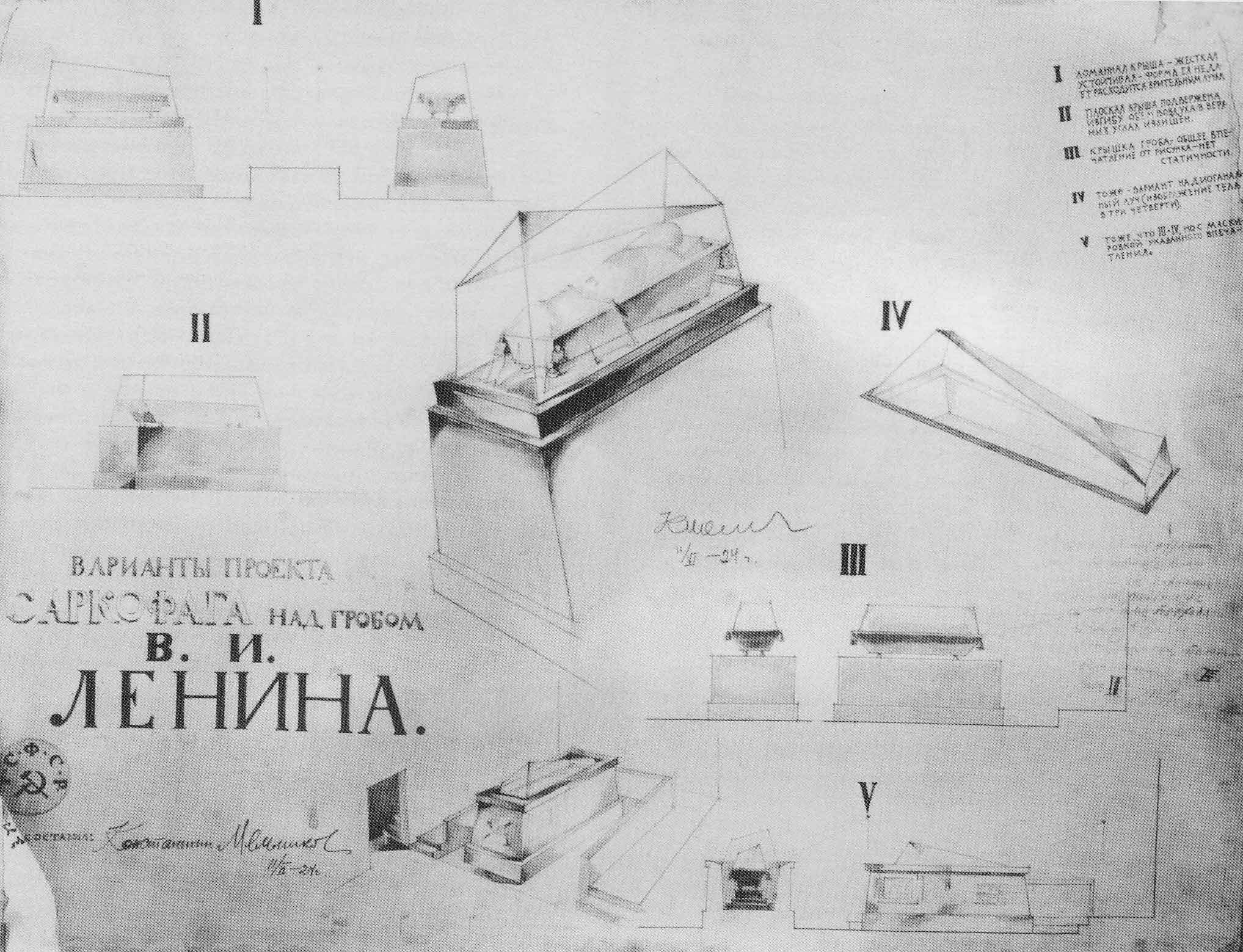
The architectural modernist Konstantin Mel’nikov’s prismatic Variations on the project of Lenin’s sarcophagus (1924), unrealized

The architectural modernist Konstantin Mel’nikov’s prismatic Variations on the project of Lenin’s sarcophagus (1924), proposed but never realized. Continue reading

Painting of Trotsky by Henry Schnautz, 1950s

Some hitherto untranslated sections of Trotsky on Nietzsche (1908)

.
Image: Henry Schnautz’s Trotsky (1950s)

.
Here are a few preliminary, still very rough translations of passages from Trotsky writing on Nietzsche not available in English. There is probably some background required to know the various philosophical and literary (idealist and symbolist, respectively) movements he’s talking about, but I think that Trotsky makes a few essential points that are in line with later interpretations advanced by Adorno.  Which makes me wonder, did Adorno et al. perhaps read this essay? Was it available in German, even if not in English? The essay’s title in English would be “Starved for ‘Culture'” or something like that, from 1908.

Note the succession in the last paragraph: Nietzsche, Kant, the Marquis de Sade! Recall the second chapter of Dialectic of Enlightenment, where precisely these figures were juxtaposed with respect to the morality of the individual under enlightened bourgeois subjectivity.

Our impoverished “decadence” of the 1890’s was not the first declaration of aristocratic, or even intellectual-bourgeois aestheticism. But from the outset, how gutless (even cowardly) it was! It scarcely dared stammer on about the absolute end-in-itself of the aesthetic (though principally erotic) “tremor” [«трепета»], or of its protest against “tendentiousness” — i.e., in practice, against the grand morality of political obligations, which gravitated toward literature and strove to give the appearance of struggling against moralizing populism. This helped it come under the aegis of the journalistic Marxism of the time, which was of little interest to the Decadents taken on its own terms. They were both still psychologically connected, if you will, by the fact that both proclaimed a “new word” and both were in the minority. The Petersburg journal Life, a combination of third-rate Marxism and kitschy aestheticism printed on good paper for an inexpensive price, was the fruit of this strange coupling. Increasing colossally overnight, the vogue appeal of Gorkii developed in the same period. According to the current definition, the tramp symbolizes the revolt against petit-bourgeois philistinism. Untrue! On the contrary! For broad groups of intellectuals, the tramp turned out to be precisely the symbol of the sudden rise of petit-bourgeois [мещанского, also connotes “philistine”] individualism. Off with one’s burdens! It’s time to straighten one’s back! Society is nothing more than an imperceptible abstraction. I — and this is me! — here came to the aid of Nietzsche. In the West, he appeared as the final, most extreme word in philosophical individualism because he was also the negation and overcoming of petit-bourgeois individualism. But for us Nietzsche was forced to perform a quite different task: we smashed his lyrical philosophy into fragments of paradoxes and threw them into circulation as the hard cash of a petty, pretentious egoism…

Наш жалконький «декаданс» 90-х годов — и был этим первым провозглашением не дворянского, а интеллигентско-мещанского эстетизма. Но как он был по первоначалу робок, даже труслив! Он едва смел заикаться об абсолютной самоцельности эстетического (главным образом эротического) «трепета» и своему протесту против «тенденциозности», т.-е. на деле против больших нравственно-политических обязательств, тяготевших на литературе, старался придать вид борьбы против морализующего народничества. Это помогло ему стать под защиту тогдашнего журнального марксизма, который сам по себе декадентов мало интересовал. Их, пожалуй, еще психологически связывало то, что оба провозглашали «новое слово» и оба были в меньшинстве. Петербургский журнал Жизнь, комбинация из дешевого марксизма и дешевого эстетизма, на хорошей бумаге и за недорогую цену, явился плодом этой странной связи. Колоссальная, в 24 часа выросшая, популярность Горького — явление той же эпохи. По ходячему определению, босяк был символом бунта против мещанства. Неправда! Как раз наоборот! Для широких групп интеллигенции босяк оказался именно символом воспрянувшего мещанского индивидуализма. Долой ношу! Пора выпрямить хребет! Общество — лишь неуловимая абстракция. Я — это я! — На помощь пришел Ницше. На Западе он явился, как последнее, самое крайнее слово философского индивидуализма и потому — как отрицание и преодоление индивидуализма мещанского. У нас же Ницше заставили выполнять совсем другую работу: его лирическую философию разбили на осколки парадоксов и пустили их в оборот, как звонкую монету маленького претенциозного эгоизма… Continue reading

Three models of “resistance” — Introduction

Introduction

Image: Elena Feliciano, Resistance

A glance at the way “resistance” has been theorized over time — in both political and extra-political contexts — might help illuminate the Left’s changing sense of its own subjective agency during the last sesquicentenary. Three models may serve as an index to its shifting historical aspirations, and capture its oscillating feelings of hopefulness and helplessness at the prospect of their attainment. Before embarking upon this exposition, however, a few facts regarding its political usages should be particularly borne in mind:

First, as Stephen Duncombe pointed out a few years ago, the concept of “resistance” is in a way inherently conservative.[1] It indicates the ability of something to maintain itself — i.e., to conserve or preserve its present state of existence — against outside influences that would otherwise change it. Resistance signifies not only defiance but also intransigence. As the editors of Upping the Anti put it a couple years back, “resistance” automatically assumes a “defensive posture.”[2] It thus appears to be politically ambivalent: it depends on what is being conserved and what is being resisted.

Secondly, “resistance” as a property can belong to any number of things, whether conscious or unconscious. The world, or nature, can “resist” our conscious attempts to transform it. Likewise society, or second nature, can prove similarly recalcitrant. Either way, this “resistance” tends to be unconscious (always in the case of the first, and usually in the case of the second). With nature, the conditions that obtain at any given moment appear objective and material. With society, by contrast, the conditions that obtain at this or that historical juncture appear quasi-objective and ideological.[3] The situation can be reversed, however. Insofar as society and the world operate unconsciously to transform the general conditions of existence, groups and individuals can consciously choose to resist these processes. Continue reading

Wilhelm Dilthey

Three models of “resistance”

Untitled.
Image: Photograph of Wilhelm Dilthey

1. The “resistance” of the world to humanity’s conscious attempts to transform it

Go to Three models of “resistance” — Introduction

In 1890, the German philosopher Wilhelm Dilthey authored a remarkable essay on “The Origin of Our Belief in the Reality of the External World and Its Justification.”  Against some of the prevailing interpretations of his day, Dilthey argued that the reality of the external world was neither an immediately given fact of consciousness nor the product of unconscious inferences linking cause to effect.  On the contrary, he asserted that the reality of the world outside of the self comes to be known to individual subjects only by encountering resistance [Widerstand] to the will.  Recognition of the external world’s reality thus arises from “[the] consciousness of voluntary motion [entering] into a relation with the experience of resistance [Widerstandserfahrung]; in this way a…distinction develops between the life of the self and something other that is independent of it.”[10]

Resistance in this model stands as the original ground on which all subsequent differentiation takes place.  Here the “I” is first separated off from a “not-I” that opposes it.  But unlike the Fichtean philosophy from which these terms are derived,[11] “I” and “not-I” for Dilthey are not distinguished (at least initially) by an act of cognition.  This cleavage is first realized, rather, through an act of volition.  In other words, the intuition of a world that exists apart from the ego does not come about through the self-positing activity of the subject in making itself an object of contemplation or thought,[12] as in Fichte.  It manifests itself through an act of the will, in the subject’s efforts to subjugate the whole of reality unto itself — thereby satisfying its every appetite.  The “pushback” it experiences in trying to enforce its will then prompts an awareness that something exists outside the self.  Thus does consciousness enter into existence, circumscribed within a world that is not of its making.  It learns the limits to its own subjective agency by encountering resistance to its sovereign will.

For Dilthey, then, this experience not only formed the basis for understanding the world as an independent and objective entity — i.e., as something separate from the self.  It was also to an equal extent the source of the ego’s self-understanding as an autonomous and subjective entity.  Dilthey went on to explain that “the difference between a ‘self’ and an ‘other’ is first experienced in impulse and resistance…,the first germ of the ego and the world and of the distinction between them.”[13]  This initial moment of separation is then necessary to lend legitimacy and significance to the network of distinctions educed from it.  “The entire meaning of the words ‘self’ and ‘other,’ ‘ego’ and ‘world,’” explained Dilthey, “and the differentiation of the self from the external world is contained in the experiences of our will and of the feelings connected with it…The core of this distinction is…the relationship of impulse and restraint of intention, of will and resistance.”[14] Continue reading

Three models of “resistance”

Untitled

.
Image: Ferdinand Schmutzer,
Portrait of Sigmund Freud (1926)

2. The “resistance” of humanity to its own self-conscious transformation

.
Go to Three models of “resistance” — Introduction
Go to Three models of “resistance” — 1. The “resistance” of the world to humanity’s conscious attempts to transform it

The second major historical conceptualization of “resistance” examined in this essay comes by way of psychoanalysis directly, rather than through the indirect affinity between Freud’s reality principle and Dilthey’s account of the reality of the external world.  Indeed, Freudian analysis largely hinges on the various forms of resistance the analyst encounters in trying to disembed layers of repressed experience buried in the patient’s unconscious: “[The] opposition…during psychoanalytic treatment…against our effort to transform what is unconscious into what is conscious…is what we perceive as resistance.  We…[name the] pathogenic process demonstrated by this resistance…repression.”[36]

Here the operative concept is the “resistance” — whether conscious or unconscious — of the subject (and more specifically the ego)[37] to the task of working through its own past, which has been systematically repressed.  Once again, this resistance expresses an extreme conservatism.  In part, the subject avoids revisiting its own history because it finds many of its experiences traumatic and disturbing.  But the patient is not simply afraid of its past.  It is also afraid of its future.  The subject is gripped by a primitive urge for self-preservation, and balks at the prospect that it might potentially become something other than what it already is.  Having fallen in love with the symptoms of its own unfreedom, the analysand stubbornly resists the idea of living without them.

This notion of “resistance,” I submit, corresponds to the work of figures like Karl Korsch, Georg Lukács, and above all Wilhelm Reich early in their careers.  Each of these thinkers sought to digest the legacy of the international workers’ movement in the aftermath of its defeat between 1917 and 1923.  Following the spectacular series of capitulations, conciliations, schisms, and betrayals that shook the Second International in the decades leading up to World War I, all three authors came to the conclusion that the greatest obstacle to the proletariat’s emancipation was the proletariat itself — or more precisely, its inability to “work through” its own reified forms of consciousness.  For the emancipation of the working class was to be self-emancipation.  The “resistance” thus encountered was no longer that of the world maintaining itself against the actions of humanity.  In this case, the “resistance” was instead that of humanity in preserving its present condition of unfreedom against the challenge of fulfilling its destiny. Continue reading