Suprematism in architecture: Kazimir Malevich and the arkhitektons

Painting and the Problem of Architecture

Kazimir Malevich
Nova generatsiia
Vol. 3, №. 2 (1928)

If we examine the painting of the first quarter of the 20 century we immediately notice two trends: “objective” and “non-objective.”

These two trends differ both formally and in their Weltanschauung and attitude to art.

Corresponding to the different types of Weltempfang there arise various artistic classifications.

In the “objective” trend there exist various stages: the first stage is figurative; it perceives the model as such. In this stage we see objects in their artistic expression “as they are.”

In the second stage the subject or model is only a means of communicating the artist’s experience in works of art. What is more, all the objects, or nature, are artistically unified by the tone passing through them.

In the third stage we see how as the result of a particular artistic Weltempfang there occurs “artistic deformation of phenomena”; hence follows the disintegration of the object into separate pictorial elements. They create a new order which is called “the cubic form of revealing artistic expression.”

At this stage the object itself is not considered “as such,” and “as such” it is not the content of artistic skill; it exists only as the sum of unorganized painterly elements.

Next come two variants of the fourth stage of communicating Weltempfang: they are called “non-objective.”

In one of these types we see the total eclipse of the object and have a work of pure painterly Weltempfang.

The other “non-objective” type is not only the revelation of artistic Weltempfang but also of a whole series of the dynamic, static, magnetic, and other elements which exist in nature.

These two figurative stages deal exclusively with the form of objects, i.e. forms with the help of which objects are created on the canvas “as such.”

In the “non-objective” stages, on the other hand, form plays an important role, since without form it becomes impossible to convey any kind of Weltempfang.

In the “non-objective” stages one is not dealing with the representation of phenomena “as such,” but with the communication of definite sensations which exist in the phenomenal world.

In the “non-objective” stages there comes to the fore the question of creating the “forming element” with which to communicate sensations.

Thus the problem of form arises only in the new “non-objective” art. This is why the “non-objective” arts have had to rid themselves of the contents of various ideologies and also of the entire material side of everyday life, the system of which has been developing on a basis harmful to painting. Thus, for example, the table, house, motor, wedding, marriage did not develop as a result of people’s perceiving life artistically and expressing elements of this perception, as a revelation of artistic Weltempfang, in the form of a table.

The table, in common with all objects of a technical purpose, has practical utilitarian functions, and therefore the content of such objects is functionality; and all the elements of the world’s material constitute a firm functional order.

Thus the system of artistic perception of the functional order of the object may happen not to correspond to the artistic perception of the object, as one is dealing not with the functional content of a table but with its artistic content.

The critics have regarded this trend as “abstract,” at the basis of “abstract” art, parting from practical, concrete life.

To this “non-objective” type belongs Suprematism.

From this short analysis we see that in the first two stages of revealing sensations “form” is not a problem and does not have the same importance as in the third stage and, particularly, in the “non-objective” stages.

Continue reading

Trotskyism in Greece: An interview with Andros Payiatsos

Nikos Manousakis
Platypus Review 64
March 2, 2014

.
On November 22, 2013, Nikos Manousakis, a member of the Platypus Affiliated Society in Thessoliniki, interviewed Andros Payiatsos, Secretary General of Xekinima or “Start,” the Greek chapter of the Committee for a Workers’ International (CWI). What follows is an edited transcript of their conversation.

.
Nikos Manousakis
: Tell us about the Greek chapter of the CWI. What are its involvements politically, its connection to the wider international organization, its ideological background, and what are Start’s aims in present-day Greece?

Andros Payiastos: Xekinima, which can be translated as Start, has a long history that dates back to the period of the Junta, the military dictatorship from 1967-1974. It was originally a small group that operated illegally under the Dictatorship of the Generals and, in 1974, joined the Panhellenic Socialist Movement (PASOK). Xekinima had evolved in a Trotskyist direction, although not with full clarity at the outset, and was involved in the uprising of the Athens Polytechnic in the autumn of 1973. Start members joined PASOK when the latter was created in 1974. Around the same time Start came into contact with the British counterpart of the CWI, then called Militant, which was working inside British Labour. The group has had an interesting and a complex development since then. In its initial period it was very successful within PASOK, which, in the 1970s, was an entirely different organization from the one we see today — with thousands of working-class fighters and radical left activists. It was also very bureaucratic. But Xekinima was very quickly expelled. From 1975 onwards, Xekinima has worked as a tendency outside PASOK, although it directs itself at the PASOK rank and file.

Then in the late 1980s, a discussion began to develop in Greece and internationally about the character of working-class parties, labor parties, Social Democratic parties, etc., and there was a move in the direction of abandoning them. So Xekinima, too, shifted toward independent work and abandoned any kind of relationship with PASOK. Furthermore, in the 1990s, Xekinima came out openly as an independent organization with a stated aim of rebuilding the forces of the Left, describing PASOK as a bourgeois party, which had abandoned any link to working-class interests.

The 1990s were a very difficult period. The Left, as a whole, was in crisis as a result of the collapse of Stalinism and was confronted by a major ideological offensive by the bourgeoisie globally. It is fair to say that the entire Left was in crisis, even in tatters! Many organizations split and Xekinima also suffered from such clefts.

NM: This in spite of the fact that Xekinima had a different ideological or Trotskyist background?

AP: The Trotskyist current, although it was the only one that had predicted Stalinism was a temporary historical phenomenon and that it would collapse in one way or another, nevertheless paid the cost of the collapse of the Stalinist left. Because the collapse had an adverse, negative effect on the struggles of the working class, on the consciousness of the working class, on leftist working-class organizations, and on the leadership of the trade unions, etc.

NM: So you understand 1989 to have been a turning point for the Left in Greece and globally?

AP: Without any doubt! And Xekinima paid a cost for 1989. Actually, it is fair to say that Xekinima was able to restart, to rebuild its forces, having contracted to a small group by the late-1990s, when leftist movements found new life as the repercussions of the financial-economic crisis in southeast Asia were felt internationally, by the effects of the anti-globalization movement, and then the anti-war movement. It was this rebirth that followed the collapse of the Left in 1989 that also allowed Xekinima to rebuild its forces and become one of the significant forces on the Left today.

NM: How would you define the present goals of Xekinima?

AP: The general goal, of course, is the transformation of society. Capitalism is a deadly system leading to the barbarism that we experience today. How we get to transform society is the main question and a difficult one because the entire Left claims, in one way or another, that they are struggling for a socialist society, but historically the Left has proved incapable of achieving that aim. We have two goals given the present state of things in Greece: The first is to develop a transitional program that reflects the needs of today, define the aims for the working class to fight for, launch proposals about how that fight should develop, in other words a plan of struggle for the working class in order to be able to face this barbaric attack by the troika and the Greek bourgeoisie. The second is to try to bring together the forces which agree on the fundamental tasks of our epoch, I mean forces from the rest of the Left with an orientation toward revolutionary Marxism.

The Greek left is in turmoil — reflecting the depth of the current crisis on the one hand and the deficiencies of the (international) Left on the other. What is very important, however, is that there are significant forces inside all of the major left formations which are in opposition to the ideas or political lines of the central leaderships of those left formations. Such forces exist inside SYRIZA, but also inside the ANTARSYA coalition, and the KKE, the Greek Communist Party. These forces understand the necessity of a transitional program as I have described above and, also, the vital importance of the United Front. Continue reading

Panteleimon Golosov, Leningradskaia Pravda building in Moscow (1930-1935)

The following is taken from the international art journal Docomomo. It is a serviceable enough text, if somewhat awkwardly translated from French. One gets a good sense of the project’s evolution from the remarks Forte makes, even if the context he provides is a bit superficial. Plus, he highlights a central point toward the end of this excerpt: cultural regression following upon political regression.

Repressed architecture: The Pravda publishing house in Moscow (1930-1935)

Riccardo Forte
Docomomo № 37
September 2007

.
The “heroic” building of the Pravda’s printing complex, sancta sanctorum of the communist doctrinal orthodoxy and ideological manifesto of Soviet power, was erected between 1930 and 1935 in the Muscovite district of Yamskoye Pole. Thanks to its symbolic content and programmatic commitment, it undeniably embodies an unrivaled episode in the history of modern architecture in Russia.

This prodigious building of colossal dimension, eulogistic icon of a new model of society which, forged upon the ideals of the Revolution, advancing towards the “glorious edification” of socialism and containing in its poetics of bold lines inspired by the vision of a civilisation machiniste, provided a most profound sense of that ideology of progress and aesthetics — a secular “religion of Utopia” — upon which the expectations of the modern movement were founded.

A manifesto of Utopia: The aesthetic search for the “supreme building”

.
In 1929 the Central Committee of the PCUS (Communist Party of the Soviet Union), in order to find a suitable solution for the growing production needs of the Pravda, the Bolshevik Party’s newspaper founded by V.I. Lenin in 1912, announced a national competition for a large-scale publishing house to serve as new headquarters for the newspaper, the regime’s official press organ. The plan for the editorial complex of the principal Soviet newspaper belonged in every respect to the vast modernization program which the Russian government embarked on in the mid-1920s. The period’s extraordinary intellectual effervescence and unprecedented creative fervor were such that the NEP (New Economic Policy) contributed in a decisive measure to the feverish construction activity in the public sector. Such activity was embodied by the realization of great infrastructures, services and industries, as well as in the creation of new organizational typologies, such as the “social condensers” (public housing, industrial  establishments, workers’ clubs), catalyzing centers of the new socialist culture, that are constitute the regime’s most significant experimental results.

The ambitious project launched by the Soviet leadership, whose intention was to emphasize symbolically their own hegemonic control of Russian society, simultaneously developing the device propaganda for the official party line from one boundary of the Union to the other, constituted for the avant-garde architects a once-in-a-lifetime opportunity and a formidable experimentation field for the new doctrinal directions and composition models that were formulated in those years. The competition’s prescriptions laid down that the functional units of administrative offices, newspaper offices and typographic works were to be integrated in a single large complex. The chosen site — today the area comprised between the Belorussky and Savyolovsky subway stations — was located in the Yamskoye Pole district, a strategic localization right in the city center, which at the time was still barely constructed. Continue reading

International Women’s Day

Aleksandra Kollontai
Moscow, USSR: 1920
.

A militant celebration

.
Women’s Day or Working Women’s Day is a day of international solidarity, and a day for reviewing the strength and organization of proletarian women.

But this is not a special day for women alone. The 8th of March is a historic and memorable day for the workers and peasants, for all the Russian workers and for the workers of the whole world. In 1917, on this day, the great February revolution broke out.[1] It was the working women of Petersburg who began this revolution; it was they who first decided to raise the banner of opposition to the Tsar and his associates. And so, working women’s day is a double celebration for us.

pli15413

But if this is a general holiday for all the proletariat, why do we call it “Women’s Day”? Why then do we hold special celebrations and meetings aimed above all at the women workers and the peasant women? Doesn’t this jeopardize the unity and solidarity of the working class? To answer these questions, we have to look back and see how Women’s Day came about and for what purpose it was organized.

How and why was Women’s Day organized?

.
Not very long ago, in fact about ten years ago, the question of women’s equality, and the question of whether women could take part in government alongside men was being hotly debated. The working class in all capitalist countries struggled for the rights of working women: the bourgeoisie did not want to accept these rights. It was not in the interest of the bourgeoisie to strengthen the vote of the working class in parliament; and in every country they hindered the passing of laws that gave the right to working women.

Socialists in North America insisted upon their demands for the vote with particular persistence. On the 28th of February, 1909, the women socialists of the U.S.A. organized huge demonstrations and meetings all over the country demanding political rights for working women. This was the first “Woman’s Day.” The initiative on organizing a woman’s day thus belongs to the working women of America.

In 1910, at the Second International Conference of Working Women, Clara Zetkin [2] brought forward the question of organizing an International Working Women’s Day. The conference decided that every year, in every country, they should celebrate on the same day a “Women’s Day” under the slogan “The vote for women will unite our strength in the struggle for socialism.”

During these years, the question of making parliament more democratic, i.e., of widening the franchise and extending the vote to women, was a vital issue. Even before the first world war, the workers had the right to vote in all bourgeois countries except Russia. [3] Only women, along with the insane, remained without these rights. Yet, at the same time, the harsh reality of capitalism demanded the participation of women in the country’s economy. Every year there was an increase in the number of women who had to work in the factories and workshops, or as servants and charwomen. Women worked alongside men and the wealth of the country was created by their hands. But women remained without the vote.

But in the last years before the war the rise in prices forced even the most peaceful housewife to take an interest in questions of politics and to protest loudly against the bourgeoisie’s economy of plunder. “Housewives uprisings” became increasingly frequent, flaring up at different times in Austria, England, France and Germany.

The working women understood that it wasn’t enough to break up the stalls at the market or threaten the odd merchant: They understood that such action doesn’t bring down the cost of living. You have to change the politics of the government. And to achieve this, the working class has to see that the franchise is widened.

Frauentag_1914_Heraus_mit_dem_Frauenwahlrecht

It was decided to have a Women’s Day in every country as a form of struggle in getting working women to vote. This day was to be a day of international solidarity in the fight for common objectives and a day for reviewing the organized strength of working women under the banner of socialism.

The first International Women’s Day

.
The decision taken at the Second International Congress of Socialist Women was not left on paper. It was decided to hold the first International Women’s Day on the 19th of March, 1911.

This date was not chosen at random. Our German comrades picked the day because of its historic importance for the German proletariat. On the 19th of March in the year of 1848 revolution, the Prussian king recognized for the first time the strength of the armed people and gave way before the threat of a proletarian uprising. Among the many promise he made, which he later failed to keep, was the introduction of votes for women.

After January 11, efforts were made in Germany and Austria to prepare for Women’s Day. They made known the plans for a demonstration both by word of mouth and in the press. During the week before Women’s Day two journals appeared: The Vote for Women in Germany and Women’s Day in Austria. The various articles devoted to Women’s Day — “Women and Parliament,” “The Working Women and Municipal Affairs,” “What Has the Housewife got to do with Politics?”, etc. — analyzed thoroughly the question of the equality of women in the government and in society. All the articles emphasized the same point: that it was absolutely necessary to make parliament more democratic by extending the franchise to women.

The first International Women’s Day took place in 1911. Its success succeeded all expectation. Germany and Austria on Working Women’s Day was one seething, trembling sea of women. Meetings were organized everywhere — in the small towns and even in the villages halls were packed so full that they had to ask male workers to give up their places for the women. Continue reading

Lissitzky, Wolkenbügel (1924)

.
El Lissitzky’
s skyscrapers stood on great elevated piers above intersections of radial and ring-rods in Moscow. These piers with their open-faced lift-shafts, support the horizontally cantilevered building. Beneath them are metro stations and bus-stops. The building is supposed to be made of steel and glass, all the parts being standardized so that no scaffolding is needed for its erection.

Emil Roth, the Swiss architect, also helped in working out this design. He, as well as Mart Stam, were extraterritorial members of the Society of New Architects (ASNOVA) founded in Moscow in 1923. This society consisted mostly of architects connected with the VKhUTEMAS school in Moscow. The work of Ladovskii’s pupils from that school was published in the journal ABC.

Click any of the images below to enlarge them.

El_Lissitzky_in_Weimar1Emil Roth (left) and Mart Stam (right)

The Reconstruction of Architecture in the Soviet Union (1929)

Old cities — New buildings
The future and utopia
El Lissitzky (1929)

.
The creation of an office complex that would respond to the demands of the new times within the context of the old Moscow urban fabric was the basic idea leading to the concept of the so-called “sky-hook.” Moscow is a centralized city, characterized by a number of concentric ring boulevards connected by radial main streets emanating from the Kremlin. The proposal intends to place these structures at the intersections of the radials and the boulevards, where the most intense traffic is generated. Everything delivered to the building by horizontal traffic is subsequently transported vertically by elevator and then redistributed in a horizontal direction.

Compared to the prevalent American high-rise system the innovation consists in the fact that the horizontal (the useful) is clearly separated from the vertical (the support, the necessary). This in turn allows for clarity in the interior layout, which is essential for office structures and is usually predicated by the structural system. The resulting external building volume achieves elementary diversity in all six visual directions.

The problems connected with the development of these building types, including the scientific organization of work and business, are being dealt with on an international level. In this field, as in others, reconstruction will pose new demands.

In these times we must be very objective, very practical, and totally unromantic, so that we can catch up with the rest of the world and overtake it. But we also know that even the best “business” will not of itself advance us to a higher level of culture. The next stage of cultural development will encompass all aspects of life: human productivity and creativity, the most precious faculties of man. And not in order to accumulate profits for individuals, but to produce works that belong to everybody. If we just consider all the accomplishments of our own generation, we are certainly justified in taking for granted a technology capable of solving all the tasks mentioned earlier. One of our utopian ideas is the desire to overcome the limitations of the substructure, of the earthbound. We have developed this idea in a series of proposals (sky-hooks, stadium grandstands, Paris garage).

It is the task of technology to make sure that all these elementary volumes that produce new relationships and tensions in space will be structurally safe.

The idea of the conquest of the substructure, the earthbound, can be extended even further and calls for the conquest of gravity as such. It demands floating structures, a physical-dynamic architecture.

Continue reading

The decantation chamber of Soviet modernism: VKhUTEMAS projects from the 1920s

Academic Conferences in the VKhUTEMAS

Iakov A. Kornfel’d
Sovremennaia arkhitektura
No. 5-6, 1926. Pgs. 135-137

.
In November each faculty in the VKhUTEMAS had a conference and set itself the following aims:

  1. to establish direct links between the school and its main “consumers,” i.e. the state economic organizations and soviet society;
  2. to sort out the faculty’s own program;
  3. to take note of practical shortcomings in their training of specialists and to discuss proposals for correcting the teaching program appropriately, and to look at the ideological make-up of their curriculum.

The conference in the Architecture Faculty took place on Thursday 18 November. The first session attracted 70 percent of those invited. VKhUTEMAS Rector P.I. Novitskii was elected chairman and spoke on the change taking place in the social context of our lives, with its requirement that we give form to the new way of life and solve architectural tasks of a vast scale in the fields of social, industrial, and housing construction.

Dean of the Architecture Faculty I.V. Rylskii then reported on the academic life of the faculty and on the structure of the curriculum. He noted that of the 70 students who have left the school in the three graduating classes completing the whole course since the Revolution, only one has remained on the unemployment list at the Labor Exchange — which shows that architects emerging from here really are being trained to meet today’s practical requirements. Continue reading

The artist at work

Robin Treadwell
Platypus Review
February 1, 2014
.

Book review:

Ben Davis, 9.5 Theses on Art and Class
Chicago: Haymarket Books, 2013

.
On a May night in 2012, Sotheby’s sold a version of Edvard Munch’s The Scream for 119.9 million dollars, setting a new record for the price paid for a single work of art. Meanwhile, union art handlers, locked out in a months-long dispute over a new contract, picketed the auction house along with Occupy Museums activists. While this sad little snapshot of art world disparity is not exactly new, the past few years have seen this type of excess thrown into sharp relief — against the background of the 2008 financial crisis and, to a lesser extent, the Occupy movement. Niche art blogs, art magazines, and more mainstream outlets are increasingly scandalized by the intersection of art and money, perhaps because it has become so glaring. For instance, last year Reuters’ finance blogger, Felix Salmon, wrote an outraged piece chiding a Citibank “research report” on the artist Gerhard Richter, complete with a graph tracking his auction prices and those of other blue-chip artists in comparison to the S&P 500.[1] In 2011, the New York Times published a lengthy expose of Ronald Lauder’s strategic donations of art to his own museum, the Neue Galerie, as a sophisticated tax evasion strategy.[2] Prominent art writer Jerry Saltz periodically chimes in on the subject, lately with complaints about the dominance and corrupting influence of “mega-galleries” such as Gagosian, a franchise with fourteen locations worldwide, calling them “too big not to fail.”[3] The legendary art critic Dave Hickey has opted out of the game altogether, preferring not to continue on as a member of the “courtier class”: “All we [art editors and critics] do is wander around the palace and advise very rich people. It’s not worth my time,” he told the Observer.[4] Additionally, museums and other art institutions host a seemingly endless series of public forums, talks and panel discussions with titles such as “Materials, Money & Crisis” and “Art Against Reification.”

Artists, too, have long voiced concerns. The artist Andrea Fraser has made a career of institutional critique; her inclusion in the 2012 Whitney Biennial may be a sign of this particular genre’s renewed cachet. The Biennial is traditionally viewed as an indicator of the art world’s general mood, and in 2012 this mood was introspective art-about-art. The New York Times’ Roberta Smith praised the show for its avoidance of “usual suspects and blue-chip galleries,” going on to write that it “separates art objects from the market and moves them closer to where they come from, artists.”[5] Fraser’s contribution, an incisive essay titled “There’s No Place Like Home,” argues that art discourse, her own brand of institutional critique included, has itself become co-opted; moreover, it often serves as a way to avoid actually dealing with issues in a meaningful way — critique as a form of inoculation.

Despite all the hand-wringing over the economics of the art world, one rarely finds class mentioned, much less Marxism. This despite the fact that art theory still employs the language of (Marxist) cultural theory via the Frankfurt school — as Andrea Fraser puts it in the above-mentioned essay, the “broad and often unquestioned claim” is that “art in some way critiques, negates, questions, challenges, confronts, contests, subverts, or transgresses norms, conventions, hierarchies, relations of power and domination, or other social structures.”[6] One gets the sense, however, that the contemporary art world considers itself much too (post-)postmodern and sophisticated to seriously give credence to anything as reductive as Marxism. Yet there is clearly a yearning, at least in some quarters, for a more systematic way of addressing the situation art finds itself in at present.

Lucas the Elder, Luther as Professor, (1529)

Lucas the Elder, Luther as Professor, (1529)

This is the somewhat fraught atmosphere into which Ben Davis’ new book of essays, 9.5 Theses on Art and Class, emerges. Davis, a self-identified Marxist and activist who was until recently the executive editor of Artinfo.com, wrote the title essay as a contribution to a show at Winkleman Gallery in Chelsea. The show, “#class,” was a response to yet another art world controversy, over a show at the New Museum devoted to the collection of a wealthy trustee, Dakis Joannou, and curated not by one of the museum’s staff, but by an art-star friend of Joannou, the much-loathed Jeff Koons. A numbered, cross-indexed series of declarative statements, which Davis originally taped to the gallery door a la Martin Luther, the essay stands out as the book’s boldest and most rigorous chapter:

Thesis 1.0: Class is an issue of fundamental importance for art.

1.1: Inasmuch as art is part of and not independent of society, and society is marked by class divisions, these will also affect the functioning and character of the sphere of the visual arts.

1.7: …a critique of the art market is not the same as a critique of class in the sphere of the visual arts. Class is more fundamental and determinate than the market. (27)

The essay’s central argument is that “the predominant character of this sphere [of the visual arts] is middle-class” (28). By this, Davis means that artists have a degree of authority over the conditions and, to some extent, products of their own work that wage-laborers, no matter how well-paid, do not; but that, unlike the ruling class, they are not “capital personified,” i.e., they pursue their work for more than simply profit. Continue reading

Graham Greene’s infamous review of Wee Willie Winkie (1937), starring Shirley Temple

.
Shirley Temple passed away a little over a week ago. Now that some time has gone by, though, I thought I would take this opportunity to repost a hilarious 1937 review written by Graham Greene of her movie Wee Willie Winkie. Greene, one of the great British authors of the twentieth century — and there were many — wrote with such searing cynicism and shocking innuendo that Temple’s guardians ended up suing him. He was practically forced to leave the country.

This reposting should not be seen as some sort of final dig at Temple shortly after she died. Indeed, it’s more of commentary on the whole Hollywood industry of the child star, which has claimed so many over the years. And in fact, Shirley Temple is one of the very few who did successfully transition into adult life without completely losing it (an all-too-familiar story for child actors who the studios chew up and spit back out).

Enjoy.

Shirley Temple in Poor Little Rich Girl

Shirley Temple in Poor Little Rich Girl

Wee Willie Winkie

Graham Greene
Night and Day
Oct. 28, 1937

.
The owners of a child star are like leaseholders — their property diminishes in value every year. Time’s chariot is at their backs: before them acres of anonymity. What is Jackie Coogan now but a matrimonial squabble? Miss Shirley Temple’s case, though, has peculiar interest: infancy with her is a disguise, her appeal is more secret and more adult. Already two years ago she was a fancy little piece — real childhood, I think, went out after The Littlest Rebel). In Captain January she wore trousers with the mature suggestiveness of a [Marlene] Dietrich: her neat and well-developed rump twisted in the tap-dance: her eyes had a sidelong searching coquetry. Now in Wee Willie Winkie, wearing short kilts, she is a complete totsy. Watch her swaggering stride across the Indian barrack-square: hear the gasp of excited expectation from her antique audience when the sergeant’s palm is raised: watch the way she measures a man with agile studio eyes, with dimpled depravity. Adult emotions of love and grief glissade across the mask of childhood, a childhood skin-deep. Continue reading

To remember a future long silenced by history

Greg Gabrellas
Platypus Review 27
September 2010
.
..

Book review:

Renewing Black Intellectual History
Adolph Reed Jr. & Kenneth W. Warren, eds.
(Boulder, CO: Paradigm Publishers, 2010)

.
In a 2005 commencement address, Howard Zinn urged the graduates of Spelman College to look beyond conventional success and follow the tradition set by courageous rebels: “W.E.B. Dubois and Martin Luther King and Malcolm X and Marian Wright Edelman, and James Baldwin and Josephine Baker.”[1] At first, Zinn’s lineage feels like an omnium-gatherum. Compare Malcolm X’s “by any means necessary” militarism to Marian Edelman’s milquetoast non-profit advocacy — “by any grant-writing or lobbying necessary” — and the incoherence stands out. But there is logic to Zinn’s cherry picking: namely, the flattening out of history to instill pride in one’s own identity. Du Bois and King may have belonged to radically divergent political tendencies, but what matters is their usefulness as role models, heroes in a continuous tradition of black resistance.

Zinn’s historical reasoning has a history of its own. Beginning in the early moments of decolonization, insurgent black nationalists attempted to rewrite history in the service of race pride. Think of Cheikh Anta Diop’s demonstration that the ancient Egyptians were really black Africans. Though such appeals proved too essentialist for the post-structuralist historiography of the 1970s and 1980s, historians who still hoped to preserve the therapeutic value of history continued to assert the cultural legacy of the black diaspora. This legacy was forged over hundreds, perhaps even thousands of years of oppression. And black resistance, it was claimed, dates to about the same period. In the absence of any actual politics, historical research became a substitute satisfaction. By revealing the racism implicit in, say, Orson Welles’s 1935 “Voodoo Macbeth,” the historian seems to win a political victory against racism.

In their edited collection, Renewing Black Intellectual History: The Ideological and Material Foundations of African American Thought, Adolph Reed Jr. and Kenneth W. Warren mount a challenge to the political pretensions of black studies. Now, bemoaning the excesses of identity politics is not new; in fact, it has paid for many a conservative’s third swimming pool. But Reed and Warren’s critique is meant to come from the Left, to show how the unexamined assumptions of black history mystify the present and block the development of critical politics.

One major assumption is that racism poses a persistent and persisting problem in American history. To make the point, historians, literary critics, and pundits often use W.E.B Du Bois’s adage that the problem of the 20th century would be the problem of the color line. In a recent article, for example, Linda Darling-Hammond details racial disparities in education, and asks whether America will be ready to “roll up its sleeves to at last solve the problem of the color line.”[2] Reed’s capstone essay “The ‘Color Line’ Then and Now” shows how such contemporary appropriations not only misunderstand the context of Du Bois’s remark, but also obscure the recognition of real social problems.

“Treat ‘Em Rough,” a political cartoon originally from the George Matthew Adams Newspaper Syndicate Service, August 16, 1919.

“Treat ‘Em Rough,” a political cartoon from George Matthew
Adams Newspaper Syndicate Service. (August 16, 1919).

Du Bois’s formulation was not exactly a clarion call for the black revolution; in fact, as Reed demonstrates, it came at the most conservative moment in his career. When Du Bois published The Souls of Black Folk in 1903, he was not alone in prophesying the primacy of race in current affairs: In the academy, scientific racism had reached its zenith, and in popular political discourse, the imagination of a racial “Struggle for Existence” shaped foreign and domestic policy. Balking at the notion of innate inferiority, Du Bois had a softer view of racial inheritance than most, but he shared the race-centric view of his moment. An admirer of Bismark, he advocated for social reforms to squelch racial and class tensions, and divert blacks from more radical politics. Du Bois would reevaluate his perspective, of course, over his long lifetime. A member of the Communist Party in the years before his death in 1963, he later questioned his own formulation of the “color line” as the problem of his century.[3] Continue reading

Anti-fascism: Its problematic history and meaning

       Manuel Kellner | Henning Mächerle
Wolf Wetzel | Jan Gerber
.

Platypus Review 63
February 1, 2014
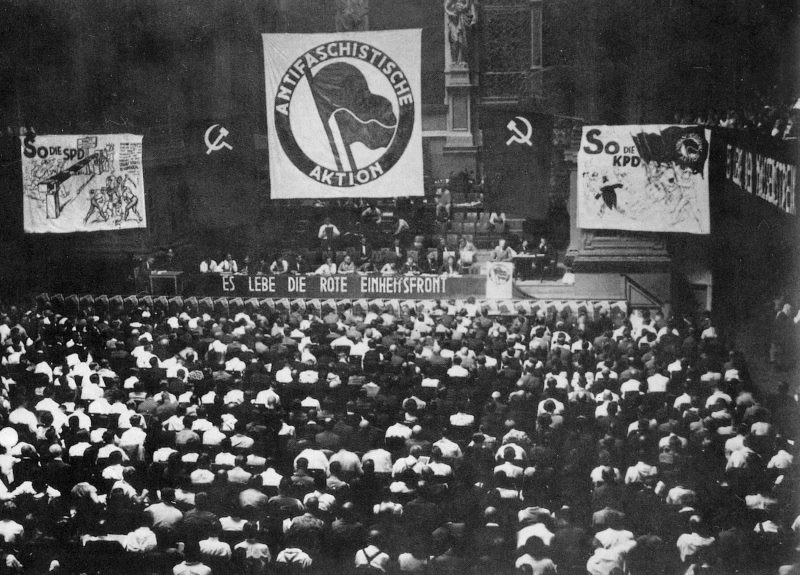
Image: Antifascist
conference (1922)
.

Since the Nazi seizure of power eighty years ago anti-fascism has been integral to left-wing politics. The struggle against fascists and Nazis is morally self-evident, so that political anti-fascism seems to be similarly self-evident. Yet in past periods of history, the politics of anti-fascism was completely different, as was the understanding of what it contributed to leftist politics more generally. Still certain continuity can be discerned in anti-fascism’s retention of anti-capitalist claims. Where does this come from? What was anti-fascism and how has it changed? How do the category and concept of anti-fascism help us to understand both historical and contemporary political realities? What does anti-fascism mean today in the absence of fascism as a mass movement?

What follows is an edited transcript of an event organized by The Platypus Affiliated Society in Frankfurt on April 30, 2013. The discussion addressed the different historical and political implications of anti-fascist politics in order to throw into relief the underlying questions and problems of left-wing politics in the present.
.

Opening remarks

.
Wolf Wetzel:
This discussion is itself an historical event. The Left is at present so fractured, that it is impossible, even forbidden, to have discussions with each other.  We would normally never see a group like this on a platform together. Yet the problem of the Left is also one of anti-fascism.  Many people from the “Antifa” [anti-fascist movement] here in Frankfurt have refused to attend this discussion, since on the evening before an anti-Nazi march, they can only meet to discuss plans of action. They cannot allow themselves to discuss anti-fascism itself because for them to do so on the day before an action would be demobilizing.  This is remarkable given that formerly such discussions of political substance were commonplace.

The other issue is the intense mutual criticism of the different positions represented on this platform. Who can speak with whom? When is it a betrayal? When is it bourgeois, even counterrevolutionary? The assemblage here — representing anti-German, Trotskyist, German Communist Party (DKP), and Autonomist positions — could meet nowhere else in the Federal Republic. Even though I oppose many of the views represented here, these meetings are valuable because they show where these political differences come from and what lessons can be drawn from them.

I want to raise the question of the role Nazism plays today and how to understand the Nazis. This is a big question, one that is too often avoided by anti-fascists themselves. But one must ask: How threatening are they? Are they dangerous materially, politically, or ideologically? Also the historical question must be raised: Who in the ruling apparatus and state institutions of the 1930s when the Nazi Party was on the rise had an interest in their program? If the system itself is in crisis and the political elite hit rock bottom, what prevents the Left from coming to power (something much more likely in the 1930s than it is today)? At that time, it was an existential crisis for the political and business class: Would the conflict arising in the capitalist crisis be answered in a rightwing, fascistic way, or in a socialist way? Might not the crisis conclude with the bursting apart and transcendence of the capitalist system itself?

When we demonstrate against the Nazis we should ask what significance they have, not how many of them there are — 200 or 500. Such figures anyway sometimes get exaggerated in order to inflate the sense of the threat the Nazis pose.

We must discuss what role neo-fascist organizations, their parties, and their armed groups play. My view is that conditions today are massively different from the 1930s. The fascist movement then and today cannot be equated. The political class and the political system have become something quite different. It is absolutely necessary to ask where the true menace lies. I do not believe that the neo-Nazis are the driving protagonists of German racism and nationalism. Racism and nationalism are mainstream and have the support of the majority.  These arrived a long time ago at the center of society. They are represented by political power. The National Democratic Party (NPD) and the other, less organized neo-Nazi groups only express consistently what is already established as mainstream.

Swastika mass ornament, Nuremberg 1933

Swastika mass ornament, Nuremberg 1933

Henning Mächerle: What we are discussing here today depends on the fact that the German workers’ movement of the 1920s and 1930s failed. The Communist Party of Germany was defeated. At the time, it was the biggest Communist Party outside the Soviet Union and it failed without organizing any significant armed resistance or, indeed, interfering with the functioning of the Nazi Party on a large scale. The dilemma of the German Left is that we drag this historical burden along with us. That we are mortgaged to history in this way is the occasion for this debate on anti-fascism. To advance our discussion first we need to understand fascism. That is only possible when we describe society as a class society and understand that it is one in which the owners of the means of production — the ruling class — have a compelling interest in the maximization of profit for which a large number of people must sell their labor power. Because of this, the workers’ movement formed and, through its decisive battle with the capitalist class, shaped the last 150 years. For Eric Hobsbawm, the October Revolution was the decisive point of the “short 20th century” that first showed the possibility of establishing a non-capitalist, perhaps socialist society of free and equal people.  The Left was then — unlike today — a truly serious social movement. It was comprised of people who were not primarily ensconced in universities, but had normal wage work and social interests. The big problem of the Communist Party was it only represented a specific milieu within the workers’ movement. Continue reading