Color illustration from Modern Architecture (1929) of a disurbanized dwelling

Ginzburg’s reply to Le Corbusier on deurbanization

.Untitled
IMAGE: Color illustration in Modern Architecture
of a “disurbanized” dwelling unit (1929)

.Untitled

My dear Le Corbusier,

Our recent conversation about city planning and your letter have compelled me to rethink the entire problem, to recall your objections, the objections you made when you visited me and which you now write about in your letter.

Like all my friends, I value you tremendously not only as a subtle master architect but also as a man with the ability to solve radically and fundamentally the important problems of organization.

For me you are today the greatest and most brilliant representative of the profession that gives my life content, goal, and meaning.

That is why your ideas and solutions in the area of city planning have for us a quite exceptional interest and importance. Continue reading

El Lissitzky,Proposal for a monument to Rosa Luxemburg (1919)

A response to Reid Cane’s “Leninism or Luxemburgism?”

.Untitled
IMAGE: El Lissitzky, Monument
to Rosa Luxemburg (1919)

.Untitled

The following is a response to some critical remarks made by Reid Kane on his blog, The Luxemburgist, in an entry entitled “Leninism or Luxemburgism?”.  Reid was responding in this post to some comments I’d made on a different entry, in which I objected to his opposition of Vladimir Lenin’s articulation of a Marxist politics to that of Rosa Luxemburg.  These are, after all, two organizational models that have frequently been held up as antithetical.  I asserted that their split had been grossly exaggerated by both Stalinists seeking to discredit Luxemburg’s former colleagues and anti-authoritarian/anti-Bolshevik tendencies in the New Left, who exalt Luxemburg as an heroic “alternative” to Lenin.  Reid provides a thoroughgoing, reasoned critique of my objection, maintaining that it is not enough to ignore their differences merely because their disagreements have been blown out of proportion.  In this I cannot but agree.  The differences between Luxemburg and Lenin cannot simply be glossed over.  And so, though this topic has been dealt with countless times by writers on the Left, I feel it is not too much to add my own thoughts on the matter here, in response to Reid’s excellent post.

Continue reading

Iakov Chernikhov’s Principles of Modern Architecture (1930)

Browsing the Russian search engine Яндекс for information about Iakov Chernikhov, I came across an online copy of his 1930 book, Principles of Modern Architecture (Основы современной архитектуры). It’s free to browse in its entirety.

Enjoy!

Dawn and decline: Two eschatological visions in turn-of-the-century Russia

.Untitled
IMAGE: 19th-century Russian
premonitions of a new “Mongolism”

.Untitled

“People who witness the beginning of great and momentous events, who can obtain only very incomplete, inexact, and third-hand information of what is taking place, will not, of course, hazard a definite opinion until a timelier moment comes.  The bourgeois papers, which continue as of old to speak of revolt, rioting, and disturbances, cannot help seeing the truly national, nay, international, significance of these events.  Yet it is this significance which invests events with the character of revolution.  And those who have been writing of the last days of the rioting find themselves involuntarily referring to them as the first days of the revolution.  A turning-point in Russia’s history has been reached.”

Lenin, “What is Happening in Russia?” From Revolutionary Days, January 1905

It has often been noted by historians of the period that a distinctly apocalyptic mood prevailed throughout large sections of the Russian intelligentsia from the last decade of the nineteenth century up through the 1917 Revolution.  Even ideological tendencies that lay in great tension with one another (if not in direct antithesis) found a common outlook in this respect.  This observation certainly finds support in the writings of the major representatives of these movements.  Intellectual currents as far apart as Marxist materialism and religio-philosophical idealism at this time both shared the sense that one age was coming to an end and another was now appearing on the horizon.  This common understanding served as the lens through which the major events of the day were interpreted, events which in turn then helped to modify the structure of these discourses.

In a strange way, many parallels existed between these two major schools of thought, Marxist materialism and religio-philosophical idealism.  These movements, which stood in starker contrast to one another than perhaps any other pair to be found amongst the Russian intelligentsia, possessed a number of similar concerns.  Each struggled to ascertain Russia’s national character, and thus grappled with questions of the country’s unique historical development and its possible role in shaping world history.  Radical political theorists like Lenin and Trotskii and religious philosophers like Vladimir Solov’ev and Sergei Bulgakov were both interested in Russia’s relation to European modernity and to its own barbaric, “Asiatic” past.  Moreover, members from these rival camps each held that Russia was to play an important part in an impending world crisis — either as the savior of European civilization from its own spiritual degeneracy or as a gateway through which revolution would spread to the most advanced industrial nations of the West.

Continue reading

Review: Orbital, Orbital 2 (Brown Album)

.
IMAGE: Cover to Orbital’s
Brown Album
 (1993)
.

Orbital 2 is a sophomore release for the ages. With expectations riding high off of their already revolutionary self-titled LP, Orbital set to work on a sequel in the winter of 1993. The fruit of their labors during these months, Orbital 2 (also known as the Brown Album), constitutes an astounding accomplishment — a timeless masterpiece still virtually unmatched within the genre. On this album, the brothers Hartnoll achieved an almost perfect balance between the ambient sound they had developed on the previous record and a new strain of hyper-futuristic trance. It cemented Orbital’s place as pioneers within trance and ambient techno and prepared the way for artists like Aphex Twin, who toured with them following the album’s release.

The songs on Orbital 2 are constructed methodically, according to a set pattern of mutation that persists more or less throughout the album. This grants the album its uncanny integrity. Each track typically proceeds in a cumulative fashion, establishing a central motif around which successive layers are then added. As new elements enter in, others recede into the background or fade entirely, only to reappear in fresh combinations later in the song. Every part simulates the whole to which it belongs, similar in this way to a fractal. Orbital weave together these constituent parts in a manner that almost approximates a lemniscate infinity — an arching ebb and flow along a laser grid whose contours have been swollen by constant digital effluxion.
Continue reading

Thomas Jeffrey’s 1762 Map of “Russia, or Muscovy in Europe”

A comparison of Larry Wolff’s Inventing Eastern Europe and Richard Wortman’s Scenarios of Power

.Untitled
IMAGE: Thomas Jeffrey’s 1762 map
of “Russia, or Muscovy in Europe”

.Untitled

Larry Wolff’s Inventing Eastern Europe: The Map of Civilization on the Mind of the Enlightenment and Richard Wortman’s Scenarios of Power: Myth and Ceremony in Russian Monarchy from Peter the Great to the Abdication of Nicholas II can be seen as approaching the same problem from two different angles. The problem is what exactly constitutes Europe, and the position of what came to be known as Eastern Europe in relation to Europe proper. Both studies are concerned with the peculiar case of a political and geographic entity that either appeared to foreigners as “European, but not quite,” or self-consciously conceived of itself that way. In the most general terms, Wolff approaches this problem from the angle of Eastern Europe by showing how it was envisioned (and indeed “invented”) by visitors from the West. Oppositely, Wortman is interested in how Europe was understood and represented by the tsarist regime in Russia. Continue reading

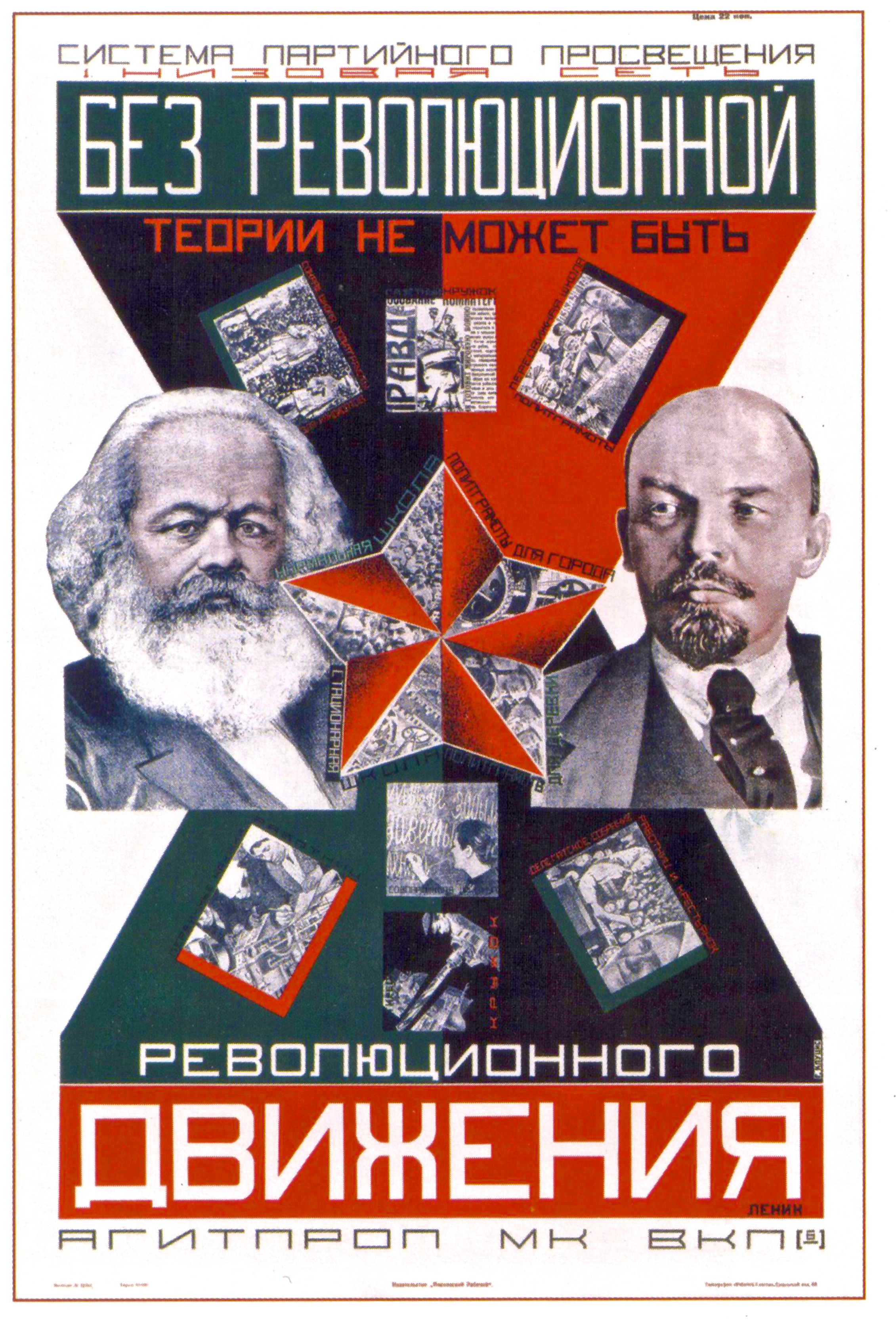
Lenin’s critique of the politics of spontaneity in What is to be Done?

.Untitled
IMAGE: Agitprop poster, 1920s:
“Without revolutionary theory,
there can be no revolutionary movement.”

.Untitled

In preparing my presentation on Lenin’s What is to be Done? this week for the UChicago Platypus reading group, I found myself returning again and again to his description of the so-called “spontaneity” of the masses.  It was on this supposed spontaneity, of course, that the Economists pinned their hopes of social revolution (should there be one at all).  I noticed that in his critique of the notion of the working class’ spontaneity, Lenin employed a number of categories borrowed from classical German philosophy.  All of these categories pertain to consciousness, and constitute an epistemology of sorts.  I found, moreover, that this seemed to provide a theoretical link to Lukács’ later account of reification.  Though this began as little more than a meditation, I brought it up at the reading group and found that it was well received.  Afterward, Sunit encouraged me to elaborate on this notion and submit my thoughts online. Continue reading

A music review of Converge’s 2001 album Jane Doe

Converge’s 2001 record Jane Doe is, more than anything else, a symptom. A symptom, of course, is a surface phenomenon that points to its derivation out of something deeper — something that lies at its root, concealed from view. It is the manifestation of that which remains latent. As such, it is the expression of another thing, distinct from itself, of which it is an unwitting reflex, purely epiphenomenal.

But in its very superficiality, Jane Doe simulates profundity. The illusion that results is, in fact, so perfect as to disguise its origin even from itself, lost in the night of its own paramnesia. Jacob Bannon might be the one singing on the record, but make no mistake: the words are not his own. In truth, they are words written by no one. Words that are the product of a thoroughly impersonal dynamic, generated by a mindless web of relations that inscribes itself into the consciousness of a human vessel — a human vessel which for it is nothing more than a mouthpiece, a means for expression.

In other words, Bannon is the puppet of forces beyond his comprehension. He dances to a tune that was not of his own making. Nor was this tune the making of any other member of Converge. His frenetic flailing during their songs is the enactment of a total powerlessness, the involuntary spasm of a marionette.

Very well, a symptom — but if so, a symptom of what?

Continue reading

The aesthetics of Russian Orthodox Church architecture: A philosophical, historical, and critical investigation

.Untitled
IMAGE: Icon from
Novgorod (1450s)

.Untitled

Though the subject of iconography has historically dominated the Orthodox discourse on aesthetics in terms of both the dogmas and philosophical reflections devoted to it, suggesting a certain “privileging” of the visual, church ritual engages all five of the senses.  Pavel Florenskii highlighted the comprehensive nature of the aesthetic experience of the Orthodox liturgy in his 1922 article “The Church Ritual as a Synthesis of the Arts.”  The ritual, as he pointed out, combines visual, audial, tactile, and olfactory phenomena to produce “the highest synthesis of heterogeneous artistic activities.”[1] The embroidered liturgical robes of the clergy, along with the smell of incense and the sound of the priest’s chanting or the singing of the choir, also form an essential part of the aesthetics of Orthodox ritual.  Less attention has been paid, however, to the role of church architecture in producing the total aesthetic effect of a service.  Aside from the work of architectural historians, this aspect of Orthodoxy has largely been overlooked.  The present study proposes to take up the question of architecture’s contribution to the aesthetics of Orthodoxy more generally, and then provide an historical account of the more traditional Russian style specifically.  Finally, it will critically engage the thoughts of one prominent 20th-century Russian writer whose work touched on this topic, Evgenii Trubetskoi.

Continue reading

Continuities and discontinuities in the Russian perception of Europe

.Untitled
IMAGE: Portrait of Aleksandr Herzen (1848)
.Untitled

Since the reign of Peter the Great, there have existed a number of continuities and discontinuities in the Russian perception of Europe.  Even at any single given time, there was usually disagreement over how European society was to be interpreted, and whether the qualities it was thought to possess should or even could be emulated by Russia.  Often there was even a consensus about what characterized the West, but opinions were split when it came to the desirability of Europeanization.  As time passed, the set of terms used to discuss Europe changed slightly, and the positions of the various thinkers and schools of thought shifted as well.  Nevertheless, they nearly all agreed that there had been a fundamental difference between the development of Russian and mainstream (Western, Romano-German) European society.  And despite the changing nature of the Russian discourse on Europe, several categories remained fairly constant throughout and were continuously revisited by its participants.  So while the specific configuration of these categories was bound to be different in each age, a few common threads can be established between them.

In explaining the separate path of Western European development, a few factors were consistently identified by Russian intellectuals as accounting for this difference.  Most agreed that the religious establishment of Roman Catholicism had exerted a powerful influence on the subsequent social, political, and intellectual growth of Europe.  This was contrasted with Russia’s inheritance of Greek Christianity from Byzantium, which soon thereafter became estranged from the Western Church.  Many other Russians pointed to the residual impact of the Roman legal code on the political and juridical development of the West.  Some believed that the different geographical conditions of Russia and Western Europe had been a decisive determinant in their respective histories.  The precise relationship of these factors to one another and the particular emphasis given to each point shifted from thinker to thinker, but they were still the most common themes in the Russian discourse on European history.

Continue reading