Soviet board-games, 1920-1938

Games of revolution and industry 

Untitled.
Image: Reds and Whites, a war game!
A Soviet board-game from 1929.

untitled2.

It’s the 1920s. You’re a young revolutionary living in the newly-formed Union of Soviet Socialist Republics (USSR). Now that the Allied Intervention’s been frustrated, and the reactionary White Army beaten back, the threat of counterrevolution seems to have momentarily subsided. All in all, it’s a good time to be a Marxist in old Muscovy.

There’s only one problem with this new arrangement: What to do with the free time you’re not spending locked in combat against the tsarists, yankees, and Huns? Sure, you’ve got a job at the local shoe factory. But war communism’s out, and the New Economic Program is in. It’s time to kick back and relax. Communism will be built soon enough.

Luckily, there’s a new product available to help pass the time. A.V. Kuklin’s come out with a whole batch of revolutionary board-games, featuring such riveting class-conscious titles as ElectrificationRevolutionReds vs. Whites, and Maneuvers: A Game for Young Pioneers [Soviet Boy Scouts]. Games for the whole family, even though the family form of property-relations must eventually be abolished. Let the capitalists have their Monopoly; let the imperialists play their Risk. I’ll stick to Modern War or Air Struggle.

Ages 8 and up?

.
My favorites among these include the “electrification” board-game, the chemical war game, and the Reds vs. the Whites game. You can tell that they reflect the immediate experience of devastating world war, revolution, and bloody civil war, followed by a project of social engineering and economic modernization the likes of which the world had never seen. The only other thing I’ll say is that, from an aesthetic perspective, one can see the change in the officially-sanctioned styles from the more avant-garde lines, shapes, and typography to the cartoon realism of caricatured figures in the Sots-art of the 1930s. Enjoy!

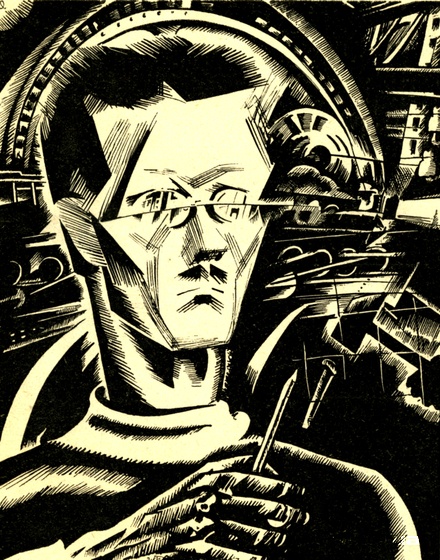
Nikolai Krasil’nikov’s terrifying planar urbanism (1928)

Nikolai Krasil’nikov
Sovremennaia arkhitektura
Vol. 3, № 6: 1928, 170-176
.
.

Problems of modern architecture
.
……Final diploma project for Aleksandr
……Vesnin’s studio at VKhUTEIN

.

In order to really know an object, it is necessary to comprehend, to study all sides of it, all its internal and external connectivities.

— Lenin

It is necessary to pursue and elaborate the implications of this proposition in every specialized field.

Central tower to Nikolai Krasil'nikov's "New City" (1928)

Nikolai Krasil’nikov’s “New City” (1928)

My initial premises:

  1. The environment in which an organic body exists has an influence upon its form.
  2. The forms of the various parts of the organic body are determined by their functions. Thus in a tree the forms of the root, the trunk, and the leaves are determined by the purposes they serve.
  3. To put it mathematically, the form of every body is a complex function of many variables (and the concept of form embraces the internal structure of the body matter).
  4. A scientific theory of the design of form can be developed through the dialectical method of thinking, with the application of mathematical methods of analysis; analysis, that is, which uses the infinitesimal quantities of analytical geometry along with both differential and integral calculus, and the theory of probability and mathematical statistics.
  5. A theory of the design of architectural form must be based on the physical, mechanical, chemical, and biological laws of nature.
  6. Socialist construction is unthinkable without the solution of economic aspects of the problem such as would yield the maximum economic effect in the very broadest sense.  So the constructional economics of a building for human work or habitation must be measured in terms of:
  • the material resources expended in erecting and running it;
  • wear (amortization) and repair of the building;
  • the time expended by people on all forms of movement in and around it;
  • impairment of the health of individuals, which depends on the extent to which the sanitary-technical norms and laws on safety at work and leisure are observed; and
  • the working conditions which would promote an improvement in the productivity of labor in general and mental work in particular, or in the conditions for leisure.

7. Under present Soviet circumstances [destvitel’nosti], the
……achievement of maximum constructional economics in
……architecture is also a vital necessity for the successful
……realization of socialism.

Continue reading

Le Corbusier painting in the nude at Eileen Gray’s Villa E-1027

Plus, the story behind
his nasty leg scar

Untitled.
Image: Le Corbusier painting a fresco in the nude
at Eileen Gray’s Villa E-1027 (Summer 1939)

untitled2.

Shirtless Corbu relaxing at Villa E-1027

Shirtless Corbu relaxing at Villa E-1027

I didn’t know about this until just now.Le Corbusier apparently got the scar while swimming in Saint-Tropez bay in 1938. He’d been staying at the architect Eileen Gray’s Villa E-1027. He got trapped under a yacht’s propeller-blades as it passed over him. As he lated recounted the incident in a letter to his mother, in his characteristically clinical tone:

The motor going at 200 horsepower — a good clip.

Le Corbusier in Saint-Tropez bay (1938)

Le Corbusier in Saint-Tropez bay (1938)

Needless to say, his right leg got terribly mangled. Apparently he remained remarkably calm, however, even while losing a ton of blood. From that same letter:

After the first turn of the blades, I was thrown out of the circuit and seemed not to have been hurt. I reached the surface, and breathed air. I hadn’t swallowed a drop of water. I saw the boat gliding slowly away. I shouted: “Hey, wait a second, you went right over me, there may be some damage!” Quite automatically my hand went to my right thigh, my arm fitting nicely inside. I looked down: a big area of blood-red water, and half my thigh floating like a ray (the fish!), attached by a narrow strip of flesh: “Throw me a buoy, I’m badly hurt.”

The yacht headed toward me, throwing me a sort of rope knot too big to be held in one hand. The side of the yacht was too high for anyone to help me. “Throw a lifesaver.” It comes, and I sit inside it. And here are some fishermen coming into port; their boat is low, they hold out their hands, and I give them my left hand, because I’m holding my thigh together with my right; we reach the place I started from, on the breakwater; I get up on the jetty; a kind driver appears out of nowhere and helps me sit down beside him. The fisherman gets in the backseat. Hospital. They put me on the table and begin sewing me together. This lasts from six to midnight, in two sessions.

Le Corbusier and his wife along with Romanian architectural critic Jean Badovici at Villa E-1027, photographed by the Irish modernist Eileen Gray

Le Corbusier & wife w/ Romanian architecture critic Jean Badovici at Villa E-1027, photographed by Irish modernist Eileen Gray

After recovering, Le Corbusier set about making some “alterations” to Gray’s design at Villa E-1027. Gray was none too happy about the liberties he took with her visual and conceptual schematization of the villa. You can read more about it here.

“Civilization”: On the history of a concept

.

Excerpted from a draft for my long-delayed essay (almost a small book now) on the relationship of revolutionary Marxism to revolutionary liberalism.

.
It is difficult to even mention the concept of civilization without conjuring up images of Occidental hauteur. One is immediately reminded of the so-called “civilizing mission” undertaken by the great colonial powers of Europe. The word’s origins, however, prove far more benign. Nevertheless, the timing of its emergence in history cannot be thought a mere coincidence. “Civilization” is an invention of the bourgeois epoch. According to the French semiotician Émile Benveniste, the term first appeared in print in a 1757 book by the Marquis de Mirabeau.1 Though it derives more generally from the Latin civilis, denoting a higher degree of urbanity and legality, “civilization” in its modern sense dates only from the Enlightenment. In its post-1765 French usage, Benveniste observed that here “civilisation meant the original, collective process that made humanity emerge from barbarity, and this use was even then leading to the definition of civilisation as the state of civilized society.”2 From there, the concept was then imported to Great Britain by Scottish Enlightenment figures like Ferguson, Millar, and Smith. This most likely came through their interactions with the French physiocrats Quesnay, Necker, and Turgot.3 Freud’s suggestion in Civilization and Its Discontents — that the civilizing process of society in history resembles the maturation of the individual4 — was already largely anticipated by Ferguson in the introductory paragraph to his Essay on the History of Civil Society. There he asserted: “Not only the individual advances from infancy to manhood, but the species itself from rudeness to civilization.”5 For Millar, as it was for Smith, civilization was marked by the development of a complex division of labor, what he called “the distinctions of professions and of ranks.” With the further articulation of this system of distinctions, “the human mind is cultivated and expanded; and man rises to the highest pitch of civilization and refinement.”6 Smith reaffirmed Millar’s identification of civilized society as being one in which there was a highly-developed system of ranks. At one point, Smith clarified that whenever he used the term “civilized society,” what he really meant was just a “society where the distinction of ranks has once been completely established.”7

Besides Benveniste, the German-Jewish sociologist Norbert Elias and his Austrian exegete Helmut Kuzmics also picked up on this civilizational theme of Mirabeau’s. One of Elias’ most interesting arguments centers on the transmission of certain conventions from pre-bourgeois European court life — an attention to good manners, etiquette, dress codes, and behavioral norms — to bourgeois civil society rising out of the collapse of the feudal order. Although later philosophers of moral sentiment like Hume and Smith did much to displace aristocratic “virtue” through their valorization of bourgeois self-love,8 these vestiges of courtly politesse in civic politeness9 account for the high premium that was placed on “courtesy” (courtoisie, cortesia) and “civility” (civilité, civiltà, Zivilität) in early bourgeois circles.10 Kuzmics is correct to add, however, that the carryover from courteous modes of conduct would have been more direct among members of the grande bourgeoisie.11 But this historical lineage passed down from medieval court society was only one part of what Elias and Kuzmics called “the civilizing process.” More broadly, what this process entailed was a transition from external restraints imposed from without to internal restraints imposed from within; one of the defining features of civilization for Elias was precisely this regime of self-restraint.12 Some have noted a similarity between Elias’ notion of “restraint” through the civilizing process and Foucault’s later concept of “discipline” through correct training,13 but this similarity is only apparent. Self-restraint for Elias has far more in common with Freud’s psychoanalytic category of repression.14 Apart from these aristocratic frills and ruffles adorning bourgeois civilization, there were several forms of self-restraint peculiar to the modern world. As Elias and Kuzmics each acknowledge, these usually had to do with vocational norms and expectations associated with the workplace (rather than the banquet hall, the baronial court, or the curia regis).15 The primary locus of modern civilization would thus seem to reside in labor.

Here, the meaning of “civilization” examined by Elias and Kuzmics reconnects with that of Benveniste, Lucien Febvre, and the political economists like Smith, Ferguson, and the physiocrats. Of the new behaviors inculcated as a result of the generalization of the wage-relationship — along with the progressive refinement of the social division of labor and the more precise measurement of the labor-time expended — moderation, diligence, expedience, and what E.P. Thompson called “time-discipline” were foremost. From the schoolyard to the factory floor, both children and adults now “entered the new universe of disciplined time.”16 Max Weber, commenting upon the utilitarian ethos of Benjamin Franklin’s advice in Poor Richard’s Almanack, recorded that for the modern bourgeoisie, “[h]onesty is useful, because it assures credit; so are punctuality, industry, frugality, and that is the reason they are virtues.”17 Beyond these highly-valued bourgeois personality traits (or “civic virtues”), this civilizing process in modern society moves from the ethical domain of individual behavior to the political domain of liberal policies of governance. The old practices of government-controlled monopolies, tariffs, protectionism, and trade restrictions — in short, of French and British mercantilism and German cameralism — now appeared antiquated and barbaric. With respect to these more specifically bourgeois aspects of civilization, Kuzmics asserts:

From [the physiocrats] on, the French concept of civilization is wedded to the bourgeois notion of progress; knowledge turns into one of its central categories; the concept of “being civilized” is transferred from the behavior of individuals to the state, the constitution, the educational system (and access to that system by the populace) and to a penitentiary system which is seen to be barbaric. Social inequality, anchored in feudal barriers, appears as barbaric and unreasonable. The same perspective is brought to bear on the lack of economic freedom imposed by government trade restrictions. The refinement of manners and the pacification of civil society are supposed to be the consequence of civilization in this wider sense.18

That “civilization,” a concept born of the Enlightenment, should bear the imprint of the narrative of progress should not come as a shock to anyone. Indeed, the Swiss philologist and literary critic Jean Starobinski not long ago suggested that “[t]he word civilization, which denotes a process, entered the history of ideas at the same time as the modern sense of the word progress.”19 As such, it would appear that “civilization” is perhaps a distant cousin of the later concept of “modernization,” as a process implying progress or enhanced development over time, though Kuzmics warns against such interpretations.20 Already by 1775, Diderot was using the term in exactly this sense: “[C]ivilization follows from the inclination which leads every man to improve his situation.”21 Condorcet was even more wildly optimistic than Diderot when it came to the linkage between progress and civilization. It was while awaiting the guillotine, at the height of the Terror, that Condorcet penned his famous ode to progress, A Sketch for an Historical Picture of the Future Progress of the Human Mind (1793), in which he asked:

Will all nations necessarily approach one day the state of civilization achieved by those peoples who are most enlightened, freest, and most emancipated from prejudice, such as the French and the Anglo-Americans? Will we necessarily see the gradual disappearance of that vast distance now separating these peoples from the servitude of nations subjected to kings, the barbarism of African tribes, the ignorance of savages? Are there regions of the globe where the inhabitants have been condemned by their environment never to enjoy liberty, never to exercise their reason? Do the differences in enlightenment, resources, or wealth so far observed between the different classes within civilized peoples — the inequality that the initial advances of society augmented and may even have produced — derive from the very nature of civilization or from the current imperfections of the social art? Must these differences continually diminish, giving way to the real equality that is the ultimate goal of the social art, that of reducing the very effects of natural differences in individual capacities while allowing for the continuation only of an inequality useful to the common interest because it will foster the progress of civilization, education, and industry without entailing dependence, humiliation, or impoverishment?22

The passage from Condorcet excerpted here above introduces a third meaning to the term “civilization,” besides its association with mannerly ennoblement and technical progress. This third meaning of “civilization” attains its significance only in contradistinction to its conceptual antipode, “barbarism.” Between these two poles one might find a spectrum of intermediate stages, ranging from conditions of relative civility to conditions of relative barbarity. Another term, “savagery,” enters in at times, as well. In most discussions of civilizational benchmarks during the Enlightenment, Foucault rightly noted, the “savage” suggests a pre- or non-civilized person living in a state of nature, whereas the “barbarian” suggests a person who is actively opposed to civilization, who is thus anti-civilizational, living in a state of general crudity and boorishness.23 This understanding corresponds, more or less, to the somewhat lacking categories established by Louis Morgan and later employed by Engels in his writings on The Origins of the Family, Private Property, and the State: 1.) savagery (hunger-gatherer, predominantly nomadic, or pre-historic society); 2.) barbarism (agrarian, predominantly rural, or traditional society); and 3.) civilization (commercial/industrial, predominantly urban, or modern society).24 Civilization would thus seem to presuppose widespread urbanization (or “citification”): “Before rusticus and rusticitas can be defined as antonyms of urbanus and urbanitas, there must be cities and people who live in cities.” According to these antinomic pairs, the civilization of the city was counterposed to the barbarism of the countryside. This opposition was reflected, as Starobinski points out, in dictionaries from the time. “Unlike the bourgeois, peasants are not civilized,” asserted Furetière’s Dictionnaire of 1694.25

Indeed, one of the commonest misunderstandings about the concept of “civilization” concerns its specific reference to the capitalist social formation. Building on the work of the French and British political economists, Marx and Engels used the term “civilization” as basically equivalent to modern bourgeois society. “[Capitalism] forces all nations to adopt the bourgeois mode of production or go under,” they wrote in the Manifesto. “[I]t forces them to introduce so-called civilization amongst themselves, i.e., to become bourgeois.”26 This is a point Spencer Leonard brought home in a recent interview with Kevin Anderson, in combating charges of “Eurocentrism” and “Orientalism” that post-colonial theorists like Edward Said have recently leveled at Marxism.27 “Capitalism for Marx is not a superior civilization,” Leonard elucidates. “Rather, capitalist society is ‘civilization,’ per se…The issue is the universality of the form realizing itself at the level of world history…[W]hen he is using that language, he is talking about a social form, one that just happens to have emerged in Europe.”28 Nor is this merely some sort of clever rhetorical flourish. Certain selections from Engels clearly seem to substantiate Leonard’s general equation of modern bourgeois society with civilization as a whole: “[C]ivilization is that stage of development of society at which division of labor, the resulting exchange between individuals, and commodity production, which combines the two, reach their full development and revolutionize the whole of hitherto existing society.”29 Already, Marx had on several occasions written of “the civilizing aspects of capital,” insofar as it helped to eradicate the forms of slavery and serfdom that preceded it.30 In his preparatory work on the Grundrisse, he had similarly praised “the civilizing influence of external trade.”31 But perhaps the most irrefutable proof that, for Marx, capitalist society is “civilization” can be found in his endorsement of John Wade’s provocative proposition that “Capital is only another name for civilization.”32 Marx, who did not think much of Wade’s original contributions to the study of political economy (accusing him at one point of plagiarism), still admitted that “Wade is…correct…insofar as he posits capital = civilization.”33

On this level, then, it appears that the commonplace objection to the identification of civilization with the capitalist West, an identity upheld by classical liberals and Marxists alike, commits a category mistake. The simultaneous birth of civilization and modernity in Europe, and along with it their exponential growth in productivity, has nothing at all to do with the supposedly innate “superiority” of Western peoples or cultural institutions. This is why the pseudo-radicalism of postmodern hermeneutics — which interprets the logic of capital to be somehow intrinsically white, Christian, European, male, etc. — is utterly inadequate to the understanding of civilization, qua bourgeois society. In fact, this view even tends to reinforce the chauvinist discourse that treats all the accomplishments of Western civilization as the outcome of the heroic feats of the industry, ingenuity, and spirit of innovation that supposedly characterize all white, Christian, European males. Such accounts overlook the practically ubiquitous stereotype of the peasant in medieval Europe, usually depicted as monumentally lazy, shiftless, and ignorant. Neither Marx nor Engels had much patience for the quaint customs and inoffensive, folksy conventions of traditional society, no matter where these traditions stemmed from. Nowhere was the authors’ disgust with reactionary traditionalism more evident than in Engels’ evaluation of “The Civil War in Switzerland” in the Deutsche Brüsseler Zeitung in 1847. Engels could not for an instant countenance sympathy with the stout resistance of these “Alpine shepherds” — whose favorite pastimes included acorn-eating, cheese-making, yodeling, and chastity.34 The fact that such unrelenting criticisms were directed as the traditions of a country in the heart of Europe should put to rest the notion that either Marx or Engels unconsciously harbored racist or Orientalist sentiments. Both were fairly ecumenical (or, to put it differently, “equal opportunity”) when it came to choosing objects to critique.35 The ruthless criticism of everything existing could leave no rock unturned.

Related to such objections to the concept of “civilization,” especially its normative or universalizing claims, is a tendency to prefer speaking of so many particular “cultures.” Sadly, this preference, like several others acquired during the postmodernist “cultural turn” — which sought relativize the hegemonic pretensions of the Western civilization — harkens back to reactionary antimodernist (even fascist) sources. The invidious contrast between “culture” and “civilization” goes back to the sociologist Alfred (brother of Max) Weber’s conservative and irrationalist drift following the German defeat in World War I. Typically, the distinction is this: Kultur is understood as authentic, concrete, and firmly rooted in real, organic community traditions; Zivilisation is understood as superficial and abstract, rootlessly trailing after imaginary, inorganic social trends. Weber was looking to separate out two distinct components of human social life that he believed had become rather carelessly intermingled. He thus fulminated against Hegelianism, and by extension Marxism, which he felt had indiscriminately united both the “intellectual” and “spiritual” dimensions of social existence.36 Much of the mischief, Weber surmised, arose from an ambiguity in the meaning of the German term Geist, which at once signifies both “mind” and “spirit.”37 “This [Hegelian] notion of objective spirit [Geist] bound up…intellectual elements (mastery of existence) with…elements of spiritual expression, thus…identifying intellect and soul, and hopelessly confusing civilization and culture,” recorded Weber.38 Civilization was the cerebral sphere of science, progress, technology, and rationalization in their universal unfolding — “the epitome of mankind’s increasing enlightenment.”39 Oppositely, culture was the spiritual sphere of art, religion, convention, and intuition of a particular life-world in its givenness40 — “simply the soul’s will and expression…of an ‘essence’ lying behind all intellectual mastery of existence.”41 The civilizational subject is the individual or ego who has developed his own outlook, worldview, or perspective.42 The cultural subject is the community — the family, church, or nation — with its own “yearnings,” desires, or “destiny.”43 Weber’s contemporary, the phenomenologist Max Scheler, associated civilization with a deep “hatred of the world.” This hatred originated, the philosopher conjectured, first with Judaism (following Sombart)44 and then later with Calvinism (following the elder Weber).45 “Everything can rise again in the area of pure, spiritual culture,” wrote Scheler in 1917. “But in the area of technical values,…values of utility, a renascence would be tantamount to ‘regress,’…because continuous progress and internationality belong to the cosmos of civilization [Zivilisationskosmos].”46

More temperate minds have in the past expressed some reservations at setting up such a rigid bifurcation between the concepts of “culture” and “civilization.” All the same, however, they also recognized that any attempt to privilege the former to the detriment of the latter would be a reactionary gesture. Some of them, like Elias, have acknowledged the partial legitimacy of distinguishing these terms, according to their normal usages. In his sociogenetic account of this distinction, Elias conveyed the progressive character of civilization: “‘Civilization’ describes a process or at least the result of a process. It refers to something which is constantly in motion, constantly moving ‘forward.’”47 Moreover, he highlighted its implicit internationalism. “[T]he concept of civilization plays down the national differences between peoples; it emphasizes what is common to all human beings,” he observed. “In contrast, the German concept of Kulturplaces special stress on national differences and the particular identity of groups.”48 Elias was, without a doubt, well-acquainted with the distinction between culture and civilization, having once trained with Alfred Weber and his erstwhile associate, Karl Mannheim (who defended Weber’s choice to disentwine the two terms).49 The Austrian modernist and critic Robert Musil had a more sardonic take on this conceptual division between culture and civilization. In his review of Spengler’s Decline of the West, Musil confessed that figuring out “[h]ow to distinguish between culture and civilization is to my way of thinking an old and really fruitless quarrel.” Despite his professed indifference, he could still discern of some of the finer points with either word. “Every civilization is characterized by a certain technical mastery over nature and a very complicated system of social relations,” Musil wrote in 1921, while mocking the pedantic tone of those who insisted on the opposite meanings of the two words. “An immediate relation to the essence of things is almost always ascribed to culture, a kind of fateful security of human demeanor and an assurance that is still instinctive, in comparison to which reason, the fundamental symptom of civilization, is supposed to possess a somewhat lamentable uncertainty and indirectness.”50 But it was without question Horkheimer and Adorno who most stringently criticized the tendency to exalt the “authenticity” of Kultur against the purported “inauthenticity” of civilisation. “In the name of culture,” declared Adorno, “civilization marches into barbarism.”51 Of the various theorists to treat this opposition, Adorno, Horkheimer, and other members of the Frankfurt School were again the ones best able to make out the connection between the industrial revolution and the onset of modern civilization.52 To bemoan the loss of organic forms of “culture” in the face of modernization’s steady onslaught, however, was useless and regressive. They thus warned:

Only that consciousness which despairs of creating a human world out of freedom and consciousness will arrive at the point of sharply separating culture, as the creation of the spiritual, from the externality of civilization, of setting up culture against the latter and rendering it absolute. And often enough in so doing it opens the gate to the true enemy, barbarism. Whoever glorifies culture at the expense of civilization today is more concerned with setting up cultural preserves than with humanity…It is not proper to invoke culture against civilization. The gesture of invocation itself, the exalting of culture at the expense of mass society, the devoted consumption of cultural values as a confirmation of one’s elevated internal spiritual equipment, these are inseparable from the decadent character of the civilization. The invocation of culture is powerless.53

But if barbarism is admitted to exist in backward, traditional, or premodern communities, as well as in the atavistic appeal to cultural practices lost in the process of civilization, then where is that recognition, so central to the Marxist critique, of “the ‘barbarism’ of bourgeois society” itself? As Losurdo rightly notes, this was one of Marx’s and Engels’ most original and devastating insights.54 After all, it was not only civilization that they discerned in liberal bourgeois society. Contained within these very same forms of social organization there also lurked the possibility of a new and untold barbarism. The issue at hand here is the one Adorno and Horkheimer dealt with as “the reversion of enlightened civilization to barbarism.”55 Civilization itself, they maintained, had relapsed into a sort of barbaric state.56 Bourgeois society had mutated into what Adorno (and Lenin before him) called “civilized barbarism.”57 On the eve of the World War, in an article bearing the title of “Civilized Barbarism,” Lenin expressed his total astonishment at the way that “the civilized nations [especially France and Great Britain] have driven themselves into the position of barbarians.”58 Three decades earlier, Engels noticed this tendency of bourgeois society — that is, civilization — to increasingly move to conceal the traces of its own steady barbarization. “[T]he more civilization advances,” he asserted, “the more it is compelled to cover the ills it necessarily creates with the cloak of love, to embellish them, or to deny their existence.”59 But of all the variations on this theme in the annals of Marxist literature, none approaches the poetry of Rosa Luxemburg’s Junius Pamphlet: The Crisis of German Social Democracy:

Friedrich Engels once said, “Capitalist society faces a dilemma, either an advance to socialism or a reversion to barbarism.” What does a “reversion to barbarism” mean at the present stage of European civilization? We have read and repeated these words thoughtlessly without a conception of their terrible import. At this moment one glance about us will show us what a reversion to barbarism in capitalist society means. This world war means a reversion to barbarism…This is the dilemma of world history, its inevitable choice, whose scales are trembling in the balance awaiting the decision of the proletariat. Upon it depends the future of culture and humanity. In this war imperialism has been victorious. Its sword of murder has dashed the scales, with overbearing brutality, down into the abyss of shame and misery. 60

The naked barbarity that was seen in the trenches of Europe in World War I was simply the homecoming of what post-1848 European liberalism hoped to confine to its colonies. “The profound hypocrisy and inherent barbarism of bourgeois civilization lies unveiled before our eyes,” commented Marx, in an 1853 article on India, “turning from its home, where it assumes respectable forms, to the colonies, where it goes naked.”61 Still, this inherent barbarism of bourgeois society did not first show its face in the colonies. It had actually emerged several years prior, as Engels wrote in 1849, in the core of old Europe: “On the one side the revolution, on the other the coalition of all outmoded estate-classes and interests; on the one side civilization, on the other barbarism.”62

Notes


1 Benveniste, Émile. “Civilization: A Contribution to the Word’s History.” Translated by Mary Elizabeth Meek. Problems of General Linguistics. (University of Miami Press. New York, NY: 1971). Pg. 289.
2 Ibid., pg. 291.
3 Ibid., pg. 293.
4 “[T]he development of civilization is a special process, comparable to the normal maturation of the individual.” Freud, Sigmund. Civilization and Its Discontents. Translated by James Strachey. (W.W. Norton & Co. New York, NY: 1962). Pgs. 44-45.
5 Ferguson, An Essay on the History of Civil Society. Pg. 7.
6 Millar, John. The Origin of the Distinction of Ranks. (Liberty Fund. Indianapolis, IN: 2006). Pg. 26.
7 Smith, Adam. An Inquiry Into the Nature and Causes of the Wealth of Nations. (University of Chicago Press. Chicago, IL: 1976). Pg. 315.
8 “I esteem the man, whose self-love, by whatever means, is so directed as to give him a concern for others, and render him serviceable to society.” Hume, David. An Enquiry Concerning the Principles of Morals. Edited by Geoffrey Sayre-McCord. Moral Philosophy. (Hackett Publishing Company, Inc. Indianapolis, IN: 2006). Pgs. 268-280.
“Dr. [Francis] Hutcheson was so far from allowing self-love to be in any case a motive of virtuous actions, that even a regard to the pleasure of self-approbation, to the comfortable applause of our own consciences, according to him, diminished the merit of a benevolent action. This was a selfish motive, he thought, which, so far as it contributed to any action, demonstrated the weakness of that pure and disinterested benevolence which could alone stamp upon the conduct of man the character of virtue.” Smith, Adam. Theory of Moral Sentiments. Pg. 358. See also pgs. 17, 112-113, 158, 159, 184, 321, 322.
9 Klein, Lawrence E. “From Courtly Politesse to Civic Politeness in Early Modern England and France.” Halcyon: A Journal of the Humanities. (1992). Pgs. 171-181.
10 Elias, Norbert. The Civilizing Process: Sociogenetic and Psychogenetic Investigations. Translated by Edmund Jephcott. (Blackwell Publishing. Oxford, England: 2000). Pgs. 87-88.
11 Kuzmics, Helmut. “The Civilizing Process.” Translated by Hans Georg Zilian. Civil Society and the State. (Verso Books. New York, NY: 1988). Pg. 172.
12 “[Civilized] restraint, like all others, is enforced less and less by direct physical force. It is cultivated in individuals from an early age as habitual self-restraint by the structure of social life, by the pressure of social institutions in general, and by certain executive organs of society (above all, the family) in particular. Correspondingly, the social commands and prohibitions become increasingly a part of the self, a strictly regulated superego.” Elias, The Civilizing Process. Pg. 158.
13 “Discipline ‘makes’ individuals; it is the specific technique of a power that regards individuals both as objects and as instruments of its exercise.” Foucault, Michel. Discipline and Punish: The Birth of the Prison. Translated by Alan Sheridan. (Vintage Books. New York, NY: 1995). Pg. 170.
14 “[B]y this increased social proscription of many impulses, by their ‘repression’ from the surface both of social life and of consciousness, the distance between the personality structure and behavior of adults and children was necessarily increased.” Elias, The Civilizing Process. Pg. 127.
15 “The pattern of self-restraint imposed on the people of bourgeois society through their occupational work was in many respects different from the pattern imposed on the emotional life by the functions of court society.” Ibid., pg. 156.
“Of course, the bourgeois workplace and bourgeois society were not entirely determined by their courtly legacy — the development of specifically bourgeois kinds of self-control occurs there.” Kuzmics, Helmut. “Civilization, State, and Bourgeois Society: The Theoretical Contribution of Norbert Elias.” Translated by Hans Georg Zilian. Theory, Culture, and Society. (Vol. 4, № 2: June 1987). Pg. 518-519.
16 Thompson, E.P. “Time, Work-Discipline, and Industrial Capitalism.” Past & Present. (№ 38: 1967). Pg. 84.
17 Weber, Max. The Protestant Ethic and the Spirit of Capitalism. Translated by Talcott Parsons. (Routledge Classics. New York, NY: 2005). Pg. 17.
18 Kuzmics, “The Civilizing Process.” Pg. 152.
19 Starobinski, Jean. “The Word Civilization.” Translated by Arthur Goldhammer. Blessings in Disguise; or the Morality of Evil. (Harvard University Press. Cambridge, MA: 1993). Pg. 4.
20 “[One version of the concept] concerns ‘civilization’ as exhibited in the self-interpretation of Western elites, a self-conception demarcating itself from the ‘savage’ and the ‘barbarous,’ formed by agents within pragmatic contexts. This concept is obviously ethnocentric and in this aspect similar to a naïve conception of ‘modernization,’ which does justice only to the immediately visible material of the life-world.” Kuzmics, “Civilization, State, and Bourgeois Society.” Pg. 518.
21 Diderot, Histoire des Deux Indes. Pg. 178.
22 Condorcet, Nicolas de. A Sketch for an Historical Picture of the Future Progress of the Human Mind: Tenth Epoch. Translated by Keith Michael Baker. Daedalus. (Volume 133, № 3: Summer 2004). Pgs. 66. Here Condorcet could be seen praising the liberal societies of England, France, and the United States as the pinnacles of freedom and civilization. Likewise, Diderot had written before him that “[i]n England, the love of freedom, which is so natural to the man who is conscious and thinks…sparked off in generous hearts the excessive hatred of unlimited authority.” Diderot, Histoire des Deux Indes. Pg. 189.
Such assertions would again seem to belie the strict division Losurdo tries to maintain between “liberalism” and “radicalism.” “Even when it criticized slavery, the liberal tradition did not question the identification of the West with civilization and of the colonial world with barbarism,” contends Losurdo. “Radicalism’s position was different: in the first instance, it identified and denounced barbarism in those responsible for, and complicit with, the most macroscopic violation of the rights and dignity of man.” Losurdo, Liberalism: A Counter-History. Pg. 169. The Italian philosopher thus faults even those liberals who unconditionally opposed slavery — authors such as Young, Smith, and Millar — for “complacently depicting” Europe as “a tiny island of liberty and civilization in a tempestuous ocean of tyranny, slavery, and barbarism.” “In order to indulge in such self-celebration,” Losurdo continues, “Young, Smith, and Millar were…obliged to overlook a far from trivial detail: the slave trade, which involved the most brutal form of slavery — chattel slavery — and in which western Europe, starting precisely with liberal England, was engaged for centuries.” Ibid., pg. 165. Further: “[O]n the one hand, Adam Smith con­demns and criticizes slavery very harshly. But if we ask him what was in his eyes the freest country of his time, in the final judgment, Smith answers that it is England.” Losurdo, “Liberalism and Marx.” Pg. 3.
Diderot and Condorcet, by contrast, writers who Losurdo classifies as incipient “radicals,” are excused for passing such favorable judgments on England and the United States. On Diderot’s “radicalism”: Losurdo, Liberalism: A Counter-History, pgs. 134, 136-137, 138, 164, 168-169, 311, 314, 315. On Condorcet’s “radicalism”: Ibid., pgs. 16, 28, 30, 133-134, 137, 164, 167-168, 182. Losurdo does admit here and there that both were great admirers of England: “In the columns of the Encyclopédie, Diderot held up England as an example of ‘temperate monarchy,’ where ‘the sovereign is repository solely of executive power’…In Condorcet’s view, too, they had the merit of having realized, albeit to an inadequate extent, the principles of the limitation of royal power, freedom of the press, habeas corpus, and judicial independence.” Ibid., pgs. 127-128. Losurdo attempts to account for this lapse in judgment on the part of Condorcet by explaining the “evolution” or “maturation” of the French philosopher’s thought through his disillusionment with the British and United States models in the experience of the Revolution. Ibid., pgs. 143-145. Diderot and Condorcet, it is true, ought to be commended for their principled stance against the practice of slavery and the conditions of colonial exploitation — but so should free-trade abolitionists like Smith, Millar, and Tucker. It is clear from Diderot’s Histoire des Deux Indes and Condorcet’s Sketch for an Historical Picture of the Future Progress of the Human Mind (according to Losurdo these thinkers’ most “radical” works, respectively) that both continued to speak highly of Anglo-American liberalism.
23 “The savage — noble or otherwise — is the natural man whom the jurists or theorists of right dreamed up, the natural man who existed before society existed, who existed in order to constitute society, and who was the element around which the social body could be constituted…The barbarian, in contrast, is someone who can be understood, characterized, and defined only in relation to a civilization, and by the fact that he exists outside it. There can be no barbarian unless an island of civilization exists somewhere, unless he… and unless he fights it.” Foucault, Michel. “Society Must be Defended”: Lectures at the Collège de France, 1975-1976. Translated by David Macey. (Picador. New York, NY: 2003). Pgs. 194-195.
24 “Morgan’s periodization as follows: Savagery — the period in which the appropriation of natural products, ready for use, predominated; the things produced by man are, in the main, instruments that facilitate this appropriation. Barbarism — the period in which knowledge of cattle breeding and land cultivation is acquired, in which methods of increasing the yield of nature’s products through human activity are learnt. Civilization — the period in which knowledge of the further processing of nature’s products, of industry proper, and of art are acquired.” Engels, Friedrich. The Origins of the Family, Private Property, and the State: In the Light of the Researches by Louis H. Morgan. Translated by Alick West. Collected Works, Volume 26: 1882-1889. (International Publishers. New York, NY: 1990). Pg. 139.
25 Starobinski, “The Word Civilization.” Pgs. 8-9.
26 Marx and Engels, Manifesto of the Communist Party. Pg. 5.
27 “Marx’s style pushes us right up against the difficulty of reconciling our natural repugnance as fellow creatures to the sufferings of Orientals while their society is being violently transformed with the historical necessity of these transformations…Yet in the end it is the Romantic Orientalist vision that wins out, as Marx’s theoretical socio-economic views become submerged in this classically standard image.” Said, Edward. Orientalism. (Vintage Books. New York, NY: 1979). Pgs. 153-154.
28 Leonard, Spencer. “Marx at the Margins: An Interview with Kevin Anderson.” The Platypus Review. (№ 44. March, 2012). Pg. 2.
29 Engels, The Origins of the Family, Private Property, and the State. Pg. 272. My emphases.
30 “It is one of the civilizing aspects of capital that it extorts this surplus labor in a manner and in conditions that are more advantageous to social relations and to the creation of elements for a new and higher formation than was the case under the earlier forms of slavery, serfdom, etc.” Marx, Karl. Capital: A Critique of Political Economy, Volume 3. Translated by David Fernbach. (Penguin Books. New York, NY: 1991). Pg. 958.
31 Marx, Grundrisse. Pg. 256. Also, “the relation of capital and labor…is an essential civilizing moment.” Ibid., pg. 287. “[C]apital creates the bourgeois society…Hence the great civilizing influence of capital.” Ibid., pg. 409.
32 Ibid., pg. 585. Quoted also in Capital, Volume 1. Pg. 1057.
33 Marx, Grundrisse. Pg. 634.
34 “At last it has been revealed that the cradle of freedom is nothing but the center of barbarism and the nursery of Jesuits, that the grandsons of Tell and Winkelried can only be brought to reason by cannon-balls, and that the heroism at Sempach and Murten was nothing but the desperation of brutal and bigoted mountain tribes, obstinately resisting civilization and progress. It is really very fortunate that European democracy is finally getting rid of this Ur-Swiss, puritan, and reactionary ballast.” Engels, Friedrich. “The Civil War in Switzerland.” Translated by Jack Cohen. Collected Works, Volume 6: 1845-1848. (International Publishers. New York, NY: 1975). Pgs. 367-373.
35 Seymour’s passionate defense of “the example of Marx and Engels” in his recent book on The Liberal Defense of Murder is noble, but perhaps somewhat superfluous; its only flaw is to think that these authors need defending in the first place. That some would feel they do only highlights the poor state of academic research today, and it is indeed sad that Seymour would have to spend his time debunking it. It says more about the wretched state of academic research today, however, that such a defense needs to be mounted. Seymour, Richard. The Liberal Defense of Murder. (Verso Books. New York, NY: 2008). Pgs. 36-39.
36 “It is not strange in the least that all these various theories of history and philosophies of culture, as different as they may be in their self-proclaimed principles (psychological, materialistic, positivistic, idealistic, etc.) are nevertheless so basically connected that on closer scrutiny one unexpectedly merges into the other; in fact, one is nothing but the obverse of the other. One instance of this is the affinity, nay, more, the far-reaching sociological identity between Hegelianism and Marxism.” Weber, Alfred. Fundamentals of Culture-Sociology: Social Process, Civilization Process, and Culture-Movement. Translated by G.H. Weltner and C.F. Hirshman. (Columbia University Press. New York, NY: 1939). Pg. 134.
37 “The evolutionary, historico-philosophical approach to culture-movement has its origin in the confusion of the intellectual and spiritual spheres under the collective concept of ‘mind’ [Geist] and consequently in the confusion of civilizational process and culture-movement under the collective idea of ‘mental development,’ a confusion for which the 18th century paved the way and which German Idealism brought to its climax.” Ibid., pg. 132.
38 Ibid., pg. 126.
39 “[T]he civilizational cosmos is an intellectually formed cosmos of universally valid and necessary things which cohere internally and, considered in their practical aspect, are equally and universally useful (i.e., empirically true) for human ends and considered in their theoretic aspect, are equally inevitable (i.e., theoretically true) and in the illumination of world and ego, intuitively evident (i.e., true a priori)…Its disclosure proceeds by the laws of logical causality…And its disclosed and illumined objects bear the stamp of universal validity and necessity, and spread throughout the trafficked world for the very reason that they are pre-existent for all mankind.” Ibid., pg. 121.
Civilization thus describes “a unified process of enlightenment covering the whole history of humanity and leading to a definite goal: the total illumination of the pre-existent.” Ibid., pg. 123.
40 “[T]he religious and spiritual expression of culture usually arrays itself in ‘categories of intuition.’ It presents itself as ‘revelation,’ as ‘insight,’ as ‘certain (immediately intuited) conviction of things unseen’ and ‘knowledge of the invisible.’” Ibid., pg. 123.
41 Ibid., pg. 126.
42 The junior Weber, along with Heidegger, distrusted this “world-picture.” Compare: “The civilization cosmos is nothing but a ‘world-picture’ slowly constructed and illumined the basis of these categories, the aspect of nature ‘fabricated’ by them. This view of nature is eminently suited to the purpose of dominating nature and existence in general and creating the ‘external realm of domination,’ i.e., the civilizational apparatus.” Ibid., pg. 125.
With the following: “What is…a ‘world picture’?…[I]n an essential way, ‘world picture’ does not mean ‘picture of the world’ but, rather, the world grasped as picture. The world picture does not change from an earlier medieval to a modern one; rather, that the world becomes picture at all is what distinguishes the essence of modernity.” Heidegger, Martin. “The Age of the World Picture.” Translated by Julian Young and Kenneth Haynes. Off the Beaten Path. (Cambridge University Press. New York, NY: 2002). Pgs. 67-68. Heidegger also talks about nature forced into prefabricated mathematical categories: “Every force is defined as…nothing but…its consequences as motion within the unity of time…Every natural event must be viewed in such a way that it fits into this ground-plan of nature.” Ibid., pg. 60.
43 Weber, Fundamentals of Culture-Sociology. Pg. 138.
44 “Modern technical civilization rests more on hatred than on love of the world…[P]resent-day economic civilization [is] a civilization in which values, purposes, and forms, have disappeared. The one people which, according to Sombart’s penetrating investigation, contributed most to economic civilization, was, beyond doubt, the Jewish people whose mentality of race lacks most, among all peoples, a love of the world.” Scheler, Max. “Exemplars of Persons and Leaders.” Translated by M.S. Frings. Person and Self-Value: Three Essays. (Kluwer Academic Publishers. Hingham, MA: 1987). Pg. 188.
45 “Christianity plays a part in the formation of the motivating forces that produced the mechanical civilization of our time. Modern technology and capitalist economy were…initiated by…the followers of Protestant denominations, especially those coming from Calvinism, who claimed that all the work being done on the world should be for the sake of transforming it for the glory of God and for the sake of fulfilling the ascetic, divine obligation.” Ibid., pg. 187.
46 Ibid., pg. 171.
In what is probably his most infamous contribution to the German Kriegsideologie, the novelist and Nazi fellow traveler Ernst Jünger seconded this distinction. He asked: “Who would deny that civilisation is more profoundly attached to progress than is Kultur; that its language is spoken in the large cities?” Jünger, Ernst. “Total Mobilization.” Translated by Richard Wolin. The Heidegger Controversy: A Critical Reader. (The MIT Press. Cambridge, MA: 1998). Pg. 133.
47 Elias, The Civilizing Process. Pg. 6.
48 Ibid., pg. 7.
49 “We can…see…the significance of Alfred Weber’s suggestion to distinguish between a process of ‘culture’ and a process of ‘civilization,’ and to treat the former in terms of a concrete Gestalt, the latter, however, as a rational and limitless progression allowing for the carryover of achievements made in one epoch into the following one…The ‘psychic-emotional’ phenomena, which make up what Weber calls ‘culture,’ can be adequately grasped only by methods of concrete intuition and representation stressing the Gestalt, and by a specific type of concept evolved for this purpose. ‘Civilization,’ in Weber’s sense, on the other hand, can be described by the rationalizing method of the philosophy of the Enlightenment which conceived of it as a continuous progress.” Mannheim, Karl. “Historicism.” Translated by Jean Floud and Paul Kecskemeti. Collected Works, Volume 5: Essays on the Sociology of Knowledge. (Routledge, Kegan, & Paul. New York, NY: 2007). Pg. 114.
50 Musil, Robert. “Mind and Experience: Notes for Readers Who have Eluded the Decline of the West.” Translated by Burton Pike and David S. Luft. Precision and Soul: Essays and Addresses. (University of Chicago Press. Chicago, IL: 1994). Pgs. 147-148.
51 Adorno, Theodor. “Aldous Huxley and Utopia.” Translated by Samuel and Sherry Weber. Prisms. (The MIT Press. Cambridge, MA: 1997). Pg. 113.
52 “Modern civilization has been linked, first, to the extraordinary growth in population since the industrial revolution at the beginning of the nineteenth century and the changes connected with this; then, to the dissolution of the traditional order of society by rationality [ratio].” The Frankfurt School. Aspects of Sociology. Translated by John Viertel. (Beacon Press. Boston, MA: 1972). Pg. 90.
53 Ibid., pg. 94.
54 Losurdo, Liberalism: A Counter-History. Pg. 169.
55 Adorno and Horkheimer, Dialectic of Enlightenment. Pg. ⅹⅳ.
56 It was now faced with the “horror of relapsing into barbarism.” Ibid., pg. 67.
57 Adorno, Theodor. “Cultural Criticism and Society.” Translated by Samuel and Sherry Weber. Prisms. (The MIT Press. Cambridge, MA: 1997). Pg. 24.
58 Lenin, Vladimir. “Civilized Barbarism.” Translated by George Hanna. Collected Works, Volume 19: March-December 1913. (Progress Publishers. Moscow, USSR: 1977). Pg. 388.
59 Engels, The Origin of Private Property, Family, and the State. Pg. 276.
60 Luxemburg, Rosa. The Junius Pamphlet: The Crisis in German Social Democracy. Translated by Peter Hudis and Kevin B. Anderson. Pg. 321.
61 Marx, Karl. “The Future Results of the British Rule in India.” Collected Works, Volume 12: 1853-1854. (International Publishers. New York, NY: 1979). Pg. 221.
62 Engels, Friedrich. “European War Inevitable.” Translated by W.L. Guttsman. Collected Works, Volume 8: 1848-1849. (International Publishers. New York, NY: 1977). Pg. 457.

The ultra-Taylorist Soviet utopianism of Aleksei Gastev

Including Gastev’s landmark book
How to work/Как надо работать

Untitled.
Image: From the USSR to America,
the chronometric revolution (1925)

untitled2.

Futuristic drawing of Aleksei Gastev by Tolkachev (1924)

Download Алексей Гастев – Как надо работать (1923) [Aleksei Gastev – How to Work]

The following are excerpts from my thesis on the scientific management of labor and psychotechnics in the Soviet Union during the 1920s and 1930s.

Arsenij Avraamov’s Symphony of Sirens

The Constructivists’ goal to rationalize artistic labor and thus enter life can be traced to the early Soviet intellectual fascination with the Taylorist industrial theory of scientific management. As was covered in the previous section, American Taylorism exerted an influence throughout the European world of modernist art and architecture. However, the especially central role it played through its reception and dissemination in the Soviet Union warrants further contextual reflection. For the Soviet architectural avant-garde did not simply absorb the influence of Taylorism through its mediation by the Constructivists in art, but also directly from a number of academic sources as well. Taylorism was enthusiastically embraced in the USSR by many in the revolutionary intelligentsia and even some leading Bolsheviks, including Trotskii and Lenin himself[562] (despite his 1914 article “Taylor’s System: The Enslavement of Man to the Machine”). It was mostly popularized by writers like Osip Ermanksii[563] and later advocates of the Scientific Organization of Labor (abbreviated NOT [for Nauchnaia organizatsiia truda]) like the poet and factory worker Aleksei Gastev. Gastev was the founder and, from 1920 to 1937, the director of TsIT (Central Institute of Labor). TsIT was dedicated to the improvement of industrial efficiency. Under Gastev, its official philosophy was that of Taylorism. He was doubtless the most passionate exegete of Soviet Taylorism. For Gastev, Taylor was modern industrialism’s greatest theoretician, and Henry Ford its greatest practitioner. Ford was a heroic figure for many in the Soviet Union during the 1920s for his contribution to assembly-line production and his rationalization of labor practices. Gastev, however, took this much further, going so far as to align Ford with Karl Marx as compatible (and indeed complementary) thinkers in his 1927 article “Marx and Ford.”[564] For reasons that will be discussed later, Taylorism and machine-worship was stronger in Russia than in Western Europe. As the Hungarian academic René Fülöp-Miller keenly observed, “[i]n contrast to the intoxicated enthusiasm with which Russians speak of the application of the mechanizing process to the whole of existence, Europeans describe the invasion of their life by technical elements in a completely skeptical fashion.”[565]

Motion tests, TsIT (1924)

Motion tests, TsIT (1924)

The choreography of labor: TsIT cyclograph testing motive efficiency

The Constructivists’ artistic and architectural appropriation of Taylorism in large part came by way of Gastev. Indeed, Gastev’s significance as an interlocutor can hardly be overstated, since it was his own distinctive interpretation of Taylor that so lent itself to modernist aesthetics. It was his fanatical promotion of its aspects of automation and mechanization, emerging out of a decidedly Futurist Weltanschauung, that made it a vital contribution to the early Soviet cult of the machine. He advocated “systematic planning,” the “chronometration [khronometrirovanie] of time” through the introduction of time cards, and an “automated uniformity of labor” through that standardization of the most efficient laboring motions.[566] Addressing the workers’ relation to industrial machinery, Gastev wrote:

The modern machine…possesses its own laws of pulsation, functioning, and relaxation — laws that do not stand in conformity with the rhythm of the human organism. The world of the machine, the world of mechanical equipment [oborudovaniia] and urbanized labor [trudnogo urbanizma], produces specially connected collectives, begets certain types of people. These are people who we must accept, just as we accept the machine, though we must not smash their heads on its gears. We must bring some kind of equalizing coefficient into the machine’s iron disciplinary pressure, though history insistently demands we pose these not as petty problems of the social protection of the individual personality [lichnosti], but rather the bold engineering [proektirovaniia] of human psychology according to such an historical factor as machinism.[567]

Motion tests, TsIT (1923)

Motion tests, TsIT (1923)

Cover page of Aleksei Gastev’s “Kultures” (Kharkhov 1923), along with a futuristic representation

In training workers, reasoned Gastev, “[w]e begin with the most primitive, the most elementary motions and carry out the mechanization of man himself. This mechanization we understand in the following manner: the less perfect the motion, the greater the element of deceleration and the less kinetic automatization. The perfect mastery of a given movement implies maximum automatization.” Furthermore, “[t]his principle of the mechanization or biological automatization [of man] must go very far, all the way to his so-called mental activity.”[568] Notice also, then, that here psychology is encompassed by biology (or physiology). Continue reading

Il'ia Golosov's Zuev House of Culture — Workers' Club (1928)

The sociohistoric mission of modernist architecture

The housing shortage, the urban proletariat,
and the liberation of woman

.

Housing in the Industrial Revolution

Workers’ Housing in the 19th Century

Modernist architecture — Positive Bases

.

Read the full-text PDF version of
Ross Wolfe’s “The Graveyard of Utopia:
Soviet Urbanism and the Fate of
the International Avant-Garde”

By industrializing the process of building houses and other structures, the avant-garde believed that it could help to solve many of the profound problems that had emerged out of industrial society. The housing question, about which Engels and many others wrote, as well as the divide between town and country, along with the intense overcrowding of the cities and the alienation that came with it — all these confronted the modernists as problems in need of solutions.  For Engels, the problem of housing shortages was more or less perennial.  The peculiarity of the modern crisis consisted mostly in the spectacular rate of its urbanization, the magnitude of the population it affected, and by the fact that it was felt not only by the lower classes but by members of the petit-bourgeoisie as well.[1]  While he correctly rejected the base analogy of the tenant-landlord relationship with the worker-capitalist relationship as Proudhonism,[2] Engels was emphatic that the housing question posed by industrial society could only be overcome by overthrowing capitalism as a whole.  Drawing upon an early theme he had developed in collaboration with Marx, this also meant resolving the “antithesis between town and country.”[3]  Although Engels insisted upon the dissolution of capitalist society, he wisely refrained from offering too much in the way of specifics as to what a postcapitalist solution would entail: “To speculate on how a future society might organize the distribution of food and dwellings leads directly to utopia.  The utmost we can do is to state…that with the downfall of the capitalist mode of production certain forms of appropriation which existed in society hitherto will become impossible.”[4]

The Working Poor in Substandard Housing, 19th Century

Workers’ Housing near Ebbw Vale steelworks in Wales, 19th Century

Engels was not the only one to notice the acute urban housing shortage as well as the widening divide between town and country that was taking place under heavy industrial production.  He himself was reacting polemically to treatments of the problem offered by “Proudhonist” Arthur Mülberger and “bourgeois” Emil Sax.  The problem was recognized by more moderate writers like Alfred Smith, who in his own work on The Housing Question in 1900 wrote that “the grim irony of the situation could not go further — the laboring population, who daily contribute to the wealth and comfort of the city, are for the most part driven on to congested areas and into overcrowded rooms.”[5]  A Christian socialist by the unlikely name of Moritz Kaufmann, who accused Marx of utopianism[6] and later briefly corresponded with him,[7] authored a text in 1907 on The Housing of the Working Classes and of the Poor.  In this work, Kaufmann wrote of the evils of “slumlords,” of rural depopulation, and of the different manifestations of the housing crisis in Germany, France, and Belgium.[8]  Ultimately, Kaufmann’s prescriptions for action in dealing with these matters were not far from what Social-Democratic architects like Ernst May would later put forth.  This mostly amounted to more government oversight in the provision of public programs and the bureaucratic deployment of specialists.[9]  The housing question was exacerbated by the Great War, at least in the estimation of Edgar Lauer and Victor House, members of the New York judicial system, who wrote a treatise on The Tenant and His Landlord in 1921.  “Recent housing difficulties are not a local phenomenon,” they wrote.  “Insufficiency and inadequacy of living accommodation appear to be part of the worldwide aftermaths of the Great War.”[10] Continue reading

Industrialism and the genesis of modern architecture

Modernist Architecture — Positive Bases

The spatiotemporal properties of architecture that were developed by experiments in abstract art reached their highest expression in the work of Lissitzky and Moholy-Nagy.  Stepping back from our analysis of this development, however, we may witness a crucial conjuncture between the realm of abstract art and the other major positive basis for the existence of modernist architecture — industrialism (and more specifically, the machine). This conjuncture occurred on two levels. At one level, leading avant-garde artists and architects began to draw inspiration from the monumental improvements in both factory production and machine technologies, seeing in these an ideal of economy and efficiency.  On another level, however, the research into the abstract time of capitalism undertaken by the Futurists through their representation of kinetic dynamism and motion was advanced in a more systematic and precise form by the advocates of Taylorism, whose time-and-motion studies of labor established the foundation for scientific management in industry. Taylorism, as a science of the mechanics of movement and a means for the optimization of productivity, exerted huge influence over the modernists in architecture.  Moreover, the broader cult of the machine and of the engineer in particular provided the avant-garde with a positive image for the spirit of their age. The traditionalists, who remained lost studying the annals of architectural history and reproducing its forms, were thus blind to the most obvious feature of the modern epoch — industrialization. Continue reading

The spatiotemporal dimensions of abstract art and the genesis of modern architecture

.

Read Ross Wolfe’s “The Graveyard of Utopia: Soviet Urbanism and the Fate of the International Avant-Garde”

Modernist Architecture — Positive Bases

The theory and practice of modernist architecture were positively based on two primary phenomena that developed under capitalism: the abstract sense of space and time created by the internal dynamic of capitalism, and the more concrete process of industrialization that took place in Europe over the course of the nineteenth century. The former of these developments, the abstract side of capitalism’s spatiotemporal dialectic, first manifested itself spatially in the medium of Cubist and post-Cubist abstract painting (Neo-plasticism, Purism, Suprematism) and temporally in the simultaneous representation of motion and light by movements such as Futurism and Rayonism. This abstract temporal dimension was deepened and refined by the avant-garde’s appropriation of Taylorism, the system of “scientific management” in industry founded in America just prior to the First World War.[211] A discussion of Taylorization’s impact on modernist architecture will lead into a more general discussion of the inescapable influence that European industrialization had on its overall development. Specifically, it will examine the modernists’ fascination with machine technologies, efficiency, and the principle of standardization. All these aspects of modern society had been brought into existence by nineteenth-century capitalism in the shift from more primitive manufacturing techniques to full-blown industrialism. In this way, modernist architecture can be seen in its positive connection to the forces and logic unfolding out of capitalist modernity, in addition to its negative bases that were outlined in the previous subsection. Modernism captured in its architecture the greater project of “rationalization” that was taking place throughout the Western world during this time, as theorized by thinkers such as Weber, Adorno, and Horkheimer.

A tertiary influence may be cited alongside these two main positive bases of avant-garde architecture: the working class. In some sense, the modernists’ identification with the European proletariat can be traced to their general disgust with bourgeois society, coupled with the widespread leftist idea that the working class could play a revolutionary role in the construction of a new and more rational society. But in another sense, the modernists’ valorization of working class must have stemmed from its association with industrial production, which held an obvious positive appeal for avant-garde architects. Though this affirmation of the laboring masses of Europe thus had its sources in both positive and negative aspects of modern society, its general character should be seen as positive. Either way, the avant-garde expressed its solidarity with workers in its quest to provide them with adequate dwelling conditions, and, more broadly, to overcome the chronic shortage of urban housing. The modernists’ efforts to this end can be seen in their commitment to the creation of a standard Existenzminimuml’habitation minimum, Kleinstwohnung,or “minimum dwelling.”[212]

DIALECTICS OF CAPITALISM

General

Rational

Systematic

Universal

Irrational

Anarchic

Particular

Temporal

Abstract

Homogeneous

Cyclical

Scientific

Mechanical

Concrete

Heterogeneous

Linear

Historical

Dialectical

Spatial

Abstract

Homogeneous

Global/International

Decentralized/Dispersed

Egalitarian

Expansion

Concrete

Heterogeneous

Local/National

Centralized/Concentrated

Hierarchical

Contraction

Architectural

Modernism

Traditionalism

FIGURE 1: The Spatiotemporal Dialectic of Capitalism and Architecture

Before detailing this more social component of modernist architectural ideology, it is proper to examine the formal properties imparted to it by the abstract spatiotemporal dimension of capitalism. Referring back to the characteristics established beforehand as belonging to the abstract forms of space and time manifested under capitalism,[213] the extent to which these qualities were expressed by modernist art and architecture will be made clear. The scientific, cyclical, and synchronous character of its temporality; the geometric, centrifugal, and global/international character of its spatiality; their mutual homogeneity — all these categories will be important to bear in mind moving through the following analysis. For these traits, generated by the inherent dynamism of modern society, would embed themselves in the artistic unconscious of a generation of painters and architects. These then would bubble to the surface in the works of the modernists, which expressed the new spatiotemporal sensibility of their age. Such expressions of this new aesthetic orientation should be seen as manifestations of the latent social dynamic of capitalism, however, mediated perhaps by the genius of individual artists.[214]

Ivan Kudriashev’s “Construction of a Rectilinear Motion” (1925)

Iakov Chernikhov’s “Architectural Fantasy 11” (1925-1931)

In his groundbreaking 1938 lectures on Space, Time, and Architecture, the modernist and insider historian of the avant-garde movement Sigfried Giedion credited the rise of the new architecture to a newfound sense of “space-time” that congealed around the turn of the twentieth century. According to Giedion, this modern aesthetic[215] sensibility described an abstract, four-dimensional unity of temporalized spatiality, much like the kind outlined in physics by Albert Einstein in 1905. This placed a heavy emphasis on the notion of “simultaneity.”[216] Giedion could have easily added the work that was taking place in philosophy in the writings of Henri Bergson around the same time.[217] In either case, he claimed that explicit awareness of this new sense of space and time appeared first in the works of abstract art, years before the artists’ insights were later taken up and applied by modernist architects. In the first decade of the century, Giedion asserted, “[p]ainters very different in type but sharing a common isolation from the public worked steadily toward a new conception of space. And no one can understand contemporary architecture, become aware of the feelings hidden behind it, unless he has grasped the spirit animating this painting.”[218] Continue reading

Pod-people: Soviet disurbanism and individual housing units

There actually were socialist proposals for something like the Futuro. Though he initially worked on a number of plans for communal housing, Moisei Ginzburg, along with Mikhail Okhitovich, Aleksandr Zelenko, and Aleksandr Pasternak (Boris’ brother), came close to this in their plans for “disurbanism” in late 1929 and early 1930. They opposed the existence of the traditional, centralized city as they viewed it as bound up with the capitalist social formation. Ginzburg, Okhitovich, & co. were much more interested in the development of personality and the free individual under socialism, rather than in the creation of vast collectivist dwellings. This was a welcome corrective to Leonid Sabsovich and others for whom communism meant merely the abstract negation of capitalism, and who wanted to substitute collectivism for individualism, which they associated with capitalism.

Anyway, the Disurbanists proposed small but accommodating individual housing units, or “pods,” which would moreover be mobile and collapsible. These spaces would aid in the cultivation of the individual personality, and would moreover allow each person the freedom to associate with others as he would like. If someone got married, he could “link” his pod to another’s. If the couple would then have children, they could “plant” more pods for each child to live in. Moreover, the Disurbanists believed that this would help solve the problem of divorce, housing space, and property, since a divorced couple would no longer have to fight over the space they shared or other proprietary issues. The two divorcees could simply uncouple their pod-houses from each other and go their separate ways.

Communal dwelling for comrades [товарищеская коммуна] № 17, Modern Architecture (1930)

Communal dwelling for comrades [товарищеская коммуна] № 17, Modern Architecture (1930)

The Disurbanists thus also hoped that this would help dissolve the traditional social unit of the family and more broadly “socialize” them. Like Sabsovich and the Urbanists, Ginzburg and his allies believed that the care of children in their upbringing should be primarily provided for by institutions established by society. But while familial bonds and affection would doubtless remain in many cases, one would not be forced by his involuntary association with his family to remain attached to it. Once a child would reach the age of maturity, it would be his right to dissociate himself from the rest of his natural family. Continue reading

Moisei Ginzburg, “New Methods of Architectural Thought”/Моисей Гинзбург, «Новые методы архитектурного мышления» (1926)

[From Modern Architecture, 1926 (no. 1, pgs. 1-4)]

[Pg. 1]

One decade separates us from the architectural “affluence” of the pre-Revolutionary era, when in Petersburg, Moscow, and other great centers the best Russian architects lightheartedly cultivated every possible “style.”

Is a decade so much?

It is a small fissure in time.  But the Revolution, in sweeping away the stagnant prejudices and outlived canons, has turned the fissure into an abyss.  On the far side of that abyss remain the last witherings of the already decrepit system of European thinking, of that unprincipled eclecticism which always has a thousand aesthetic recipes at the ready, all of them approved by our grandfathers and great-grandfathers.  Such thinking was ready to ladle out truth from wherever suited — provided it was from a source in the past.

On this side of the abyss is opening up a new path which still has to be paved, and great new expanses of space which still have to be developed and populated.  The outlook and worldview of the contemporary architect is being forged in the circumstances of today and new methods of architectural thinking are being created.

Instead of the old system in architectural designing, where the plan, construction, and external treatment of the building were in a state of constant antagonism, and where the architect had to use his powers to the full as peacemaker in irreconcilable conflicts of interest, the new architectural work is characterized above all by its single indivisible aim and aspiration.  It is a process in which the task is hammered out logically and which represents a consciously creative [sozidatel’ny] process from beginning to end.

In place of the abstracted and extremely individualistic inspiration of the old-style architect, the contemporary architect is firmly convinced that the architectural task, like any other, can only be solved through a precise elucidation of the factors involved [the “unknowns”] and by pursuing the correct method of solution.

The architect sees around him the fearless creativity of inventors in various fields of contemporary technology, as with gigantic steps it conquers the earth, the ocean depths, and the air, winning new bridgeheads by the hour.  It is not difficult to see that these astonishing successes of human genius are explained, in general, by the fact that the right method was pursued in tackling the task.  The inventor knows full well that however energetic the upsurge of his creative enthusiasm may be, it wil be useless without a sober consideration of all the minutiae in the circumstances surrounding his activity.  He is fully armed with contemporary knowledge.  He takes account of all the conditions of today.  He conquers the future.

Certainly it would be naïve to replace the complex art of architecture by an imitation of even the [Pg. 2] most sparkling forms of contemporary technology.  This period of naïve “machine symbolism” is already outdated.  In this field it is only the inventor’s creative method that the contemporary architect must master.  Any mould or model from the past must be categorically repudiated, however beautiful it may be, for the pursuits of the architect are in their essence precisely such invention, just like all other invention.  His is a work of invention which has set itself the aim of organizing and constructing a concrete practical task not just in response to the dictates of today but as something that will serve the needs of tomorrow.

Original model of the Vesnin brothers’ proposal for the Leningrad Pravda building

Thus first and foremost we face the question of clearly exposing all the unknowns of the problem.  First among these are the unknowns of a general charcter, dictated by our epoch as a whole.  Here we are identifying those particular features of the problem which derive from the emergence of a new social consumer of architecture — the class of workers, who are organizing not only their own contemporary way of life but also the complex forms of new economic life of the State.  It is not a question of adapting to the individual tastes of this new consumer.  Unfortunately, in posing the problem it is often reduced to precisely this, and people hastily try to attribute to worker tastes and preferences which are essentially echoes of old pre-revolutionary attitudes.

Least of all is it a matter of tastes here at all.  What we are concerned with is elucidating the characteristics of the new consumer, as a powerful collective which is building a socialist state.

It is a question, above all, of the principle of plannedness.  This must not just be a feature of the way leading state organs operate, but must become part of the work of every architect.  It is how the solving of individual problems becomes part of the larger productive network of the country as a whole.

The character of a contemporary architect’s work is radically altered by the fact that he recognizes his activity to be the establishing of architectural standards for the organization of new dwellings and towns, rather than the fulfillment of individual commissions.  He sees it as his task to be continually advancing and improving those standards, in connection with the larger characteristics of production and with the advancing technological levels both here and internationally.  In the conditions through which we are living as we develop socialism, each new solution by the architect, be it a dwelling block, a workers’ club, or a factory, is conceived by us as the invention of a more advanced model or type, which answers the demands of its brief and is suitable for multiple production in whatever quantities the needs of the state require.  From the very start, this situation diverts the architect’s energy away from the pursuit of a solution answering individual tastes, and redirects it towards further improvement of the standard type which he has devised, and a fuller, more sophisticated standardization of its details.  But in order that these type-solutions may undergo a genuinely radical renewal, they must derive from the new principles of a rational urbanism which will satisfy tomorrow’s needs as well as today’s. It is thus obvious that the conditions of our State will authoritatively throw us from the single architectural unit, through a complicated manufacturing process, to the whole complex, the village, the township, and the city.

Sketch of the Vesnins’ Leningrad Pravda Building (1924)

Unfortunately, the specialists at the head of those state organs in charge of our building are the ones least concerned about this important issue, who are least of all inclined to keenly look ahead. They [Pg. 3] are quite satisfied, for example, that construction in the largest center of the USSR — Moscow — is limited to four-or six-storey buildings.

It is needless to say that for smaller cities or housing estates these are nothing better than garden cities [goroda-sada], with their small mansions, courtyards, and flower-gardens, and yet no one seems to have this on his mind. But meanwhile this Howardian [Ebenezer Howard — RW] ideal has lagged behind modernity for no less than ten years (and also behind our Soviet modernity for an even more substantial period of time)?

In order for a modern architect to deal with such anachronisms, the greater is his need to fight on two fronts: [1] the elaboration of new, rational principles for the planning of architecture for the aggregate population [naselennykh mest] and [2] the creation of standards that would serve as a prerequisite for the foundation of a new, more prudent image of the city.

The social conditions of our modern world are such that questions of individual aesthetic developments in architecture arise only secondarily.  Today’s conditions focus our attention first and foremost onto the problem of rational new types in architecture, and by including the architect within the overall production chain of the country, they abolish the isolation which previously existed between various forms of architectural and engineering activity.  Certainly the complex development of our life is such that more than at any other time, it compels the architect to specialize in a specific field, but at the same time the firm conviction that has arisen amongst all contemporary architects that their different specialties — housing, community buildings, factories — are merely subsections of a homogeneous territory [ubezhdenie v odno-znachnosti ikh tvorchekoi deiate’nosti].  So some are busy creating a new type of housing, others with the development of new public facilities, and still others with the building of a new factory or plant.  And precisely because construction possessing a factory/industrial or engineering character was never firmly linked to the stagnant traditional art of the past, [the engineers] found that the principles underlying their mode of creation were much more responsive to the needs the time, and better suited to the serving of a new life.  As a result, not only has the boundary between engineering structures and public architecture been wiped out of our thinking, but those very engineering structures themselves have come to be seen as front-line pioneers in the shaping of a genuinely contemporary architecture.

Sober calculation of all these circumstances, which have been created and intensified by our present social conditions, is not just the first condition for a correct solution of our architectural tasks.  It is also the source of all those purely architectural possibilities which lie concealed within the changes which have taken place in our mode of life.

But alongside these, there is a series of other “unknowns” facing the architect, which derive quite separately from the particularities of each factor of the given piece of work, from the particular features of the task in hand, from its functional requirements and from the productive and locational conditions obtaining in that situation.

The solving of these ‘unknowns’ leads to an entirely new method of architectural thinking: to the method of functional design.

Free from the handed-down models of the past, from prejudices and biases, the new architect analyzes all sides of his task, all its special features.  He dismembers it into its component elements, groups them according to functions and organizes his solution on the basis of these factors.  The result is a spatial solution which can be likened to any other kind of rationally conceived [razumnyi] organism, which is divided into individual organs that have been developed in response to the functional roles which each fulfills.

As a result of this we are seeing in the works of contemporary architects the emergence of entirely new types of plan.  These are generally asymmetrical, since it is extremely rare for functional parts of a building to be absolutely identical.  They are predominantly open and free in their configurations, because this not only better bathes each part of the building in fresh air and sunlight, but makes its functional elements more clearly readable and makes it easier to perceive the dynamic life that is unfolding within the building’s spaces.

That same method of functional creativity leads not only to clear calculation of the ‘unknowns’ of the task, but to an equally clear calculation of the elements of its solution.

The architect then arranges [ustanavlivaet] the main path to the secondary in his work, from the core to the outer shell.  Only functional architectural thinking establishes [ustanavlivaet] the spatial organization firmly as the starting point of the work, indicating the place at which the bulk of the impact should be directed.  Thus, the determination [ustanovlenie] of the specific conditions of the job — the number of individual spatial variables, their dimensions and mutual connection — emerges as the primary function. From this first point alone does the modern architect proceed; it is this that compels him to unfold his plan from the inside out, rather than vice versa, as was done during the period of eclecticism.   This directs his entire future path.

The second moment for the architect becomes the framing from within of the spatial problem or from a particular material and one or another methods of construction.  It is clear that this is an inevitable function of the baseline spatial resolution.

The next stage in the work of the new architect is the ratio of the spatial volume of the outside, a grouping of architectural masses.  Their rhythm and proportions follow naturally from the first half of the architect’s activity — they stand as a function of the constructive material of the exterior and its hidden spaces.

[Pg. 4]

And finally, there is the interpretation of some wall surfaces and the design of individual — elements, holes, poles, etc. — all the functions of some of these, or any other extraneous data.

Thus the very method of functional creativity leads us to a unified organic creative process where one task leads from another with all the logic of a natural development, instead of the old-style chopping up into separate independent tasks which are usually in conflict with each other.  There is no one element, no one part of the architect’s thinking which would be arbitrary.  Everything would find its explanation and functional justification in its suitability for a purpose.  The whole unifies everything, establishes equilibrium between everything, creates images of the highest expressiveness, legibility, and clarity, where nothing can be arbitrarily changed.

In place of the ready-made models of the past which have been chewed over endlessly, the new method radically re-equips the architect.  It gives him a healthy direction to his thiking, inevitably leading him from the main factors to the secondary ones.  It forces him to throw out what is unnecessary and to seek artistic expressiveness in that which is most important and necessary.

There is absolutely no danger in the asceticism of the new architecture which emerges from this method.  It is the asceticism of youth and health.  It is the robust asceticism of the builders and organizers of a new life.

[Из Современной архитектуры 1926 (No. 1, pgs. 1-4)]

Одно десятилетие отделяет нас от архитектурного «благополучия» довоенного времени, когда в Ленинграде, Москве и других крупных центрах лучшие русские зодчие беззаботно насаждали всевозможные «стили».

Много ли десятилетие?

Маленькая трещинка времени. Но революция, уничтожив косные предрассудки и отжившие каноны, превратила трещинку в пропасть. По ту сторону пропасти остался последний этап увядания одряхлевшей системы европейского мышления, беспринципный эклектизм, имеющий наготове тысячу художественных рецептов, апробованных нашими дедами и прадедами, готовый черпать истину откуда угодно, — но только в прошлом.

По эту сторону открывается новый путь, который еще надо прокладывать, новые просторы, которые нужно еще заселить. В обстановке сегодняшнего дня куется миросозерцание современного зодчего, создаются новые методы архитектурного мышления.

Вместо старой системы архитектурного творчества, где план, конструкция и внешнее оформление задания постоянно находились во взаимной вражде и где архитектор был по мере сил своих примирителем всех этих неразрешимых конфликтов, — новое архитектурное творчество, прежде всего, характеризуется своим единым нераздельным целевым устремлением, в котором органически выковывается задача и к которому сводится созидательный процесс от начала до конца.

Вместо отвлеченного и крайне индивидуалистического вдохновения старого архитектора — современный зодчий твердо убежден в том, что архитектурная задача решается, как и всякая иная, лишь в результате точного выясненияне известных и отыскания правильного метода решения.

Зодчий видит вокруг себя смелое творчество изобретателя в разных областях современной техники, гигантскими шагами побеждающей землю, недра и воздух, с каждым часом отвоевывающей все новые и новые позиции. Не трудно понять, что этот изумительным успех человеческого гения объясняется, главным образом, правильным методом творчества. Изобретатель твердо знает, что как бы ни был ярок подъем его творческого энтузиазма — он будет бесцелен без трезвого учета мельчайших обстоятельств, окружающих его деятельность.  Он во всеоружии современного знания, он учитывает все условия сегодняшнего дня, он смотрит вперед завоевывает будущее.

Конечно, наивно было бы подменить сложное искусство архитектуры подражанием тем или иным, хотя бы [Pg. 2] самым блестящим формам современной техники. Этот период наивного «машинного символизма» уже изжит. Лишь творческий метод изобретателя должен быть завоеван современным архитектором. Должно быть категорически отвергнуто наличие каких-либо штампов прошлого, как бы прекрасно оно ни было, ибо искания зодчего по существу своему такое же изобретение, как и всякое другое, изобретение, ставящее себе целью организовать и сконструировать конкретную практическую задачу, не только диктуемую сегодняшним днем, но и пригодную для завтрашнего.

Итак, прежде всего, ясное раскрытие всех неизвестных. И, в первую очередь, неизвестных общего характера, диктуемых нашей эпохой в целом, раскрытие особенностей, связанных с появлением нового социального потребителя архитектуры — класса трудящихся, организующего не только свой современный быт, но и сложные формы новой хозяйственной жизни государства. Тут, конечно, речь идет не о подлаживании к индивидуальным вкусам нового потребителя. К сожалению, часто именно к этому сводят постановку вопроса, при чем еще стараются поспешно приписать рабочему вкусы и вкусики, являющиеся по существу отголоском старых дореволюционных взглядов.

Но тут дело меньше всего заключается во вкусах. Речь идет о выяснении особенностей нового потребителя, как мощного коллектива, строящего социалистическое государство.

Речь идет, прежде всего, о принципе плановости, который должен войти в работу не только тех или иных руководящих государственных органов, но и в работу каждого зодчего, о включении отдельных замыслов в общую производственную сеть всей страны.

Коренным образом меняет характер работы современного архитектора то, что он сознает свою деятельность не как выполнение отдельных заказов, а как установку стандартов архитектуры, организующих новые жилища и города, как непрерывное совершенствование этих стандартов, в связи с общими производственными особенностями, с уровнем нашей и международной строительной техники. В условиях переживаемого нами строительства социализма, каждое новое решение архитектора — жилой дом, клуб, фабрика — мыслится нам, как изобретение совершенного типа, отвечающего своей задаче и пригодного к размножению в любом количестве, сообразно с потребностями государства. Это обстоятельство заранее отводит энергию архитектора от поисков индивидуально-вкусового решения — к совершенствованию своего стандарта, к уточнению и максимальной типизации всех его деталей. Но для того, чтобы эти стандарты были действительно радикально обновлены, для того, чтобы они стали подлинно новыми архитектурными произведениями, конечно, они должны быть задуманы не на индивидуальном участке, не произвольной прихотью, не в тесных рамках скученного и случайно планированного города, а обратно, исходить из общего целого, из новых принципов рационального урбанизма, пригодного и для завтрашнего дня. Таким образом, очевидно, что условия нашей государственности властно отбрасывают нас от архитектурной единицы через сложный производственный процесс к целому комплексу, селению, поселку, городу.

К сожалению, специалисты, стоящие во главе государственных органов, ведающих нашим строительством, меньше всего озабочены этим важным вопросом, меньше всего расположены пытливо смотреть вперед. Они [Pg. 3] вполне удовлетворены тем, что ограничили, например, застройку крупнейшего центра СССР — Москвы — четырех-или шестиэтажными домами.

Нечего говорить о том, что для меньших городов или рабочих поселков ничего лучше города-сада, со своими маленькими особнячками, двориками и цветничками, и в мыслях не имеется. А между тем этот Говардовский идеал не отстал ли от современности не меньше чем на десяток лет, а от нашей советской современности и на более значительный срок?

Тем острее необходимость современного зодчего бороться с подобными анахронизмами, бороться с двух стороп: разработкой новых рациональных принципов планировки архитектуры населенных мест и созданием стандартов, которые послужили бы предпосылкой к созданию нового разумного облика города.

Социальные условия современности таковы, что они ставят лишь во вторую очередь вопросы индивидуально художественного развития архитектуры, они обращают наше внимание прежде всего на проблему новых рациональных типов архитектуры и, включая архитектора в общую производственную цепь страны, уничтожают обособленность, которая существовала раньше между различными видами архитектурной и инженерной деятельности. Конечно, сложное развитие нашей жизни таково, что более чем когда-либо заставляет зодчего специализироваться в той или иной области, но в то же время у всех современных зодчих выросло твердое убеждение в однозначности их творческой деятельности: одни заняты созданием типа нового жилья, другие нового общественного сооружения, а третьи — новой фабрики или завода. И именно потому, что сооружения фабрично-заводского и инженерного характера никогда не были крепко связаны с косными традициями художественного прошлого, они оказались, по принципам, лежащим в их созидании, на много более отвечающими потребностям момента, более пригодными к обслуживанию новой жизни. Таким образом, не только стерлась в нашем представлении грань между гражданским или инженерным сооружением, но даже это последнее оказалось передовым застрельщиком в формации подлинно современной архитектуры.

Трезвый учет всех этих? обстоятельств, выдвинутых и обостренных новыми социальными условиями, не только первое условие правильного решения архитектурной задачи, но и источник тех чисто архитектурных возможностей, которые таятся в изменившихся условиях нашей жизни.

Но на ряду с ними, перед архитектором стоят и другие «неизвестные», вытекающие из особенностей каждого момента работы в отдельности, из особенностей самого задания, его функций, условий и места производства.

Решение этих «неизвестных» приводит к совершенно новому методу архитектурного мышления — к методу функционального творчества.

Свободный от всяких штампов прошлого, от предрассудков и предубеждений, новый зодчий анализирует все стороны задания, его особенности, он расчленяет его на составные элементы, группирует по их функциям и организует свое решение по этим предпосылкам. Получается пространственное решение, уподобленное всякому разумному организму, расчлененное на отдельные органы, получающие то или иное развитие, в зависимости от функций, ими выполняемых.

В силу этого, мы видим в работах современных архитекторов появление совершенно нового плана, большей частью асимметричного, — так как редко функции частей эданин бывают абсолютно одинаковыми — предпочтительно открытого и свободного в своей конфигурации, потому что тогда не только лучше омываются все части сооружения воздухом и светом, но и четче читается его функциональная члененность, легче угадывается развертывающаяся в них динамическая жизнь.

Тот же метод функционального творчества приводит не только к ясному учету «неизвестных» задачи, но к такому же учету элементов ее решения.

Зодчий устанавливает тогда в своем творчестве путь от главного к второстепенному, от костяка к оболочке. Только функциональное архитектурное мышление жестко устанавливает пространственную организацию, как исходную точку работы, указывает то место, куда должен быть направлен основной удар. Таким образом, выясняется как первая функция конкретных условий задания — установление количества отдельных пространственных величин, их размеров и взаимной связи. Из этого, прежде всего, исходит современный архитектор, это заставляет его развертывать свой замысел изнутри наружу, а не обратно, как это делалось в периоды эклектизма, это направляет весь его дальнейший путь.

Вторым моментом становится конструирование изнутри развертывающейся пространственной задачи из того или иного материала и теми или иными конструктивными методами. Ясно, что оно является неизбежной функцией основного пространственного решения.

Дальнейший этап работы нового архитектора: — соотношение пространственных объемов извне, группировка архитектурных масс, их ритм и пропорции вытекают естественно из первой половины его деятельности, — становятся функцией сконструированной материальной оболочки и скрытого за ней пространства.

[Pg. 4]

И, наконец, трактовка той или иной стенной поверхности, оформление отдельных элементов, отверстий, опор и т. д., все это функции тех или иных перечисленных, или каких-либо других привходящих данных.

Таким образом, самый метод функционального творчества вместо старого дробления на отдельные независимые и обычно враждебные друг другу задачи — приводит к единому органическому творческому процессу, где одна из задач вытекает из другой со всей логикой естественного развития. Нет ни одного элемента, ни одной части замысла архитектора, который был бы стихиен. Все находит себе объяснение и функциональное оправдание в своей целесообразности. Целое все объединяет, все уравновешивает, создает образцы высочайшей выразительности, четкости, ясности, где ничто не может быть изменено.

Вместо готовых, бесчисленное множество раз пережеванных образцов прошлого, новый метод коренным образом перевооружает зодчего. Он дает здоровое направление его мыслям, неизбежно устремляя их от главного к второстепенному, заставляет его отбрасывать ненужное и искать художественную выразительность в самом важном и необходимом.

Нет никакой опасности в вытекающем из этого метода аскетизме новой архитектуры, который отпугивает близоруких. Это — аскетизм молодости и здоровья, бодрый аскетизм строителей и организаторов новой жизни.