“Safe” spaces

Making the world “safe”
for continued capitalism

Introduction

.
Left Unity, making the world “safe” for the perpetuation of capitalist social relations without serious political opposition.

Policies like these seem to me the rhetorical equivalent of a panic room, a ridiculously oversecure place where small groups of people go to hide from the “evils” of society that lurk somewhere outside. As in a panic room, there are all sorts of procedures, protocols, and safeguards meant to ensure that the security perimeter is not breached.

Unfortunately, these problems originate in the world at large, and cannot be dealt with at the level of “rules of conduct” for bureaucratic enclaves supposedly resisting capitalism. This article by Paul Demarty on Left Unity’s recent “safe spaces” initiative originally appeared on the CPGB’s Weekly Worker website.

Safe spaces

Paul Demarty

/
There was once an exchange on an internet discussion list run by the National Campaign against Fees and Cuts (NCAFC), a left student front associated with the Alliance for Workers’ Liberty.

During a particularly hot-headed intervention, a comrade made mention of the word “cunt” to describe an allegedly disreputable individual. Inevitably, a sea of complaints came forth. A feminist angrily denounced the allegedly sexist use of the word “cunt”; after all, a vagina is a beautiful thing, which should not be degraded by comparisons with an individual all were agreed was a bad egg.

Immediately, a trans woman took to her keyboard to decry the implicit association of womanhood with the possession of the full, double-X chromosome plumbing. Finally, the original poster argued that censoring the word “cunt” was oppressive to those from Scotland, where, apparently, it means something different (not that different, I suspect). Continue reading

Criticism after utopian politics

Zoltan “Pac” Pobric
The Brooklyn Rail
May 3rd, 2013
.
.

.
Following up on yesterday’s “advice to critics,” I thought it would be appropriate to include a reflection on the state of criticism today. This short article was written by my friend Zoltan “Pac” Pobric, an editor of the Platypus Review. A few other pieces on the subject have been written lately that I’d recommend, such as Ben Davis’ “Crisis and criticism” and Laurie Rojas’ “Confronting the ‘death’ of art criticism.” Pac’s piece is posted here for its exceptional clarity and concision, qualities lacking in much of what passes for “criticism” in the present.

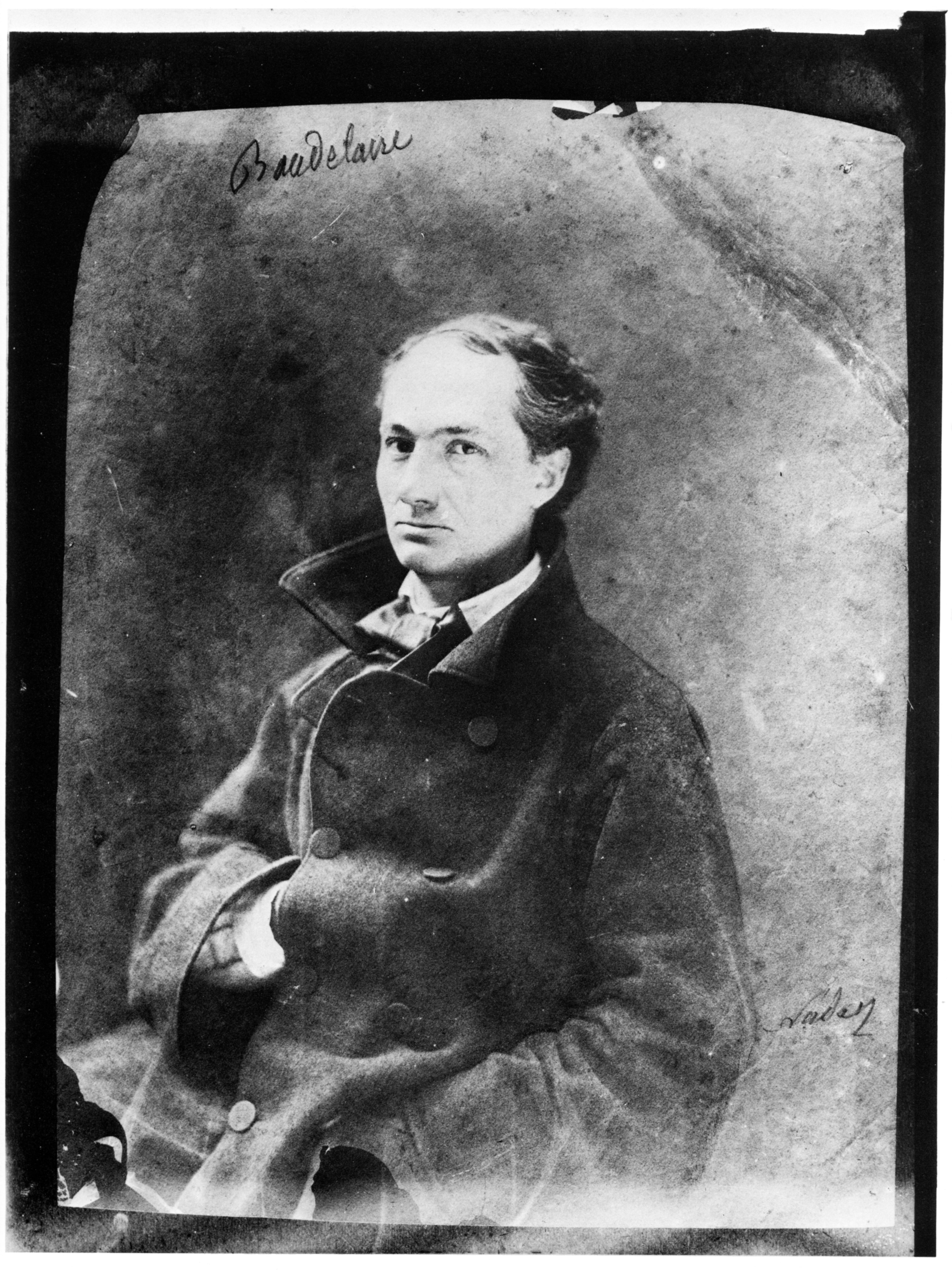
Originally published on The Brooklyn Rail‘s website. The image is Charles Baudelaire photographed in 1855.

.
.
There has been no lack of talk, for the past ten or so years, of some kind of “crisis” in art criticism. James Elkins, Arthur Danto, Katy Siegel, Hal Foster, et al.; everyone seems to have some stake in the failure or ineptitude or impossibility of critical thought. Elkins says that judgment should return; Danto says it’s unnecessary. Siegel says critics have little, if any, real power, and Foster, when pressed, seems to conclude that contemporary criticism is too confused to pin down, which of course is true. Yet all the hand wringing has little to do with criticism per se. The deeper problem, no doubt, is political, and all the anxiety about whether or not we understand contemporary art and culture is misplaced from a deeper distress: do we even understand the world we live in? What’s unclear is not only how we got to our present historical condition, but also, by default, what progress beyond it would look like.

Jacques-Louis David, Death of Marat, 1793. Oil on canvas, 63 3/4 × 50 3/8". Royaux des Beaux-Arts/Koninklijke Musea voor Schone Kunsten, Brussels.

Jacques-Louis David, Death of Marat, 1793. Oil on canvas,
63 3/4 × 50 3/8″. Royaux des Beaux-Arts, Brussels.

Nor does culture seem to offer any directive past the impasse, although the problem isn’t the lack of excellent contemporary art. There is good art today, as there always has been. The deeper problem is that no one seems to be able to recognize it. Art, of course, relies on a receptive audience, and the fundamental question is whether or not one exists today. If even art, like politics, does not seem to be on the verge of a major breakthrough, that may simply be because we cannot imagine what that breakthrough might be.

Our historical moment is a peculiar one. We exist in a quite different universe from the political environments that produced Diderot, writing about the Salon on the eve of the French Revolution; or Baudelaire on Courbet in the wake of the Revolutions of 1848; or even Greenberg, writing about Abstract Expressionism at a time when Trotskyism was still a serious, if increasingly untenable, political position. Our climate is more pessimistic, and progress is more elusive. Revolutionary change is nowhere on the horizon today, as it was for the best critics of the past. Continue reading

The antinomy of art and politics

A critique of art as cultural resistance

Untitled.
Image: Gustave Courbet, Self-Portrait:
Man Smoking a Pipe (c. 1848-1849)

untitled2

Introduction

.
This article first appeared in September 2011, the same month that Occupy Wall Street officially began its reclamation of public space. It was written by Chris Mansour, a good friend and member of the Platypus Affiliated Society, the organization to which I formerly belonged. My reasons for republishing it here are several: the two-year anniversary of the movement recently came and went to little fanfare, my ongoing interrogation of the relationship between architecture and politics, and my reposting yesterday of an article by the German-French Marxist and architecture critic Claude Schnaidt on “Architecture and Political Commitment.” In that reposting, I recommended Adorno’s essay on “Commitment” as supplementary reading. Chris draws upon this article in the course of his own exposition. A good piece that is worthy of reflection.

Platypus Review № 39, editorial introduction: At the 2011 Left Forum, held at Pace University between March 18–21, Platypus hosted a conversation on the theme of “aesthetics in protests.” Panelists Stephen Duncombe (Reclaim the Streets), Marc Herbst (Journal of Aesthetics and Protest), Chris Mansour (Platypus), Laurel Whitney (The Yes Men), were asked to consider: “What are the historical roots that contribute to the use of current aesthetic interventions in political protests? In what ways do they expand or limit the possibilities for protests to transform the social order? How does experimenting with aesthetic and artistic sensibilities influence our political consciousness and practice?” The same theme was the subject of another event held at the New School in NYC on May 23, which featured Marc Herbst (Journal of Aesthetics and Protest), Chris Mansour (Platypus), A.K. Burns (W.A.G.E.), and Beka Economopoulos (Not An Alternative). A full recording of the discussion at the Left Forum can be found online. The article that follows is a modified version of the opening remarks made by Chris Mansour of Platypus at both events.

The antinomy of art and politics

by Chris Mansour

.
..
The very notion that art should have nothing to do with politics is itself a political position.

— George Orwell

.
There is an interesting passage in Herbert Marcuse’s short book, Counterrevolution and Revolt, which aims to flesh out how art relates to politics. In reflecting on art’s role in revolutionary struggle, Marcuse writes,

In its practice, art does not abandon its own exigencies and does not quit its own dimension: it remains non-operational. In art, the political goal appears only in the transfiguration which is the aesthetic form. The revolution may well be absent from the oeuvre even while the artist himself is “engaged,” is a revolutionary.[1]

Marcuse cites the example of Courbet, whose paintings signal the birth of modernity, and who founded a socialist club in 1848 and was later a member of the governing council of the Paris Commune in 1871. Yet, counterintuitive though it is, Marcuse remarks that “[there is] no direct testimony of the revolution in his paintings…[they contain] no political content.”[2] The “weight and sensuality” of Courbet’s still lifes — which were painted shortly after the collapse of the Commune — are far more “powerful” than any “political painting” could ever be.[3] Writing these statements in 1972 — four years after the failed “revolutions” of 1968 — it was becoming clearer to Marcuse that the politics of the New Left were losing their grip and its revolutionary energy was deflating. Likewise, the situation that Courbet found himself in after 1848 or 1871 was probably similar to, if not more tragic than, 1968.

Gustave Courbet, Still Life: Fruit, c.1871-1872. Oil on canvas, 23 1/8" × 28 1/4" (59 × 72 cm)

Gustave Courbet, Still Life: Fruit (c. 1871). Oil on canvas, 59 × 72 cm.

The separation between art and political activity that Marcuse was pointing to in Courbet may appear a bit strange to self-proclaimed cultural radicals or art-activists today. From Marcuse’s point of view, art remains autonomous from any exterior motives other than itself, and art cannot — and should not — act merely as a functional device for putting forth political aims. [4]  Continue reading

Divagation on “activism” in aesthetics and politics

From a forthcoming review

Untitled.
Image: Cover to Lajos Kassák’s
Ma: Aktivista folyóirat (1924)

untitled2

.
Excerpted and partially excised from a generally much more favorable review of Ben Davis’ Art and Class, a very worthwhile read. Some of this material strayed a little too far off course to be included.

.
The one glaring weakness of Ben Davis’ recent collection 9.5 Theses on Art and Class is its conflation of activism and politics. Of course, Davis is not alone in considering them more or less identical. For many who joined the antiwar movement of the mid-2000s, protest marches were the default mode of political participation. Much of Davis’ frustration with the self-important posturing of “radical” artists stems from this formative experience.

Early on in Art and Class, he recalls an exchange he had with an artist during this period. After conversing for a while about their shared opposition to the Iraq invasion, they each agreed to attend the next chapter meeting of the ANSWER coalition in New York. When the artist failed to show, Davis followed up only to find out that he’d spent his evening in front of an easel instead. The artist apparently informed him that “his painting…was his contribution to making the world a safer place.”[1] Needless to say, Davis was nonplussed by this explanation. Wondering what might lead someone to supply such a dubious alibi, he decided to submit the very idea (or, more accurately, the ideology) of “aesthetic politics” to further scrutiny. Upon closer inspection, he concludes that “[a]s a critical trope, ‘aesthetic politics’ is more of an excuse not to be engaged in the difficult, ugly business of nonartistic political activism than it is a way of contributing to it.”[2] Repeatedly Davis expresses his consternation at this state of affairs, finding most answers to the problem of art and politics wanting. Worse yet, he alleges, the question is no longer even asked: “The question of what, if any, relation artists might have to activism has receded into the background.”[3] Continue reading

PROUN

The “way station” between
painting and architecture

Untitled.
Image: El Lissitzky,
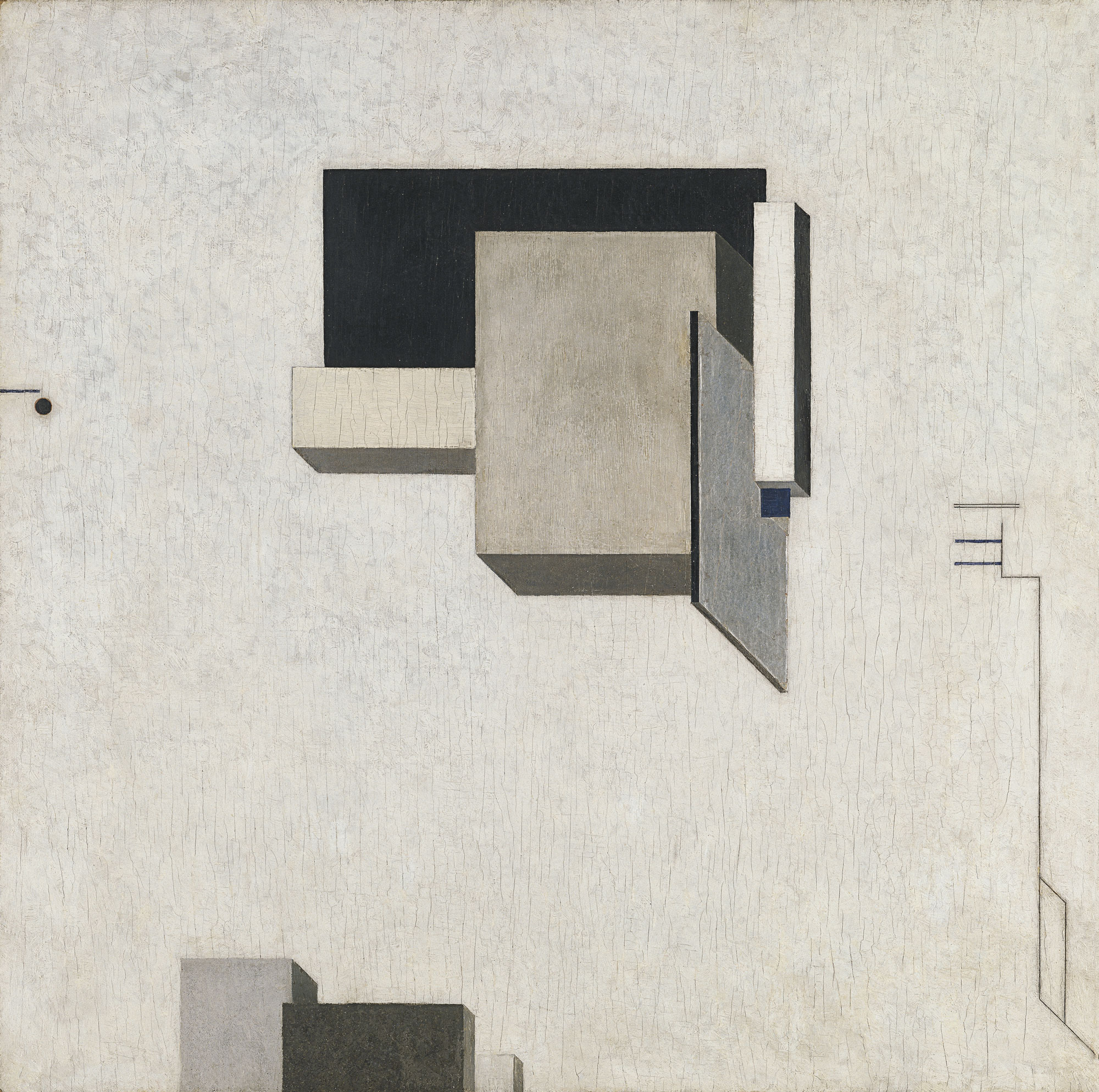
PROUN 1-C (1919)

untitled2

.
From “Theses on the PROUN: From painting to architecture” (1920)

Not world-illusion
but world-reality

.
1.
We have named PROUN a station on the path to the construction of the new form. […] From being a simple depicter the artist becomes a creator (builder) of forms for a new world — the world of objectivity. This does not mean the creation of a rivalry with the engineer. Art has not yet crossed paths with science.

2. PROUN is understood as the creative construction of form (based on the mastery of space) assisted by economic construction of the applied material. The goal of PROUN is progressive movement on the way to concrete creation, and not the substantiation, explanation, or promotion of life.

The path of the PROUN does not lie within the narrowly limited, fragmented, and isolated scientific disciplines — the builder consolidates them all together in his own experimental investigation.

The path of the PROUN is not the incoherent approach of separate scientific disciplines, theories, and systems, but is rather the straightforward path of learned influence over reality. […]

Continue reading

Soviet architecture: Notes on its development, 1917-1932

by Berthold Lubetkin, 1956

Untitled.
Image: Lubetkin’s trade pavilion
for the USSR, Bordeaux 1926

untitled2

Note: The following brief essay by Berthold Lubetkin, a constructivist architect and comrade of El Lissitzky who moved to Britain in the early 1930s, is actually remarkably lucid in its presentation of the theory-praxis problem so central to Marxism. I find the longitudinal distinction between “philosophies of East and West” a bit crude, but this is to be expected from a popular presentation intended for a British readership. Of course, Marxism (and Hegelianism, which is central for Lubetkin) had originated in the West, but by the time Lubetkin was writing this they had been driven out of mainstream Western political and intellectual discourse. Positivism, empiricism, and pragmatism appeared in its stead.

Lubetkin certainly wouldn’t deny the historical importance of Kant or Hume for the development of philosophy culminating in Hegel, but would instead emphasize the regression signaled by recourse to these figures after 1850, and the epistemological skepticism this entailed toward notions of causation. He was fond of quoting Hegel’s (and Spinoza’s before him, Engels’ after him) dictum that “freedom is the conscious recognition of necessity,” and always stressed the dialectical legacy of Marxist thought.

One of the recognizable dividing lines between the philosophies of East and West is gnoseology, and relates to the interpretation an generalization of the observed phenomena of life, and the coordination of the results into coherent theories and systems. The West, partly, no doubt, as a reaction against medieval dogmatism with its a priori, unverifiable order of things, and the consequent futility of scientific enquiry, partly as a reflection of its economic structure, shuns assumptions and principles, mistrusts generalizations, proceeds empirically to the point of denying the validity of law, of causality in nature and in society.

Berthold Lubetkin photographed in 1933

Berthold Lubetkin photographed in 1933

Under the influence of Kant and Hume, experienced facts are regarded as the ultimate finality, and are incapable of linkage into systems. The mere sequence by which one phenomenon follows another does not justify the conclusion that they are in causal relation, but rather that they coexist in our expectation, in our experience.

Through all forms of contemporary Western philosophy (relativism, empiricism, pragmatism, positivism, etc.), the disbelief in causality stands out as a common factor of decisive significance. In analyzing the interaction of phenomena, the objective character of laws is reduced to psychological necessity, regularity is equated with the particular case of accident, and the notion of objective truth is altogether eliminated, so that scientific results appear as a system or framework with no other end in view but that of convenience, utility, and economy of thought.

The West is thus basically skeptical, hostile to theoretical generalizations, to historical motivation, to the embodiment of experience into binding conclusions with the validity of objective laws.

The resulting intellectual atomization and fragmentation finds its counterpart in economics, in the crisis of productive relations, and it is revealed clearly and hauntingly in the manifestations of our art. Continue reading

Modernity for penguins — modernity for all!

Berthold Lubetkin’s celebrated
Penguin Pool in London (1934)
.

.
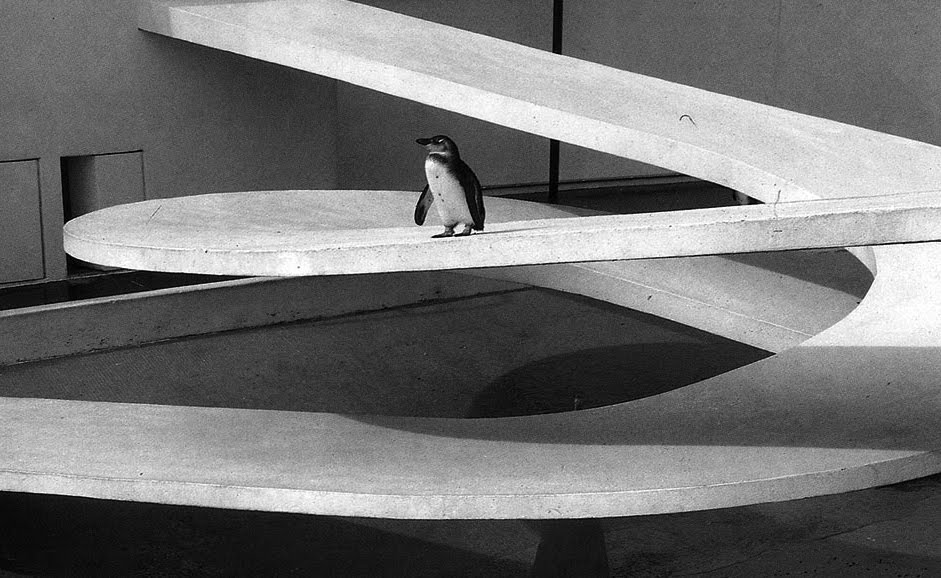
Image: A penguin pauses
midway down the ramp
of Lubetkin’s pool (1934)

.
Aviary, London zoological garden

Reyner Banham

.
.
From The Architectural Review.

(№ 138: Sept. 1965). Pg. 186.

.
Collapsed goal-posts among the trees — this, undoubtedly, is the first impression of the North Aviary from Primrose Hill, and equally undoubtedly it is a very belated contribution to the Arcadian tradition in British architecture. But, within that tradition, it does not belong to the gimcrack wing that gave us so many fake ruins and other collapsed objects among trees; rather, it belongs to the tough-minded stream whose triumphs are the palm stove at Kew Gardens, or Paxton’s Victoria Regia house at Chatsworth.

Lubetkin and Tecton's Penguin Pool (built 1934, photo late 1930s)

Lubetkin and Tecton’s Penguin Pool (built 1934)

In common with these great temples of acquisitive botany, the aviary is a walk-through exhibition-environment. This is not a total innovation at Regent’s Park Zoo, because one is also permitted to share the same physical space as the humming-birds, for instance. But to build on this scale and in the open is a very different problem from the creation of the small, totally artificial environment in which the humming-birds enjoy a manufactured climate secured by double-doored light-trap entrances. In the North Aviary the problem was more that of taming a piece of the existing topography and covering it with an enclosure high enough and broad enough for large birds to fly convincingly — and yet keep the public close enough to avoid the “Whipsnade effect” of sheer distance and natural surroundings making the exhibits invisible. With very little ingenuity, the form and levels of the present site would probably have made for better-than-average visibility even with an enclosure that permitted observation only from the outside. The creation of an internal observation route, by means as complex as a dog-leg bridge without intermediate supports, therefore proposes a significant improvement over outside viewing — and if the design failed to deliver this, then it would fail as architecture however handsome the covering structure. But quite obviously (though not so obviously that one does not have to explain it, alas) the bridge offers a bird’s-eye-type view of the cliff-face that no rearrangement of the solid topography could afford, except by making an equally high cliff directly opposite, and cliff-nesting birds do not nest on the sides of trenches. The other views, of birds washing and wading in the cascades for instance, are supernumerary benefits by comparison, though their sum-total is a substantial additional justification for the bridge. Continue reading

Instrumentality, “habitability,” and the city

A critique of Pierre Bourdieu
and Michel de Certeau

Untitled.
Image: Detail from Seher Shah’s
Object Relic: Unité d’Habitation(2012)

untitled2.

Architecture is a tool for oppression and control.
Architecture is a tool for revolution and liberty.

— Nick Axel, “Manifesto for an architectural future”

Metaphors that liken architecture to a kind of “tool” for the transformation or perpetuation of society fall well short of their respective objects. The relationship is too crudely put. So when Axel instrumentalizes architecture by calling it a tool for “oppression and control” or “revolution and liberty,” he tacitly sets up a one-to-one correspondence (or some other ratio) between politics and the built world. Consciousness cannot be fabricated in such a ham-fisted manner, however. Though specific configurations of space may prove conducive to the development of definite patterns of behavior, sensibilities, and inclinations, prompting individuals to modify their practices to match a certain set of circumstances and conditions, this seldom amounts to more than banal habituation.

Rendering of Le Corbusier's Unité d'Habitation. Text: "Can architecture inhabit us as much as we see ourselves inhabiting it?" I am not so sure.

Le Corbusier’s Unité d’Habitation. Text: Can architecture inhabit us as much as we see ourselves inhabiting it? I am not so sure.

Such habits and routines, insofar as they are thought to constitute a politics, supposedly crystallize within a habitus — a “type of environment” that engenders “systems of durable, transposable dispositions” amongst its inhabitants.[1] Intended as a way around the customary divisions within modern philosophy (between subject and object, structure and agency), the habitus is conceptualized as a kind of “immanent law, lex insita, laid down in each agent by his earliest upbringing, which is the precondition not only for the coordination of practices but also for practices of coordination.”[2] But what this thought-figure actually ends up doing is sidestep the most crucial issue: the instigation of political consciousness. Praxis is fractured into so many “practices,” politics reduced to micropolitical “acts of resistance,”[3] subjectivity deflated into a flaccid feeling of “agency.” All these accumulate until a sort of critical mass is reached, or so it is alleged, triggering a reflexive awareness of class interest. Still, the threshold marking the segue to this “awakening of consciousness” is never made clear.

The locus classicus for this line of thought, at least as it pertains to architecture and city life, remains the French Jesuit scholar Michel de Certeau’s treatment of “spatial practices” in The Practice of Everyday Life. In the famous chapter on walking in the city, de Certeau asked: “[W]hat spatial practices correspond …to…apparatuses that produce a disciplinary space?” Drawing on a couple motifs from Bourdieu and Foucault, he proposed to “follow out these multiform [spatial practices], resistance, tricky and stubborn procedures that elude discipline without being outside the field in which it is exercised, and…lead…to a theory of everyday practices, of lived space, of the disquieting familiarity of the city.”[4] Of course, the majority of the liberatory spatial practices elaborated by de Certeau occur in spite of architecture, or “functionalist totalitarianism,”[5] rather than because of it. Whether architecture or urbanism could ever function as a positive factor encouraging such habits is open to speculation; for de Certeau, they only provide a negative impetus. Architecture is for the most part viewed as a repressive device — “mathematical order imposed upon stone,” in Bataille’s hyperbolic phrase, “monumental productions grouping servile multitudes under their shadow, inspiring admiration and amazement, stasis and constraint” — with no emancipatory power to tell.[6] People seem to be liberated from architecture, not by architecture. Continue reading

Architecture in revolutionary times

Parallels after Emil Kaufmann

Untitled.
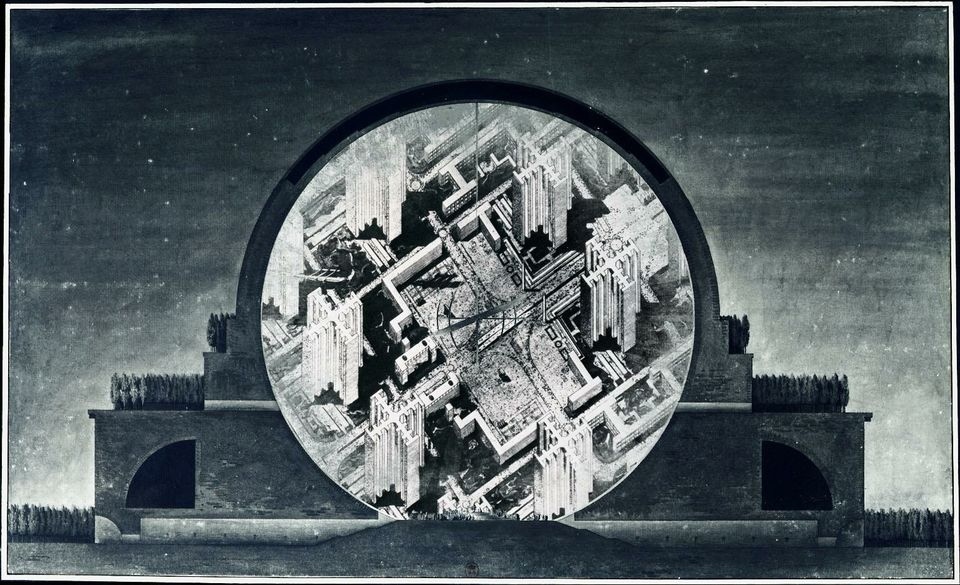
Image: Clever visual paraphrase of Kaufmann’s Von
Ledoux bis Le Corbusier
(1933). Von Boulée bis Le
Corbusier
? Corbusier’s Ville Contemporaine (1922)
inscribed in Boulée’s Cénotaphe à Newton (1784)

untitled2

Determining the relation of architecture to revolution clearly depends in no small measure on how these terms are defined. Before revisiting this familiar counterposition, however, it is worth noting that revolutionary politics makes up only one part of politics proper. Even if one were to grant architecture some kind of inbuilt political status, this by no means guarantees the politics it embodies are of the revolutionary variety. Architecture can for instance be politically reformist in character, as in Ernst May’s Neue Frankfurt settlement or Walter Gropius’ Törten district outside Dessau, Karl Ehn’s iconic Karl Marx-Hof block in Red Vienna, and JJP Oud’s Spangen/Kiefhoek estates in Rotterdam.[1] In the last few decades, critical regionalists such as Kenneth Frampton, Alexander Tzonis, and Lilliane Lefaivre have likewise spoken of “an architecture of resistance,” understood as “a cultural density which under today’s conditions could be said to be potentially liberative in and of itself.”[2] Despite its many outspoken adherents, practical examples of critical regionalism are harder to come by than those associated with interwar Sozialpolitik.[3] Most of the time it’s tended to emerge alongside movements struggling for autonomy against neoliberal integration, as in Catalonia, Scandinavia, and the Baltics during the ’70s and ’80s. But objections have been raised even on purely theoretical grounds.[4]

So much for the architectures of resistance and reform. Is there, then, an architecture of revolution? Certainly, some have made the case that there is. Foremost among them is the Viennese art historian, Emil Kaufmann, who in his 1952 study Three Revolutionary Architects: Boulée, Ledoux, and Lequeu described these most radical bourgeois architects of the French Enlightenment as “men imbued with the great new ideals set forth by the leading thinkers of the century [who] strove, unconsciously rather than intentionally, to express these ideals in their own medium.”[5] Though the actual basis for this correlation is never spelled out in detail, inferred from a shared emphasis on the idea of “autonomy,”[6] Kaufmann’s chief merit consists in precisely this intuition of a nonsensuous similarity between the philosophic and architectonic modes of its expression. At times he came close to discerning its sociopolitical root. “Having lived in the atmosphere of growing political and social discontent,” Kaufmann wrote, “the revolutionary architects wished to realize, for the common good, the ideals of the time by contriving architectural schemes such as had never existed before.”[7]

Jean-Jacques Lequeu's Monument to the revolution (1791)

Jean-Jacques Lequeu’s Monument to the revolution (1791)

Two aspects of Kaufmann’s classic account of revolutionary architecture deserve to be mentioned. First, there is the procedure he adopts in attempting to situate architecture and revolution. Rather than assume direct correspondence between them, either according to a linear model of cause and effect or a reciprocal model of mutual causation and effectuation, Kaufmann suggested a more circuitous and indirect link. In other words, architecture neither brings about revolution by itself nor prevents it from coming about, and vice versa. Still less could the matter be resolved simply by asserting that they simultaneously codetermine one another. Kaufmann instead contended the apparent isomorphism of moral and architectural conceptions of autonomy during this period arose out of their common participation in its revolutionary Zeitgeist.[8] A materialist would only add that this radical spirit of innovation he perceived was but the ideological reflection of real historical dynamics. Continue reading

Trellick Tower: The fall and rise of a modern monument

Fosco Lucarelli and
Mariabruna Fabrizi


.

Image: Ernö Goldfinger’s monumental
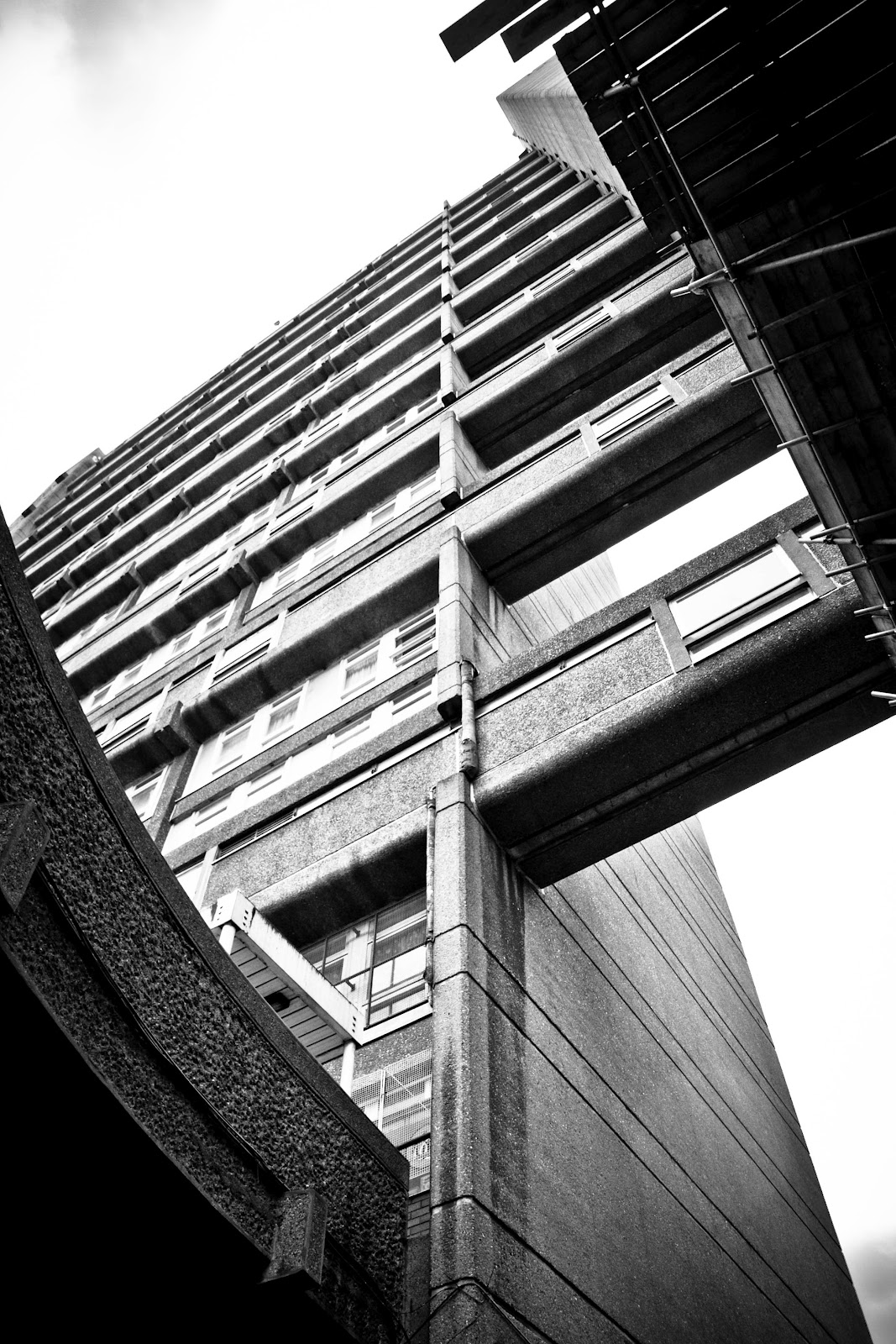
Trelleck Tower in London (built 1972)

.
Drawing by San Rocco / Salottobuono
Published in San Rocco Magazine
№ 5 — Fall 2012 [Scary Architects]
Reposted from the blog microcities

Recalling his first job experience, a certain gentleman still remembers the horrified faces of his friends after revealing he was just about to start working at Ernö Goldfinger’s architectural firm. In retrospect, he admits, it was pretty much like the reaction of the peasants to young Harker’s sister when he announced that his brother was going to visit Count Dracula.
Few architects, if any, would earn as much public loathing as Goldfinger during the 1960s and ’70s, and it is not by chance that Ian Fleming’s villain was named after him.

Ernö Goldfinger in front of Trellick Tower_45687163_8

Hated for his short temper as well as for his architectural production, Goldfinger — a lifelong Marxist who practiced in Perret’s atelier — embodied the last phase of heroic, utopian modernism, and experienced its subsequent fall in public opinion.

The socialist utopian ideology associated with the Brutalist style was a perfect fit in the context of the British post-war housing shortage, and the development of high-rise buildings in the relatively flat London boroughs was initially touted by the government as a modern, forward-looking solution. If high-density housing was the setting, then concrete was to be the protagonist. For two decades, practicality had been aesthetics: being economical, flexible and indestructible, concrete became a metaphor for “the future” and acquired enough respect to be emphatically exposed on the façades of large buildings.

Starkly aggressive, with its thirty-one floors towering over a low-rise neighborhood, Goldfinger’s 1972 Trellick Tower in London is a tragic syntax comprising raw concrete, deep shadows, and sky bridges evoking the purified silhouette of a mediaeval castle. With its uncompromising materiality — which inelegantly quotes Le Corbusier — the tower is a daring presence in London’s post-war landscape, an expressionistic monument for the masses. Continue reading