Architecture and social structure

.
Originally published as part of MAS Context‘s “In Context” section. You can read the full piece over at Iker Gil’s elegantly designed website for the journal, including some pieces I curated from its back issues along new narrative lines.

Architecture today is, first and foremost, a social product. Not just in the sense that it’s constructed by means of a complex, global division of labor (though this also), but at an even more basic level — it both embodies and envisions certain relations between men, as well. Make no mistake of it, however. In no way should this be taken to imply that architecture is produced for the sake of society. Quite the opposite. Like any other commodity, a building comes about socially, through the productive agency of groups and individuals working together. But this work is directed toward ends fundamentally alien to itself; its purpose is not to benefit society or edify mankind but rather serve as a site for the accumulation of capital. Either that, or the built object merely rematerializes that which already floated up from the base, ideological figments and fragments that have outlived the historical conditions from which they arose. These now nestle into mortar, stone, and brick. All that melted into air is made solid once more.

Of course, none of this is to say that great architecture can’t be produced under capitalism. Hardly anything could be further from the truth. The architectural legacy of the modern age is at least as impressive as that which preceded it — whether one begins, as Kaufmann did, with the French revolutionary architects of the eighteenth century, or reaches further back, like Tafuri, to the city-states of the Italian Renaissance. Modernism itself was nothing but the self-conscious attempt to take hold of the forms and forces unleashed by modernity, as the spirit of the times comprehended in concrete. Continue reading

Rousseau, Kant, and Hegel

Chris Cutrone
Platypus Review 61
November 2013
.

.
Originally published in the Platypus Review.

On June 9, 2013, the Platypus Affiliated Society organized a panel discussion on “Revolution without Marx? Rousseau and his followers for the Left” for the 2013 Left Forum at Pace University, New York. What follows is the edited version of the first of the prepared opening remarks. A full recording of the event is available online.
.

Introduction

.
Bourgeois society came into full recognition with Rousseau, who in the Discourse on the Origin of Inequality and On the Social Contract, opened its radical critique. Hegel wrote: “The principle of freedom dawned on the world in Rousseau.”

Marx quoted Rousseau favorably that “Whoever dares undertake to establish a people’s institutions must feel himself capable of changing, as it were, human nature…to take from man his own powers, and give him in exchange alien powers which he cannot employ without the help of other men.”

Rousseau posed the question of society, which Adorno wrote is a “concept of the Third Estate.”

Marx recognized the crisis of bourgeois society in the Industrial Revolution and workers’ call for socialism. But proletarian socialism is no longer the rising force it was in Marx’s time. So what remains of thinking the unrealized radicalism of bourgeois society without Marx? Kant stated that if the potential of bourgeois society was not fully achieved as the “mid-point” of freedom then Rousseau may have been right to prefer savagery against civilization’s “glittering misery.” Nietzsche warned that we might continue to be “living at the expense of the future:” “Perhaps more comfortably, less dangerously, but at the same time in a meaner style, more basely.”[1] How have thinkers of the revolutionary epoch after Rousseau, Adam Smith, Kant, Hegel, Benjamin Constant, and Nietzsche himself, contributed to the possibility of emancipation in a world after Marxism?

Karl Marx, photographed in 1870

Marx and Rousseau

.
Marx’s favorite quotation of Rousseau, from On the Social Contract, goes as follows:

Whoever dares undertake to establish a people’s institutions must feel himself capable of changing, as it were, human nature, of transforming each individual, who by himself is a complete and solitary whole, into a part of a larger whole, from which, in a sense, the individual receives his life and his being, of substituting a limited and mental existence for the physical and independent existence. He has to take from man his own powers, and give him in exchange alien powers which he cannot employ without the help of other men.[2]

Marx wrote that this was “well formulated,” but only as “the abstract notion of political man,” concluding that,

Human emancipation will only be complete when the real, individual man has absorbed into himself the abstract citizen; when as an individual man, in his everyday life, in his work, and in his relationships, he has become a species-being; and when he has recognized and organized his own powers as social powers so that he no longer separates this social power from himself as political power.[3]

What did Marx mean by “social powers” as opposed to the “political power” from which it has been “separated?” Continue reading

Bauhaus color

.
Here are some hard-to-find color renderings by Bauhaus students (Herbert Bayer, Farkas Molnár, Joost Schmidt, Peter Keler), with text by Tadeusz Peiper.
.

At the Bauhaus

Tadeusz Peiper
(1927)

.
Bauhaus, the one in Dessau. So, off to Dessau. Three hours by passenger train from Berlin. We’re already there by 5 p.m. Even the feet on the stairs in the hallway of the station make it clear we’re in the provinces. But not in the Prussian provinces. Prussian towns differ only in the size of their population, not in their essence. There is almost no trace of Berlin left here. We are in the capital of the duchy of Anhalt. Small one- and two-story houses, almost like those in the Szweska district of Cracow or in the Elektoralna district in Warsaw. Around the city tall red smokestacks shoot up. We are in one of central Germany’s coal-mining centers.

A café. Frankfurters. Malevich has three cups of tea. Call Kandinsky, not home. Stop in front of every lighted store window. Sighs of longing from Malevich at overcoats, tablecloths, and suitcases. We pretend to purchase a bed. Call Kandinsky, still not home. Back into the street. Damned rain.

No time to lose. Call Gropius, the director of the Bauhaus. We go into a cafe. I call. He’s home! He is very pleased, offers us to let us spend the night at his home, drives up to the cafe in the director’s car. A noble face, veiled in fatigue, hardened by truth.

We are at his place. Entry hall. A wall that consists of a thin, sandy cloth curtain behind which stands — as we will see the following day — the dining room, which is directly connected to the kitchen, with a sliding window between the two. Continue reading

Adam Smith, revolutionary

Spencer A. Leonard
Platypus Review 61
.

By exposing the historical necessity that had brought capitalism into being, political economy became the critique of history as a whole.

— Theodor W. Adorno[1]

Unlike Jean-Jacques Rousseau or even Friedrich Nietzsche, Adam Smith is a thinker few on the contemporary Left will have much time for. This tells us more about the impoverishment of the currently prevailing intellectual environment than about the persistent, if ever more obscure, influence of bourgeois radicalism on the Left. Today, of course, it is fashionable to have “a critique of the enlightenment” or, alternatively, to defend it against an array of enemies, including postmodernism, religious conservatism, and academic obscurantism. Those currents of the contemporary Left that still seek to lay claim to the Enlightenment must fend off Smith, because, like Rousseau, his is an Enlightenment that cannot be upheld simply as an affirmation of “reason” or the demand for “human rights.” Smith’s Enlightenment demands to be advanced. His 1776 treatise, An Inquiry into the Nature and Causes of the Wealth of Nations, is not a product of the Scottish Enlightenment but of the cosmopolitan radical Enlightenment, stretching from the coffeehouses of Rotterdam to the meeting rooms of Calcutta. If that cosmopolitan Enlightenment project remains “unfinished,” it is because the course of history since the publication of Smith’s magnum opus failed to fulfill and indeed undermined the radical potentials of the eighteenth century.

Cornwallis’ 1781 surrender at Yorktown, where American soldiers sang the British Revolutionary song “The World Turned Upside Down”

Cornwallis’ 1781 surrender at Yorktown, where American soldiers
sang the British Revolutionary song “World Turned Upside Down”

Smith’s powerful influence upon French revolutionaries such as the Abbé Sieyes and the Marquis de Condorcet, and through them upon Immanuel Kant, Benjamin Constant, and G.W.F. Hegel, are not as well known as they should be, but that need not detain us from coming to terms with the profound radicalism of his thought. Less well known still is the respect that Smith and his close friend, David Hume, held for Rousseau’s works. Hume, refusing to allow his famous public quarrel with Rousseau to cloud his judgment, contended in a letter to Smith that the Genevan’s writings were “efforts of genius.”[2] This was an estimate Hume doubtless knew would find favor with his friend, since as early as 1756 Smith had written an article that is perhaps the earliest discussion in English of Rousseau’s Discourse on the Origin and Basis of Inequality Among Men, singling that work out as the act whereby the Francophone world re-established its supremacy in philosophy for the first time since Descartes, displacing the preeminence of English political and social thought that had lasted for almost a century with the writings of Hobbes, Locke, Mandeville, Shaftesbury, and others.[3] Continue reading

In memoriam: Lebbeus Woods one year after his death

.
A little over a year ago the visionary architect Lebbeus Woods died. I never got around to writing up a reflection on his passing, something commemorating and celebrating his lifework. Thankfully, many whose opinions and insight I respect did.

What follows is thus a pastiche of images by Woods and text from two articles — one by Sammy Medina (then at Architizer), with whom I’ve collaborated in the past, the other by Kelly Chan (then at ArtInfo), a fantastically overproductive architecture critic who I know through Sammy — as well as a quote from the British author Douglas Murphy on Woods’ oeuvre.

Early drawings

Not much I can really add to their comments, really, except to point out a few intersecting themes that unite them (for good reason, too, as I think they hit upon something):

  • First, there is the contrast of Woods’ career with those of his contemporaries Daniel Libeskind and Zaha Hadid, both of whom transitioned from speculative architectural drawing in the late 1970s and 1980s to become “starchitects” by the mid-1990s. Douglas, Sammy, and Kelly all stress Woods’ disappointment with the naked careerism of his former peers.
  • Second, related to the first point, there was Woods’ refusal to capitulate to the imperative to build in a reactionary age. This wasn’t an act of simple asceticism, I don’t think, but rather a recognition of historical reality.
  • Finally, there is the comparison that both Sammy and Kelly made of Woods to the pioneering Italian draughtsman Piranesi — whose work, according to Manfredo Tafuri, prefigured that of the twentieth century avant-garde. Piranesi, like Woods, built very little during his lifetime. Both are instead remembered for their resolute commitment to “paper architecture,” whose unsettlingly speculative content served to disenchant the triumphant conservatism that had overtaken architecture in their time.

With that, I’ll conclude. Enjoy.

Lebbeus Woods, Makeshift House (1990s)

Lebbeus Woods, Makeshift House (1990s)

On the passing of Lebbeus Woods

Douglas Murphy
Guardian

.
Guardian quotes Douglas Murphy as follows:

Around the end of the 1980s Lebbeus Woods was just one of a number of radical architects making their name through the production of imaginary projects; elaborate drawings and paintings occupying a milieu somewhere between fine art and architecture, which allowed many to interrogate the conventions of their discipline. Open a book on the experimental architecture of that period and Woods’ heartfelt and haunting drawings regarding the siege of Sarajevo share space with early works from the likes of Daniel Libeskind and Zaha Hadid. But unlike so many of that generation who eventually made the career transition from avant-garde upstarts to global superstars, Lebbeus Woods never got rich by building rubbish. Continue reading

Nietzsche’s untimeliness

Sunit Singh

.
The following article first appeared in the Platypus Review. It covers some of the same terrain that I explored around a year ago in my reflections on the recent “anti-Nietzschean turn” that has taken place on the Left. Sunit’s piece ranges a bit more widely than my own, and incorporates important insights from the early Marxist Franz Mehring and the later critical theorists of the Frankfurt School elucidating Nietzsche’s fraught relationship to his own time, bourgeois liberal democracy, and the rise of the socialist workers’ movement.

I’d also recommend Mazzino Montinari’s excellent overview, Reading Nietzsche. Montinari was an Italian Marxist dissident who left the PCI during the early 1970s, and helped edit the collected works of Nietzsche in German.

Introduction
.
.

Eros and Civilization: the title expressed an optimistic, euphemistic, even positive thought, namely, that the achievements of advanced industrial society would enable man to reverse the direction of progress, to break the fatal union of productivity and destruction, liberty and repression — in other words to learn [Nietzsche’s] gay science.

— Herbert Marcuse

In [ancient] philosophy the duties of human life were treated as subservient to the happiness and perfection of human life. But when moral, as well as natural philosophy, came to be taught only as subservient to theology, the duties of human life were treated of as chiefly subservient to the happiness of a life to come…[But even] in [what came to be called] the modern philosophy [perfecting virtue] was frequently represented as generally, or rather as almost always inconsistent with any degree of happiness in this life; and heaven was to be earned only by penance and mortification, by austerities and abasement of a monk; not by the liberal, generous, and spirited conduct of man.

— Adam Smith

Nietzsche believed that gaining even a modicum of reason and freedom had to be a hard won, blood-soaked, and world-historical affair, but was nevertheless inclined to be as uncharitable in the extreme toward Jean-Jacques Rousseau, “the seducer” behind the idealist and rabble in the French Revolution, as toward the socialists who claimed to be the inheritors of the Jacobin tradition. He identified Of the Social Contract — a meditation on the conditions of possibility for the radical self-determination of modern civilization — as putting forward the first image of modern man to inspire mortals to a “transfiguration” of their own circumstances. However, modern man turned out to be a creature afflicted with a fevered historical self-consciousness that periodically flared up in revolutions, “like Typhon under Etna.”[1] It was a symptom of this curious sickness, Nietzsche held, that had led the philosophizing son of a watchmaker to characterize man as a creature full of pity or empathy and as capable of perfectibility, while positing an unwarranted faith in nature as an idyll of freedom. Nietzsche saw modern civilization as a chimera, characterized by what Kant had referred to as “glittering misery” and by the creation invidious interdependencies, but had reached the opposite conclusion as the “Citizen of Geneva.” For Nietzsche, plunging further into the civilization that the latter abhorred “is precisely that which speaks in favor of civilization.”[2] For moderns, who were proving themselves unable to squarely take on the task of Enlightenment, it was as “reasonable” to consider a return to nature as it was for them to revive Greek tragedy; we moderns had no chance of ever going back to the state of nature — the state of nature was itself a myth that the dialectic of Enlightenment had necessitated.

Photograph of Nietzsche, Paul Rée, and Lou Salome, circa 1882.

Photograph of Nietzsche, Paul Rée,
and Lou Salome, circa 1882.

Despite identifying “the labor question” as an intractable issue of the industrial age, Nietzsche never offered a clear resolution to the “the physiological self-contradiction” that defines capitalism. One can admit as much without either attempting to shape Nietzsche on a Marxist lathe — the accusation once leveled at Adorno — or giving in to the idea that Nietzsche was an elitist, anti-democratic, and anti-liberal conservative.[3] The efforts to “let workers be themselves” had failed, Nietzsche wrote in Twilight of the Idols, as a result of “the most irresponsible negligence.” Nietzsche was apportioning fault for this “negligence” directly on the socialists, who were confounded as to why, in spite of the fact that workers had made enormous strides toward sociopolitical equality since the industrial revolution, and justifiably wanted more and felt “their existence to be desperate… an injustice,” their demands for “a social democracy” could not be met by the vote and contractual rights. Europe had to answer the workers, while the workers tried to articulate their own demands and to answer, “What do they will?”[4] But the socialists — those “superficial, envious, and three-quarter actors” infected with “nihilism” — had turned freedom into an ethic and so crab-walked backward into “a will to negate life.”[5] Further, their values were little more than refashioned Christian ideals rather than peculiarly modern aspirations; their certitude that a socialist revolution was inevitable was motivated by the same animalistic instincts that had led Christians to see the Last Judgment as “the sweet consolation of revenge.”[6] Such vituperations also masked the actual task of emancipation and left the socialists with the muddle-headed belief that, “[as] time marches forward…Everything that is in it also marches forward — that the development is one that moves forward.” Although, even “the most level-headed are led astray by this illusion,” Nietzsche claimed, “the nineteenth century does not represent progress per the sixteenth…’Mankind’ does not advance, it does not even exist…Man represents no progress over the animal: the civilized tenderfoot is an abortion.”[7] Despite the touted “progress” of the nineteenth over the eighteenth century, the socialists had overlooked or were unable to recover what earlier revolutionaries, inspired by the notion of the infallible sovereignty of the General Will, had understood — that rather than “dance in our ‘chains’” we had to break them.[8]

The case of anti-Nietzsche

.
The aristocratic antipathy in which Nietzsche held the Left is presumably one reason behind the leftist “anti-Nietzsche” stance. Others chafe at the fact that Nietzsche was a staunch individualist who clubbed the Marxist social-democrats together with the anarchists as well as with the Christian socialists; Nietzsche was satisfied to say that anarchism held “the same ideal [as socialism], but in a more brutal fashion,” while the dogmatic social-democrat who hypostatized class relations was in as bad faith as the Protestant minister who reconciled men to their wretched fate.[9] Malcolm Bull is the latest leftist to argue for an anti-Nietzsche stance. But with the critical difference that Bull’s criticism of Nietzsche is rooted in a conservatism that obfuscates the established tradition of left criticism of Nietzsche, which dates back to the revisionist debate. Bull compares Nietzsche to Durkheim, as both were diagnosticians who theorized that the incompleteness of our transition to modernity had manifested itself pathologically in what Nietzsche referred to as “decadence” or “nihilism,” and in what Durkheim called “anomie.” Continue reading

Internationalism fails

Chris Cutrone

.
This article is reposted from Platypus Review no. 60. Generally, I agree with its assertions about “anti-imperialist” politics in the present. Nevertheless, this should not be taken to mean that I support US military aggression overseas (not that I have any say in the matter). On Facebook, a heated exchange between James Heartfield, Chris Cutrone, Spencer Leonard, and Reid Kotlas followed. If they don’t mind, I might repost snippets of that argument as a supplement.

The “anti-imperialist Left” considers itself opposed to all U.S. government action as “imperialist” on principle. But, as Trotsky wrote to his followers in 1938, “Learn to think!” while one may oppose the government politically, to oppose the government putting out a fire, especially when there is no alternative agency for doing so, is nonsense. But the “Left” today is not the inheritor of Trotsky, but rather of what he pitilessly assailed, the policy of the Stalinist “Popular Front Against War and Fascism” of the 1930s, for which the shibboleth was, “Which side are you on?”

The idea is that the defeat of imperialist policy creates possibility for an alternative, and therefore one must always be against imperialism to be on the side of an alternative to it. Historically, Marxists have understood such a strategy in terms of either “revolutionary defeatism” or “revolutionary defensism.” Simply put, the defeat of an imperialist power is seen as providing the possibility for a political alternative to the government of the imperialist country; whereas the defense of a country against imperialist attack is seen as providing the possibility for a political alternative in the subaltern country. Importantly, these are not pacifist positions against war, but rather political military strategies in time of war, moreover with the aim of revolution.

Pivertistes, Mai 1938: Royan, Daniel Guérin

Pivertistes, Mai 1938: Royan, Daniel Guérin

Historically, there are two examples of success of these strategies of revolutionary defeatism and revolutionary defensism: the role of the Bolsheviks in the Russian Revolution is regarded as a success of revolutionary defeatism, in which the defeat of the Tsarist Russian Empire undermined the government and gave rise to political and social revolution; and Mao’s Communists in the Chinese Revolution, in which the defense of China against Japanese imperialist attack undermined the nationalist Kuomintang and allowed for Communist-led revolution. Continue reading

Women’s liberation in non-Western contexts

.
Seeing all this press coverage of
Malala Yousafzai and the plight of women’s education in Taliban-controlled regions in Pakistan, and having recently revisited the sad history of the degradation of women’s rights in Afghanistan after the PDPA was defeated and the Red Army was driven out in 1989, I’ve been pondering the question of women’s liberation in “Oriental” (i.e., traditional non-Western) contexts. Lately I’m reminded of the revolutionary transformations that took place in Uzbekistan between 1920 and the early 1930s, especially with Zhenotdel‘s mass unveiling ceremonies, programs for women’s education, and anti-illiteracy campaigns in the region. All of these activities were carried out in tandem, as religious prejudices, domestic bondage, and illiteracy were to be combated both directly and indirectly — directly through propaganda work, and then indirectly through the removal of economic conditions that give rise to such social ills.

Education and domestic emancipation are more or less uncontroversial. Abolishing reactionary religious traditions is another matter, however. Despite the fact that Lenin was already insisting in 1922 that militant materialism necessarily implied “militant atheism” [воинствующий атеизм, more literally “warlike” atheism], there’s been a great deal of distortion on this score. This has to do with efforts to reinterpret the past to suit the perceived political exigencies of the present. Making the past dance to the tune of the present is a fairly routine procedure amongst certain parts of the Left.

Tashkent before the reforms.

Dave Crouch, writing for the International Socialist Journal, would like to pin all of the blame for antireligious initiatives like the khudzhum [i.e., the mass unveiling campaigns] on “Stalinist bureaucracy.” The fact of the matter is that the women’s division [Zhenotdel] and the Union of Tatar Godless [Soiuz tatarskykh bezbozhnikov] already laid the groundwork for such measures in the early 1920s. Members of either organization cannot be fairly characterized as “Stalinist”; indeed, Stalin had both of these wings within the party disbanded by the end of the decade.

Luckily, Gerry Byrne has already gone through and written a point-by-point refutation of some of Crouch’s more obvious gaffes. A couple points are worth mentioning. In the footnotes, two passing remarks by Crouch are particularly revealing:

It is a pity that Richard Stites, one of the foremost historians of women’s liberation in Russia, fails to see the khudzhum as part of Stalin’s “sexual Thermidor.” Richard Stites, The Women’s Liberation Movement in Russia: Feminism, Nihilism and Bolshevism 1860-1930. (Princeton, 1978). Pg. 340.

Crouch only says it’s a pity because Stites’ judgment runs counter to the view he would like to promote. Whether or not the khudzhum was a wise policy, a botched and culturally “insensitive” attempt to liberate women from traditional roles and conventions, it cannot be considered even remotely equivalent to the stricter divorce policies, abortion ban, and recriminalization of homosexuality instituted under Stalin’s regime. Stites is here, as usual, a far better historian than pseudo-Trot revisionists.

Education.

A few footnotes later, Crouch writes:

In 1922 the 4th Congress of the Communist International corrected its policy adopted at the 2nd congress and endorsed temporary alliances with pan-Islamism against imperialism.

If this were actually the case, the Cliffites’ mechanistic anti-imperialism might appear grounded in longstanding revolutionary tradition. Unfortunately, no such “correction” ever took place. Lenin remained adamant to the end that Marxists’ position toward anti-imperialist movements abroad should stress “the need for a struggle against the clergy and other influential reactionary and medieval elements in backward countries,” as well as “the need to combat Pan-Islamism and similar trends, which strive to combine the liberation movement against European and American imperialism with an attempt to strengthen the positions of the khans, landowners, mullahs, etc.” Of course, as Lenin’s injunction directly contradicts the ISO’s general line toward political struggles in the Middle East, it’s omitted. E.H. Carr’s book indicates nothing of the sort, either. See pgs. 254-255 of his book on The Bolshevik Revolution.

For this post, I’ve assembled three excerpts. The first is excerpted from an article in Kommunistka [Communist Woman] by Marie Vaillant-Couturier (mother of the famous French Resistance fighter Marie-Claude Vaillant-Couturier, who testified at Nuremberg) on women delegates publicly casting off their veils [chadry] and burqas [parandzhi] at the Second International Women’s Congress in 1922. The second is from Louis Bryant, the wife of John Reid and a famous leftist journalist in her own right, in which she records some of Aleksandra Kollontai’s thoughts on women’s liberation, along with a couple of mild criticisms. Finally, I’ve translated an article Kollontai herself wrote about the conference with communist women and labor organizers of the East in April 1921. Moreover, there are some documentary photographs by the extraordinary Constructivist photographer Max Penson, who captured these revolutionary social shifts upon moving to Tashkent, Uzbekistan in 1920 (he was Jewish-Belarusian in origin). Penson stayed in Tashkent for the next twenty years. These photos show Uzbek women going from full-body veils (women caught without them were often threatened by men with blades, burning water, and acid, even having dogs sicced on them) to brandishing rifles within ten years. Continue reading

Dialectics and historical reality

.
Dialectics is not some sort of thought-trick or rhetorical sleight-of-hand, let alone the so-called “epistemological magic-key to revolutionary tactics or theory.” Of course, I don’t doubt that more than a handful of people (ab)use dialectics in this way. But this is true of practically every discourse, some more than others. There’s literally almost no end to jargon and the obfuscatory use of concepts. But where a feeble mind like Eugen Dühring dismissed Marx as someone “deeply bitten with the Hegelian pestilence,” seeing his dialectics as mere “verbal jugglery,” closer inspection would have revealed an actual content to what Marx was saying. More attention still would have disclosed a rationale as well behind his way of saying it.

Honestly, I’m not even sure something like epistemology is useful to politics, since arguably we’re only able to know the world insofar as we’re able to change it. Joseph Dietzgen, Theodor Adorno, and Alfred Sohn-Rethel critiqued epistemology along precisely these lines. Marx’s own Theses on Feuerbach (1845) set out to articulate this peculiar epistemological quandary and the conditions for its historical supersession. Turning prior materialist philosophies on their head, Marx wrote:

I. The chief defect of all hitherto existing materialism — that of Feuerbach included — is that the thing, reality, sensuousness, is conceived only in the form of the object of contemplation, but not as sensuous human activity, practice, not subjectively. Hence, in contradistinction to materialism, the active side was developed abstractly by idealism — which, of course, does not know real, sensuous activity as such.

II. The question whether objective truth can be attributed to human thinking is not a question of theory but is a practical question. Man must prove the truth — i.e. the reality and power, the this-sidedness of his thinking in practice.

This provides the basis for Marxism’s dialectical methodology. “Truth” is not a matter of passive consumption, whether intuited sensuously or conceptualized contemplatively. Rather, objective truth can only be attained only through humanity’s active participation in its own self-transformation.  Continue reading

Antiurban political economists in Scotland after Smith

James Anderson on
town and country

Untitled.
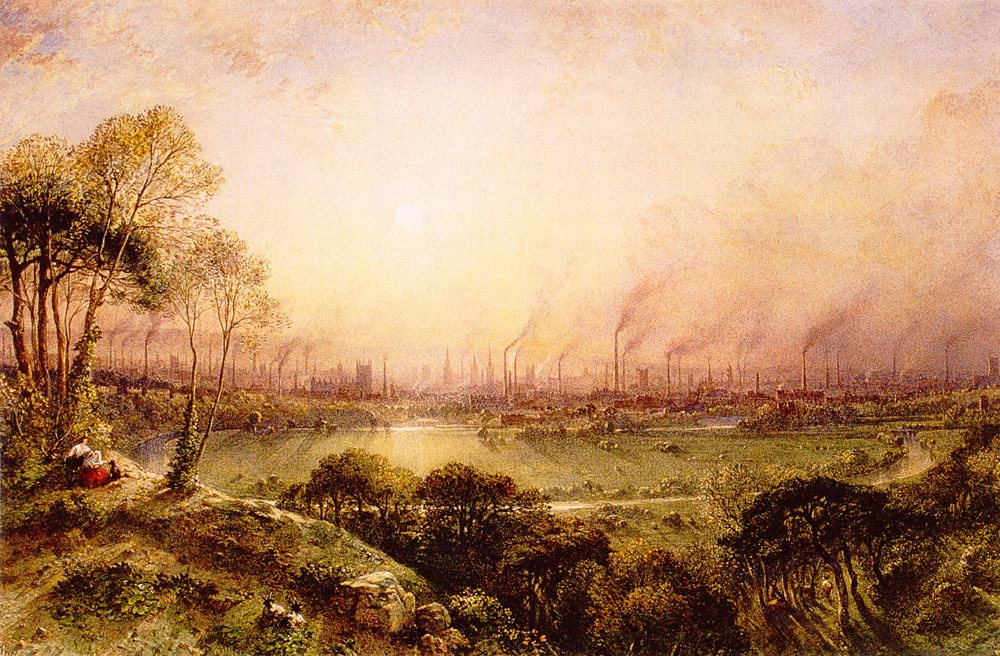
Image: Painter William Wylde’s
Manchester, from Kersal Moor (1852)
untitled2

A couple days ago I somehow found myself reading Adam Anderson, Dugald Stewart, Arthur Young, and James Anderson, all lesser economists of the Scottish Enlightenment. This was part of my background reading on the antithesis between town and country.

Last week I posted some classical bourgeois views on the issue. While James Steuart and the French Physiocrats idealized the countryside somewhat, assigning it priority over the emerging commercial and industrial centers of modern Europe, Smith stressed a kind of harmonious reciprocity or equilibrium between the two. Smith stood virtually alone in advocating for the city. His successors in fact opposed his position.

I’m reposting a section of James Anderson’s 1794 article “Of Manufacturing and Agriculture” here to give a sense of the deep conservatism of antibourgeois, anti-liberal aristocrats after Smith. Not until Ricardo and Sismondi were the main lines of Smith’s argument extended in any measurable way. Even then, Ricardo was never as keen on the novelty of capitalist conurbations, and Sismondi succumbed at times to romanticism in favoring “territorial wealth” (agriculture, the countryside) over “commercial wealth” (industry, the town).

The radicalism of Smith’s economic theory comes through especially sharply when contrasted with tracts like this.

William Hogarth's Harlot's Progress, Plate II (1732), in which Molly seduces a depraved Jewish urbanite

William Hogarth’s Harlot’s Progress, Plate II (1732),
in which Molly seduces a depraved Jewish urbanite

Of manufacturing and agriculture

James Anderson

Manufactures are subjected to great variations in the demand at market. Sometimes the orders for those of one sort are so great, that the highest exertions are required for supplying that demand. During this period every thing assumes the most inviting appearance. The master manufacturers have it in their power to enhance the price or diminish the quality. Their profits are great. Every one is anxious to obtain as great a share as possible in this gainful business; he tries to obtain as many hands as possible; journeymen, of course, become scarce, and obtain higher wages; this induces more persons to enter into that business. All is life and bustle; and smiling prosperity brightens every countenance. The lower classes of the people are enabled to pick and cull the nicest viands; for rearing which the farmer gets great prices, so as to enable him to abandon more common articles of produce. Continue reading