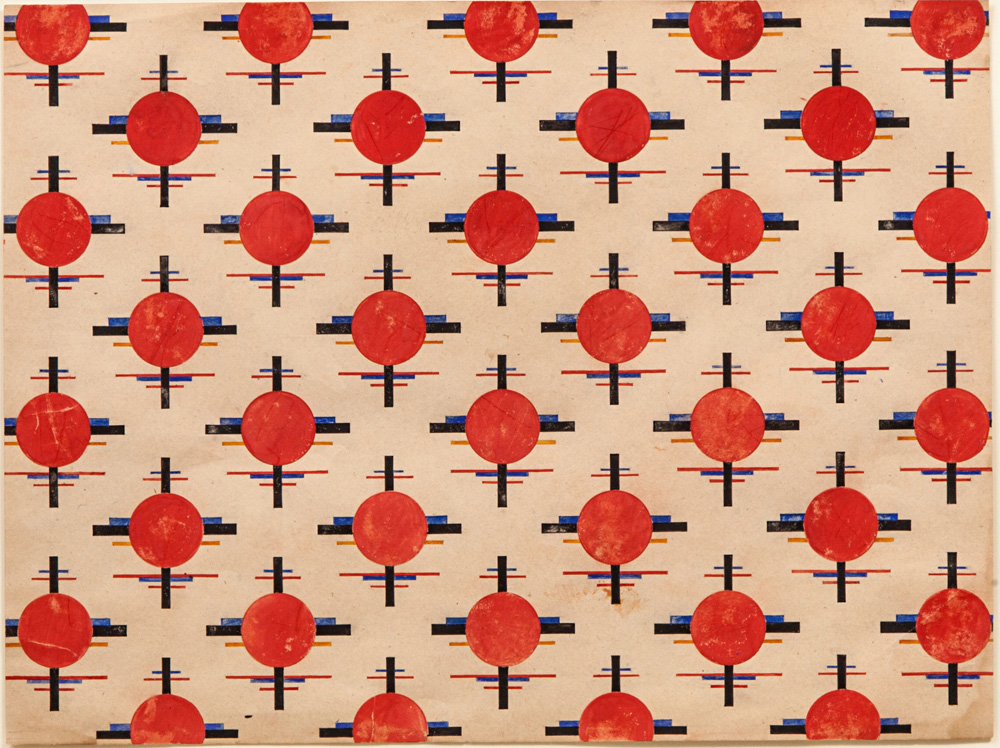
Aleksandr Deineka, The Red Army (1929)

00002 00003 00004

Problems of the Red Army

Leon Trotskii
The Communist
November 1919
.
.

Red divisions are over a front of vast length. Draw a line from Moscow in any direction, prolong it, and you will reach some part of the Red Army which is fighting for Soviet Russia so heroically. The organization of this army is a very good example of the efficiency of the revolution.

No wonder the war was called an examination to the people. Of course, war itself is a great barbarity, and all Socialists are bent upon its extermination. But it must be overcome; that is, circumstances must be changed so that war will become not only needless but impossible. The people cannot leap over war instantly, surrounded by the jackals of imperialism, until the mad teeth are jerked out of the mouths of these jackals. And if the people are forced to wage war, then in its capability of defense, battle and attack all the resources of the people are shown: its economic power, its strength of organization, the spiritual average of its masses, the amount of material for leadership, etc., etc.

And so, taking the question from this angle, we may say with assurance that in a land such as ours, worn out, despoiled and ruined to the last degree, no other regime could organize an army. We may now say with certainty that an army will not be successfully organized in Germany, neither by Ebert or Scheidemann. Only Communists, who have taken the power into their own hands and shown in a practical way that this power knows no interests, worries or problems other than those of the working class, will find it possible to organize an army which will become the dependable hedge of the Socialist Republic.

We commenced with the divisions of the Red Guards. Into these we accepted workers, not seldom those who took a gun into their hands for the first time. While the task was to overcome the fighting bourgeoisie, junkers, white guards, groups of students, etc., the Red Guards showed an incomparable excellence in their revolutionary spirit and determination. In a very short period Red Guard divisions spread the Soviet power to all parts of the country. But with the offensive of the Germans in February of last year the condition changed immediately. The enthusiasm of the untrained, badly armed people proved weak before the well-organized Hohenzollern divisions under junker leadership. The first battle showed this, and brought about a fall of spirits in our divisions and armies. This fall of spirits resulted in decomposition within the ranks.

00005 00006 00007 00008

Think of that period. The old army turned into an armed beggary all of Russia, filled all stations, cars, made direct attacks upon the workers on the railroads, ruined railroad property, forcefully robbed the food supplies, etc. The enemy attacked us from the west, taking the Ukraine. The Cossacks rebelled on the Don: in the East, the Czecho-Slovaks, and in the north Archangel was taken from us. The ring was growing tighter and tighter. Then the Mensheviki wrote about the “dying corpse” of the Soviet power. Not only the direct enemies of the working class, but some of the friends of the workers thought that there is no way out, salvation is impossible.

It was this moment of deadly danger for the revolution which gave birth to the crisis of salvation. The watchword: “The Socialist Fatherland is in danger” awakened the best that is in the laboring masses. This was the test of one revolution. Now we may say with quiet assurance that the workers’ revolution has passed the test. Continue reading

Il’ia Chashnik, revolutionary suprematist (1902-1929)

.
Il’ia Grigorievich Chashnik was born to an unremarkable Jewish family in Lyucite, Latvia on June 20, 1902. He spent most of his childhood in Vitebsk, leaving school at the age of eleven to work in a small watchmaking workshop.

From 1917 to 1919, Chashnik studied art with the local artist Iurii (Yehuda) Pen before moving to Moscow in 1919 to attend the newly-opened VKhUTEMAS [Higher State Art and Technical Studios]. Just a few months later, however, he transferred to the Vitebsk Art Institute in order to study under the Russian-Jewish folk painter and avant-gardist Marc Chagall. Soon he became enamored of the work of Kazimir Malevich, the mastermind of Suprematism. Malevich also happened to teach at the Institute, before receiving a promotion and taking it over during the winter of 1919-1920. El Lissitzky also mentored Chashnik briefly before departing to Western Europe.

Once his apprenticeship under Malevich began, Chashnik’s paintings underwent a radical change. Chashnik cultivated his own distinctive style within the Suprematist idiom, developing Malevich’s ideas of abstraction and non-figuration to produce floating geometric shapes with crossing planes. While Malevich composed white-on-white paintings wrapped in fragile stillness and simplicity, Chashnik moved toward more dynamic pieces where black was the predominant element.

David Walsh of the World Socialist Website described the young painter’s unique talents with considerable eloquence in a review he wrote of The Great Utopia exhibition of 1993, which featured some of Chashnik’s work. Walsh wrote:

Chashnik’s The Seventh Dimension: Suprematist and his Color Lines in Vertical Motion demonstrate an enormous talent. His Cosmos — Red Circle on Black Surface (1925), for example, is an extraordinary work. A giant red circle (sun, planet) hovers in blackness (sky, atmosphere). Under it on the painting’s surface floats a Suprematist-like structure (space station), lines and rectangles arranged horizontally across a central bar. The Suprematist craft — delicate, outweighed, pale in color — is seemingly directed toward the gigantic, perfect red sphere. The enormity of the task, the terrifying emptiness of the universe, the flimsiness of the vessel, are clear to the viewer.

Along with some other talented students of Malevich’s class — Nikolai Suetin, Vera Ermolaeva, and Lev Iudin — Chashnik participated in the organization of the group POSNOVIS [Followers of the New Art], later renamed UNOVIS [Affirmers of the New Art], contributing to all of its exhibitions. He became particularly close with Suetin, a friendship and creative partnership that would endure until the former’s untimely passing in 1929.

Even further, while still in Vitebsk, Chashnik helped Malevich draft the syllabus for the Department of Architecture and Technology at Vitebsk in 1921. There he explained:

The constructions of Suprematism are blueprints for the building and assembling of forms of utilitarian organisms.Consequently, any Suprematist project is Suprematism extended into functionality. The Department of Architecture and Technology is the builder of new forms of utilitarian Suprematism; as it develops, it is changing into a huge workshop-laboratory, not with the pathetic little workbenches and paints in departments of painting, but with electric machines for casting, with all kinds of apparatuses, with the technological wealth of magnetic forces. [This department works] in concert with astronomers, engineers, and mechanics to attain a single Suprematism, to build organisms of Suprematism — a new form of economics in the utilitarian system of modernity.

When local authorities forced UNOVIS out of Vitebsk in 1922, Chashnik, Suetin, Ermolaeva, and Iudin followed Malevich to join the GINKhUK in Petrograd. Throughout the Petrograd/Leningrad period, Chashnik spent his days exploring possible applications of Suprematist art to everyday life.

Creative product photography, catalog and web-site photography Creative product photography, catalog and web-site photography Architektonisches Projekt, 1926-1927. Bewegung der Farbe, 1921-1922. Suprematistische Komposition, 1922-1923 Continue reading

Radical chic: Avant-garde fashion design in the Soviet 1920s

In part, a re­sponse to Alana Mas­sey

.
Alana Mas­sey re­cently guest-wrote a short art­icle for The New In­quiry’s beauty blog “The Be­held,” which is usu­ally run by Au­tumn White­field-Mad­rano. Its title is rather ex­cru­ci­at­ing: “The Party’s girls and party girls: Ne­go­ti­at­ing beauty in the So­viet Uni­on.” Parts of it are okay, however, the in­suf­fer­able puns not­with­stand­ing.

What fol­lows is a brief re­flec­tion on her piece and some thoughts of my own, con­cern­ing one of its ma­jor la­cunae.

defrag- Varvara Stepanova's sport uniform. defrag- Varvara Stepanova's sport uniform Varvara Stepanova. Students in sports clothing designed by Stepanova. in performance of An Evening of the Book,. 1924. spelling out “intermission” 1 Varvara Stepanova. Students in sports clothing designed by Stepanova. in performance of An Evening of the Book,. 1924. spelling out “intermission”

Let’s get a few oth­er minor quibbles out of the way be­fore pro­ceed­ing to the stronger points Mas­sey makes, though:

  1. First, there’s this tone of cas­u­al fa­mili­ar­ity to the whole piece that really grates on me, and I could’ve done without the self-in­dul­gent an­ec­dote about get­ting a bikini wax at Spa Jolie. Could be that I’m just old-fash­ioned, even slightly prudish. Don’t think so, though.
  2. Bey­ond that, the Tiqqun­esque ty­po­lo­gies — the So­viet wo­man, the post-So­viet wo­man — also bothered me a bit, es­pe­cially con­sid­er­ing how Sla­vo­phil­ic the whole story is. Mas­sey seems not to real­ize that there are post-So­viet wo­men who aren’t from Rus­sia or Ukraine. Wo­men from Kaza­kh­stan or Uzbek­istan of­ten don’t have the “razor cheekbones and the per­man­ent pout of down­ward-slant­ing lips” she de­scribes (i.e., what Anna Khachiy­an has termed “Rus­si­an cunt face,” a vari­ant of “bitchy rest­ing face”).

Nev­er­the­less, all the stuff about im­pro­visa­tion and beauty stand­ards, the weird tricks and tech­niques by which So­viet wo­men would com­pensate for scarce con­sumer goods, seems to me fairly ac­cur­ate. There were ana­log­ous meth­ods when it came to mak­ing do with short­ages of food or amen­it­ies. Some of this bri­co­leuse men­tal­ity is prob­ably even pre-So­viet, as far as I can tell. For ex­ample, Louise Bry­ant wrote about an in­ter­ac­tion she had with the Bolshev­ik re­volu­tion­ary lead­er Aleksandra Kollon­tai back in 1921 as fol­lows:

Once I com­pli­men­ted her [Kollon­tai] on a smart little fur toque she was wear­ing. She laughed and said, “Yes, one must learn tricks in Rus­sia, so I have made my hat out of the tail of my coat which is already five years old.”

Most of the nar­rat­ive fo­cuses on the later dec­ades of the So­viet Uni­on, un­der­stand­able giv­en the av­er­age age of the sub­jects she in­ter­viewed. Yulia Grad­skova, pro­fess­or of gender his­tory at the Uni­versity of Stock­holm, and Anne Mar­ie Sk­varek, a mas­ter’s stu­dent at the Uni­versity of Ari­zona, provide some his­tor­ic­al depth, but on the whole the story moves from the 1960s up to the USSR’s dis­sol­u­tion in 1991.

Vera Mukhina

Style: Style: Style: Style: Style: Style: Style: Style: Vera Mukhina, sporty costume Style: Style:

Varvara Stepanova and Liubov Popova

Ref­er­ence was made in passing to of­fi­cial “mes­sages” about waist-to-hip ra­tios passed down from the 1930s, but it seemed just leap out of the blue. Not en­tirely sure what she’s talk­ing about.

It would be in­ter­est­ing to know what she made of the really av­ant-garde fash­ion ex­per­i­ments of the 1920s, however, with Var­vara Stepan­ova’s col­or­ful tex­tile pat­terns, Li­ubov Pop­ova’s sportswear, Vladi­mir Tat­lin’s work out­fits, and Vera Mukh­ina’s gen­er­al ward­robe ad­vice. Continue reading

1776 — revolution or counterrevolution?

Recent challenges to
the classical narrative

.

Anti-revisionist revisionism

.
Predictably, with July 4th fast approaching, a flurry of interviews and articles attacking the revolutionary credentials of the American War of Independence have come out over the last couple days. First and foremost, there’s the interview Amy Goodman and Juan González conducted with the Stalinist historian Gerald Horne on his new book The Counter-Revolution of 1776: Slave Resistance and the Origins of the United States of America. (Horne’s politics are more or less identical to those held by the CP-USA, that grand old bastion of anti-revisionist orthodoxy. While he voiced a few tepid criticisms of Stalin’s “excesses” in his biography of W.E.B. Dubois, Horne still saw fit to draw a moral equivalence between the Soviet premier and the American revolutionaries in a letter to the editor of the Chronicle of Higher Education entitled “Stalin was no worse than the Founding Fathers.” I’m no vulgar Stalinophobe. Still, I find the comparison ridiculous.)

One of the more choice quotes from this interview, though obviated by the title of his latest release, runs as follows:

July 4th, 1776, in many ways, represents a counterrevolution. That is to say that what helped to prompt July 4th, 1776, was the perception amongst European settlers on the North American mainland that London was moving rapidly towards abolition. This perception was prompted by Somerset’s case, a case decided in London in June 1772 which seemed to suggest that abolition, which not only was going to be ratified in London itself, was going to cross the Atlantic and basically sweep through the mainland, thereby jeopardizing numerous fortunes, not only based upon slavery, but the slave trade.

Nothing really too new about this, to be honest. Arguments of this sort have been presented before, even half-jokingly caricatured, by intellectuals like Richard Seymour, who once referred to the American Revolution as “a preemptive strike against liberty.” If so many seem to hold this view, though, and certain facts seem to support it, what’s wrong with their argument?

Well, for starters, the British didn’t end up abolishing slavery outside of the colonial metropole, permitting its continuation in the colonies well into the nineteenth century. Whether or not the main impetus behind the revolt of American patriotts against the crown was based on a (mis)perception that emancipation was just around the corner is immaterial. Jefferson, Hamilton, and Jay advanced a program of radical republicanism that not only did away with monarchical rule over the thirteen colonies, but helped to usher in the French Revolution across the Atlantic. Both materially and ideologically, it so happens: materially by bankrupting the Ancien Régime  over in France, and ideologically by providing Thomas Paine’s blueprint on The Rights of Man. France also vacillated on the question of hereditary rule, incidentally, much as the United States offered Washington the throne in the 1780s. Later, the Jacobins would draw upon another revolutionary tradition, that of the England of 1648, to find precedent for their own regicide.

Ever since the New Left began its “long march through the institutions” decades ago, such counter-narratives have become commonplace within contemporary historiography. Domenico Losurdo’s long and scathing Marxist critique of liberal thought in Liberalism: A Counter-History (2011), typifies this approach. In an interview I conducted with him a couple years ago, Losurdo stated that “the American Revolution was, in reality, a ‘counter-revolution’…” “[I]f we consider the case of the natives or the blacks,” he continued, “their conditions became worse after the American Revolution. Of course conditions in the white community became much better. But…numerous U.S. historians…consider the American Revolution a counter-revolution.” Gerald Horne is certainly prominent among them.

Classical Marxism and the bourgeois revolutions

.
Such a dismissive attitude toward the bourgeois revolutions of the sixteenth, seventeenth, and eighteenth centuries will no doubt come as a surprise to those who have any acquaintance with Marx’s high opinion of the Dutch Revolt of 1572, the English Civil War of 1648, the “Glorious Revolution” of 1688, the American War of Independence of 1776, and the Great French Revolution of 1789. As Marx himself wrote to Abraham Lincoln on behalf of the First International in 1864, “[t]he workingmen of Europe feel sure that, as the American War of Independence initiated a new era of ascendancy for the middle class, so the American Antislavery War will do for the working classes. “

Veen01 1647 Civil War painting  Basing House

This perspective was hardly limited to Marx, either. Classical Marxism in general smiled with admiration at the history of bourgeois revolutionary struggles. Lenin, for example, asserted in his “Letter to the American Workers” that “[t]he American people…set the world an example in waging a revolutionary war against feudal slavery.”

He continued:

The history of modern, civilized America opened with one of those great, really liberating, really revolutionary wars of which there have been so few compared to the vast number of wars of conquest which, like the present imperialist war, were caused by squabbles among kings, landowners, or capitalists over the division of usurped lands or ill-gotten gains. That was the war the American people waged against the British robbers who oppressed America and held her in colonial slavery, in the same way as these “civilized” bloodsuckers are still oppressing and holding in colonial slavery hundreds of millions of people in India, Egypt, and all parts of the world.

Today, however, accounts like this are regularly written off as teleological, tainted by Marxism’s uncritical adoption of “Whiggish optimism” from bourgeois liberalism (which it otherwise ruthlessly critiqued) Late Stalinists like Losurdo and Horne make entire careers out of these claims.  Against such petty iconoclasm, James Vaughn explains:

While classical Marxism readily assumed and asserted the epochal significance of 1776, it has become necessary in the postmodern wasteland of the present to painstakingly reconstruct the historical and social imagination from which such statements sprung.

Vaughn’s outstanding essay on “1776 in World History: The American War of Independence as a Bourgeois Revolution,” provides a much-needed antidote to the debilitating disease of “history from below.” I urge everyone reading this to take a look at it.

Petty iconoclasm

.
Anyway, Thomas Jefferson is one of the more significant casualties of this tabloid-style exposé. Pointing out liberal hypocrisies, especially those that are several centuries old, has become such a hackneyed routine that I’m not sure why anyone even bothers with it anymore. Everyone knows that Jefferson was a slaveholder, and that he would do business Napoleon and try to suppress the Haitian Revolution during his presidency is common knowledge also. But few are aware of Jefferson’s earlier commitment to ending slavery, eloquently expressed in this deleted passage from the Declaration of Independence:

[King George] has waged cruel war against human nature itself, violating its most sacred rights of life and liberty in the persons of a distant people who never offended him, captivating and carrying them into slavery in another hemisphere or to incur miserable death in their transportation thither. This piratical warfare, the opprobrium of infidel powers, is the warfare of the Christian King of Great Britain. Determined to keep open a market where Men should be bought & sold, he has prostituted his negative for suppressing every legislative attempt to prohibit or restrain this execrable commerce. And that this assemblage of horrors might want no fact of distinguished die, he is now exciting those very people to rise in arms among us, and to purchase that liberty of which he has deprived them, by murdering the people on whom he has obtruded them: thus paying off former crimes committed again the Liberties of one people, with crimes which he urges them to commit against the lives of another.

Delegates from Carolina and Georgia struck such language from the final draft only with great difficulty, and after much debate. Though the contradiction between liberty and slavery tormented Jefferson in his youth, and despite his naïve belief (shared with many other Founding Fathers) that the peculiar institution would wither away within the space of a couple generations, he clearly changed his tune later on and became an apologist for the status quo. What gives, then? Surely there’s no point defending such an obvious hypocrite.

vc182

In anticipation of Independence Day, however, and looking further down the road to Bastille Day, it behooves us to consider more carefully Jefferson’s place within the revolutionary pantheon of his time. For Jefferson not only instigated the American Revolution, after all; he was a participant in the French Revolution as well, though in the role of a diplomat and observer. And his sympathies lay with the Jacobins, which is something he makes clear in several of his letters. Continue reading

Cruising past: Moscow’s forgotten gay history

Agata Pyzik
Calvert Journal
July 17, 2013
.

In honor of Pride Week, which just passed here in New York, I thought I’d repost this excellent article by Agata Pyzik. Agata is a journalist who writes for the Guardian and author of the recently released Poor but Sexy: Culture Clashes between East and West, which I cannot recommend highly enough. (My review of it should be published shortly; until then, check out Sebastian Truskolaski’s piece over at Review 31, which gives a great overview of the work). Though Pyzik’s article here takes the form of a review of Yevgeniy Fiks’ photo collection Moscow, it clearly is part of a broader reflection on sexual politics and the Left.

Lately, you see, I’ve been somewhat dismayed by the number of LGBT activists online who’ve expressed admiration for communist leaders like Stalin and Mao. Meanwhile, they explicitly rejecting “revisionist” or anti-Stalinist currents such as Trotskyism, revolutionary strains of anarchism, and left communism. Despite being solidly part of the leftist tradition, perhaps even its most historically significant iteration, Stalin and Mao were both cultural conservatives who passed legislation banning abortion and criminalizing homosexual intercourse. Stalin appended the law to the 1934 Soviet Criminal Code under Article 121, which stated that

…sexual relations between men are punishable by prison terms of up to five years hard labor…

Officially, homosexuality was associated with “bourgeois decadence” and immorality, and pathologized as a mental disease harmful to social morality. How any of this squares with their LGBT activism is beyond me. The RCP-USA, I know, held a similar stance until just the last decade, when it apparently underwent an “internal cultural revolution” (whatever that means). For the most part, though, I don’t even see this issue being addressed.

By contrast, the entry on homosexuality in the Great Soviet Encyclopedia just three years earlier was extremely liberal in its tolerance given the standards of the time. While its author, M. Sereinski, did consider it an “unnatural” form of attraction, he was largely sympathetic to the plight of gay men and women who were persecuted in other countries for supposed immorality. Sereinski appealed to the authority of the prominent sexologist Magnus Hirschfeld and the father of psychoanalysis Sigmund Freud, two early advocates for decriminalization. He asserted that many of history’s greatest geniuses — he names Socrates, Michelangelo, Leonardo da Vinci — exhibited homosexual tendencies, and further lamented the fact that many attempted suicide due to the social stigma attached to it. “Soviet law does not recognize so-called crimes against morality,” he explained. “Our legislation, based on the principle of social defense, punishes only those cases in which the object of the homosexual’s sexual interest is under age.”  

img_3087

Homophobia has never been in a “better” state in Russia than it is today. The horrific murder of 23-year-old Vladislav Tornovoy in Volgograd this May — he was raped with a bottle, castrated, and stoned — shook the public. But not enough, it seems: little has been done to prevent a repeat. One of the murderers admitted the reason for the killing was the “provocative” dress of the victim and his sexual orientation, which, apparently, “hurts patriotic feelings.” The authorities did have to admit it was a hate crime and to acknowledge Russia’s homophobia problem; but this is a problem that the government themselves have exacerbated with the recent introduction of a new nationwide law “against the propaganda of homosexuality.”

Russian history does not, however, present an uninterrupted line of hellish homophobia. The Bolsheviks legalized homosexuality soon after seizing power in 1917, at the same time establishing equal rights for women. And, although homosexuality was banned in the Thirties as part of Stalinist retrenchment, the Soviet landscape did accommodate spaces of social dissent and revolution in which gay men could express their sexuality together.

1340677744_1338506154_4e8d1

These spaces — the city’s hidden topography of gay life — have recently been brought to light in the work of New York-based Russian photographer Yevgeniy Fiks. A self-proclaimed “post-Soviet artist,” Fiks sees it as his duty to react against the collective amnesia surrounding the Cold War period; previously he commemorated the overlooked history of communism in New York. At first glance, Fiks’ plainly titled new book, Moscow, could be just an ordinary photo album of public places in the Russian capital: we see parks, squares, boulevards, riverside embankments and public toilets. We admire the splendid architecture of the capital, its greenery and its striking constructivist-classicist constructions and we are impressed by the care taken by the Soviet authorities to make even toilets look beautiful. The pictures emanate a sense of peace and silence. But the way in which we see the locations depicted in these photographs is transformed when we learn that each and every one of them was a Soviet cruising ground.

What we suddenly perceive in these pictures is the eye of the original viewer. Yes, there are a lot of public toilets, but we now see these facilities in a different way, as sites that enable spontaneous relations between adults. These prohibited actions had to take place in hiding, away from prying eyes; paradoxically, this was only possible in public. Fiks has ordered the photos chronologically according to the period in which certain haunts were popular, from the Twenties to the Eighties, which means here we’re looking at the complete history of Moscow cruising. But the timescale seems to leave one question unanswered, quite deliberately: what about the years after the transition from communism? Fiks’ photographs seem to distance the author from Soviet, and specifically, Stalinist, times, and to reclaim the public space for a different version of history (not one much promoted in official versions of the Soviet past) and to reclaim homosexuality from today’s horrifically homophobic climate.

As well as a sui generis chronicle, Moscow is also a specific “work of mourning,” in which pleshki — the Russian name for cottaging sites — become unorthodox repositories of collective memory, what Pierre Nora called “lieux de memoire.” Nora’s idea has been influential in Holocaust studies as a term to describe places of extermination and it is striking that the places photographed by Fiks feel completely empty and abandoned, reinforcing the sense of the disappearance and silencing of the victims of homophobia. And these places were dear to many: they acquired a private slang terminology in which the statues of Lenin and Marx that were present in every Russian city were affectionately referred to as “Auntie Lena” and “Director of the Pleshka,” both out of familiarity and as a way of queering them. To use Situationist terminology, gay men were carrying out a détournement of these areas and symbols of revolution — a sort of satirical, subversive reappropriation that demonstrated that there was no real conflict between communist ideology and alternative sexual orientations.

The current spread of far-right, homophobic sentiments cannot be overlooked and marked down as just another effect of the years of communism; instead it must be seen as part of the failed transition to capitalism. The persecution of people with alternative sexual identities must be a serious PR blow to Russian liberals who’d like to see Russia as a potential market, free from the “eastern barbarism” that this part of the world is still often associated with. If homosexuality had been banned in Soviet Russia, anti-communist liberals would have a perfect argument, linking homophobia and the Soviet past; but it wasn’t, or at least not initially. In the Bolsheviks’ original conception of communism, sexuality wasn’t there to be policed by the state; it was there to revolutionize the citizen, with love seen as a public good. Continue reading

World War I: The SPD left’s dirty secret

Benjamin Lewis
Weekly Worker 1016
June 26, 2014
.

The following article by Ben Lewis provides a fairly neat overview of “left” renegacy within the SPD in the run-up to, and aftermath of, Germany’s declaration of war on August 4, 1914. He challenges some of the predominant narratives of this history, especially those which trace the origins of German Social Democracy’s capitulation to the vulgar Marxism of the SPD center led by Karl Kautsky. In this respect, Lewis’ intervention may be seen as motivated by the rehabilitation of Kautsky and Kautskyism by the Canadian academic Lars Lih and the Communist Party of Great Britain. Some of the more orthodox Trotskyist sects, such as the Spartacists, have polemicized against the so-called “neo-Kautskyites” as merely recycling the Second International. For a more balanced article that is still critical of Lih and the CPGB, please see Chris Cutrone’s article on “1914 in the History of Marxism.”

Nevertheless, Lewis et al.‘s rigor in reconstructing the sequence of events and the personalities involved is to be welcomed. While Kautsky himself did not vote for war credits, as a mere consultant to the SPD delegation (he recommended abstention in this matter), he did still view the war as “German ‘self-defense’ against the Russian bear,” as Lewis put it. Only later did he and others come out in opposition to the war.

.
As long as there is imperialism, there will be “social”-imperialism, with sections of the “left” seeking to apologize for, downplay, or cheerlead for the actions of its own state. This article — based on continuing research and translation work with Mike Macnair 1 — will briefly outline the formation of a rather peculiar “social-imperialist” outfit within German social democracy around the publication, Die Glocke (The Bell), founded in 1915. This article draws largely on Robert Sigel’s study, Die Lensch-Cunow-Haenisch-Gruppe: eine Studie zum rechten Flügel der SPD im Ersten Weltkrieg (Berlin 1976), as well as my translation work.

Bundesarchiv_Bild_147-0978,_Reichstag,_Plenarsitzungssaal seance-reichstag-4-aout-1914

The leadership of the Social Democratic Party, of course, fell behind the kaiser’s war effort, as symbolized by the SPD parliamentary deputies voting for war credits on August 4 1914. The peculiarity of Die Glocke, however, lies in the fact that it was made up of figures who before 1914 had overwhelmingly been on the hard, anti-imperialist left of the party. Regularly working alongside several anti-imperialist icons of the workers’ movement — not least Rosa Luxemburg, Franz Mehring, and Karl Liebknecht — lefts like Parvus (Israel Lazarevich Gelfhand, 1867-1924), Konrad Haenisch (1876-1925), Heinrich Cunow (1862-1936) and Paul Lensch (1873-1926) rapidly transformed themselves into some of the most vociferous champions of a German victory.

The fact that a grouping of this nature emerged poses various theoretical and historical questions regarding both our conceptions of anti-imperialist strategy and the history of social democracy. Additionally, many of the theoretical traps fallen into by the group concerning political democracy, the nature of war-driven nationalisations and the need to choose a side at all costs in imperialist conflicts remain a persistent problem of many sections of the left to this day.

August 4634_Die_Sozialdemokratie_und_der_Krieg copy

.
The dominant account is that the SPD’s ignominious capitulation to German imperialism on August 4, 1914 can largely be traced back to the Marxist center around Karl Kautsky and the non-dialectical, evolutionist and fatalist outlook for which he and his political allies were responsible. By contrast, so the story goes, the consistent struggle of Lenin and the Bolsheviks against the imperialist war either reflected the fact that they were much closer to the left of the SPD (like Luxemburg, Anton Pannekoek, and others) or that with the outbreak of war the scales suddenly fell from the eyes of Lenin and co, who abruptly broke with the center’s perspectives to chart new political territory.

In light of recent research, it is clear that this account is radically false, not only when it comes to Lenin,2 but because it overlooks the fact that some of the most important figures of the pre-1914 German left came out in support of the war and German victory — and did so more aggressively than the pro-war majority of the party.

Almost all historians agree that August 4 1914 was a milestone in the history of European socialism. But was the vote, and the consequent policy of Burgfrieden (social peace), a break with or a continuation of earlier perspectives? Was it a necessary outcome of the party’s development before 1914 — in particular its approval of the government’s Military Tax Bill to enlarge the German army (1913), on the basis that this bill introduced progressive property taxation?3

In his German Social Democracy 1905-1917, Carl E Schorske argues that “the vote for the war credits on August 4, 1914 is but the logical end of a clear line of development.”4 Susann Miller,5 by contrast, accepts that reformism had come to dominate the party, but states: “the question is merely whether a reformist policy necessarily had to the lead to the decision of August 3” (when the majority of the party’s Reichstag fraction agreed on the action to be taken the following day). Could another decision have been possible? For Georges Haupt, writing in 1970, “the fiasco of 1914…still always dominates judgements and views [in relation to the Second International]. One had emphasized the significance of this “capital offense,” yet neglected a clarification of the process that led to it, thereby arriving at the false conventional posing of the question: is [August 4] based on the lack of theoretical reflection or on the thoughtless repetition of the lessons of a Marxism that had been raised to…a dogma and isolated from practice?”6

The group around Die Glocke sheds some new light on the question of how, in the words of the Austro-Marxist Friedrich Adler, “it could come to pass that this revolutionary-socialist approach, something that was stressed over and again, burst like a bubble at the moment the war broke out.”7

Parvus63297027_parvus1 (2)

.
Parvus is a somewhat enigmatic figure, chiefly famous on the left for his influence on Trotsky’s theory of permanent revolution. Yet there is nothing mysterious about his theoretical commitment to the struggle against imperialism and war before 1914. He wrote a range of different publications on the world market and the main states’ colonial division of the world. His classic was Colonial Policy and the Breakdown, published in 1907 in the wake of the SPD’s unexpected defeat at the hands of a pro-colonialist political bloc in the so-called “Hottentot elections.”8 Luxemburg, Kautsky, and others drew on his theoretical output for their polemics on questions of war and peace. But on August 4 1914 Parvus advocated a German victory, albeit from abroad, and, given his importance, it is quite likely that he provided the inspiration for others to rethink their anti-war politics.

Parvus gave an interview to the Istanbul daily, Tasvir-i Efkar, which was published on August 4 1914 — not only the day of the SPD Reichstag fraction’s vote, but of the British declaration of war. It came three days after the German declaration of war on Russia, and a week after the Austrian declaration of war on Serbia. Parvus was thus very quick to make up his mind in stating his opinion on what the war means for Turkey: “The hostilities in Europe laid bare all matters of conflict. Those nations who fail to get their demands will be the prey of others. The time for talk and reasoning has passed. Now action is needed! You should heed this well.” Parvus could not be more clear: now the war had started, it was impossible to stand aside from it. Before leaving Istanbul, he also wrote for Türk Yurdu two pamphlets with the same theme: Umumî Harb Neticelerinden: Almanya Galip Gelirse (The Outcome of the General War if Germany Wins), and Umumî Harb Neticelerinden: İngiltere Galip Gelirse (The outcome of the general war if England wins). Continue reading

Response to Peter Frase on identity politics

.
Jacobin
has published a short reflection by Peter Frase on identity politics, with the humorous title
“Stay Classy.” Unfortunately, the title is probably the best thing about it. The rest of it is a bit slapdash, haphazardly whipped together. Especially the bit on “racecraft,” which seems both tacked on and untrue to  Barbara and Karen Fields’ argument in their book of the same name. Generally I think Frase is the brains of the bunch over at Jacobin, and still recommend his “Four Futures” essay to anyone interested in the journal. But this piece — as well as his earlier article on the 2011 protests in Wisconsin, “An Imagined Community,” in which he claimed “all politics are identity politics” — I find far weaker.

Anyway, I read this article when it appeared on  Frase’s blog. Here’s what I wrote there, with a few slight alterations:

.
The emphasis on “identity” is misleading.

Marx stressed the significance of the proletariat as the “universal class” of bourgeois society because of its decisive position within the capitalist mode of production. Not because workers are the most downtrodden or marginalized members of society, but because they are uniquely placed to overturn the present social order. Immiseration notwithstanding, lumpenproletarians (the so-called “lazy lazzaroni” of  the “classes dangereuses“), the unemployable reserve army of labor, and those still involved in peasant labor have it far worse than those who manage to find waged or salaried jobs under capitalism. So if oppression doesn’t index political potential, what does? What makes the working class so special?

a1bd69a243f8

Once again, it’s not that the working class is inherently radical or progressive. History has shown again and again that workers are susceptible to the influence of reactionary ideologies, and quite often act in ways that seem to go against their best interest. Proletarian parties and political movements have repeatedly erred in assuming that the laboring masses would eventually come around to socialism, only to see their expectations dashed at the final moment. All the same, the proletariat remains the sole hope that capitalism might someday be overcome. If workers aren’t natural-born revolutionaries, though — if they don’t automatically organize around socialist principles — what could possibly justify this continued belief?

Though it risks sounding redundant, we would do well to remind ourselves that the fundamental structuring principle of the capitalist social formation is capital. Capital is a social relationship in which a given magnitude of value, itself comprised of finished products embodying dead labor, must augment itself through the process of production, by coming into contact with living labor that valorizes it further. It is thus necessarily mediated at every level by wage-labor, on which its fructification relies. For this reason, it is dependent on a class of laborers — a social group determined by its relation to the means of production. Continue reading

Pour Hegel: Marx’s lifelong debt to Hegelian dialectics

.

By now it should be obvious to anyone who has looked at Karl Marx’s entire corpus, both published and unpublished works, that the philosophy of Georg Wilhelm Friedrich Hegel was an abiding influence on his thought. Marx certainly had no patience for those “the ill-humored, arrogant, and mediocre epigones” who treated Hegel a “dead dog,” much in the same way that the Leibnizian philosopher Moses Mendelssohn treated Spinoza like a “dead dog.” This is amply evident both in the 1873 postface to his masterpiece, Capital, as well as in private letters written to friends and colleagues between 1866 and 1870.

In this post, I will adduce clearly that Marx still held Hegel in high regard up to and beyond the publication of his “mature” works (if one still insists, following Althusser and Colletti, upon drawing a rigid distinction between the Young Marx and Old Marx). Even further, I will show that Marx understood his own dialectical method as a critical application or “inversion” of Hegel’s. As Marx saw it, the principal difference between his own theoretical framework and that of Hegel consisted in their respective points of departure. Hegel was an idealist, after all, and started with the Idea. Marx, on the other hand, started with the real world. “With [Hegel],” Marx wrote, “[the dialectic] is standing on its head. It must be inverted, in order to discover the rational kernel within the mystical shell.”

First, however, a couple of caveats:

  1. None of this should be taken to mean that Marx was still wasting his time with philosophy as he sat down to write Capital. He and Engels had settled that score back in the 1840s, with a number of searing polemics against the Young Hegelians. Philosophy was, for all intents and purposes, finished by then. Hegel had completed it, and all that was left to do was to realize what philosophy had merely declared, ideologically, at the level of the Idea. Any attempt to travel back down that road was bound to lead to a dead end. Engels himself reaffirmed in 1886 that “with Hegel philosophy comes to an end.”
    .
    Joseph Dietzgen probably came closest to providing a philosophical account of Marx’s theory; Marx and Engels affectionately called him “the philosopher of socialism.” Generally speaking, however, the notion of founding a Marxist “philosophy” is absurd — something Althusser failed to recognize. Which isn’t to say that it’s not useful to retrace the steps by which Marx and Engels took their leave of philosophy. Karl Korsch’s outstanding essay “Marxism and Philosophy” (1923), makes the strongest case for this exercise.
    .
  2. My aim here is hardly to “re-mystify” Marx’s thought, or to turn him into some harmless figure whose books can be found in the philosophy section of Barnes and Noble. There’s doubtless cruel irony in the fact that Marx was overwhelmingly voted the “greatest philosopher” of all time in a 2005 BBC poll. He would doubtless have been appalled by the verdict, since he understood his vocation to be non-philosophical. Instead, my intention is to elucidate Marx’s rationalization and demystification of Hegel’s dialectic, placing it on terra firma rather than high up in the clouds.

Plenty of clues exist which verify Marx’s favorable opinion of Hegel, not just in the 1873 postface itself (though here also) but in letters Marx sent to colleagues around the same time, corroborating his annoyance with “ill-humored” anti-Hegelian boors. A proper timeline will help clear things up a great deal.

So before we take a look at his letters, let’s glance at the relevant passage from the postface again:

My dialectical method is, in its foundations, not only different from the Hegelian, but exactly opposite to it. For Hegel, the process of thinking, which he even transforms into an independent subject, under the name of “the Idea,” is the creator of the real world, and the real world is only the external appearance of the idea. With me the reverse is true: the ideal is nothing but the material world reflected in the mind of man, and translated into forms of thought.

I criticized the mystificatory side of the Hegelian dialectic nearly thirty years ago, at a time when it was still the fashion. But just when I was working at the first volume of Capital, the ill-humored, arrogant, and mediocre epigones who now talk large in educated German circles began to take pleasure in treating Hegel in the same way as the good Moses Mendelssohn treated Spinoza in Lessing’s time, namely as a “dead dog.” I therefore openly avowed myself the pupil of that mighty thinker, and even, here and there in the chapter on the theory of value, coquetted with the mode of expression peculiar to him. The mystification which the dialectic suffers in Hegel’s hands by no means prevents him from being the first to present its general forms of motion in a comprehensive and conscious manner. With him it is standing on its head. It must be inverted, in order to discover the rational kernel within the mystical shell. (Capital, pgs. 102-103)

Clearly Marx credits Hegel as being “the first to present [the dialectic’s] general forms of motion in a comprehensive and conscious manner,” despite the mystifications it suffers at his hands. This does not render Marx’s own theoretical efforts superfluous: his task is precisely to demystify it and place it back on its feet. Its “general forms of motion” are the same, as readers from Lenin to Postone have pointed out, but its trajectory is precisely the reverse (“exactly opposite”). He places Hegel’s dialectic on solid foundations. After all, Marx says outright that “[his] dialectical method” is exactly opposite to Hegel’s “in its foundations.”

But wait, you might ask: Who were these “ill-humored, arrogant, and mediocre epigones who now talk large in educated German circles,” anyway? And when was it that Marx was provoked by their unlettered anti-Hegelianism to openly avow himself the pupil of that “great thinker” (Hegel)? Marx doesn’t provide any examples of who he’s talking about in the 1873 postface, nor does he indicate when he took such umbrage at their treatment of Hegel like a dead dog. Continue reading

On the first socialist tragedy

Andrei Platonov

.
It is essential not to thrust oneself forward and not to get drunk on life; our time is both better and more serious than blissful delight. Everyone who gets drunk is sure to be caught, sure to perish like a little mouse that messes with a mousetrap in order to “get drunk” on the fat on the bait. All around us lies fat, but every piece of this fat is bait. It is necessary to stand in the ranks of the ordinary people doing patient socialist work — that is all we can do.

The arrangement of nature corresponds to this mood and consciousness. Nature is not great and is not abundant. Or her design is so rigid that she has never yet yielded her greatness and her abundance to anyone. This is a good thing; otherwise — in historical time — we would long ago have looted and squandered all nature; we would have eaten our way right through her and got drunk on her right to her very bones. There would always have been appetite enough. Had the physical world been without what is, admittedly, its most fundamental law — the law of the dialectic — it would have taken people only a few centuries to destroy the world completely. More than that, in the absence of this law, nature would have annihilated itself to smithereens even without any people. The dialectic is probably an expression of miserliness, of the almost insuperable rigidity of nature’s construction — and it is only thanks to all this that humanity’s historical development has been possible. Otherwise everything would long ago have come to an end on this earth — like a game played by a child with sweets that melt in his hands before he has even had time to eat them.

What is the truth to be seen in the historical picture of our own time?

It goes without saying that this picture is tragic — if only because true historical work is being carried out not on the whole of the earth but only on a small, and greatly overburdened, part of the earth.

Truth — in my opinion — lies in the fact that “technology decides everything.” It is indeed technology that constitutes the theme of our contemporary historical tragedy — if technology is understood to mean not only the entire complex of man-made production tools but also the social organization that is based on the technology of production, and if ideology too is included in this understanding. Ideology, incidentally, is located not in the superstructure, not on some “height,” but somewhere within, in the heart of society’s sense of itself. To be more precise, unless in our concept of technology we also include the technician himself — the human being — our understanding of the question will remain obtuse and leaden.

The relationship between technology and nature is tragic. Technology’s aim is “Give me a fulcrum and I shall overturn the world.” But nature’s construction is such that she does not like being outmaneuvered. With the right moment of force it is possible to overturn the world, but so much will be lost in the journey and in the travel time of the lever that in practical terms the victory will be useless. This is an elementary example of the dialectic. Let us look now at a fact from our own time: the splitting of the atomic nucleus. It is the same thing. The hour will come when we expend n quantity of energy on the destruction of an atom and in return receive n + 1 — and we will be ever so pleased with this meager increase, because this absolute gain will have been obtained by virtue of something like an artificially induced change to nature’s most fundamental principle: the dialectic itself. Nature stays aloof, she keeps us at bay; a quid pro quo — or even a trade with a mark-up in her own favor — is the only way she can work. Technology, however, strains to achieve the opposite. It is through the dialectic that the external world is defended against us. And so, however paradoxical this may seem: nature’s dialectic is both humanity’s enemy and its instructor. The dialectic of nature constitutes the very greatest resistance to technology; the aim and function of technology is to deny, or at least mitigate, the dialectic. Up until now its success in this has been modest, which is why the world cannot yet be kind and good for us.

And at the same time, the dialectic is our only instructor and our only means of defense against the premature and senseless destruction involved in childish delight. Just as the dialectic is itself the power that has created all our technology.

In sociology, in love, in the depth of a human being, the law of the dialectic functions no less immutably. A man with a ten-year-old son left the boy with the boy’s mother — and married a young beauty. The boy began to long for his father and patiently, clumsily hanged himself. A gram of delight on one end of the lever is balanced by a ton of graveyard earth on the other. The father took the rope from the boy’s neck and soon followed him into the grave. What he wanted was to get drunk on the innocent beauty; he wanted to bear love not as a duty, not as an obligation with a single wife, but as pleasure. Don’t get drunk — or it will be the end of you.

Some naïve people may retort that the contemporary crisis of production overturns this point of view. It does not overturn anything. Imagine the extremely complex technical equipment of the society of contemporary imperialism and fascism, the grinding exhaustion and destruction of the people of these societies — and it will become only too clear at what price this increase in the forces of production has been achieved. Self-destruction in fascism, war between states — these are the losses entailed by increased production, these are nature’s revenge for it. The tragic knot is cut — but without being resolved. What results cannot — in the classical sense of the word — even be called tragedy. Without the USSR, the world would be certain to destroy itself in the course of no more than a century.

The tragedy of man, armed with machine and heart, and with the dialectic of nature, must in our country be resolved by way of socialism. But it must be understood that this task is an extremely serious one. Ancient life on the “surface” of nature was able to obtain what was essential to it from the waste products and excretions of elemental forces and substances. But we mess about deep inside the world, and in return the world crushes us with an equivalent strength.

Translated by Robert Chandler, Elizabeth
Chandler, Joan Brooks, and Olga Meerson

Continue reading

The politics of preservation: Shukhov radio tower in Moscow, 1920-1922

Originally published by Metropolis
magazine back in March 2014.

.
Moscow’s Shukhov radio tower, an iconic work of early Soviet constructivism, has lately become a subject of intense debate within Russia, involving several government ministries and independent civil society organizations. Erected between 1920 and 1922, the structure today faces either disassembly or potential collapse, resulting from lack of proper upkeep and decades of neglect. Once a symbol of revolutionary optimism and progress, Vladimir Shukhov’s masterpiece of light engineering now takes on an aspect of fragility. Its steel frame stands as a material reminder of the extraordinary experiment once underway in that part of the world, another delicate relic of a bygone age.

According to Russia’s Federal Ministry of Communications and Mass Media, the aging tower has fallen into such irrevocable disrepair that the only hope for salvaging it is to dismantle it immediately so that the original pieces can be put back together at a future date. “The only possible solution to the problem is a two-stage reconstruction and renovation of the station, which stipulates…its dismemberment for the conservation and preservation of elements for later restoration,” an unnamed spokesperson told The Moscow Times last month. Failing this, ministry officials warn, the radio tower will sooner or later succumb to decay, the latticework no longer able to resist the force of gravity pulling it down to earth. In their view, it must be removed at least for the time being. Some have even raised the possibility of permanent relocation to another, yet-to-be-determined site, a still more controversial prospect.

rodchenko-shukhov-transmission-tower-1919Башня радио-станции %22Большой Коминтерн%22 1927

Not everyone agrees with this dire forecast, however. Opponents of this proposal — which include the Russian Ministry of Culture as well as the architect’s great-grandson, also named Vladimir Shukhov — acknowledge the seriousness of the situation, but suggest a method of restoration that would leave the building intact for the duration. With careful precision, they contend, it would be possible to reinforce points of structural weakness without tearing the tower down. Moreover, there is some question as to the legality of such a motion, were it to take place, especially given the Shukhov tower’s protected status as a cultural monument. The Calvert Journal reports the sense of dismay felt by many enthusiasts of the Soviet avant-garde upon learning of the government’s flagrant disregard for its own prior legislation. Shukhov’s living descendent remarked disparagingly that “[t]he government’s actions just show the law isn’t important in Russia.” Continue reading