On the ideology of “anti-Islamophobia”

Alexandra Pinot-Noir
and Flora Grim, Non
Fides (May 26, 2016)
.

Originally posted by Comin Situ
Translated from the French

.
.
The intention of this text is to reply to those among the anarcho-communists who are engaged in the fight against “Islamophobia” and who, for that reason, bar all criticism of Islam. In an atmosphere of increasing tension, they endorse a theory of “social race” that leads to accusations of racism and even physical attacks against those who criticize Islam.

Even though the term “Islamophobia” probably dates back to the early twentieth century, it only recently came to designate racism against “Arabs” in its widespread use. This corresponded to a shift from racism against North Africans to terror or horror aroused by the Muslims’ religion. Immigrants and their descendants, formerly rejected for “ethnic” reasons, are discriminated against today for their supposed adherence to an original culture identified with one of its dimensions — the Muslim religion — which many of them do not even practice, although some might observe certain traditional customs.

Through this artifice, religion is assimilated to “race” as a cultural matrix in what amounts to a “cultural mystification… by which an entire cross-section of individuals is assigned, on the basis of their origin or physical appearance, to the category of ‘Muslims.’ Any criticism of Islam is perceived not as a critique of religion, but as a direct manifestation of racism, and thus silenced.”1 While Claude Guillon sees “contempt” [mépris] in this “antiracism of fools,”2 we mainly recognize the specter haunting the left as third-worldism, which entails uncritical support for the “oppressed” against their “oppressor.” During the Vietnam War, denouncing the Americans meant supporting the Viet Minh and the politics of Ho Chi Minh. So student committees chanted his name and waved his portrait at every demonstration. Nowadays, taking the Kurds’ defense usually involves support for the PKK and waving around Oçalan’s portrait. Back when France was at war with Algeria, those who viewed the “colonized” as the exploited group par excellence unconditionally supported the NLF. This scenario was repeated with the Iranian revolution in 1979 and with the Palestinian liberation movement. Little by little, the third-worldist perspective abandoned the view that the proletariat was revolutionary subject of history, replacing it first with the colonized, then the immigrant, the descendant of immigrants… and finally the believer. While third-worldism initially promoted cultural relativism, its successors adopted “culturalism.” Cultural differences are posited to explain social relationships. SOS Racisme deftly manipulated this shift during the 1980s by turning it into a doctrine, which in turn gave rise to all the excesses we’ve witnessed lately. Particularly the Muslim identity imputed to “Arab” immigrants and their descendants as a whole.

Ironically, the culturalist ideology assumed by part of the left after 1968 became the angle of attack for an emerging current on the far-right — the New Right. The latter’s rejection of immigration no longer rests on biological racism but rather on the idea of identity, the assignation of which is based on a view of societies frozen in ancient tradition. Cultural homogeneity must be maintained so as to ensure social peace. In the feverish rantings [élucubrations] of neorightists — for whom there are ethnocultural conflicts but none of class — North Africans from Maghreb are affiliated with Muslim culture. As such, they must remain in their native country and live together according to their traditions! New Right leaders like Alain de Benoist go so far as to defend anti-imperialist struggles in the Third World and thus deny the racist character of their “defense of European identity.” Something similar has occurred in recent years in the discourse of another far-right party seeking respectability. Borrowing certain aspects of the New Right’s rhetoric, the National Front (FN) now insists that the problem is no longer “immigrants” but rather “Muslims.” Continue reading

Hatred of homosexuality

Gegen Kapital und Nation
Streifzüge (April 15 2014)
.
.

Theses toward a critique
of bourgeois sexuality
.

A) Nature, society, individual

.
1
Homo-, hetero-, and bisexuality are not biologically determined. Every scientific inquiry into the biological origins of homosexuality seeks to establish statistical correlation between sexual preference and physical attributes. Bigger earlobes, the properties/condition of testicles, shape of the brain, DNA sequences, etc., cannot count as causes, even if correlates exist within the group under review. For, in order to prove cohesion, one has to find not only a formal coherence of phenomena, but material coherence as well. After all, the high incidence of men with white beards and red coats around Christmas Eve does not prove that Santa Claus in fact brings the presents. Human sexuality is a specifically social thing. So it is just wrong to look for purely biological determinants or explanations.1

2 Nature provides the material preconditions of human sexuality: a body equipped with nerves, the brain, diverse fluids, etc. But it’s society that provides the historical conditions under which it takes place: everything from the form of political authority with its rules and acts, the prevailing perceptions, expectations, and aspirations of human coexistence, as well as the available knowledge about sexuality (including stimulants, toys, assorted utilities). The forms and contents of sexuality, however, originate in the thoughts and feelings of individuals who interpret these biological preconditions and sociological conditions.

3 The reason the “nature” argument appears obvious to so many people is that their sexual desires cannot be changed at a mere whim. Even if their sexual orientation changes once again after a certain point in their lives, they quite often think that now they’ve finally discovered their very own, formerly suppressed, true sexual identity. Precisely because modern human beings want to express their true nature in love and sexuality, they also seem to find here the identity of who they really are (not as determined by others). Henceforth, their sexuality and falling in love shall be entirely their own. The long road bourgeois subjects must take from birth so as to develop explicit sexual fantasies and practices — along with the wealth of experiences and decisions, all the sensible and senseless thoughts and feelings about human desire, objects of desire and their behaviors — this then appears to them like the long road to themselves. And all of this is put retrospectively in order to make sense of it. When this result is obtained, the process is at an end.

4 [“Born this way”] sexual inheritance was politically welcomed by the gay movement, because it could serve as an argument against concepts of therapy to reform and punish gay people. It also came in handy to confront fundamentalist Christians with the following question: Why would the Lord create gay and lesbian people, if he hates them so much? The notion of sin implies free will, the ability to violate God’s commandments. If homosexuality is inherited, it can’t be a sin. Yet this argument is defensive, often helpless, but always foolish and dangerous. At worst, it could even have brutal consequences. Defensive because gays appear as predetermined ninnies who might want to be otherwise if only they could, instead of saying that it’s fun and doesn’t harm anyone.2 Helpless because ideologies long ago evolved to reconcile the contradiction between divine creation and allegedly natural homosexuality (e.g., “special burden,” or “we love homosexuals but hate their sinful lifestyle,” etc.). Right-wing moralists will not be dissuaded from their hatred of gays after learning about gay penguins. Foolish and dangerous because the argument affirms biologism, which purports to derive everything from the links between amino acids to unemployment, French kissing [Zungenkuss], as well as Zionism. Manmade affairs are thereby transfigured into unalterable matters of nature. Lastly, it could have at worst brutal consequences, for if homosexuality is seen as an evil caused by nature this might lead to the conclusion that homosexuals and other miscellaneous “deviants” need to be outlawed and marginalized, if not annihilated outright.2

5 Humans make their own sexuality, but they do not make it as they please. They cannot simply undo what has already happened to them, either by or without their consent, as well as what they have (un)consciously made of these experiences. Psychoanalysis once promised to render these mechanisms visible and thereby enable patients to better handle them. That sounded appealing to a number of gay people looking for a psychoanalytic “cure” in the 1950s, 1960s, and 1970s. With regard to homosexuality, over the decades psychoanalysis developed into a form of heteronormative enforcement therapy, in only partial compliance with its founder. It managed to promote some of the silliest and most contradictory psychological theories about homosexuality being conditioned by the family. Either the mother was too cold, affectionate, dominant, absent, or the father was too cold, affectionate, dominant, absent. Nowadays psychologists will say “multifactorial,” at least putting it on record that they have no idea where homos come from either.

6 Still, this isn’t so bad given that the question itself is somewhat stupid. Usually it’s just a prelude to pathologization or persecution which turns gays, lesbians, bisexuals, and transgender people into an anomaly demanding explanation. Rather than, say, putting into question the concept of choosing a partner or fuck buddy based on primary or secondary sexual characteristics, of all things. Even if a certain type of build, one’s hairiness, or the presence of a penis or vagina4 can be more or less sexually attractive:

a) biological sex is, in most cases, simply a matter of chance, since men and women and trans* and intersex are fortunately not as uniform as commonly maintained, and
b) the sexual function of bodily attributes is not independent of the thoughts and emotions people have about it.

Moreover, the commonplace notion is that love somehow naturally coincides with sexual attraction. But that’s not necessarily the way things work. Continue reading

Early Marxist criticisms of Freudian psychoanalysis: Karl Korsch and Georg Lukács

.
Much has been written over the years about the similarity between and compatibility of Marxian sociology and Freudian psychology. Here is not the place to evaluate those claims. Suffice it to say, for now, that both social critique and psychoanalysis have seen better days. Both doctrines have lost whatever pretense they once had to scientific status and today are relegated mostly to the humanities. One is more likely to hear Marx and Freud mentioned in the halls of the academy than shouted in the streets or whispered in clinical settings.

Tomorrow or the next day I plan to post PDFs of the complete works of Wilhelm Reich in English, German, and possibly Spanish. I will perhaps devote a few lines to the question of Marxism and Freudism, to the way each approaches and interprets irrationality. Whether as social ideology or psychopathology, this is their shared concern and primary motivation. Each aims to render that which is unconscious conscious, to master the forces of nature (external or internal) in a more rationally ordered life. “Just as Marxism was sociologically the expression of humanity becoming conscious of the exploitation of a majority by a minority,” asserted Reich, “so psychoanalysis is the expression of humanity becoming conscious of the social repression of sex.”

Freudian analysis tends to fall back on biological explanations of irrational behavior, whereas Marxist theory places more emphasis on the historical dimension. Yet both of them ultimately fall under the heading of materialism, even if somewhat “idealistic” strains. Psychoanalysis gives too much priority to sexual factors, important though these doubtless are. Vulgar Marxism is quite often guilty of reducing everything to economic factors. Desires and drives are a major part of psychoanalysis, while needs and motivations are a major part of Marxism.

A word about these texts. Korsch’s article first appeared in the councilist periodical Living Marxism in February 1938. Its main point of reference, besides Freud’s work, is Wilhelm Reich, whose writings were virtually unknown in America at the time. Reuben Osborn’s 1937 book on Marx and Freud: A Dialectical Study is also dealt with, but Reich is the one Korsch for the most part has in mind. He is generally appreciative of both Freud, whose postulates about the unconscious Korsch calls a “genuine discovery,” as well as Reich’s efforts to understand the rise of fascism on its basis. Oddly, Korsch — who by then had long since abandoned Leninism and increasingly considered Marxism a lost cause — had recourse to Lenin’s arguments against the Economists in defending Marxist methodology.

Lukács’ review of Group Psychology by Sigmund Freud appeared even earlier, in the German communist paper Die rote Fahne [The Red Flag] in 1922. For whatever reason, Lukács never struck me as someone interested in Freud. Victor Serge had described him as “a philosopher steeped in the works of Hegel, Marx, and Freud” in Memoirs of a Revolutionary, so maybe I just forgot. Either way, Lukács makes very clear that he considers Freud “a researcher of integrity,” and even after criticizing psychoanalytic interpretations of military psychology insists: “We did not quote this example in order to expose an otherwise meritorious researcher to deserved ridicule.” Interesting stuff.
Continue reading

We are not “anti”

Bernard Lyon
Revue Internationale
(May 25, 2005)
.
.

Amadeo Bordiga once famously quipped that the worst product of fascism, politically speaking, was anti-fascism. The same could also probably be said of imperialism, only substituting anti-imperialism for anti-fascism. Nothing is worse than anti-fascists who call for communists to bloc with the Democrats in a popular front against the fascist scourge of Trump. Except, maybe, going to some anti-war march to see anti-imperialists waving around placards with Bashar al-Assad’s face on them. So it goes, more or less, down the line: anti-nationalism, anti-Zionism, anti-Stalinism, anti-globalization, etc. While such prefixes may serve as a convenient shorthand indicating opposition to a given feature of the social totality, as part of the overall effort to overcome that totality, to fixate upon one or another facet of capitalist society as the ultimate evil and prioritize it above all others is at once short-sighted and one-sided. Very few have positively embraced the “anti-anti-imperialist” label, though Loren Goldner and Arya Zahedi are among them, two of the best.

What follows is a translation of « Nous ne sommes pas Anti », a 2005 text by Bernard Lyon of the French group Theorie Communiste. Lyon has a couple articles that have been rendered into English, including “Intervention and the Communizing Current” as well as “The Suspended Step of Communization: Communization vs. Socialization.” I have my reservations when it comes to communization theory, roughly similar to those expressed in value-critical terms by Kosmoprolet. Nevertheless, I think Lyon’s article gets at some essential points. Moreover, I do not think that it contradicts my last couple posts, in which I made the case for a politics of negation and non-identity over a politics of affirmation and difference. To be pro-communism is to be for the abolition of existing conditions, an essentially negative operation. Being anti-fascist often means affirming bourgeois democracy in developed countries, while being anti-imperialist often means affirming bourgeois dictatorship in undeveloped countries.

.

Translated by Jake Bellone.

.

We are not “anti.” That is to say, we are not against extreme forms of exploitation, oppression, war, or other horrors. Being “anti” means to choose a particularly unbearable point and attempt to constitute an alliance against this aspect of the capitalist Real.

Not being “anti” does not mean to be a maximalist and proclaim, without rhyme or reason, that one is for total revolution and that, short of that, there is only reformism. Rather, it means that when one opposes capital in a given situation, one doesn’t counterpose to it a “good” capital. A demand, a refusal poses nothing other than what it is: to struggle against raising the age of retirement is not to promote the better administration of direct or socialized wages. To struggle against restructuration is not to be anti-liberal; it is to oppose these measures here and now, and it is no coincidence that struggles can surpass themselves in this way. We’re neither anti-this nor anti-that. Nor are we “radical.” We pose the necessity of communization in the course of immediate struggles because the non-immediate perspective of communization can serve as the self-critical analytic frame of struggles, as such, for the historical production of the overcoming of capital.

If anti-liberalism, or at least anti-ultraliberalism — which currently [2005] constitutes a national union, a nearly total frontism — furnishes a blinding example of how the “anti” approach permits position within a front, then it is organized along the lines of “Attac” [Association for the Taxation of financial Transactions and Aid to Citizens] or something more informal. The archetype of this attitude is anti-fascism: first the ideology of popular fronts in Spain and France, then the flag uniting the Russo-Anglo-Saxon military coalition against the Germano-Japanese axis. Anti-fascism had a very long life, since it was the official ideology of Western democratic states as well as Eastern socialist states up to the fall of the [Berlin] Wall in 1989.

Besides anti-fascism there was anti-colonialism, an ideology combining socialism and nationalism within the tripartite world of the Cold War. This structuring ideology of the aptly-named national liberation fronts placed the struggles of colonized proletarians alongside those of local bourgeois elements under the political and military direction of the autochthonous bureaucratic layers produced by colonial administrations. Anti-colonialism and anti-imperialism were also the frame for the alliance of bureaucratic-democratic revolutionaries with the socialist camp. Such ideologies have then always functioned as state ideology (existent or constituent) in the context of confrontations and wars, global and local, between the different poles of capitalist accumulation. In the metropoles anti-imperialism was, with anti-fascism, an essential element for communist parties after the Second World War, presented as the defense of the socialist fatherland and the “peace camp.” It articulated the conflict-ridden day-to-day management of exploitation with capital in a global perspective where socialism remained on the offensive. Anti-imperialism has been, and to a certain extent remains, a framework of mobilization intrinsically linked to and for war. Continue reading

Identity crisis: Against capital and nation

.
Below you can read a couple English-language translations of texts by the German Gruppen gegen Kapital und Nation. They are relevant to a number of issues which I plan to cover in a forthcoming post.

Gegen Kapital und Nation is chiefly informed by Marx’s original writings, but draws inspiration from the anti-nationalism of Rosa Luxemburg and the council communism of Anton Pannekoek as well. It is useful to revisit these texts, both released in 2010, since many self-declared ultraleftists seem to be wavering on issues of national liberation and the politics of identity. Activistic Maoism and academic poststructuralism have sadly not lost any of their allure.

Enjoy.

the longing for identityProud to be… so what?

Gegen Kapital
und Nation
.
.

Identity, the forced community of individuals

.
When the term identity is applied to a person, a reasonable interpretation would be to understand it as signifying their self-awareness as a thinking entity in a material body, both of which — in this dyadic union — are forced to endure a great deal in this society already, well before acquiring the capacity of even thinking in such terms. But all humans are also branded with another type of identity: They are combined into groups according to their “sex,” gender, nationality, “race,” sexual desire and a plethora of other categories. This is more than just a harmless indication of a person’s physical characteristics, the pigmentation of their skin or whom they happen to be in love with. To a considerable degree, this sorting influences one’s material circumstances, psychological state, and even the duration of one’s existence.

“One is not born a woman, but becomes one”

.
With this truth, feminist critics have unmasked the differences asserted by various (social) groups as socially constructed, well over sixty years ago. Without fail, all people are subsumed under any given number of collective identities. They are ascribed qualities and behavioral patterns which are attributed to their alleged “essence.” Predications of ethnicity, gender, “race,” sexual orientation, (dis)ability, or class manifest themselves as essentialist judgements. The people in question are subjected to binding statements which aim at fundamentally defining their lives, their thoughts as well as their actions. In that process they are being differentiated from one part of humanity while a strong bond is constructed with another, with whom they are supposed to share a common fate. Many of these statements are simply false (“all black men have large penises”), while some are undue generalizations (“all British people drink warm beer” and “all Canadians wear tuques”), and even where a particular attribution actually does characterize a large number of people (homo homini lupus), it is socially produced.

All this is not the same as saying that “all footballers are idiots,” which would be no more than a polemic conclusion, equating a social practice with someone’s propensity for reasoning, in order to attack a sports craze. One can stop playing football at any time, while one cannot stop being black. An attribution based purely on social practice is a distinctly different thing than one based on someone’s supposed nature.1 As soon as an essentialist judgement has been coined and socially established, the people affected by it have no choice but to react to it: judgements must be refuted, positively or negatively adopted — or criticized. In some cases, the affected groups may even break up into sub-collectives in the course of the debate over different strategies of response. These judgements are all the more severe wherever they are part of strategies of discrimination or even form the legitimization for the exclusion or oppression of a particular group. That is wherever such judgements are taken as proof for any given group’s inferiority and serve as the basis for their subjugation. Continue reading

Moscow constructivism

.
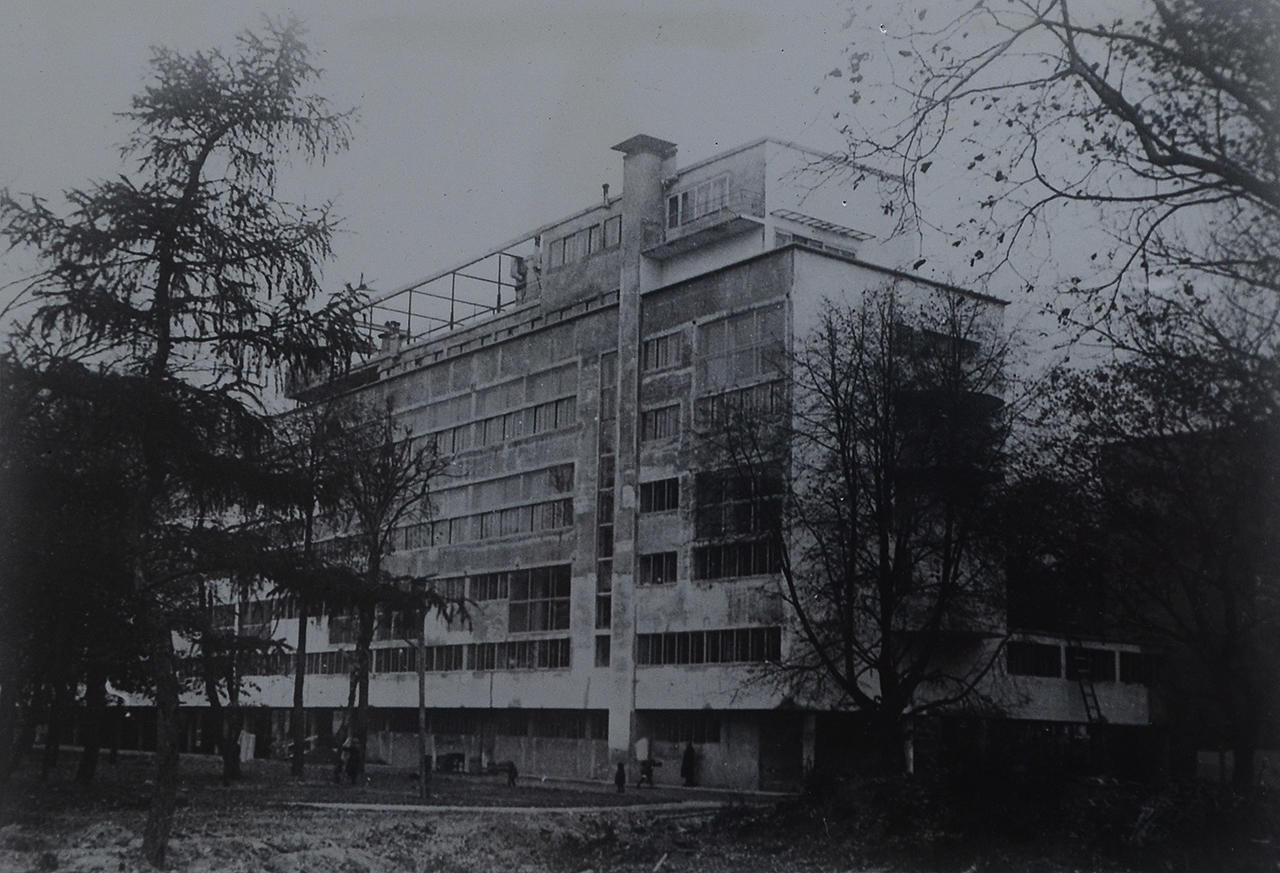
Images taken from the Russian language website Medusa, along with a translation of the short blurb that accompanied it. Reportedly several hundred Musvovites gathered to protest the razing of the Tagansk Telephone Exchange, mentioned below. But developers went ahead with it anyway.

.
Demolition of the Tagansk Telephone Exchange — a constructivist building lacking the official status of architectural landmark — began at the end of April in Moscow. In place of the Telephone Exchange, they plan to build a hotel. Aleksandr Gorokhov, photo editor of Medusa, found in the archives of the Shchusev Architecture Museum some old photographs of other constructivist buildings, in order to show readers how they looked having just been built.

В конце апреля в Москве начался снос Таганской АТС — конструктивистского здания, не имевшего формального статуса памятника архитектуры. На месте АТС планируют построить отель. Фоторедактор «Медузы» Александра Горохова нашла в архиве музея архитектуры имени Щусева старые фотографии других конструктивистских зданий, чтобы показать читателям, как они выглядели, когда только были построены.

Вегнер А.П., Мотылев М.И., Молоков Н.М., Звездин И.А., Шервинский Е.В., Федоров А.Н., Буров И.Г., Блохин Б.Н., Савельев Л.И., Виссинг М.Г. Дворец культуры автозавода им. Сталина-Лихачева. Здание столовой. Архитекторы братья Веснины А.А., В.А., Л.А. Фото 1937 года Дворец культуры автозавода имени Сталина-Лихачева (ЗИЛа). Крыша с обсерваторией. Архитекторы братья Веснины А.А., В.А., Л.А. Фото 1937 года Дворец культуры автозавода имени Сталина-Лихачева. Клубная часть. Интерьер, лестница. Архитекторы братья Веснины Фото 1937 года Дворец культуры автозавода имени Сталина-Лихачева. Переход из театрального зала в клубную часть. Архитекторы братья Веснины Фото 1937 год. Дом «Известий». Архитектор Бархин Г.Б. Фото 1937 года Continue reading

Nikolai Sokolov, proposal for a resort hotel in Matsetsa (1928-1929)

.
Spotted over at Togdazine, which translates roughly to Then Magazine. Check it out. It’s a great site.

Nikolai Sokolov (1904-1990) was a student at VKhUTEIN, the State Arts and Technical Institute, from which he graduated in 1930. A member of the Society of Modern Architects, or OSA, Sokolov served as an editor for the group’s journal Modern Architecture. Later he worked with the constructivist architect Moisei Ginzburg as part of Stroikom, the building commission within the state planning agency of the RSFSR, Gosplan.

He designed this hotel spa or resort for his final project in an architecture course taught by Aleksandr Vesnin.

BookScanStation-2013-02-24-08-12-40-PM0011 copy 2

Курсовой проект Николая Соколова «Курортной гостиницы в Мацесте», выполнен на архитектурном факультете ВХУТЕИН в мастерской А. Веснина. IV курс. 1928/29 учебный год.

Николай Соколов — (1904, Одесса — 1990, Москва) член Юго-Лефа. Окончил ВХУТЕИН в 1930 году. Член: ОСА, редколлегии журнала «Современная архитектура». Работал в Стройкоме РСФСР, Госплане РСФСР, Гипрогоре под руководством Моисея Гинзбурга.

Курсовойпроект Николая Соколова «Курортной гостиницы в Мацесте»

“Thus is conquered the whole of nature.” Cover sheet for the project.

«Так берите природу всем…». Вводный лист к проекту.

Генплан

General plan.

Генплан.

Индивидуальный домик. Фасад, планы, развертка «улицы»

Individual housing-unit [domik]. Façade, plans, elevation, “the street.”

Индивидуальный домик. Фасад, планы, развертка «улицы».

Фасад индивидуального домика

Left: Axonometric view of an individual housing-unit, and “street” perspective. Right: Façade of an individual housing-unit.

Слева: Аксонометрия индивидуального домика, перспектива «улицы». Справа: Фасад индивидуального домика.

Перспектива подземной «улицы»

Perspective of the subterranean “street.”

Перспектива подземной «улицы».

Общественный комплекс. Фабрика — кухня. Фасад, перспектива, разрез. Разрезы подземной «улицы»

Communal complex. Factory-kitchen. Façade, perspective, section. Underground “street” sections.

Общественный комплекс. Фабрика-кухня. Фасад, перспектива, разрез. Разрезы подземной «улицы».

Images courtesy the archives of the Shchusev Museum of Architecture.

Marxism and legal theory

.

For Marx, law or right [Recht] would wither away with the shift to communism. Even among avowed Marxists, this sort of reification of the law is increasingly common. Domenico Losurdo, a Stalinist political philosopher, has abandoned the Marxist doctrine of the progressive dissolution of the state. If scholars like Losurdo feel Lenin was too “leftist” for upholding this principle, others find Lenin’s commentary on the character of the state too conservative or bound to Second International conceptions. My friend Pavel Minorski wondered how “the figure who most clearly exposed Social Democratic opportunism and provided the clearest statement of the need to smash the bourgeois state could then go on to write about how the dictatorship of the proletariat would be ‘the bourgeois state without the bourgeoisie’.”

Nevertheless, I think that Lenin’s line of reasoning was correct regarding “the bourgeois state without the bourgeoisie.” Marx talked about the persistence of bourgeois law or right [Recht] up to the advent of a higher form of communist society. From this conclusion it follows that the state administering legislation would be the Rechtstaat, i.e. the modern class state that emerged gradually out of the wreckage of the ancien régime (the Standestaat, which was based on unique privileges of special estates). Here is Lenin’s gloss on the passage by Marx in the Critique of the Gotha Program, which in turn appears in State and Revolution:

In its first phase, or first stage, communism cannot as yet be fully mature economically and entirely free from traditions or vestiges of capitalism. Hence the interesting phenomenon that communism in its first phase retains “the narrow horizon of bourgeois law”. Of course, bourgeois law in regard to the distribution of consumer goods inevitably presupposes the existence of the bourgeois state, for law is nothing without an apparatus capable of enforcing the observance of the rules of law. It follows that under communism there remains for a time not only bourgeois law, but even the bourgeois state, without the bourgeoisie!

This may sound like a paradox or simply a dialectical conundrum of which Marxism is often accused by people who have not taken the slightest trouble to study its extraordinarily profound content. But in fact, remnants of the old, surviving in the new, confront us in life at every step, both in nature and in society. And Marx did not arbitrarily insert a scrap of “bourgeois” law into communism, but indicated what is economically and politically inevitable in a society emerging out of the womb of capitalism.

Strictly speaking, there is a certain redundancy in the term “bourgeois right,” though it’s helpful to reiterate at times. “Right” itself is bourgeois, something universally possessed by free and equal citizens who have reached a certain age (some positive rights are reserved for adults, like voting or drinking or whatever). Classically, right would be opposed to privilege, explicitly tied to title or rank within a noble or priestly order. This is why those who reduce Marxism to “fighting for equal rights,” or for “human rights,” are so profoundly mistaken. Marxism aims at the transcendence of right altogether.

Marxist legal theorists debated many of these same issues in the first decade following the October Revolution. You can read a few exemplary pieces illustrating this below. What is perhaps most striking about these texts is the incredibly high level of debate, both the theoretical subtlety and practical urgency that saturate them. They are taken from an old book released by Johns Hopkins on Soviet Political Thought. Download the rest of them this link: Michael Jaworskyj, Soviet Political Thought: An Anthology (1967). Not only are they of merely historical interest, either. They have a very contemporary relevance as well, insofar as many seem to believe that Marxism is preoccupied chiefly with social justice, economic inequalities, and redistribution of wealth. Goikhbarg’s piece destroys these misconceptions.

Also see Evgenii Bronislavovich Pashukanis, The General Theory of Law and Marxism and Franz Neumann and Otto Kirchheimer, The Rule of Law under Siege: Selected Essays for more on Marxist theories of law.

the constitution

“Law and right are inherited like an eternal disease”

Pëtr Ivanovich Stuchka
October Upheaval and Proletarian
Dictatorship
(Moscow, 1919)
.
.

If, in considering the law, we have in mind only its bourgeois meaning, then we cannot speak of a proletarian law, for the goal of the socialist revolution is to abolish law and to replace it with a new socialist order. To a bourgeois legal theorist, the term “law” is indissolubly tied in with the idea of the state as an organ of protection and as an instrument of coercion in the hands of the ruling class. With the fall or rather the dying away of the state, law in the bourgeois meaning of the term also dies away. When we speak of a proletarian law, we have in mind law of the transition period, law in the period of the dictatorship of the proletariat, or law of a socialist society, law in a completely new meaning of the term. For, with the abolition of the state as an organ of oppression in the hands of one class or another, the relationships between men, the social order, will be regulated not by means of coercion but by means of the conscious good will of the workers, that is, the will of the entire new society.

In this respect the tasks of bourgeois revolutions were considerably easier than the task of a socialist revolution. Voltaire’s revolutionary statement is well known: “If you intend to have good laws, then burn the old and create new ones.” We know that this requirement was not fulfilled by any bourgeois upheaval, not even by the great French Revolution. The latter mercilessly burned feudal castles and the titles to these castles, liquidated privileges and the holders of these privileges, and replaced the feudal system with a bourgeois one. Notwithstanding, the oppression of man by man survived, and some old laws remained unburned and binding. The legal monument of the French Revolution — Napoleon’s Civil Code — came into being only ten years after the Revolution (1804), and only after the victory of the counterrevolution.

In one of his earlier writings (1843), Marx vividly outlined the basic difference between bourgeois and socialist revolutions: “A bourgeois revolution dissolves old feudal forms of organization through the political emancipation of independent persons, without tying and subordinating them to a new economic form… It divides the person into man and citizen, whereby all the socioeconomic relationships of citizens belong to the sphere of their private affairs which are of no interest to the state… Man appears to be leading a double life, a heavenly and an earthly life, in the political community, where he is a citizen, and in a bourgeois society, where he acts as a private person and either looks upon other men as means, or lowers himself to a means or a toy in the hands of others.” Private interests are indifferent, for, regardless of whether a man in bourgeois society is satisfied or hungry, whether he is physically fit or incapacitated, whether he has time to satisfy his spiritual needs, this is his private affair, the egoistic interest of each separate person, with which the state does not interfere. “The state can be turned into a free state without turning man into a free man.”

What the bourgeois revolutions did was merely to put into power a new class in place of the old one, or along with the old, and to change the form of the organization of state power. The mode of oppression was freely changed without changing the text of old laws. The continuity of law seems to be the essence of the stability of human society, which is based on the principle of exploitation of man by man. Thus, the laws of slaveholding Rome survived not only the feudal system but even all phases in the development of capitalism, imperialism included:
Es erben sich, Gesetz und Recht
Wie eine ewige Krankheit fort
.1

Bourgeois revolution did not always adhere to Voltaire’s words; it did not burn old laws as resolutely as it should, and when it burned them it failed to eradicate them from the minds of the people. As pointed out by Renner, “The human mind is a reliable storehouse in which Moses’ stone tables with his commandments are as real as any recent decree issued by the government; in it the ancient historical elements are interwoven with contemporary elements into a single reality.” This is the source of all theories of the divine origin of such institutions as sacred property, the “inborn” character of class privileges, the “natural right” of the master to the services of the worker, etc.

Continue reading

All in the family: Hendrik de Man and his nephew, Paul

.
Texts by Paul de Man

  1. Aesthetic Ideology
  2. Allegories of Reading: Figural Language in Rousseau, Nietzsche, Rilke, and Proust
  3. Critical Writings, 1953-1978
  4. Notebooks
  5. Romanticism and Contemporary Criticism
  6. The Post-Romantic Predicament
  7. The Resistance to Theory

Texts on Paul de Man

  1. The Political Archive of Paul de Man: Property, Sovereignty, and the Theotropic
  2. Material Events: Paul de Man and the Afterlife of Theory

Texts by Hendrik de Man

  1. The Psychology of Marxian Socialism
  2. Beyond Marxism: Faith and Works

Texts on Hendrik de Man

  1. Zeev Sternhell, The Idealist Revision of Marxism: The Ethical Socialism of Henri De Man
  2. José Carlos Mariátegui, A Defense of Marxism

Texts on Paul and Hendrik de Man

  1. Dick Pels, The Intellectual as Stranger: Studies in Spokesmanship

.

Hendrik and Paul de Man

.
In a 1973 article on “Semiology and Rhetoric,” the literary theorist Paul de Man raised a question posed by Archie Bunker: “What’s the difference?” Bunker was of course the lovably racist protagonist of the popular sitcom All in the Family. Playing on the character’s last name, de Man therefore continued: “Suppose it is a de-bunker rather than a ‘Bunker,’ and a de-bunker of the arche (or origin), an archie Debunker such as Nietzsche or Derrida for instance, who asks the question ‘What is the difference?’ — and we cannot even tell from his grammar whether he ‘really’ wants to know ‘what’ difference is or is just telling us that we shouldn’t even try to find out.”

Deconstruction takes, or took, such punning deadly serious. One hesitates over the tense because, well, it’s unclear whether deconstruction is taken too seriously anymore. After all, the term is usually taken to derive from Martin Heidegger’s Destruktion, as Derrida made clear in a 1986 interview: “It was a kind of active translation that displaces somewhat the word Heidegger uses: Destruktion, the destruction of ontology, which also does not mean the annulment, the annihilation of ontology, but an analysis of the structure of traditional ontology.” (Later Derrida would trace the concept further back to the thought of another German named Martin: namely Luther, whose word destructio prefigured its contemporary use by several centuries. This is somewhat beside the point, however).

Paul de Man accusations leveled against him

Skeletons in the closet

.
Ever since the publication of Victor Farías’ incendiary, if imperfect, 1985 exposé Heidegger and Nazism, the great German thinker has fallen into disrepute. Numerous titles were released in the wake of this bombshell, by scholars like Hans Sluga, Tom Rockmore, and Domenico Losurdo. Recently the discovery of the so-called Black Notebooks, which contain Heidegger’s lecture notes for 1933 up through 1935, has added to the mountain of evidence proving he was a committed fascist and virulent antisemite both in private and in public. Translation into English is slated to come out this year from Indiana University Press, but a lengthy commentary and introduction by Emmanuel Faye has been out since 2009.

Many of the criticisms made since Farías reignited the controversy have simply confirmed the judgment already passed on fundamental ontology by figures like Günther Anders and Theodor Adorno. As early as 1948, Anders accused Heidegger of nihilism: “He had no principle whatsoever, no social idea: nothing. When the trumpet of National Socialism started blaring into his moral vacuum, he became a Nazi.” In 1963, Adorno polemicized against The Jargon of Authenticity (by which he meant Heidegger’s philosophy). “Jargon even picks up banal [words], holds them high and bronzes them in the fascist manner which wisely mixes plebeian with elitist elements.”

Jean-Pierre Faye, father of Emmanuel, further implicated Heidegger’s French admirers in the camp of deconstruction already in the 1970s. Unlike Anders or Adorno, who primarily addressed a German and American readership, Faye extended his critique of Heideggerianism to the Francophone world. Loren Goldner, a left communist and outspoken opponent of poststructuralism, explained the substance of his critique in a review entitled “Jean-Pierre Faye’s Demolition of Derrida”:

[He] shows that the famous word Dekonstruktion was first used in a Nazi psychiatry journal edited by the cousin of Hermann Göring, and that the word Logozentrismus was coined (for denunciatory purposes) in the 1920s by the protofascist thinker Ludwig Klages. In short, sections of French and, more recently, American academic discourse in the “human sciences” have been dominated for decades by a terminology originating not in Heidegger but first of all in the writings of Nazi scribblers, recycled through Latin Quarter Heideggerians. Faye zeroes in with surgical skill on the evasions of those, particularly on the left, for whom the “greatest philosopher” of the century of Auschwitz happened to be — as a mere detail — a Nazi.

After 1933, under pressure from Nazi polemics, Heidegger began to characterize the prior Western metaphysical tradition as “nihilist” and worked out the whole analysis for which he became famous after 1945: the “fall” in the Western conception of Being after Parmenides and above all Aristotle, the essence of this fall in its modern development as the metaphysics of the “subject” theorized by Descartes, and the evolution of this subject up to its apotheosis in Nietzsche and the early Heidegger of Being and Time. Between 1933 and 1945, this diagnosis was applied to the decadent Western democracies overcome by the “internal greatness” of the National Socialist Movement; after 1945, Heidegger effortlessly transposed this framework to show nihilism culminating not in democracy but…in Nazism. In the 1945 “Letter on Humanism” in particular, Western humanism as a whole is assimilated to the metaphysics of this subject The new project, on the ruins of the Third Reich, was to overthrow the “Western humanism” that was responsible for Nazism! Thus the initial accommodation to Krieck and other party hacks, which produced the analysis in the first place, passed over to a “left” version in Paris, barely missing a step. The process, for a more American context, goes from Krieck to Heidegger to Derrida to the postmodern minions of the Modern Language Association. The “oscillation” that Faye demonstrated for the 1890-1933 period in Langages totalitaires has its extension in the contemporary deconstructionists of the “human sciences,” perhaps summarized most succinctly in Lyotard’s 1988 call to donner droit de cite a l’inhumain.

Faye is tracking the oscillation whereby, in 1987-1988, it became possible for Derrida, Lyotard, Lacoue-Labarthe, and others, to say, in effect: Heidegger, the Nazi “as a detail,” by his unmasking of the nihilistic “metaphysics of the subject” responsible for Nazism, was in effect the real anti-Nazi, whereas all those who, in 1933-1945 (or, by extension, today) opposed and continue to oppose fascism, racism, and antisemitism from some humanistic conviction, whether liberal or socialist, referring ultimately to the “metaphysics of the subject”-such people were and are in effect “complicit” with fascism. Thus the calls for an “inhuman” thought.

Paul de Man’s reputation in the meanwhile has suffered a fate similar to that of Heidegger. Shortly after his death in 1983, it was revealed that he enthusiastically welcomed the Nazi occupation of Belgium. Between 1940 and 1942, de Man contributed a number of articles to Le Soir while the newspaper was under the management of fascist ideologues. One of the articles, on “The Jews and Contemporary European Literature,” was extremely antisemitic. Coming fresh on the heels of the Heidegger controversy, defenders of deconstruction were now faced with another scandal. De Man’s friends and co-thinkers rallied to defend his memory, organizing conferences in the vain hope that his legacy might yet be salvaged. Though several essay collections resulted from this engagement, featuring heavyweights from across the theoretical spectrum, de Man’s writings are no longer fashionable. Not the way they once were.

DoubleLifeofPauldeMan

Last year, though, Evelyn Barish released a biography detailing The Double-Life of Paul de Man. Suzanne Gordon, one of his former students, wrote a piece for Jacobin in which she denounced de Man as “a Nazi collaborator, embezzler, bigamist, serial deadbeat, and fugitive from justice in Belgium.” Here is not the place to wag fingers at de Man’s extramarital affairs, lackluster parenting skills, or casual misappropriations. While public interest in these aspects of his life is perhaps to be expected, as is its craving for salacious details, a lot of the information in Barish’s book is pure tabloid. Rumors and gossip do not merit serious consideration in the evaluation of a person’s work. Biography is not destiny.

Continue reading

Classical revolutionary historiography and revisionist endeavors

Albert Soboul
La Pensée
Fall 1974
.
.

The French Revolution has often been presented as the crowning achievement of the century of the Enlightenment and thus essentially as an ideological act.1 It still appears as such in the work of François-Alphonse Aulard.2 Jean Jaurès was the first who wanted to see in it a social phenomenon and thus of economic origin.3 Not that Jaurès had denied any importance to the philosophical movement. “Just as it would be vain and false,” he writes in the introduction to his Socialist History of the French Revolution, “to deny the dependence of thought and even dreams on the economic system and the concrete forms of production, so it would be puerile and crude to summarily explain the movement of human thought solely by the evolution of economic forms.” It is not solely by the force of things that the Revolution was accomplished; it is also “by the force of men, by the energy of consciousness and will.” It is nevertheless true, and Jaurès notes it vigorously, that the Revolution itself was the result of a long economic and social evolution that made the bourgeoisie master of power and the economy. The historiography of the French Revolution has remained at that point: Albert Mathiez reedited the work of Jaurès in 1922; Georges Lefebvre acknowledged Jaurès as his master.4

Actually, the Jaurès interpretation is not new. From the period of the Restoration, historians of the liberal school, even if they were hardly interested in the economic origins of the social movement, had strongly emphasized one of the essential characteristics of our national history: the appearance, growth and final triumph of the bourgeoisie; between the people and the aristocracy, the bourgeoisie had slowly created the framework and clarified the ideas of a new society of which 1789 was the consecration. Such is Guizot’s essential idea in his course on The History of Civilization in France.5 Such was also the conviction of both Tocqueville6 and Taine.7

From the period of the Revolution, however, Barnave had pushed the social analysis further. In his Introduction to the French Revolution, written in 1792, after having posited the principle that property influences institutions, Barnave states that the institutions created by the landed aristocracy impeded and slowed the arrival of a new era. “Once the arts and commerce succeeded in penetrating the people and created a new means to wealth to aid the laboring class, all was ready for a revolution in political laws: a new distribution of wealth produced a new distribution of power.”8 It is to this line of thought that the 1847 Communist Manifesto of Karl Marx, and then the first volume of Capital in 1867, subscribe. Thus the social interpretation of the French Revolution plunges deeply into our historical past. From the beginning, this interpretation alone, through its scholarly demands and critical reflection, established itself as truly scientific: compare the work of Guizot — or even that of Thiers — always concerned with documents, even if they were official ones, to that of Lacretelle.9 This interpretation was gradually perfected, in order to realize the complexity of the Revolution. Philippe Sagnac, in the last volume of The History of France published under the direction of Ernest Lavisse, and even more strongly Albert Mathiez, have clarified what was in the eighteenth century the aristocratic reaction that culminated in 1787-1788 in the nobiliary revolt.10 Yet it is not enough to distinguish between the revolt of the aristocracy and the revolution of the Third Estate. First Jaurès and then Mathiez after him have insisted on the rapid disintegration of the latter.

Antagonisms were quickly manifested between the various bourgeois categories and between the bourgeoisie and the popular masses, accounting for the complexity of revolutionary history and the progression of its various stages. Following in the same spirit with his study of the peasant masses, Lefebvre demonstrated the existence, in the general framework of the Revolution, of a peasant current possessing autonomy and specificity in its origins, procedures, crises and tendencies. This same approach has been applied by several of his students to the study of the popular urban masses.11

Thus the social interpretation of the French Revolution was gradually perfected through a long development, secular to say the least. By its constant recourse to scholarly research (“Without scholarship there is no history,” Lefebvre repeated), by its critical spirit, by its efforts at theoretical reflection, by its global vision of the Revolution, it alone merits to be considered truly scientific.

This deepening of the social interpretation of the Revolution has progressed to the rhythm of history itself. It would be banal to recall here that the vision of history is shaded or modified by each generation of historians: it is under the weight of lived experiences and real history that history is also written. The history of the French Revolution could not escape this law. For almost two centuries, each generation in its turn, through its hopes and dreams, studied the Revolution, matrix of our history, either to exalt it or reject it. Not without results. The movement of history has gradually revealed to each generation new aspects, more and more numerous factors and a more and more complex interaction. Thus new meanings, up to then masked by the very complexity of the phenomenon, have been brought to light. It is significant that it was in Kiev, in that Ukraine where the peasant had just been freed from serfdom, but without gaining property, that Loutchisky became that first to be attracted to the study of the agrarian question during the French Revolution; in 1897, he published Small Property in France before the Revolution and the Sale of National Lands. It is significant that it was during the First World War that Mathiez understood the economic necessities for conducting a great national war and the requirement of a controlled economy; he then wrote the studies that formed, in 1927, The High Cost of Living and the Social Movement during the Terror.

Thus the social interpretation of the French Revolution progressed at the same rhythm as history. And if, in the middle of our century, the attention of its historians is focused on the popular urban masses, wouldn’t it be because the world has entered an era of mass movements? These movements don’t exist without frightening the ruling classes; this leads, in the opposite direction, to those vain efforts to deny the French Revolution its historical reality or its social and national specificity, a vain precedent. Consequently, a revisionist line confronts the classical social interpretation. Thinking to discredit it, certain revisionists have baptized the classical interpretation “Jacobin historiography” of the Revolution, a description we do not challenge, understanding by that, as Lefebvre has taught us, the understanding and faithfulness to the cause of the people, but without the historian abandoning any of the essential requirements of the scholarly method and critical spirit. Let us say more precisely, a progressive tradition of revolutionary historiography, from Jules Michelet to Lefebvre, passing through Jaurès, Aulard, and Mathiez, and whatever may have been the shades of difference and divergences among these men — the only tradition which, in its principled progression, has been and remains scientific. Continue reading