The speculative constructivism of Iakov Chernikhov’s early architectural experiments, 1925-1932

Chernikov-11 main libraryIakov Chernikhov, strict integration of individual structural elements into a single coordinatedd unit

Problems of constructivism
in their relation to art

Erikh Fedorovich Gollerbakh
Construction of Architectural
and Machine Forms
(1930)

.
In this epoch of the triumphant development of mechanical engineering and the continuous growth of industrialization a new conception of artistic activity is being born. New demands are being made of the fine arts. Old and decrepit forms are being repudiated. Modernity demands of fine art that it should directly serve the urgent needs of our time.

Bending their ear to the modern world’s demands, artists are trying to find new principles forgiving form to their intentions — new principles that will be in keeping with the industrial and technological character of modern civilization. If they proceed from outside and amount to an “adapting” of old forms to new content, these attempts are rarely successful. Art can be brought onto its true path only through the creation of new forms which are adequate to the forms of life itself, and which answer its concrete requirements. Instead of seeking every kind of adaptation from the outside, what we need is the equally possible discovery of new values from within, that is, in the field of those phenomena which are characteristic of the modern tenor of life, of the modern state of technology. To a certain degree, art may become engineering. It must move from its previous aimless decorativeness, from its unprincipled aestheticism alienated from life, to an existence of practical utility. In this process the question of a transformation of artistic forms must not depend exclusively upon ideological content, but must be solved on the basis of a fundamental re-examination of the means of expression. Industrial and technological “being” cannot fail to influence the artistic and creative “consciousness.”

Needless to say, diverse other factors can also influence this consciousness. In the latest Western European art, and on the Left Front of the visual arts in the USSR, one can see the influence of prehistoric, primitive art, of ancient, archaic cultures, of the art of savages, children folk-cultures and so on. But when we are told that the artists who soak up these influences are “setting up new traditions,” are “achieving one of the greatest revolutions ever known in the history of the arts,” we are justified in doubting the extent to which these “new” traditions have any genuinely revolutionary content. Would it not be more correct to regard them as feeble imitation sui generis, as a conscious return to those albeit great, but already incarnate and largely extinct forms of which countless multitudes fill the long history of art — sometimes outreaching their original prototypes created at the dawn of human existence, sometimes endlessly inferior to them. Do we have to seek artistic models in the cemeteries of dead art, in the depth of history, amongst socially backward strata of modern humanity, when the progress of modern life is endlessly generating new forms, is conquering the indifference of the elements and harnessing them in the steel chains of technology. Instead of imitating the stiffened corpses of dead forms — albeit of beautiful ones — is it not better to seek the basis of a new art in the deep structures of organic and spatial phenomena in the world around us?

Iakov Chernikhov teaching in an arts class in Leningrad, 1920s

Investigation of the principles governing these structures leads to an identification of the primary geometrical laws common to the most diverse phenomena of the external world. It is precisely investigation, positing the principle of a scientific foundation for art, that will offer the possibility of finding a synthesis of technology with all aspects of the visual arts in a single constructivist art.

We do not yet have one single investigation specifically devoted to the question of constructivism. More than that, we do not have so much as an essay which elucidates the concept of constructivism, or outlines its course of development. Most discussion of constructivism is very superficial and unconvincing: people point out that it is based on principles of the mechanical and geometrical inter-relations of materials and their forms. They mention that constructivism aspires to create practically useful and externally beautiful objects (or in the first place, designs for them). Finally they underline constructivism’s direct connection with the mechanization of the whole structure of our lives, with the intensive development of industrial production, and so on. None of these diffuse and foggy definitions give any precise or true understanding of the essence of constructivism. Indeed, it is difficult to give a precise definition when it has still not fully defined itself. It is impossible to write an investigation of a subject whose actual nature has still not yet entirely emerged. This is why constructivism should not now be written about by historians of art or aesthetic critics, but by theoreticians of art or — even better — by practitioners, that is to say by those artists (or engineers) who are themselves constructivists.

The book presented to the reader here by architect-artist Iakov G. Chernikhov constitutes precisely such an experiment in laying out the fundamentals of constructivism. The author is not an art historian evaluating an artistic phenomenon “from the sidelines,” but a builder-artist pursuing and creating relatively new forms of depiction in his own personal professional work.

Chernikhov’s book The Construction of Architectural and Machine Forms is not a narrowly specialist technical investigation or handbook; if it were the latter there would be no place in it for a preface from an art historian. This book has an incomparably broader perspective. It is an investigation of theoretical principles which touch upon certain problems of the philosophy of art. The questions which the author raises about the meaning of the constructive approach, about its essence, about the nature or “constitution” of that approach, about the laws of construction and about constructive principles of form-generation, all these lead to the boundaries where the theory of art begins. However the author does not withdraw into the debris of abstract cognition. He does not get cut off from the real origins of his theoretical debate. In his role as a practicing artist participating directly in the productive and constructional life of our country, Chernikhov knows all too well the importance and value of concrete tasks in the art of today understanding “art,” as I do, in the very broadest sense of that word. While taking into account the methodological value of abstract solutions and structures, he also knows that we must not build forms which are beyond the realm of the useful, that we must not prop up the concept of a self-sufficient, “pure” art. His book rests upon a recognition of the profound commonality of the constructive principles underlying art and technology. And with that, on a recognition that the creative handling of materials can become a great organizing force, if it is directed towards the creation of useful, utilitarian forms. Continue reading

Program and utopia

Roger Rashi, Sam Gindin, Richard Rubin,
Aaron Benanav, and Stephen Eric Bronner

.
.
This year’s Platypus International Convention concluded with the plenary “Program and Utopia,” held on June 6 at the School of the Art Institute of Chicago. This closing plenary brought together Roger Rashi, founding member of Québec Solidaire; Aaron Benanav, of the Endnotes collective; Stephen Eric Bronner, a professor at Rutgers University, scholar of modernism and the history of socialism, and member of the Democratic Socialists of America (DSA); Sam Gindin, author, and director of the Greater Toronto Workers’ Assembly; and Richard Rubin, of Platypus. What follows is an edited transcript of the conversation that night. A full video of the plenary can be found online.

Opening remarks

.
Roger Rashi:
Thank you for inviting me to speak tonight. I am honored to be on a panel with such distinguished guests. Can utopia and program be merged in a new, formal relation in the 21st century? It will not be easy, but I think we can follow the example of Marx, who, as the French Marxist philosopher Henri Lefebvre has pointed out, synthesized the utopian and the political trends within French Socialism and thereby politicized utopia. Marx hypothesized that, by seizing power, we could eventually, through a series of stages, arrive at a classless society. This synthesis was put to the test in the 20th century and has not come out unscathed. Can we undertake this synthesis again in the 21st century? I believe we can. However, it will be a difficult process that requires our involvement in mass struggles and in the anti-neoliberal movements, which are starting to merge into one.

Today, the Left is in crisis. But there remain many social movements. The first decade of the 21st century saw a rise of mass movements challenging neoliberalism. This has taken two major forms. In Latin America there is the “pink tide” — Chavez in Venezuela, Morales in Bolivia, Correa in Ecuador — representing attempts to use state power to move gradually towards a form of socialism, although it is not socialism yet. Then, there is the new active struggle in the Middle East and southern Europe: the tremendous movement of the Arab Spring and the ongoing fight against austerity, respectively. Out of these movements, how can we craft a new political expression for the Left that will synthesize utopia — the goal of a classless society — and program, the practical movement towards formulating this kind of plan?

One approach is to come back to a vision of communism that Marx had in the middle of the 19th century. Here we should remember that Communism is not just a program or a utopia, but the actual movement attempting to abolish the existing state of affairs. It is the practical movement struggling against the status quo. From this perspective we can understand the emergent Left parties in different parts of the world, including Québec City, where I live. In the movement there, we have tried to develop from a united front against neoliberalism into a political party that can engage in elections as well as mass struggles — what we call combining the street and the ballot. We hope to move towards an understanding of what it means to overcome neoliberalism as well as the basis of neoliberalism: capitalism.

Continue reading

Der Palast der Sowjets: Entries by German architects to the Palace of the Soviets competition

Hans Poelzig [Ганс Полциг]

Walter Gropius [Вальтер Гропиус]

Hannes Meyer [Ганнес Майер]

Erich Mendelsohn [Ерих Мендельсон]

“The Soviet Union and modern architecture” (1932)

Hans Schmidt

Translated from the German by Eric Dluhosch.
El Lissitzky, Russia: An Architecture for World Revolution.
(MIT Press. Cambridge, MA: 1970).

• • •

The outcome of the competition for the Palace of the Soviets has filled all radical architects in the West with indignation and disbelief. We have no intention of using this occasion to mollify their outrage; on the contrary, it is incombent upon us to inform the reader in the same breath that the decision was neither accidental nor an isolated occurrence. In fact, a limited competition among ten Soviet architects has been held and since and has yielded similar results. At the same time, however, we do consider it our duty to give our Western colleagues a more objective picture of the architectural situation in the Soviet Union and to put into perspective those matters that have been misunderstood and distorted by overexposure and sensation-seeking publicity. In our case, the attempt to be objective reflects the desire to look at modern architecture not simply as a completed phenomenon, but as a process intimately connected to all the social, political, and technical manifestations of a whole culture.

Let us first attempt briefly to trace developments as faras the West is concerned. The present situation of modern architecture in the West has come about as the result of a long struggle, with many interacting and mutually interdependent movements often appearing to be countermanding each other, as for example the Arts and Crafts Movement in England, the Dutch Rationalist Movement (Berlage), the Art Nouveau Movement, the Fin de Siècle Movement, etc. The bourgeoisie of the nineteenth century, which after the French Revolution had at first decided to take over the styles bequeathed by feudalism, later attempted by movements such as those mentioned to evolve their own cultural forms in architecture as well as in other fields of artistic endeavor. It is significant to note that all these early attempts had one thing in common: they all tried to find their outlets within the context of high capitalism. As a result of this we had a revival of the Arts and Crafts Movement, the negation of the metropolis, the embracing of social ideas, i.e., garden cities for the workers, etc. Under the influence of technical developments in the last phase of capitalism, and as a result of rationalization and standardization, the real program of modern architecture eventually came into existence, demanding absolute unity between art form and technical form, both firmly rooted in developed capitalist technology. Even here, social ideas crept in, such as the notion that prosperity for all could be solved simply be harnessing capitalism to modern technology. The realization that this was not necessarily the case had as its consequence the eventual decision by the left wing of modern architecture to embrace the idea of Socialism. Continue reading

On massive vs. curvilinear structures

from a fragment by an
unknown modernist

Untitled.
Image: Nikolai Ladovskii, scheme for the
“green city” [зеленый город] in Moscow (1930)

untitled2.

Not all forms of fatness are structurally equal. It’s one thing to be “curvy”; it’s quite another to be an amorphous blob.

Part of it consists in weight.
Another part in distribution.
Maybe it’s in their balance.

General plan of Moscow (1935): The shapeless Moscow amoeba

General plan of Moscow (1935): The shapeless Moscow amoeba accumulating layers, rings, and folds

Le Corbusier’s project for the Palace of the Soviets (1928-1931)

The Radiant City: Elements for a doctrine
of urbanism for the machine age 
(1933)

Le Corbusier

The Main Auditorium: an audience of 15,000. Open-air platform: 50,000 people. And perfectly regulated acoustics. Small auditorium: 6,500 people. Huge crowds can move about at their case of the esplanade. Cars are on a lower level; the parking lot is beneath the auditoriums.

General ground-level plan: The natural declivities of the ground are left untouched. Automobiles are assigned a circuit on either side, in the open or underground. The circuit leads to the various entrances: an automatic classification of all visitors. Pedestrians never come into contact with cars. (There can be 25,000 people inside the Palace, and 50,000 more on the open-air platform).

Le Corbusier’s sketches of the Palais des Soviets

1932: Project for the Palace of the Soviets in Moscow

1928-1931 Moscow classified traffic system

The ground is devoted to movement: pedestrians, cars.

Everything above the ground (the buildings) is devoted to stability.

No similarity between the two. The ground beneath the buildings must be freed, for regular streams of cars and lakes of pedestrians. The streams flow directly to certain entrances; the pedestrians are widely scattered. This makes for a new economy of layout.

The streams of cars can flow in sunken beds or along elevated highways. Starting 5 meters above the ground, buildings take on definite shape. Distribution of traffic has been achieved below, on the ground.

Here, the dynamic functions: distribution of sorts of traffic.

(Pilotis on the ground level).

Here, the static function is expressed by offices, club, and auditorium. 1928. Palace of Light Industry (first called the Tsentrosoiuz) in Moscow. Now built.

Le Corbusier at a conference in Moscow, 1928

.
Here, the dynamic functions: distribution of sorts of traffic.

(Pilotis on the ground level).

Here, the static function is expressed by offices, club, and auditorium. 1928. Palace of Light Industry (first called the Tsentrosoiuz) in Moscow. Now built.

Tsentrosoiuz: Plans, models, site visits

Master plan for the urbanization of the city of Moscow

.
In 1931, Moscow officials sent me a questionnaire, admirably thought out, about the city’s reorganization. If only all cities would send out such questionnaires! Their lot would be improved.

The theoretical drawings of the “Radiant City” were made in order to answer this questionnaire. They form a theory of urbanization for modern times.

My “Answer to Moscow” caused an unexpected reaction: its technical aspects were hailed in flattering terms. But the cornerstone of my work was freedom of the individual, and this was held against me. Doctrinal vehemence prevented any worthwhile discussion. Capitalist? bourgeois? proletarian? My only answer is a term expressing my line of conduct and my ingrained revolutionary attitude: human. My professional duty, as architect and city planner, is to achieve what is human.

Charitable colleagues — Frenchmen, too, and far from being “Reds” — proclaimed to all who would listen or read, “that I wanted to destroy Moscow.” Whereas they themselves, if only they were called upon, would, etc.…

The plate which appears opposite (last in the “Radiant City” series), is not a program for Moscow’s destruction but on the contrary, for its construction. It shows zoning and axes of movement along which the city could gradualIy achieve a position of supple ease, expansion without difficulty, and so forth. This plate shows a specimen of urban biology.

So far, only the International Congress for Modem Architecture, the C.I.A.M. has required its members to seek the lines of vital communication which can bring a city into efficient contact with its surrounding region. (A task which will fall to the 5th Congress).

Corbu’s iconic model of the Palais des Soviets

Palace of the Soviets in Moscow

.
The administration building, on the left, is independent of the ground. Not only is the ground freed but, moreover, the expanse of open space beneath the building forms a highly architectural frame for the landscape seen in the background.

On the right, impressive ramps lead the way to the open-air platform for 50,000 people.

By contrast, 15,000 can reach the main auditorium from ground level by means of a continuous inclined plane, becoming concave until it reaches the seats. No stairways, not even a single step can be tolerated in a public building — and certainly not “monumental” stairways!

[scribd id=148867100 key=key-1nop3ccszuv9lqi76ea2 mode=scroll]

Corbusier in the USSR
Space, Time, and Architecture (1941)

Sigfried Giedion

Le Corbusier’s Geneva plan remained a project, but the principles embodied in it were partially realized in the Tsentrosoiuz at Moscow (1928-34). The erection of the Tsentrosoiuz — now the Ministry of Light Industry — was retarded partly by the requirements of the Five-Year Plan and partly by the emergence of an architectural reaction. It was one of the last modern structures erected in Russia.

Le Corbusier with Sigfried Giedion and Gabriel Guervekian at La Sarraz for CIAM 1 (1928)

Le Corbusier with Sigfried Giedion and Gabriel Guervekian
at La Sarraz for the founding of CIAM (1928)

Le Corbusier’s design for the Palace of the Soviets (1931) fell within the period of Stalinist reaction. With the ceiling of the great hall suspended on wire cables from a parabolic curve, it was Le Corbusier’s boldest accomplishment up to that time. In 1931 the realization of this project or any of the other contemporary schemes, such as those by Gropius and  Breuer and by the sculptor [Naum] Gabo, was no longer conceivable in the U.S.S.R.

[scribd id=148866567 key=key-lz6rycnznpeoy1dmw3s mode=scroll]

Russian translation of Le Corbusier's 1925 classic, Urbanisme [Планировка города]

Russian translation of Le Corbusier’s 1925
classic, Urbanisme [Планировка города]

Leninbulb

Alternate poster design by Gustav Klutsis, "Electrification of the entire country!" (1921)

Alternate poster design by Gustav Klutsis,
“Electrification of the entire country!” (1921)

Vladimir  Lenin, “Preface” to I.I. Stepanov’s
The Electrification of the R.S.F.S.R. and
the Transitional Phase of World Economy


Written: 18 March, 1922
First Published: Pravda No. 64, March 21, 1922; Published according to the text in I. Stepanova The Electrification of the R.S.F.S.R. and the Transitional Phase of World Economy, Moscow, 1922, checked with the manuscript
Source: Lenin’s Collected Works, 2nd English Edition, Progress Publishers, Moscow, 1965, Volume 33, pages 245-246
Translated: David Skvirsky and George Hanna
Transcription/HTML Markup: David Walters & R. Cymbala
Copyleft: V.I. Lenin Internet Archive (www.marx.org) 2002. Permission is granted to copy and/or distribute this document under the terms of the GNU Free Documentation License


Lenin: "Communism = soviet power [совласть] + electrification!"

Vladimir Lenin: “Communism = soviet
power [совласть] + electrification!” (1922)

I heartily recommend this book by Comrade Stepanov to all Communists.

The author has succeeded in giving a very able exposition of exceedingly difficult and important problems. He did very well in not writing a book for intellectuals (as is the practice among many of us who copy the worst manners of bourgeois writers), but for the working people, for the masses, for rank-and-file workers and peasants. To his book the author has appended a list of references for supplementary reading for the benefit of those who may find it difficult to understand some parts of it without further explanation. as well as for the benefit of those who would like to consult the principal works on this subject published in Russia and abroad. Special reference must be made to the beginning of Chapter VI, where the author splendidly outlines the significance of the New Economic Policy, and magnificently answers the “airy” scepticism that is displayed in some quarters about the possibility of electrification This scepticism is usually a cloak to conceal the absence of serious thought on the subject (that is, if it is not a cloak to conceal whiteguard, Socialist-Revolutionary and Menshevik hostility to all Soviet construction, which, in fact, is sometimes the case). Continue reading

Black politics in the age of Obama

Cedric Johnson and Mel Rothenberg

Platypus Review 57 | June 2013

On May 6, 2013, the Platypus Affiliated Society  hosted a conversation on “Black Politics in the Age of Obama” at the University of Chicago. The speakers included Cedric Johnson, the author of Revolutionaries to Race Leaders: Black Power and the Making of African American Politics (2007) and The Neoliberal Deluge: Hurricane Katrina, Late Capitalism, and the Remaking of New Orleans (2011); and Mel Rothenberg, a veteran of the Sojourner Truth Organization and coauthor of The Myth of Capitalism Reborn: A Marxist Critique of Theories of Capitalist Restoration in the USSR (1980). Michael Dawson, author of the forthcoming book, Blacks In and Out of the Left, was unable to attend due to an emergency. What follows is an edited transcript of the conversation. Complete audio of the event can be found online.

Cedric Johnson: I want to demystify the Obama phenomenon, which dates back much further than the 2004 DNC, as it has unfolded over the past decade. I also want to demystify the notion of “black politics” generally.

I am not disappointed with Obama, because being disappointed would mean I had expectations that had not been realized. I certainly disagree with Obama, but he has done just about everything I expected him to do with respect to domestic policy, questions of inequality, or geopolitics. He has been fairly consistent.

The problem with the Obama phenomenon is that too many people got caught in the rhetoric of “change.” As a political slogan it was perfect: No matter where you were, you could find something you could connect with. This operated on at least three different registers. On one level, it simply meant a change to another party’s leadership. For some, simply turning the page on the Bush years counted as change. At another level, there was what might be called the Jackie Robinson effect: There were those who wanted to see Obama break the barrier and become the first black president. Finally, and this was the most dangerous, many believed that Obama was going to deliver some substantive revitalization of liberalism within the United States. The idea was that he would be the second coming of FDR. People have made the same argument more recently. Michael Eric Dyson made this case last year on Democracy Now!, in fact, urging support for Obama’s reelection bid. One or another of these arguments proved convincing for many who ought to have known better — not just liberals, but people who consider themselves Marxists or radical leftists. Continue reading

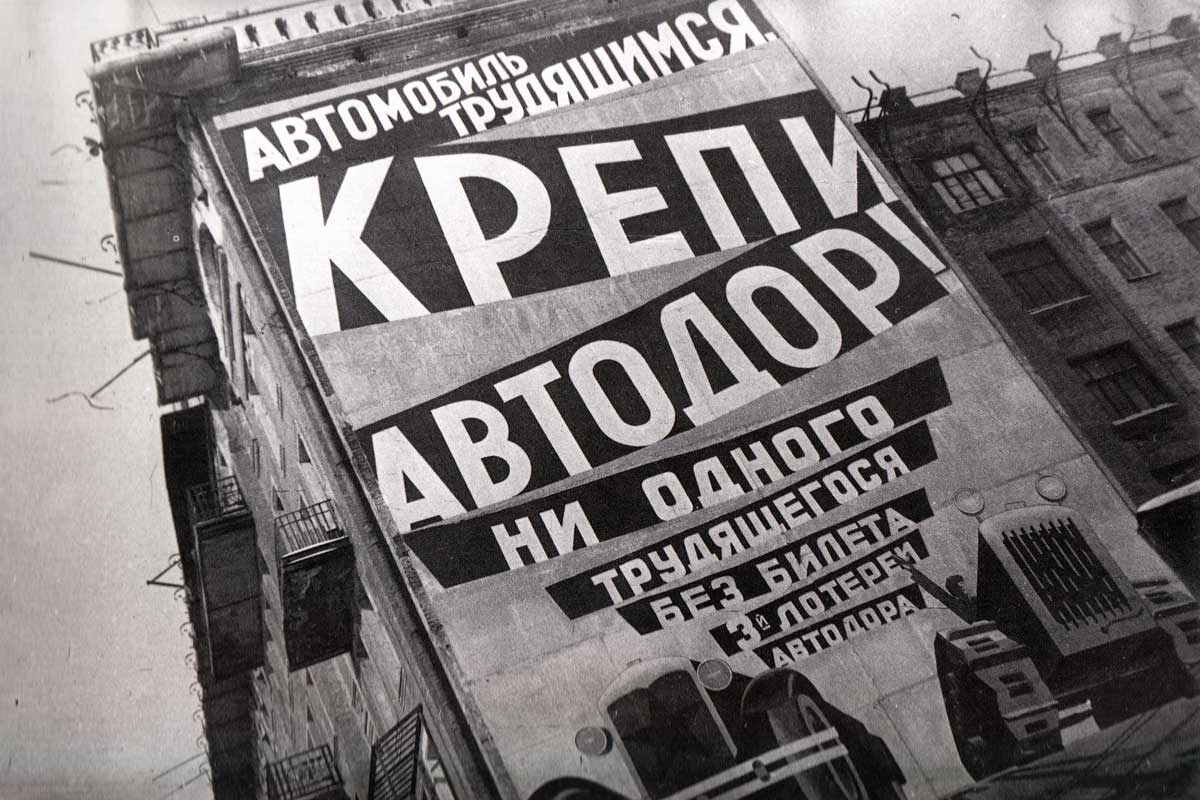
Soviet auto-building in the 1930s

With a 1928 poem by
Vladimir Maiakovskii

Untitled.
Image: Poster on the side of a building in Leningrad
that reads “Automobiles are Workers” (1929)

untitled2.

Image Gallery (captions coming)

“Letter to Comrade Kostrov”

Comrade Kostrov,
…………..I’m sure you won’t mind —
I know,
……..generosity’s one of your merits —
if part of the lines
…………..for Paris assigned
I’ll squander
…………..on petty lyrics.
Imagine:
…….a beauty
…………..enters a hall
framed
…….in necklace and furs,
and I
…….says to her
…………..with no preface at all
these very selfsame words:
I’ve
…….just come
…………..from Russia, comrade.
In my country
…………..I’m a figure. Continue reading

Le Corbusier’s Tsentrosoiuz building in Moscow (1928-1936) over the years

Planning and construction

.
In his 1928 proposal for the Soviet Central Union building, Le Corbusier invoked his much-vaunted principle of pilotis. As a postscript to his 1930  Precisions on the Present State of Architecture and City Planning:

Pilotis

Since we no longer have to lay foundations in the ground for the carrying walls; since on the contrary all we need is posts covering only .5% of the surface built upon and furthermore, since it is our duty to make the house more healthful by raising its bottom-most floor above the ground, we will take advantage of this situation by adopting the principle of “pilotis” or stilts.

What is the point of using pilotis? To make houses more healthful and at the same time allow the use of insulating materials which are often fragile or liable to decay and so should be placed far from the ground and possible shocks.

But most of all: behold, they are available to work a thorough transformation in the system of traffic on the ground. This is as true of the skyscraper as of the office building, of the minimum houses as of the streets. One will no longer be “in front of” a house or “in back of” it, but “underneath” it.

We have to reckon with cars, which we will strive to channel into a sort of river with regular banks; we need to park these cars without, at the same time, blocking up the river bed. When we leave our cars we must not paralyze traffic all along the river and when we come out of our buildings, we must not obstruct the areas reserved for movement. Continue reading

The brothers Golosov

Built and unbuilt works

Untitled.
Image: Il’ia Golosov, competition entry
for the Leningrad Pravda office (1924)

untitled2.

Note: Translation forthcoming of the lecture notes below! “New paths in architecture,” by Il’ia Golosov.

«Новые пути в архитектуре»

.
Лекция, прочитанная И. А. Голосовым в 1922 г. в Московском архитектурном обществе. Приведены лишь отдельные выдержки из этой лекции, касающиеся построения архитектурной формы. ЦГАЛИ СССР, ф. 1979, оп. 1, д. 69. Полный текст ее опубликован в сб. Из истории советской прхитектуры (1917—1925 гг.). Документы и материалы, М., Изд-во Академии наук СССР, 1963, стр. 26—31.

(…] Почему все еще громадное большинство пережевывает жвачку повторения и комбинаций древних форм, имевших смысл в сооружениях древних, но совершенно не подходящих к новым сооружениям, и нам кажется несомненным, что новое вино надо влипать в новые мехи и что современная архитектура должна найти себя на пути правильного отражения идеи сооружения — его души.

Конечно, высказываемая мысль приложима не только к архитектурным сооружениям, но к любым созданиям человека. Возьмем, например, паровоз. В современном мощном красавце-паровозе, олицетворенном воплощении силы и как бы готового к прыжку стального зверя, от первоначальной его формы, похожей вполне на грубые игрушки, нет и следа. И, несомненно, художник имел бы право голоса наряду с техником в усовершенствовании и конструировании паровоза так, чтобы его внешняя форма, без ущерба для целей техники, олицетворяла и ярче выражала его идею, его душу.

И во всяком случае, украшение вещей не в духе их идей, не в духе их назначения является вандализмом.

Сооружения исключительно технического характера, например подъемные краны, доки и пр., нельзя себе представить в дружном сожительстве с чисто украсительными формами. В сооружениях Этого типа нет места бесполезной детали, здесь все сливается с основной идеей вещи и, я думаю, не может быть спора о том, что встречающиеся иногда в подобных сооружениях формы исключительно украсительного характера или вовсе не замечаются, или производят впечатление явной их ненужности и неуместности. Трудно себе представить, чтобы формы паровоза можно было усовершенствовать введением орнаментировки его частей, так же трудно представить автомобиль или аэроплан в стиле какой-либо эпохи. Отсюда ясно, что техника вырабатывает свои, индивидуальные, только ей присущие формы. Само собой разумеется, что здесь не может быть и речи о применении классических форм, ибо здесь живет форма исключительно как таковая, в художественном своем выражении логически совпадающая с целью самого явления, то есть самой вещи.

Continue reading