Against inadvertent climate change; for великое преобразование природы instead

.
Even casual readers of Marx will likely know that his favorite figure from antiquity was Spartacus. In his responses to one of the questionnaires that periodically circulated — or “confessions,” quite popular during the nineteenth century — he listed the great leader of the Roman slave revolt as his hero. Johannes Kepler was his modern idol. What is less widely known, however, is that Marx’s favorite figure from classical mythology was Prometheus, who revolted against the gods. Marx did mention Aeschylus, author of the famous tragedy Prometheus Bound, as his favorite ancient poet in the 1865 “confession.” Shakespeare took the title as greatest of the moderns; Nietzsche would have approved of both choices. He went so far as to quote Aeschylus’ Prometheus in the introduction to his dissertation, in March 1841: “Philosophy makes no secret of it. The confession of Prometheus — ‘in a word, I hate all gods’ — is its very own confession, its own sentence” (MECW 1, pg. 130).

Franz Mehring later pointed out the affinity Marx felt with the fallen Titan, who stole the technology of fire from the gods and bestowed it upon humanity. Edmund Wilson would expand on this motif in his outstanding intellectual history To the Finland Station, placing Lucifer alongside Prometheus as one of Marx’s twin patron anti-deities. Both challenged the gods. “In one of Karl Marx’s ballads,” Wilson explained, “a Promethean hero curses a god who has stripped him of his all; but he swears that he will have his revenge, though his strength be but a patchwork of weaknesses: out of his pain and horror he will fashion a fortress, iron and cold, which will strike the beholder livid and against which the thunderbolts will rebound. Prometheus is to be Marx’s favorite myth” (To the Finland Station, pg. 116).

After his journal, the Rheinische Zeitung, was suppressed by state censors in 1843, Marx was depicted in a contemporary cartoon as Prometheus chained to a printing press, being disemboweled by a Prussian eagle. There’s also a squirrel holding a rifle featured in the upper left of the picture, the symbolism of which has been lost to time. Regardless, Marx was quite flattered by the comparison.

Marx als Prometheus, 1843

One of the more controversial subjects within Marxist discourse over the last forty or so years has been Marx’s relationship to what is commonly called “Prometheanism.” Following the appearance of the Club of Rome’s neo-Malthusian study The Limits to Growth (1972) and the Romanian mathematician Nicholas Georgescu-Roegen’s ruminations on entropy (1970, 1975), optimistic visions of mankind’s mastery of self and world were generally frowned upon. Since this time, many sympathetic to Marx tried to distance the his theories from more Promethean strains of applied Marxism or actually-existing socialism. They stress Marx’s ambivalence toward large-scale machinery in heavy industry, marveling at its productive powers while also decrying their effect on the humans who operated them.

John Bellamy Foster, for example, tries to turn the tables by revisiting Marx’s critique of Proudhon, supposedly on grounds of the latter’s “Prometheanism.” In his book, Marx’s Ecology, Foster claims that Marx impugned “Proudhon’s fetishistic approach to machinery, which gives it a reified ‘Promethean’ character” (Marx’s Ecology, pg. 131). Foster fails to produce textual evidence that Marx argued in these terms. Marx’s argument, in fact, is not that Proudhon is too Promethean. If anything, he is not Promethean enough. Ever the dialectician, Marx recognized the dual-sided character of progress in capitalist society: “In our days, everything seems pregnant with its contrary,” wrote Marx. “Machinery, gifted with the wonderful power of shortening and fructifying human labor, we behold starving and overworking it…At the same pace that mankind masters nature, man seems to become enslaved to other men or to his own infamy. Even the pure light of science seems unable to shine but on the dark background of ignorance” (MECW 14, pgs. 655-656).

Clearly, there is a dimension of the old man’s thought that is far from being naïvely enthusiastic about newfangled industrial technologies. He can hardly be called a vulgar technocrat. But it is not so easy to disaggregate Marx’s own Prometheanism from that of his so-called “epigones.” Quite plainly, if one looks to his writings, Promethean undertones are readily apparent. For example:

Herr Daumer’s cult of nature…is a peculiar one. He manages to be reactionary even in comparison with Christianity. He tries to restore the old pre-Christian natural religion in a modernized form. Thus he of course achieves nothing but Christian-Germanic patriarchal drivel on nature…[T]his cult of nature is limited to the Sunday walks of an inhabitant of a small provincial town who childishly wonders at the cuckoo laying its eggs in another bird’s nest, at tears being designed to keep the surface of the eyes moist, and so on, and finally trembles with reverence as he recites Klopstock’s Ode to Spring to his children. There is no mention, of course, of modern natural science, which, with modern industry, has revolutionised the whole of nature and put an end to man’s childish attitude towards nature as well as to other forms of childishness. But instead we get mysterious hints and astonished philistine notions about Nostradamus’ prophecies, second sight in Scotsmen and animal magnetism. For the rest, it would be desirable that Bavaria’s sluggish peasant economy, the ground on which grow priests and Daumers alike, should at last be ploughed up by modern cultivation and modern machines. (MECW 10, pg. 245)

Marx had very little patience for reverential attitudes toward nature, or romantic anticapitalism in general. As he saw it, the main problem faced by society under the capitalist mode of production was the subjugation of all its efficiency toward ends foreign to itself. Humanity, which is able to marshall wondrous materials and energies in pursuing its productive enterprise, nevertheless does not produce for the good of society. Social production serves an end outside of itself, namely the valorization of capital. Other considerations take a back seat to the primary goal of capitalization, so it is seldom that the unintended consequences or harmful byproducts of this process (such as climate change) are questioned. This is one of the ways production is “alienated,” to borrow the terminology of the young Marx.

In fact, the character of Prometheus reappears in Marx’s Capital. Here Prometheus stands in for enchained humanity: “[T]he law which always holds the relative surplus population or industrial reserve army in equilibrium with the extent and energy of accumulation rivets the worker to capital more firmly than the wedges of Hephaestus held Prometheus to the rock” (Capital, pg. 799). The implication is that capitalist production after a time actually constrains the creative capacities of mankind, instead of cultivating them. This was the sense of the metaphor summoned up by the revolutionary leader Clara Zetkin almost sixty years later, discussing Comintern’s need to “accelerate the advent of the proletarian world revolution.” Zetkin implored her audience to “learn from Lenin to believe implicitly that within the bosom of every proletarian and of every oppressed human being, there dwells the titanic promethean defiance which says to the strongest oppressors: ‘And yet you cannot slay me!’ Let his spirit teach us to snap the chains of Prometheus and forge them into weapons for freedom and into tools for construction.” Once again, the technologies which today constrain the proletariat tomorrow may just liberate them, effectively repurposed to serve society.

Continue reading

From painting to photography: Aleksandr Rodchenko’s revolution in visual art

r1338_7

Against the synthetic portrait, for the snapshot

Aleksandr Rodchenko
Novyi lef № 4, pgs. 14-16
Moscow (April 1928)
.

.
I was once obliged to dispute with an artist the fact that photography cannot replace painting in a portrait. He spoke very soundly about the fact that a photograph is a chance moment, whereas a painted portrait is the sum total of moments observed, which, moreover, are the most characteristic of the man being portrayed. The artist has never added an objective synthesis of a given man to the factual world, but has always individualized and idealized him, and has presented what he himself imagined about him — as it were, a personal summary. But I am not going to dispute this; let us assume that he presented a sum total, while the photograph does not.

The photograph presents a precise moment documentarily.

It is essential to clarify the question of the synthetic portrait; otherwise the present confusion will continue. Some say that a portrait should only be painted; others, in searching for the possibility of rendering this synthesis by photography, follow a very false path: they imitate painting and make faces hazy by generalizing and slurring over details, which results in a portrait having no outward resemblance to any particular person — as in pictures of Rembrandt and Carrière.

rodchenko_33

Any intelligent man will tell you about the photograph’s shortcomings in comparison to the painted portrait; everyone will tell you about the character of the Mona Lisa, and everyone forgets that portraits were painted when there was no photography and that they were painted not of all the intelligent people but of the rich and powerful. Even men of science were not painted.

You need not wait around, intelligentsia; even now AKhRartists will not paint you. True — they can’t even depict the sum total, let alone .001 of a moment.

Now compare eternity in science and technology. In olden times a savant would discover a truth, and this truth would remain law for about twenty years. And this was learned and learned as something indisputable and immutable.

Encyclopedias were compiled that supplied whole generations with their eternal truths.

Does anything of the kind exist now? …No.

Now people do not live by encyclopedias but by newspapers, magazines, card catalogues, prospectuses, and directories.

Modern science and technology are not searching for truths, but are opening up new areas of work and with every day changed what has been attained.

Now they do not reveal common truths — “the earth revolves” — but are working on the problem of this revolution. Continue reading

Hans Arp and El Lissitzky, The “isms” of art (1924)

.
Monoskop recently posted a scan of El Lissitzky and Hans [Jean] Arp’s Kunstismen (1924), translated roughly as The “Isms” of Art. It is reproduced here in its entirety, page by page, or in
full-text pdf format.

The original text runs in three parallel columns separated by thick dividers, very much in a constructivist style. Each column is in a different language: first German, then French, then English. Originally, I was planning on pasting the text from these in the body of the post. But I decided against it because, upon further examination, the translations are simply awful. German might have been a natural second language for Lissitzky; French and English were clearly not his strong points.

So instead, I’m posting an article that came out shortly afterward by the Hungarian art critic Ernő [sometimes Germanized as Ernst] Kállai, translated by John Bátki. Kállai’s work is not well known in the Anglophone world, though I did rely on one of his articles fairly extensively in an article on architectural photography. Here he summarizes the rapid succession of “isms” in art from 1914-1924 and astutely observes that this period ferment was then drawing to a close.

The twilight of ideologies

Ernő [Ernst] Kállai
“Ideológiák alkonya”
365 (April 20, 1925)

.
Translated from the original Hungarian by John Bátki.
Between Two Worlds: Central European Avant-Gardes,
1910-1930. (The MIT Press. Cambridge, MA: 2002).

Kunst kommt von Können. [Art comes from ability.]

The saying is very old and a commonplace, and has even acquired some ill repute; still, it is high time we pay heed to it and, more important, put it to use.

The age of ferment, of “-isms,” is over. The possibilities of creative work have become endless, but at the same time all paths have become obstructed by the barbed wire barriers of ideologies and programs. It takes a man indeed to try and fight one’s way from beginning to end, across this horrible cacophony of concepts. Not that all of these theoretical skirmishes, manifestoes, and conclusions for the record were not indispensable for the evolution of ideas, or were incomprehensible. Even the wildest flights of pathos, the most doctrinaire stylistic catechisms had their own merit. It was all part of the ferment caused by Impressionism, and the infighting of the various expressive, destructive, and constructive schools.

But all of this turmoil is now finally over. Our awareness of the diverse possibilities has at last been clarified, so that today we are witnessing a time of professional consolidation and absorption in objective, expert work. This holds true for the entire front: the areas of political, tendentious art and Proletkult as well as those of Cubism, Expressionism, Constructivism, Neoclassicism, and Neorealism — and also in criticism. The most extreme, most exacting measure of individual vocation and achievement is that which is being employed by each and every school or camp toward its own. The process of selection has begun, and its sole essential guiding principle is this: what is the artist capable of accomplishing in his own field, through his own particular means and message.

Continue reading

El Lissitzky on “pangeometry” and art (1925)

.
In the essay A. and Pangeometry  El Lissitzky analyses the changing role of perspective in art and introduces axonometric projection (or parallel perspective) as a new means to represent and perceive space. It was first published in German in Europa-Almanach, (Carl Einstein and Paul Westheim, Kiepenheuer Verlag, Potsdam, 1925, p.103-113) and was reprinted in 1984.

This English translation was published in the book El Lissitzky. Life – Letters – Texts, Lissitzky-Küppers, Thames & Hudson, London, 1992 (out of print). The blog The Detached Gaze posted it a few months back.

NOTE: Abbreviations: A. = art, F. = form.

europa-almanachKunst und pangeometrie lissitzky

Art and pangeometry

El Lissitzky
Europa Almanach
Potsdam (1925)

.
Seeing, of course, is also an A.

In the period between 1918 and 1921, a lot of old rubbish was destroyed. In Russia we also dragged A. off its sacred throne “and spat on its altar” (Malevich 1915). At the first Dada-event in Zurich, A. was defined as “magical excrement” and man as the “measure of all tailors” (Arp).

Now after five years (five centuries in the old chronology) in Germany for example, Grosz brings only one reproach upon himself: “our only fault was that we ever took the so-called A. at all seriously.” But a few lines further on he writes: “Whether my work is therefore called A. depends on the question of whether one believes that the future belongs to the working classes.” I am convinced that it does, but neither this conviction nor the excrement and the tailors are universal criteria for A.

A. is a graduated glass. Every era pours in a certain quantity: for example, one puts 5 cm of Coty perfume, to titillate the nostrils of fashionable society: another throws 10 cm of sulphuric acid into the face of the ruling class; yet another pours in 15 cm of some kind of metallic solution which afterwards flares up as a new source of light. So A. is an invention of our spirit, a complex whole, combining the rational with the imaginary, the physical with the mathematical, √1 with √-1. The series of analogies which I am going to bring to your attention is put forward not to prove — for the works themselves are there for that — but to clarify my views. The parallels between A. and mathematics must be drawn very carefully, for every time they overlap it is fatal for A.

Planimetric space

.
Plastic F. begins, like elementary arithmetic, with counting. Its space is the physical two-dimensional flat plane. Its rhythm — the elementary harmony of the natural numerical progression 1, 2, 3, 4, …

Man compares the newly-created object [1] — for example, the relief, the fresco — with natural objects. If, for example, in a relief, the animal in front covers a part of the animal behind, this does not mean that that part has ceased to exist, but that there is a distance, space, existing between these two bodies.

image1_a_and_pangeometry_el_lissitzky_1925 image2_a_and_pangeometry_el_lissitzky_1925

One comes to know from experience that there is a distance existing between individual objects, that the objects exist in space. This two-dimensional plane ceases to be just a flat surface. The plane begins to presume upon space and there arises the numerical progression, 1, 1½, 2, 2½ …

Perspectival Space

.
The space of the plane developing into view lengthens and widens, increases to a new system, which finds its expression in perspective. It is generally accepted that perspective representation is the clear, objective, obvious way to represent space. It is said that, after all, the camera also works perspectivally and at the same time one is forgetting that the Chinese once built the object-lens with concave instead of convex lenses as we have, and so would also have produced an objective and mechanical image of the world, yet quite a different one. Perspective has comprehended space according to the concept of Euclidean geometry as a constant three-dimensional state. It has fitted the world into a cube, which it has transformed in such a way that in the plane it appears as a pyramid. [2] The tip of this visual pyramid either lies in our eyes — therefore in front of the object — or we project it on to the horizon — behind the object. The former concept was chosen by the East, the latter by the West.

Perspective defined space and made it finite, then enclosed it; but the “universal set” [3] of art became richer. Planimetric space provided us with the arithmetical progression. There the objects stood in the relation: 1, 2, 3, 4, 5…In perspective space we acquired a new geometric progression; here the objects stand in a relation: 1, 2, 4, 8, 16, 32… Up to the present time the “universal set” of A. has acquired no new enrichment. In the meantime science undertook fundamental reconstructions. The geocentric Ptolemaic conception of the universe was replaced by the heliocentric system of Copernicus. The Euclidean conception of fixed space was destroyed by Lobatschewski, Gauss, and Riemann. The impressionists were the first to begin exploding the hereditary notion of perspectival space. The cubist method was more decisive. They transposed the space-confining horizon to the foreground and identified it with the area being painted. They made improvements to this fixed area through psychic features (walls covered with wallpaper and so on) and by destroying some elementary forms. They built from the perspective plane forward into space. The latest sequels are: the reliefs by Picasso and counter-reliefs by Tatlin. Continue reading

Walter Gropius’ International Architecture (1925)

.
The following translation of Walter Gropius’ International Architecture (1925) is adapted from Kenneth W. Kaiser’s 1964 translation for his thesis at MIT. It is, to date, the only translation of the brief text which accompanies the photos and plans featured in the volume. All the images and pages reproduced here come from scans uploaded over at the excellent Monoskop archive. Here’s the full-text PDF of Gropius’ groundbreaking Internationale Architektur.

Further on, directly after the translation, there’s the original German text. Quite short,though not quite Miesian in its brevity. Of course, Gropius openly admits that the book’s primary function was intended to be visual. Enjoy!

Bauhausbücher 1, Walter Gropius (ed.), Internationale Architektur, 1925, 111 p, 23 cm_Page_101 Bauhausbücher 1, Walter Gropius (ed.), Internationale Architektur, 1925, 111 p, 23 cm_Page_038

International Architecture

Walter Gropius
Bauhaus Books 1
Weimar, 1925

Foreword

.
International Architecture
is a picture book of the modern art of building. It will in concise form give a survey of the works of the leading modern architects of the cultured countries of the world and make the developments of today’s architectural design familiar.1

The works pictured on the following pages carry beside their differing individual and national characteristics, common features that are the same for all countries. This relationship, which every layman can observe, is a sign of great significance for the future, foretelling a general will-to-form of a fundamentally new kind represented in all the cultured countries.

In the recent past the art of building sank into sentimental decorative conceptions of the aesthete,, whose goal was the outward display of motives, ornaments, and profiles taken mostly from past cultures, which were without essential importance to the body of the building. The building became depreciated as a carrier of superficial, dead decoration, instead of being a living organism. The indispensable connection with advancing technology (and its new materials and construction methods) was lost in this are many for each building problem — the creative artist, within the boundaries his time sets upon him, chooses according to his personal sensibilities. The work therefore carries the signature of its creator. But it is wrong to infer from this the necessity for emphasis on the individual at any cost. On the contrary, the will to develop a unified world picture, the will which characterizes our age, presupposes the longing to liberate spiritual values from their confinement to the individual and to elevate them to objective importance. Then the unity of the arts, which leads to culture, will follow by itself. Continue reading

Nietzsche through the lens of Nazism and Marxism

Mazzino Montinari
Reading Nietzsche
West Berlin, 1982
.

Mazzino Montinari (4 April 1928 – 24 November 1986) was an Italian scholar of Germanistics. A native of Lucca, he became regarded as one of the most distinguished researchers on Friedrich Nietzsche, and harshly criticized the edition of The Will to Power, which he regarded as a forgery, in his book The Will to Power Does Not Exist.

1981_Fersen-Montinari_dic-1981

After the end of fascism in Italy, Montinari became an active member of the Italian Communist Party, with which he was occupied with the translation of German writings. During 1953, when he visited East Germany for research, he witnessed the Uprising of 1953. Later, after the suppression of the 1956 Hungarian Revolution, he drifted away from orthodox Marxism and his career in party organizations. He did however keep his membership in the Italian Communist Party and upheld the ideals of socialism.

At the end of the 1950s, with Giorgio Colli, who was his teacher in the 1940s, Montinari began to prepare an Italian translation of Nietzsche’s works. After reviewing the contemporary collection of Nietzsche’s works and the manuscripts in Weimar, Colli and Montinari decided to begin a new, critical edition. This edition became the scholarly standard, and was published in Italian by Adelphi in Milan, in French by Éditions Gallimard in Paris, in German by Walter de Gruyter and in Dutch by Sun (translated by Michel van Nieuwstadt). Of particular help for this project was Montinari’s ability to decipher Nietzsche’s nearly unreadable handwriting, which before had only been transcribed by Peter Gast (born Heinrich Köselitz).

95034900_large_hitlerandnietzsche 95034863_b02a76b014c6e408029b0fee0c8dca77_image_document_large_featured_borderless

In 1972, Montinari and others founded the international journal Nietzsche-Studien, to which Montinari would remain a significant contributor until his death. Through his translations and commentary on Nietzsche, Montinari demonstrated a method of interpretation based on philological research that would forgo hasty speculations. He saw value in placing Nietzsche in the context of his time, and to this end, Colli and he began a critical collection of Nietzsche’s correspondence. Montinari died in Florence in 1986.

I’m posting this here in anticipation of the 1,000+ page book by Domenico Losurdo, Nietzsche: The Aristocratic Rebel, translated by Peter Thomas. From the reviews that’ve been written of the book by Thomas and Jan Rehmann, it appears to be an epic screed. Last year I wrote up a bit on Malcolm Bull’s The Anti-Nietzsche. Sunit Singh also wrote up a good article on “Nietzsche’s Untimeliness,” from a Marxist perspective.

B1253280T1253285a

Nietzsche between
Alfred Bäumler and
Georg Lukács

Nietzsche and National Socialist ideology: Alfred Bäumler’s interpretation

.
1. A national socialist “ideology” in the current sense of the word could, perhaps, be reconstructed. But it would be impossible, on the contrary, to speak of a genuine national socialist assimilation of Nietzsche’s ideas. As recent research has determined, Nietzsche was as good as alien to the founders of national socialism. Alfred Rosenberg, who laid claim to him as a forerunner to “the movement” in Mythos des 20. Jahrhunderts, placed Nietzsche in the dubious company of Paul de Lagarde (whom Nietzsche despised) and Houston Stewart Chamberlain (who, from his Wagnerian and racist standpoint, rejected Nietzsche). Hitler himself had no relation to Nietzsche; it is questionable whether he had read him at all. The entire ideology of race was profoundly alien to Nietzsche. It would be carrying coals to Newcastle if I were to cite the countless passages in which Nietzsche spoke out against the racial theories of the true forerunners of national socialism in general and antisemitism in particular. He even had occasion to correspond with someone who later was a national socialist representative, Theodor Fritsch; his two letters to the latter are a complete mockery of the muddled racial theories of the eighties in the previous century, with their — as Nietzsche said — dubious concepts of “Aryanism” and “Germanism.” Shortly after his correspondence with Nietzsche, Theodor Fritsch reviewed Beyond Good and Evil in 1887 and found in it (with good reason!) a “glorification of the Jews” and a “harsh condemnation of antisemitism.” He disposed of Nietzsche as a “philosopher-fisherman of the shallows” who had abandoned “any and all understanding for national essence” and who cultivated “old wives’ philosophical twaddle in Beyond Good and Evil.” According to Fritsch, Nietzsche’s pronouncements concerning the Jews were the “flat twaddle, too forced, pretending to be intellectual, of a Judaized type, self-taught in some apartment”; luckily, he believed, “Nietzsche’s books will be read by scarcely more than two dozen men.”1 This was Nietzsche’s actual relationship to antisemitism and Germanism as long as he lived. And yet still today, among the wider public, Nietzsche is considered an “intellectual pathfinder of national socialism.”

2. We owe Hans Langreder credit for having carefully examined “the confrontation with Nietzsche in the Third Reich” using the methods of historical-empirical research in his dissertation at Kiel from 1970. In this way he was able to determine that there was no consensus in the Third Reich in the evaluation of Nietzsche. He spoke of a “positive” (in the sense of national socialist ideology) and a “negative” image of Nietzsche in the Third Reich. Among national socialist ideologues, there were several who endeavored to win him for Hitlerism; others who on the contrary opposed the unsettling, cosmopolitan, decadent, individualistic Nietzsche; and as a result, still others who sought to mediate between the two positions. The so-called positive image of Nietzsche officially won the upper hand and unfortunately still holds it today. Langreder rightfully named the “conservative revolutionary” Alfred Bäumler as the key figure in Nietzsche’s appropriation into the Third Reich. “At the inception and at the mid-point of the development of a positive Nietzsche image in the national socialist period stands […] Alfred Bäumler”: thus Langreder in his dissertation. After the “seizure of power,” Bäumler was called to the newly founded academic chair for political pedagogy at the University of Berlin; soon afterward he became head of the science department in the governmental office of the “führer’s deputy for oversight of the general spiritual and philosophical schooling and education of the NSDAP,” hence in the so-called Rosenberg bureau [Amt Rosenberg].2 Continue reading

Afrofuturism, Aaron Douglas, and W.E.B. Du Bois (1920s-1930s)

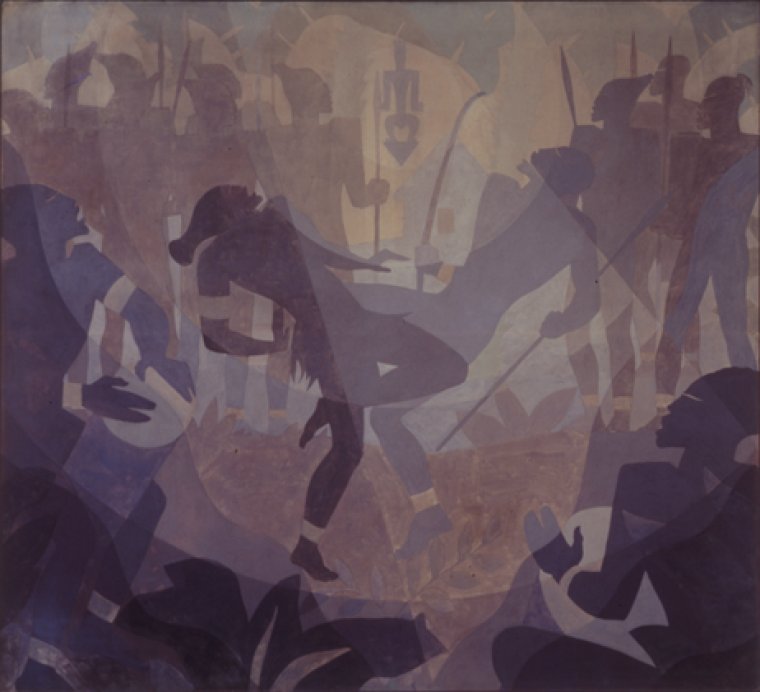
artstor_103_41822000904639Study for %22Aspects of Negro Life- An Idyll of the Deep South%22 (1934), tempera on paper, by Aaron DouglasAaron Douglas, Aspects of Negro Life- From Slavery to the Reconstruction, 1934. Harlem Renaissancepicture49-142E3580479301EA0AA

Lanre Bakare writes in The Guardian that “[a] new generation of artists [is] exploring afrofuturism. OutKast and Janelle Monáe take the philosophy to the mainstream, while Flying Lotus and Shabazz Palaces push jazz and hip-hop to their extremes.” He traces its musical lineage as follows:

The ’50s and ’60s were dominated by the free jazz and avant-garde work of Sun Ra and his Arkestra, John Coltrane, Miles Davis, Don Cherry, and Alice Coltrane, with some psychedelic input from Jimi Hendrix and Love. The ’70s and ’80s were when George Clinton’s Parliament Funkadelic and Prince sent funk to outer space and dub innovators such as King Tubby and Lee “Scratch” Perry beamed out cosmic signals from Jamaica. The ’90s saw a renaissance and reimagining of Afrofuturism in hip-hop (OutKast, Kool Keith’s Dr Octagon alias, and RZA), neo-soul (Erykah Badu) and techno (specifically Detroit producers such as Drexciya), with all embracing the philosophy and giving it their own distinctive edge.

If Bakare’s right, things must be looking up. Though I’m by no means an afrofuturist connoisseur, I love Miles Davis, Prince, and Jimi Hendrix. Plus, Flying Lotus’ 2010 record Cosmogramma was great. As far as cinematic afrofuturism is concerned, I’m a longtime fan of John Sayles’ Brother from another Planet (1979).

Bakare devotes most of his article to an examination of music and film, so we may forgive him for neglecting to mention the great afrofuturist art that was made in the first half of the twentieth century. This post might go some way in correcting his omission.

Of all the great figures from that period, the Harlem Renaissance painter Aaron Douglas stands apart. Raymond E. Jackson and select others deserve some recognition, but no one approaches Douglas. I’d almost describe it as deco-futurism with a heavy emphasis on African symbolism and history, at least as he understood it. Douglas first began to be noticed for his illustrated covers to W.E.B. Du Bois’ “chronicle of the darker races,” The Crisis. At that time in the mid-’20s, the journal had a discernibly Marxist political bent (in keeping with Du Bois’ own views).

He also did some work for Opportunity: A Journal of Negro Life. Later he was commissioned to do murals at a number of clubs and universities in Chicago and New York. These are truly stunning; they use a whole range of colors to achieve a deeply atmosphere effect. In this post you can see some of his work, or read more about his life via Wikipedia.

index (5) 9Aspiration Aaron Douglas Harriet Tubman Mural at Bennett College, Greensboro, North Carolina 1 Continue reading

Catastrophe, historical memory, and the Left: 60 years of Israel-Palestine

Historians Group
Platypus Review 5
May-July 2008

.
.
Some readers will doubtless find my decision to republish this 2008 article by the Platypus “Historians Group” (which no longer seems to exist in any meaningful way) questionable in light of Chris Cutrone’s unfortunate remarks, made in private, regarding the so-called “rational kernel of racism.” Like many of his formulations, this was clearly intended as a provocation against the received wisdom of the Left — however extravagant and misguided it may have been in this instance.

In any case, he has since explained himself in a manner that I consider satisfactory. Therefore, I see no problem posting this older piece, written on the sixtieth anniversary of the founding of the state of Israel. Given the recent ground invasion into Gaza, the latest round of violence in this decades-old territorial dispute, it is perhaps worth remembering how this whole wretched situation came to pass.

.
The contours of the present day Middle East have been shaped by a mid-twentieth century triptych of genocide and ethnic cleansing.

The first panel in this triptych is the “Holocaust” [the “Shoah” in Hebrew, or “Khurbn” in Yiddish], the systematic murder of approximately two-thirds of European Jewry by the Nazis in 1941-1945. The second panel is the ethnic cleansing of Palestine by the Zionists in 1947-1949, the “Nakba.” The third panel, which does not have a commonly accepted name, is the forced exodus of hundreds of thousands of Mizrahi Jews from Arab countries. Most of these ended up in Israel, where they strengthened the Zionist state in crucial ways despite frequently encountering racial discrimination there at the hands of Ashkenazi Jews.

Each of these catastrophes was both a product of the failure of the Left and paved the way for further defeats.

Before the Holocaust, Zionism — despite persistent and rising anti-Semitism throughout most of Europe — was distinctly a minority movement among European Jews, who for the most part trusted to liberalism and varieties of socialism and communism to beat back the rising tide of barbarism. On a per capita basis, more than any other Europeans, European Jews played central roles in the European Left. The triumph of Zionism is centrally and tragically predicated on the failure of the European Left to stop Hitler. Palestinians have become the secondary victims of this failure.

nakba2

Secondly, the failure within Mandate Palestine to develop an anti-Zionist politics on a progressive basis meant that Palestinians’ just and necessary struggle against Zionism and British imperialism took on a communalist character — which, in the face of military defeat by the Yishuv in 1947-1949, led to the Nakba.

Thirdly, the retaliatory expulsions and persecution of Mizrahi Jews strengthened Zionism both materially and ideologically: materially, by greatly fortifying Israel’s demographic base; ideologically, by appearing to confirm that Jews could not live in peace as minorities in the Arab world. If the Palestinians are the secondary victims of the disaster that overtook European Jews, Mizrahi Jews were in a sense the tertiary victims. Continue reading

Jean Jaurès, one hundred years after his assassination

Jean Jaurès

Leon Trotsky
Kievskaya Mysl
July 17, 1915

.
A
 year has passed since the death of the greatest man of the Third Republic. Events the like of which history has not previously known have welled up almost as if to wash away Jaurès’ blood with new blood and to divert attention away from him and to swallow up even his memory. But even the very greatest events have only partially succeeded in this. In France’s political life a great void has been left behind. New leaders of the proletariat answering the revolutionary character of the new era have not yet arisen. The old leaders only make us remember the more clearly that there is now no Jaurès.

HUMA

The war has thrown on one side not only individual figures but a whole era with them: the era during which the present leading generation in all spheres of life had been educated and brought up. Today this departed era on the one hand attracts our thoughts by the obstinacy of its cultural heritage, the uninterrupted growth of its technology, science and workers’ organizations; and on the other seems petty and characterless in the conservatism of its political life and in the reformist methods of its class struggle.

After the Franco-Prussian War and the Paris Commune (1870-1871) a period of armed peace and political reaction set in. Europe, if one excluded Russia, knew neither war nor revolution. Capital developed on a mighty scale outgrowing the framework of nation-states and overflowing into the remaining countries and subjugating colonies. The working class built its trade unions and its socialist parties. However the whole of the proletarian struggle of this period was impregnated with the spirit of reformism, of adaptation to the existing order and to the nation’s industry and the nation’s state power. After the experience of the Paris Commune the European proletariat did not once pose the question of the conquest of political power in a practical, that is, a revolutionary way. This peaceful, “organic” character of the era reared a whole generation of proletarian leaders thoroughly steeped in distrust for the direct revolutionary mass struggle.

16f1e6e264de6a4e6d9c6f8b0cbf3b55_XL

When the war broke out and the nation-state embarked on its campaign with all its forces armed to the teeth, this generation could without difficulty place the majority of the “socialist” leaders down on their knees. The epoch of the Second International has thus ended with the violent wrecking of the official socialist parties. True they are still standing as monuments to a past age and supported both indirectly and forcibly by the governments. But the spirit of proletarian socialism has fled them and they are doomed to collapse. The working masses who have in the past accepted the ideas of socialism are only now, amid the terrible experience of the war, receiving their revolutionary baptism of fire. We are entering upon a period of unprecedented revolutionary earthquakes. New organizations will be brought to the fore by the masses and new leaders will stand at their head. Continue reading

Tony Cliff’s legacy today

James Heartfield
Platypus Review
July 24th, 2014
.

Tony Cliff’s recognition in his own moment of a certain kind of impasse within Trotskyism and his attempt to overcome it require full consideration and appreciation both in terms of the merits of its potential and a consciousness of its limits.

A panel on the legacy of Tony Cliff opened the panel discussion at the Sixth Annual Platypus International Convention held in Chicago on April 4th, 2014. What follows are the opening remarks by English journalist and author James Heartfield.
.

International Socialism and the tradition of Lenin and Trotsky
.
.

I became a Trotskyist in 1933. The theory of state capitalism is a development of Trotsky’s position…But at the end of the Second World War, the perspectives that Trotsky had put forward were not realized. Trotsky wrote that one thing was certain: the Stalinist bureaucracy would not survive the war. It would either be overthrown by revolution or by counterrevolution…The assumption was that the collapse of the Stalinist bureaucracy would be a fantastic opening for the Trotskyist movement, for the Fourth International. The Stalinist bureaucracy not only didn’t collapse but it expanded…Therefore, at that time, Stalinism had a fantastic strength. And we had to come to terms with it.

— Tony Cliff, interview with
Ahmed Shawki (1997)

.
Let me start by saying how grateful I am to be invited here today. I’ve been a keen watcher and reader of Platypus. It is really useful that we look critically at the thinking and reasoning of the Left because if the Left doesn’t become self-reflective, it won’t have any importance whatsoever. In my comments on the International Socialist Group, which was founded by Tony Cliff and a few others, I want to say roughly this: the best way to understand the intellectual development of Tony Cliff and of the International Socialist Group is to see it in context.

Tony Cliff was very interested in an argument about socialist organization derived from something Lenin said in the early 20th century. In the pamphlet What is to Be Done? Lenin “bent the stick,” as Tony Cliff used to say, and very forcefully made the point that the spontaneous consciousness of the working class would not go beyond trade-union consciousness and that political, theoretical reflection upon that would necessarily be, as Lenin wrote in the pamphlet, “introduced from the outside.” That argument of Lenin’s was anathema to Tony Cliff and a point he criticized; he criticized it in a 1959 book he wrote about Rosa Luxemburg and in a 1960 pamphlet on Trotsky called Party and Class.

Now this is the core of the argument. What Lenin is doing is very old-fashioned in philosophical terms in that his argument is derived from an Enlightenment view. He’s saying that in essence there is a distinction to be made between higher thought and opinion, between rational or reflective thought and immediate or natural thinking. That distinction would be commonplace amongst Enlightenment thinkers like Hegel or Locke; it would be easily understood by them.

tumblr_mzxbt3RXJE1s5syp8o7_1280 dsc05417

Did it have the sectarian implication that Cliff saw in it? I suggest not.

Lenin, like Hegel, understood that when he talked about higher thought or reflective thought or theoretical reflection, and distinguished it from the merely spontaneous reflections of people in their activity, he understood that essentially they were the same — they were the same stuff, the same substance. That reflection, that theoretical thinking, was not separate and apart wholly — it was not an absolute distinction — but it was of the same material. It was a distillation of experience, but that distillation was not something that could happen unbidden. That was the very point: it could only come about through organization; it would have to be reflected through organization. Continue reading