For black Trotskyism

James Robertson & Shirley Stoute
SWP-US Discussion Bulletin
(Vol. 24, № 30: July 3, 1963)
.

What follows is a classic but seldom read document from the history of American Trotskyism, covering a particularly tumultuous period of struggle against separatism within the party and institutionalized racism (like Jim Crow) in society at large. This was of course written at the height of the Civil Rights movement, as black nationalist groups like the Nation of Islam rose to challenge more mainstream integrationist currents such as Dr. King’s. As Trotskyists who still considered themselves part of the vanguard of the working class, the question was, as ever, one of leadership. Stoute and Robertson’s document also touches upon the relationship between theory and practice, as well as the crucial distinction of “class vs. class” rather than “oppressed vs. oppressor” as the center around which to orient a Marxist politics.

Moreover, the original nomenclature of “Negro” has been retained instead of “black” or “African-American,” both of which are common today. The term “Negro” was the standard, accepted, and inoffensive at the time.
.
.

.

If it happens that we in the SWP are not able to find the road to this strata [the Negroes], then we are not worthy at all. The permanent revolution and all the rest would be only a lie.

— Lev D. Trotsky, quoted in the
SWP 1948 Negro Resolution

The Negro Question has been posed before the party for exceptional consideration and with increasing sharpness as the gap has widened over the past ten years between the rising level of Negro struggle and the continuing qualitatively less intense general Trade Union activity.

.
I. General introduction

.
1. Basic theory: National or race/color issue? Breitman vs. Kirk, 1954-57

.
[The reference is to internal discussion in the SWP between George Breitman and Richard Fraser, whose party name was Kirk.]

To our understanding, what was involved then was a shading of theoretical difference. Breitman saw the Negro people as the embryo of a nation toward whom the right of self-determination was acknowledged but not yet, at least, advocated. Kirk interpreted the Negro question as a race issue which, under conditions of historic catastrophe (e.g., fascism victorious) could be transformed into a national question. Hence he agreed to the support of self-determination should it become a requirement in the Negro struggle, but he assumed it could conceivably arise only under vastly altered conditions. Both parties agreed to the inappropriateness of self-determination as a slogan of the party then.

The present writers agree essentially with Kirk’s view of the time, in particular with the 1955 presentation, “For the Materialist Conception of the Negro Question” (SWP Discussion Bulletin A-30, August 1955). We concur in noting the absence among the Negro people of those qualities which could create a separate political economy, however embryonic or stunted. This absence explains why the mass thrust for Negro freedom for over a hundred years has been toward smashing the barriers to an egalitarian and all sided integration. But integration into what kind of social structure? Obviously only into one that can sustain that integration. This is the powerful reciprocal contribution of the Negro struggle to the general class struggle. Continue reading

Marxism and class, gender, and race: Rethinking the trilogy

Martha Gimenez
Race, Gender, Class
Vol. 8, № 2 (2001)

.
.
Photo: 
Young Uzbek woman from Tashkent holding up her Komsomol membership card, 1927.

Dr. Martha E. Gimenez is an Argentinian Marxist-feminist theorist and retired Professor of Sociology at the University of Colorado at Boulder, where she was instrumental in the creation of the Women’s Studies Program. She studied Law and sociology at the Universidad Nacional de Cordoba, receiving her Ph.D. from UCLA in 1973. She has published numerous articles and book chapters on Marxist Feminist Theory, the political economy of population, U.S. politics of racial/ethnic construction, and problems of democratization in the global economy. Gimenez is the founding editor of PSN — the Progressive Sociologists Network, PPN — the Progressive Population Network, and together with Chrys Ingraham and Rosemary Hennessy, founded MATFEM — Materialist Feminism, and together with Malgosia Askanas and Carrol Cox, moderates M-Fem — Marxist-feminism. In her work, Martha E. Gimenez has sought to use Marx’s methodology and theoretical framework for understanding the oppression of women under the capitalist mode of production. Her work aims to demonstrate the continuing relevance of Marx and Marxist theory for feminist theorizing and feminist politics.
.

Introduction

.
A taken for granted feature of most social science publications today, especially those about inequality, is the ritual critique of Marx and Marxism in the process of introducing theoretical alternatives intended to remedy its alleged “failures.” This practice became popular in early feminist literature: Marx and Marxists were criticized for not developing an in-depth analysis of the oppression of women, their “economism,” “class reductionism,” and “sex blind” categories of analysis. Soon after it became common place to assert that Marxism was also at fault for neglecting race, demography, ethnicity, the environment and practically everything that mattered to the “new social movements” in the West. As the movements died, scholarship informed by those political concerns flourished; the energy that might have been spent in the public arena found expression in academic programs (e.g., women’s studies, racial/ethnic studies) and efforts to increase “diversity” in the curriculum and the population of educational institutions.

Publication of the journal Race, Sex, & Class (changed afterwards to Race, Gender, & Class), in 1993, signaled the convergence of those political and intellectual interests into a new social science perspective that soon acquired enormous visibility, as demonstrated by the proliferation of journal articles and books with race, gender and class in their titles. This perspective, put forth primarily but not exclusively by social scientists of color, emerged as a reaction to feminist theories which neglected racial/ethnic and class differences among women, theories of racial/ethnic inequality which neglected sexism among men of color and, predictably, as a corrective to Marxism’s alleged shortcomings. For example, Jean Belkhir, editor and founder of Race, Sex, & Class, prefaces an article on this topic as follows: “The ‘failure’ of Marxism to develop adequate tools and a comprehensive theory of ethnicity, gender, and class issues is undisputable” (Belkhir, 1994: 79). The list of putative “failures” could be as long as we wanted it to be but what would that prove, beyond the fact that Marx’s and Engels’ political and theoretical priorities differed from those of contemporary social scientists? Less biased, albeit debatable, is the conclusion that Marxism, although offering “crucial and unparalleled insights” into the operation of capitalism, “needs to develop the analytical tools to investigate the study of racism, sexism and classism” (Belkhir, 1994: 79). To refer to class as “classism” is, from the standpoint of Marxist theory, “a deeply misleading formulation” (Eagleton, 1996: 57; see also Kandal, 1995: 143) because class is not simply another ideology legitimating oppression; it denotes exploitative relations between people mediated by their relations to the means of production. Nevertheless, it is the case that neither Marx nor Engels devoted the intensity of effort to the investigation of gender and race (and other issues) that would have satisfied today’s critics. It is (and any literature review would support this point) far easier to emphasize their “sins” of omission and — in light of current political sensibilities — commission, than it is to use their theoretical and methodological contributions to theorize and investigate those aspects of capitalist social formations that today concern us. Notable exceptions are Berberoglu (1994), who has examined the underlying class forces leading to gender and racial divisions in the U.S. working class, linking gender and racial oppression to capital accumulation, and Kandal (1995), who has forcefully argued for the need to avoid the racialization and feminization of social conflicts while minimizing or overlooking the significance of class.

In this essay, I intend to argue that Marxism does contain the analytical tools necessary to theorize and deepen our understanding of class, gender, and race. I intend critically to examine, from the standpoint of Marxist theory, the arguments for race, gender, and class studies offered by some of their main proponents, assessing their strengths and limitations and demonstrating, in the process, that Marxism is theoretically and politically necessary if the study of class, gender, and race is to achieve more than the endless documentation of variations in their relative salience and combined effects in very specific contexts and experiences.
.

91b1b90c684fd8e5c2ec1b7418ca380f_XL-e1345224957145

Race, gender, and class as part of a social science perspective

.
Long before the popularization of the race, gender, & class (RGC) perspective, I suspect that most Marxist sociologists teaching social stratification were already adept practitioners. For many years, for example, the Section on Marxist sociology of the American Sociological Association included in its annual program a session on Class, Gender, and Race. I certainly called my students’ attention, in twenty nine years of teaching social stratification and other subjects in which inequality matters, to the fact that everybody’s lives are affected by class, gender, and race/ethnic structures (in addition to age and other sources of inequality). We are, in Marx’s terms, “an ensemble of social relations” (Marx, 1994: 100, emphasis added), and we live our lives at the core of the intersection of a number of unequal social relations based on hierarchically interrelated structures which, together, define the historical specificity of the capitalist modes of production and reproduction and underlay their observable manifestations. I also routinely called students’ attention to the problems inherent in the widespread practice of assuming the existence of common interests, ideologies, politics, and experiences based on gender, race, and ethnicity because class location, and socioeconomic status differences within classes, divide those population aggregates into classes and strata with contradictory and conflicting interests. In turn, aggregates sharing the same class location, or similar socioeconomic characteristics within a class, are themselves divided by gender, race, and ethnicity so that it is problematic to assume that they might spontaneously coalesce into class or status self-conscious, organized groups. This is why, in the late sixties and early 1970s, I was critical of feminist theories which ignored class, racial and ethnic divisions among women and men, and theories of patriarchy that ignored how most men under capitalism are relatively powerless (Gimenez, 1975). Later on, I published a critical assessment of the “feminization of poverty” thesis because it was not sensitive to the effects of class, socioeconomic status, racial and ethnic divisions among men and women; it neglected the connections between the poverty of women and the poverty of men and overlooked the significance of this thesis as a powerful indicator of the immiseration of the lower strata within the U.S. working class (Gimenez, 1990).

I am aware, however, that most sociologists do not take Marxism seriously and that theorists of gender and racial oppression have been, on the whole, hostile to Marxism’s alleged reductionisms. More importantly, this is a country where class is not part of the common sense understanding of the world and remains conspicuously absent from the vocabulary of politicians and most mass media pundits. Continue reading

Spartakiade: A Bolshevik alternative to the Olympics

.
With opening ceremonies for the 2014 Winter Olympics a couple nights ago in Sochi, Russia — and all the pomp, pageantry, and slapstick that went with it — it’s perhaps appropriate to reflect on the oft-forgotten Soviet alternative to the Olympics: the proletarian Spartakiade, set up in 1924 as a challenge to the hegemony of the bourgeois Olympiad. It’s important to remember that the modern Olympic games were a fairly recent phenomenon. The idea of holding an international sporting event along these lines was only revived in 1894, and the inaugural Games held just two years later. “Physical culture,” Fiskultur in German and Физкультура in Russian, was an ideology embraced across the political spectrum in the late nineteenth and early twentieth century, part of a popular cult of the body that emphasized fitness as part of a well-rounded education (along with literacy and basic math skills). From mainstream European Social-Democracy during the 1890s to North American “muscular Christianity” around the same time, the idea enjoyed a great deal of support.

After conflicts broke out between the major European powers in 1914, the early days of what would eventually become known as the Great War, the Olympic games were put on hold. Though the Second International (founded 1889) capitulated to the spirit of patriotic belligerence that same year, upheaval in Russia resulted in the collapse of tsarism in February 1917 and the revolutionary seizure of power by the Bolsheviks a few months later. Its leaders thereupon declared the foundation of a Third, Communist International — the Comintern. One might view the stance taken by the Comintern during the early 1920s toward international sporting competitions like the Olympics as paralleling its own relationship to international bourgeois legal and political institutions around the same time. By establishing the Spartakiade as a rival to the Olympiad, the Bolsheviks hoped to set up a proletarian alternative to bourgeois internationalism.

Similarly, the Comintern itself would be viewed as a proletarian version of the bourgeois League of Nations, from which the USSR had been excluded, though here the socialists had a head start over their capitalist competitors (the First International Workingmen’s Association was organized in 1863, while the League of Nations would only take shape in June 1919). The Spartakiade existed as an international sporting event from 1924-1937, ending around the same time as the as the Comintern became defunct. Again, this mirrored the Soviets’ shifting attitude toward internationalism in general. Under Stalin’s doctrine of “socialism in one country” [социализм в одной стране], Spartakiads were instead repurposed as national events between the various semi-autonomous Soviet Republics. Likewise, just as the Soviet Union was made a participant in the United Nations after 1947, Soviet sportsmen began participating in the Olympics in 1952. This marked the effective integration of the USSR in the postwar status quo, less of an imminent threat to the bourgeois social order than its cynical cooperant.

Below is reproduced the Comintern’s November 1924 Manifesto of the Red Sport International. You can read the original May 1925 English translation of the document in Young Worker. Also included are some outstanding posters, photos, and promotional art for the games, which can be enlarged by clicking on the thumbnails.


.

Manifesto of the Red Sport International
Executive Committee, Comintern
November 21, 1924
.

To the Working-class Sportsmen of all Countries!

To all Working Men and Working Women In Town and Countryside!

The Third World Congress of the Red Sports International addresses this manifesto on behalf of the delegates who represent twenty-one countries at the Congress, to all workers belonging to gymnastics and sports organizations, and invites them to join the international association of proletarian and peasant gymnastics and sports organizations — the Red Sports International.

The bourgeoisie does its utmost to keep the oppressed classes under its domination. In the hands of the bourgeoisie, gymnastics and sports organizations are converted into tools of bourgeois militarism and fascism, and thereby into fighting cadets of the reactionaries against the proletariat of the home country, as well as the proletariat of foreign countries.

The bourgeoisie is fully aware of the important role of gymnastic and-sport organizations and it is using them as a means to corrupt the proletariat and to permeate it with bourgeois ideology, providing thereby active defenders of bourgeois capitalist interests in the everyday economic struggles (factory sports, clubs under capitalist control, strikebreaking, technical aid, etc.), as well as in the present and future political struggles (Chauvinist national organizations, military training of the young, national militia, etc.).

From being a means of the class struggle of the bourgeoisie against the proletariat, proletarian gymnastic and sports organizations must become an important factor — for the proletariat — in the world struggle of the workers and poor peasants for the establishment of a proletarian social order.

In the atmosphere of class struggle there can be no “neutrality” and no “non-political attitude” for the workers also with respect to gymnastics and sports. Collaboration or class truce with and within bourgeois organizations, especially with the bourgeoisie, is tantamount to a betrayal of proletarian interests. Continue reading

Persecutedness euphemized as “difference”

Elif Batuman, from “Get
a real degree” (9.23.2010)
London Review of Books
.

The law of “find your voice” and “write what you know” [in creative writing programs] originates in a phenomenon perhaps most clearly documented by the blog and book Stuff White People Like: the loss of cultural capital associated with whiteness, and the attempts of White People to compensate for this loss by displaying knowledge of non-white cultures. Hence Stuff White People Like #20, “Being an Expert on Your Culture,” and #116, “Black Music that Black People Don’t Listen to Anymore.” Non-white, non-college-educated or non-middle or upper-class people may write what they know, but White People have to find the voice of a Vietnamese woman impregnated by a member of the American army that killed her only true love.

The situation is summed up in [Mark] McGurl’s construct of the “World Pluribus of Letters” (a play on the critic Pascale Casanova’s “World Republic of Letters”):

While the citizen of the Republic of Letters disaffiliates from the nation in order to affiliate with art, the citizen of the World Pluribus of Letters disaffiliates from…the super-nation, in order to reaffiliate with a utopian sub-nation, whether that be African or Asian or Mexican or…Native American…The expression of formerly enslaved, immigrant or indigenous populations, these subnational cultural interventions…forge symbolic links to an international literary space which is not, however, the space of universal literary values but a pluralized…space of decolonized global cultural difference.

The World Pluribus of Letters has replaced a primary standard of “universal literary value” with a primary standard of persecutedness, euphemized as “difference.” It seems strange to me that McGurl, who sees the situation so clearly, seems not to view it as a problem. Perhaps his status as a White Person prevents him from objecting to the ideals of the Pluribus. But my hardworking immigrant parents didn’t give me a funny name and send me to Harvard for nothing, so I’m going to go ahead and say how damaging I think this all is. Although there is nothing intrinsically wrong with writing about persecution, for either the persecuted or the non-persecuted, there is a genuine problem when young people are taught to believe that they can be writers only in the presence of real or invented sociopolitical grievances.

This really is the message that some young people take from the [creative writing] program, as we learn in a quotation from the Chicana writer Sandra Cisneros (The House on Mango Street, 1984):

Until Iowa I had never felt my home, family and neighborhood unique or worthy of writing about. I took for granted…the strange speech of my neighbors, the extraordinary lives of my family and relatives which was nothing like the family in Father Knows Best…What could I write about that my classmates, cultivated in the finest schools in the country like hothouse orchids, could not? …What did I know that they didn’t? …What did I know except third-floor flats…that’s precisely what I chose to write: about third-floor flats, and fear of rats, and drunk husbands throwing rocks through windows…anything as far from the poetic as possible.

There is nothing objectionable in a young writer plumbing her childhood and family for literary material. It isn’t even a huge problem that poor people have been a “poetic” subject since at least Romanticism. But I was deeply depressed to learn from McGurl that Cisneros here is making “canny use of an operational paradox involved in…the ‘wound culture’ of the contemporary US: a paradoxically enabling disablement.” Continue reading

The city as a regulated industry: Cornelis van Eesteren and urban planning

Umberto Barbieri
Urbanista revista
№ 8, June 1989
.

to be completely elementarily experienced again, and only by elementary means can beauty be attained again. In the first place it is a question of proportion, not of form. (…)

The drawings only indicate an idea of the form, the embryo of the form.

Cor. v. Eesteren, “Moderne Stedebouwbeginselen
in de Practijk,” De Stijl, vol. VI. № 10/11 (1925)

Cornelis van Eesteren won the 1921 Prix de Rome award for architecture with his design for an Academy of Sciences, Literature and Arts in Amsterdam. This design, made while he was still a student, has a classical layout, characterized by symmetry, monumentality, and decorative elements. His prize was a bursary to travel to Germany and Scandinavia in order to study the use of brick in architecture.

Van Eesteren’s stay in Berlin, one of the stops on his European trip, provided his first confrontation not only with the reality of the big city, but also with the culture of the avant-garde.

He met Hans Richter and Adolph Behne, who advised him to continue his studies at the Bauhaus in Weimar. That is where he met Theo van Doesburg for the first time, marking the start of a “relationship” that was to last until 1925. Van Eesteren’s interim report to the Prix de Rome commission for the purpose of extending his bursary demonstrated his interest in the subject of urban construction: his reflections on Berlin, for instance, revealed his specific observation of that city, focussed on the way traffic functioned and on city zoning.

In 1923 a number of parameters could already be observed in van Eesteren’s work pertaining to ideas about urban planning such as the differentiation of residential and working districts, a redefinition of the historical center, the links between the various functions and the regulation of the use of land. A start to putting this approach to the urban phenomenon into actual practice was made in 1929, the year van Eesteren was given a job at the recently-established Department of Urban Development in Amsterdam. In the meantime he had experimented on various scales and in various situations with constructing and deconstructing architectonic material.

His collaboration with van Doesburg was of crucial importance for this examination.

As stated above, the Weimar encounter of May 4th 1922 between van Eesteren and the founder of De Stijl marked the  start of an intense association in theoretical and design matters. Together they developed the famous Stijl models (the Rosenberg house, a private residence and an artist’s house) which were exhibited in 1923 at the Stijl show in Rosenberg’s Paris gallery. They composed manifestos for the occasion, heralding the second, constructive period of De Stijl. The first declaration proclaimed the end of destruction and the beginning of the great age of construction. It was folio wed by the manifesto Towards a Plastic Architecture, published in 1924, in which van Doesburg announced the new architecture to be elementary, i.e. developed from elements of construction in the widest sense. These elements such as: function, mass, plane, time, space, light, color, material, etc., are also plastic elements. Continue reading

First as tragedy, then as farce…then as low-budget bondage porn

.
Richard Seymour, China Mieville, and Magpie Corven have, along with several others, resigned from the fledgling International Socialist Network following an internet row over interracial lesbian bondage porn and its ideological implications. (Not kidding. You can read about the original incident here and the ISN Steering Committee’s official response here). Jara Handala alerted me to this development by linking me to the online document they published on Dropbox; thanks for that.

The toxicity of these witch-hunts and irresponsible accusations probably requires no further explanation or commentary by me. But hey, I’ll say a couple words about it anyway.

First, while I’m hardly sympathetic to Seymour as an intellectual or political figure, I hold no sympathies for the International Socialist Network either. As far as I can tell, they are little more than Cliffite Trots who’ve lately supplemented this old-fashioned, weak-tea brand of revolutionary socialism with vogue theories of “intersectionality.” Probably to compensate for the culture of institutionalized sexism that characterized the British Socialist Workers Party following its scandalous coverup of rape allegations about a year ago.

Second, in this particular instance I actually find Seymour and Magpie to be far less ridiculous than their accusers. Granted, Seymour’s a stubborn and arrogant prick — but hey, aren’t we all? Like I said a couple posts ago, there’s part of me that feels like his fall from grace (within International Socialist circles, at least) is a kind of comeuppance, that he somehow deserved to be pilloried and lambasted the way he was because he’d used similar logic to anathematize others. But another part of me felt genuinely sorry for the guy. It’s sad enough that the Left has degenerated to such a pitiful state, where it squabbles over such piddly crap. Did Seymour and co. really need to have their reputations ruined on account of it, though? Tarred as perverts and racists? I don’t think so.

Ad hominem arguments and insinuation cannot stand in for rational, ruthlessly critical discourse and debate. Without tedious moralization and thought-taboos. Seymour can and should be challenged at the level of his ideas and actions, but not on the basis of this nonsense. Below is the letter of resignation they released a few hours ago.

Бухарин

Resignation from the ISN

.
To the Steering Committee (SC) and our comrades in the International Socialist Network (ISN):

With great regrets, we are resigning from the ISNetwork. Many of us were involved in the setting up of the network, and we are very sad that it has come to this. We remain in full solidarity with ISN comrades, and look forward to working with them on campaigns.

Despite the repeated characterization of us as a “right bloc,” we do not represent any unified political position beyond our concerns about both the political direction and internal culture of the ISNetwork. It has been clear for some time that our critiques put us in a minority: contrary to a common smear, we have always been willing to argue from this position, and welcomed this political debate. However, there has been an increasing breakdown of trust between us and various leading members of the organization. It is now clear that we are not welcome in the ISN. Continue reading

Stalinism and Bolshevism

Leon Trotsky
Socialist Review

(August 1937)

.
Reactionary epochs like ours not only disintegrate and weaken the working class and isolate its vanguard but also lower the general ideological level of the movement and throw political thinking back to stages long since passed through. In these conditions the task of the vanguard is, above all, not to let itself be carried along by the backward flow: it must swim against the current. If an unfavorable relation of forces prevents it from holding political positions it has won, it must at least retain its ideological positions, because in them is expressed the dearly paid experience of the past. Fools will consider this policy “sectarian.” Actually it is the only means of preparing for a new tremendous surge forward with the coming historical tide.

The reaction against Marxism and Bolshevism

.
Great political defeats provoke a reconsideration of values, generally occurring in two directions. On the one hand the true vanguard, enriched by the experience of defeat, defends with tooth and nail the heritage of revolutionary thought and on this basis strives to educate new cadres for the mass struggle to come. On the other hand the routinists, centrists and dilettantes, frightened by defeat, do their best to destroy the authority of the revolutionary tradition and go backwards in their search for a “New World.”

One could indicate a great many examples of ideological reaction, most often taking the form of prostration. All the literature if the Second and Third Internationals, as well as of their satellites of the London Bureau, consists essentially of such examples. Not a suggestion of Marxist analysis. Not a single serious attempt to explain the causes of defeat, About the future, not one fresh word. Nothing but clichés, conformity, lies and above all solicitude for their own bureaucratic self-preservation. It is enough to smell 10 words from some Hilferding or Otto Bauer to know this rottenness. The theoreticians of the Comintern are not even worth mentioning. The famous Dimitrov is as ignorant and commonplace as a shopkeeper over a mug of beer. The minds of these people are too lazy to renounce Marxism: they prostitute it. But it is not they that interest us now. Let us turn to the “innovators.”

Vanishing commissars 1.

The former Austrian communist, Willi Schlamm, has devoted a small book to the Moscow trials, under the expressive title, The Dictatorship of the Lie. Schlamm is a gifted journalist, chiefly interested in current affairs. His criticism of the Moscow frame-up, and his exposure of the psychological mechanism of the “voluntary confessions,” are excellent. However, he does not confine himself to this: he wants to create a new theory of socialism that would insure us against defeats and frame-ups in the future. But since Schlamm is by no means a theoretician and is apparently not well acquainted with the history of the development of socialism, he returns entirely to pre-Marxist socialism, and notably to its German, that is to its most backward, sentimental and mawkish variety. Schlamm denounces dialectics and the class struggle, not to mention the dictatorship of the proletariat. The problem of transforming society is reduced for him to the realisation of certain “eternal” moral truths with which he would imbue mankind, even under capitalism. Willi Schlamm’s attempts to save socialism by the insertion of the moral gland is greeted with joy and pride in Kerensky’s review, Novaia Rossia (an old provincial Russian review now published in Paris); as the editors justifiably conclude, Schlamm has arrived at the principles of true Russian socialism, which a long time ago opposed the holy precepts of faith, hope and charity to the austerity and harshness of the class struggle. The “novel” doctrine of the Russian “Social Revolutionaries” represents, in its “theoretical” premises, only a return to the pre-March (1848!) Germany. However, it would be unfair to demand a more intimate knowledge of the history of ideas from Kerensky than from Schlamm. Far more important is the fact that Kerensky, who is in solidarity with Schlamm, was, while head of the government, the instigator of persecutions against the Bolsheviks as agents of the German general staff: organised, that is, the same frame-ups against which Schlamm now mobilises his moth-eaten metaphysical absolutes.

The psychological mechanism of the ideological reaction of Schlamm and his like, is not at all complicated. For a while these people took part in a political movement that swore by the class struggle and appeared, in word if not in thought, to dialectical materialism. In both Austria and Germany the affair ended in a catastrophe. Schlamm draws the wholesale conclusion: this is the result of dialectics and the class struggle! And since the choice of revelations is limited by historical experience and…by personal knowledge, our reformer in his search for the word falls on a bundle of old rags which he valiantly opposes not only to Bolshevism but to Marxism as well.

At first glance Schlamm’s brand of ideological reaction seems too primitive (from Marx…to Kerensky!) to pause over. But actually it is very instructive: precisely in its primitiveness it represents the common denominator of all other forms of reaction, particularly of those expressed by wholesale denunciation of Bolshevism.

“Back to Marxism”?

.
Marxism found its highest historical expression in Bolshevism. Under the banner of Bolshevism the first victory of the proletariat was achieved and the first workers’ state established. No force can now erase these facts from history. But since the October Revolution has led to the present stage of the triumph of the bureaucracy, with its system of repression, plunder and falsification — the “dictatorship of the lie,” to use Schlamm’s happy expression — many formalistic and superficial minds jump to a summary conclusion: one cannot struggle against Stalinism without renouncing Bolshevism. Schlamm, as we already know, goes further: Bolshevism, which degenerated into Stalinism, itself grew out of Marxism; consequently one cannot fight Stalinism while remaining on the foundation of Marxism. There are others, less consistent but more numerous, who say on the contrary: “We must return Bolshevism to Marxism.” How? To what Marxism? Before Marxism became “bankrupt” in the form of Bolshevism it has already broken down in the form of social democracy, Does the slogan “Back to Marxism” then mean a leap over the periods of the Second and Third Internationals…to the First International? But it too broke down in its time. Thus in the last analysis it is a question of returning to the collected works of Marx and Engels. One can accomplish this historic leap without leaving one’s study and even without taking off one’s slippers. But how are we going to go from our classics (Marx died in 1883, Engels in 1895) to the tasks of a new epoch, omitting several decades of theoretical and political struggles, among them Bolshevism and the October revolution? None of those who propose to renounce Bolshevism as an historically bankrupt tendency has indicated any other course. So the question is reduced to the simple advice to study Capital. We can hardly object. But the Bolsheviks, too, studied Capital, and not badly either. This did not however prevent the degeneration of the Soviet state and the staging of the Moscow trials. So what is to be done? Continue reading

Hal Foster’s critical turn

.
There’s a good review by Jeffrey Petts over at the low-key online publication Marx and Philosophy of Hal Foster’s excellent The Art-Architecture Complex (2011). Currently I’m writing a double-review of Foster’s book along with another very good book, Gevork Hartoonian’s recent Architecture and Spectacle: A Critique (2013) for the LA Review of Books. Petts covers all the major points of Foster’s study with clarity and concision; I especially appreciate the way he elucidates the connection with Kenneth Frampton’s advocacy of “critical regionalism.” Indeed, the opposition between image and building, the visual and the tactile, the scenographic and the tectonic — frames the entire discussion. (Same goes for Hartoonian, incidentally).

But one thing I’m really grateful to Petts’ review for was its reference to criticisms Foster has recently leveled against the post-Marxist philosopher and aesthetic theorist Jacques Rancière. He cites an November 2013 review Foster wrote of Rancière’s Aisthesis, just translated into English by Zakir Paul and published by Verso. You can read that review in PDF form here. Rancière has been enthusiastically embraced by art critics and practitioners alike for too long. It’s high time that he be properly critiqued. And so below I am reproducing an article Foster wrote in December 2012 for The Brooklyn Rail on “post-critical” theory, focusing on Rancière and the French philosopher Bruno Latour. This represents Foster’s latest move away from his earlier promotion of aesthetic postmodernism in The Anti-Aesthetic (1981), a collection of essays he edited.

Post-critical

Hal Foster
Brooklyn Rail
12.10.2012

.
Critical theory took a serious beating during the culture wars of the 1980s and the 1990s, and the 2000s were only worse. Under Bush the demand for affirmation was all but total, and today there is little space for critique even in the universities and the museums. Bullied by conservative commentators, most academics no longer stress the importance of critical thinking for an engaged citizenry, and, dependent on corporate sponsors, most curators no longer promote the critical debate once deemed essential to the public reception of advanced art. Indeed, the sheer out-of-date-ness of criticism in an art world that couldn’t care less seems evident enough. Yet what are the options on offer? Celebrating beauty? Affirming affect? Hoping for a “redistribution of the sensible”? Trusting in “the general intellect”? The post-critical condition is supposed to release us from our straightjackets (historical, theoretical, and political), yet for the most part it has abetted a relativism that has little to do with pluralism.

How did we arrive at the point where critique is so broadly dismissed? Over the years most of the charges have concerned the positioning of the critic. First, there was a rejection of judgment, of the moral right presumed in critical evaluation. Then, there was a refusal of authority, of the political privilege that allows the critic to speak abstractly on behalf of others. Finally, there was skepticism about distance, about the cultural separation from the very conditions that the critic purports to examine. “Criticism is a matter of correct distancing,” Benjamin wrote in One-Way Street (1928). “It was at home in a world where perspectives and prospects counted and where it was still possible to adopt a standpoint. Now things press too urgently on human society.” How much more urgent is this pressing today? Continue reading

On “conference communism”

Some thoughts in closing

.
Fol­low­ing the ap­pear­ance of my be­lated re­port on “con­fer­ence com­mun­ism” a couple days ago, I re­ceived a num­ber of ap­pre­ci­at­ive com­ments, e-mails, and replies. It would seem I wasn’t alone in my rather low opin­ion of these con­fer­ences. A few of the people who sent me notes to this ef­fect caught me genu­inely off guard; it al­ways feels vin­dic­at­ing to know that oth­ers agree with you.

Pre­dict­ably, however, the re­sponses that came in from the speak­ers who ac­tu­ally par­ti­cip­ated in the event, es­pe­cially those who had been singled out for cri­ti­cism, were less than ap­pre­ci­at­ive. Some seemed to take it all quite per­son­ally — and one of them, George Cic­car­i­ello-Ma­h­er, went so far as to de­friend me on Face­book. Was a bit sur­prised by it, to be hon­est; I’d al­ways thought he had pretty thick skin, oth­er­wise. For the most part, I think, I’d re­frained from the ad hom­inem at­tacks and man­aged to keep my re­marks strictly ad rem. Maybe he felt that by at­tack­ing his cre­den­tials to speak on a giv­en sub­ject, I was thereby in­dir­ectly at­tack­ing his char­ac­ter. This was not my in­ten­tion.

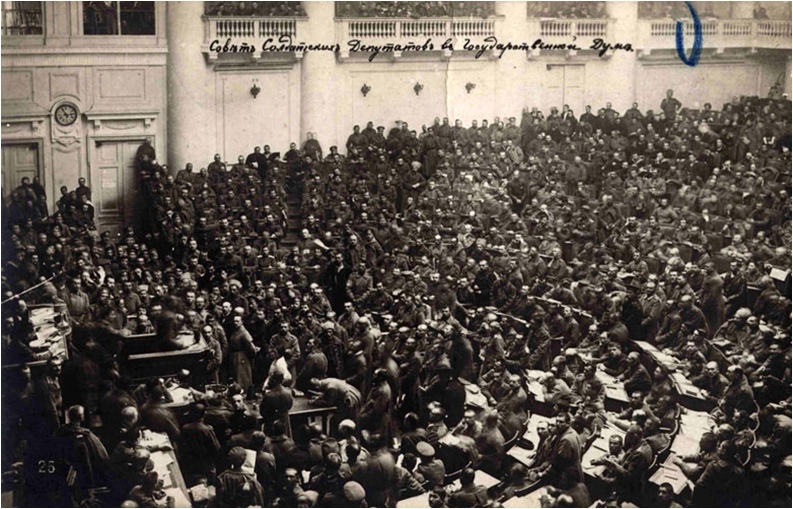
Congress of Soviet deputies, 1918

Either way, it’s not like it mat­ters. I’d an­ti­cip­ated it any­way. Just goes to show you can’t please every­one. Continue reading

Stalinist kitsch

.
The title of this entry deserves some explanation. “Stalinist kitsch,” one might object, is a bit superfluous. Or redundant, rather. Everything is announced by simply saying “Stalinist,” after all. Doesn’t matter if it’s politics, aesthetics, whatever. It’s already assumed that it’s kitsch.

All the same, there’s plenty about Stalinism that deserves to be taken seriously. Not because it’s “right” about history or society or economics; no, nothing like that. Rather, it’s because whether we admit it or not, Stalin did seem to represent one solution (or at least stopgap) to the problem of mass society. Perhaps not a likable answer to the issues posed by modernity, but a likely one. This is something that Boris Groys, among others, has pointed out.

Moreover, though Stalin might have been more than a little lackluster as a theoretician — the primitiveness and crudity of his imagination was legendary — it’s not like he was completely ignorant. Least of all about Bolshevism and its various controversies over the years. He’d been in the party since 1903, so he was hardly a novice. And to be honest, many historians politically aligned with Stalinism wrote very rigorous, detailed accounts of their various objects of study. Though they may be a little vulgar and undertheorized at times, they’re preferable to a lot of the crap that’s published.

What’s even scarier is that those few explicitly Stalinist parties that still exist often have better politics than their soi-disant “Trotskyist” counterparts, who now operate more or less according to the logic of Stalinoid popfrontism, but without even the vague self-consciousness that Stalinists possessed. Sad times indeed.

Below are a bunch of the kitschier photos, posters, and artworks from the Stalin era. Click on any of the images to enlarge them. Furthermore, to compensate for this bit of lighthearted parody, I’m including Evtushenko’s somber 1961 poem, published in Pravda, on the “heirs of Stalin.”

The heirs of Stalin

.
Mute was the marble. Mutely glimmered the glass.
Mute stood the sentries, bronzed by the breeze.
Thin wisps of smoke curled over the coffin.
And breath seeped through the chinks
as they bore him out the mausoleum doors.
Slowly the coffin floated, grazing the fixed bayonets.
He also was mute — his embalmed fists,
just pretending to be dead, he watched from inside.
He wished to fix each pallbearer in his memory:
young recruits from Ryazan and Kursk,
so that later he might collect enough strength for a sortie,
rise from the grave, and reach these unreflecting youths.
He was scheming. Had merely dozed off.
And I, appealing to our government, petition them
to double, and treble, the sentries guarding this slab,
and stop Stalin from ever rising again
and, with Stalin, the past. Continue reading