The nightmare surrealist: H.R. Giger (1940-2014)

.
The nightmare is over for H.R. Giger. Giger, pioneering artist and designer of one of science fiction’s most famous on-screen monsters, died at age 74 yesterday.

A piece I’ve written up commemorating him will hopefully appear over at Metropolis tomorrow. For now, here are just a few of the images he produced that managed to burn themselves into my brain.

Grigorii Barkhin, Izvestiia newspaper building in Moscow (1926-1928)

.
Some have noted the formal similarities between the original conception of Grigorii Barkhin’s Izvestiia newspaper building in Moscow and Walter Gropius’ proposed Chicago Tribune tower in Chicago. Barkhin himself attested to the latter’s influence on his own project. The initial plan for the building would have featured a base covering about a quarter of a city block, supporting a tall high-rise section that jutted suddenly skyward from it.

Owen Hatherley parsed their relationship several years back on his Kino Fist blog:

The Soviet skyscraper designs of the 1920s were strippings and rationalisations of the USA’s huge, atavistic fantasy-palaces. Aware of the mystificatory absurdity of a Woolworth Building, the extension of the Gothic up into the sky, the USSR’s early architects took their cue from the factories behind the facade. In one particularly memorable instance, this centred on the 1922 competition for the Chicago Tribune skyscraper. Bauhaus director Walter Gropius proposed a tower based on the printworks at the back, extending their modules into a futurist vision of cool, precise technology. It was ridiculed, of course, in favour of flying buttresses and Gothicky ornament. So in another act of plunder, the Soviet architects Grigori and Mikhail Barkhin proposed to build a slightly modified version of Gropius’ Chicago in Moscow for the Izvestia newspaper — and got it built, albeit drastically reduced.

We’ll return to this reduction later.

Walter Gropius and Adolf Meyer: Competition Entry for "Chicago Tribune" Tower (1922). Model, dynamic perspective.

Walter Gropius and Adolf Meyer: Competition submission for
Chicago Tribune tower (1922). Model, dynamic perspective.

Grigorii Barkhin, original plan for Izvestiia newspaper building (1926)

Grigorii Barkhin, original plan for Izvestiia building (1926)

A more proximate source of inspiration for Barkhin’s design (drafted 1926) was likely the Vesnin brothers’ Palace of Industry competition entry from 1923, which came a year after Gropius’ 1922 piece. One immediately notices the even greater similarities between them.

Here again there was some influence of Gropius’ project on the Vesnins’. (Both ultimately went unrealized). Indeed, there would later be some controversy when the rationalist architect Nikolai Dokuchaev accused his constructivist colleagues at VKhUTEMAS, the Vesnins, of copying the tower by Gropius. Dokuchaev further insinuated that there was some ideological contamination as a result, with some of the capitalist ideology of the Chicago Tribune proposal seeping into the structurally similar Palace of Labor. Moisei Ginzburg, by then chief theoretician of the OSA group, eventually intervened by pointing out the completely different functional contexts of the two buildings, while admitting their superficial resemblance.

The Vesnin brothers' unrealized proposal for the Palace of Labor (1923)

The Vesnin brothers’ unrealized proposal for the Palace of Labor (1923)

To be sure, the actual productive role of Barkhin’s Izvestia building was close to Gropius’ Chicago Tribune tower than was the Vesnins’ Palace of Labor, given that the first two were explicitly intended as publishing centers. Gropius’ tower would have likely served more as an office building for the writing staff than an actual printing plant, however. At least, that’s the role that Raymond Hood’s winning entry ended up playing. Barkhin’s building performed both tasks. Regardless, some overlap may be admitted.

Concerning the reduction mentioned earlier: due to material supply shortages, Barkhin and his younger brother, Mikhail, were forced to scrap the uppermost elevation. Instead, the base would be preserved as a continuous block, with rectilinear glazed façades as well as a series of distinctive circular windows over the right side of the entrance. The building still stands today, overlooking Pushkin Square in Moscow, though it now houses a Kentucky Fried Chicken store and King Sushi restaurant. Many of the photos included below are from the perspective of the park.

Enjoy! Click any of the images to enlarge, and scroll through the gallery.

Grigorii and Mikhail Barkhin. Dom Izvestiia, 1926-1927. Perspective view. Ink, watercolor, & white ink on paper.F-Moscou-Maison du Journal IsvestiaСтроительство типографского корпуса %22Известий%22Мы думаем, что снимок сделан в 1946 году  (направление съемки − север)Большой Путинковский переулок,5barhin2 Continue reading

Boris Korolev, abstract sculptures of Bakunin and Marx (1919-1920)

_21 korol001_optПамятник М.Бакунину 1919 Памятник М.Бакунину 1919а Continue reading

Samara: Constructivism into Stalinism

Architecture at the margins of
the Soviet Union (1927-1936)

.
via golem

golem adds a remark made by one E. Radniskii, who apparently wrote:

Гигантомания — это частая болезнь диктаторов. Но они не зря путают великое и большое. Кое-какой резон в этой гигантомании есть: огромные размеры устрашают толпу. Рождают бессознательное представление о мощи государства. Что же касается искусства тоталитаризма, всех этих бездушных подражаний античности, любви к тупому реализму, то вкус диктаторов, вышедших из народа, объединял их со вкусом простых людей. Но по прошествии времени происходит порой таинственное преображение – вчерашний маразм начинает казаться любопытной эстетикой.

A bit overstated, in my opinion. Rough translation of the first bits: “Gigantomania — this is a common ailment of dictators. However, don’t confuse ‘big’ with ‘great.’ The kind of reasoning that lies behind this gigantomania is: enormous size will frighten the crowd.”

I think this collapses constructivism and post-constructivism (early Stalinism), without making much distinction between their formal features. Of course, it’s not total discontinuity between avant-garde and kitsch. Boris Groys has a point here. Nevertheless, it’s a little odd that the author of this post titles it “Samaran constructivism,” and then describes the style as dictatorial or Stalinist.

Either way, some fantastic photos. You can see some of the transitional hybrid style Selim Khan-Magomedov referred to as post-constructivist here.

27. управление милиции ныне сгоревшее7. Дом промышленности6. Дом Красной Армии Continue reading

The skyscraper in the Old World

Manfredo Tafuri
The Sphere and the
Labyrinth
(1979)

.
Perhaps no better way exists of grasping what the American skyscraper is not than by studying how European culture has attempted to assimilate and translate into its own terms, especially in the years immediately following the First World War, that paradox of the Metropolitan Age. The skyscraper as a “typology of the exception”: the first elevator buildings in Manhattan — from the Equitable Life Insurance Building of Gilman & Kendall and George B. Post (1868-70) to Post’s mature works [1] — are real live “bombs” with chain effects, destined to explode the entire real estate market. The systematic introduction of the mechanical elevator, equalizing the price of rents at various floors of commercial buildings, levels in a single blow the existing economic values and creates new and exceptional forms of revenue. Immediately, the “control” of such an explosive object presents itself as an urgent problem — even if there ensues, just as immediately, a clear renunciation of any regulation of the economic effects. The entire typological elaboration that, first in New York and then in Chicago, lies at the heart of the structural inventions of architects like Post, Le Baron Jenney, John Wellborn Root, Holabird & Roche explicitly tends toward a visual control of all that which now appears as “anarchic individuality,” a mirror of the “heroic” phase of the entrepreneurship of the Age of Laissez-Faire.[2]

81 calandra 02

Winston Weisman has quite correctly emphasized the central role played by Post in the formation of the typology of the nineteenth-century skyscraper.[3] In many ways the work of Post takes an opposite path from that of Sullivan; nevertheless, Sullivan owes a great deal to the until now undervalued New York architect. In Post’s U-, “tree-,” and tower-shaped structures, there already emerges quite clearly that aspect of the skyscraper phenomenon that the European interpretations tend to overlook: namely, that it is exactly by embodying the laws of the concurrent economy and, afterwards, of the corporate system, that the skyscraper becomes an instrument — and no longer an “expression” — of economic policy, finding in this identity with economic policy its own true “value.” Only after the typological and technological experiments of the last decades of the nineteenth century have exhausted their provisional tasks, setting into position repeatable structures, will the attribution of the “surplus value” of language to these structures manifest itself — correctly — as pure ornament. But it will do so with a precise function: to emit well-known or immediately assimilable messages, to soothe the “distracted perception” of the metropolitan public subjected to the bombardment of multiple shocks, both visual and economic, provoked by the new giganti della montagna [mountain giants] in the downtowns.

It is just this phenomenon that European culture could not or would not grasp. What in the United States was produced by a complex but straightforward process was experienced in Europe as a trauma. The skyscraper, which Henry Huxley could call in 1875 the “center of intelligence,”[4] was seen, especially by German culture after 1910, as a symbol and threat of total reification, as a painful nightmare produced by the drowsiness of a metropolis on the verge of losing itself as a subject. In such a frame, optimism and pessimism wind up coinciding. In 1913 Karl Schaffler points out the possibility of a new “Spirit of Synthesis” in American territorial organization: the metropolis will be recuperated here as a conscious subject dominating the complementariness of City and Suburb — and here he reproposes a municipal administration retaining ownership of the terrain — but also reestablishing the equilibrium between the individual and the totality.[5] Reification can be overcome only by considering it a “bridge” that permits the crossing of the Grand Canyon of the anguish of the masses. A “bridge”: but precisely by going beyond the experience of the Brücke, Kandinsky, in presenting his own theatrical piece Der Gelbe Klang [The Yellow Tone] in Der Blaue Reiter Almanac (1912) , puts forward in metaphoric form a completely opposite interpretation of the same phenomenon. In Kandinsky’s unique text, as is well known, five yellow giants undulate, grow disproportionately or shrink, contort their bodies, emit guttural sounds, under a flickering light that accentuates their oneiric aspects.

File-Franz Marc and Wassily Kandinsky, published by R. Piper & Co. - Der Blaue Reiter (The Blue Rider) kandinsky.comp-4

The previous allusion to Pirandello’s giganti della montagna was not accidental. For both Kandinsky and Pirandello, the theme is that of individuals who are “all too human,” and therefore on the verge of becoming pure signs, dumbfounded testimonies of an existence whose faculties of communication have been blocked. The whispering of the yellow giants and their “difficult” movements are the last, clumsy attempts at expression by beings who, having seen the truth, feel condemned to drown in it:

at the very instant in which the con fusion in the orchestra, in the movements, and in the lighting reaches the high point, all at once, darkness and silence fall on the scene. Alone at the back of the stage, the yellow giants remain visible and are then slowly swallowed up by the darkness. It appears as if the giants are extinguished like lamps; or rather, before complete darkness sets in, one perceives some flash of light.

The finale of Der Gelbe Klang represents, in tragic form, the annihilation of value in the flux of monetary currents — which the people of Manhattan could register, non dramatically, using such real giants as the Woolworth or the Equitable Life Insurance buildings. Moreover, such giants, in reality, despite their linguistic clothing that is just as paradoxical as the yellow color with which Kandinsky clothes his “new angels,” also give off a flash of light. Continue reading

The architecture of conflict

Photos by James Rawlings

.
In his photo series Architecture of Conflict, photographer James Rawlings got a rare chance to photograph the daily life of an eerily active ghost town. England’s county of Kent is home to a collection of faux building fronts and avenues, like something from a film set, built to sharpen the response of London’s metro police in quelling an urban uprising:

Before I actually went there, the main thing that interested me was just the place itself, the fact that there was a whole town just purely built for this reason. I like the idea of it being a kind of contrived, built-up thing — an architecture meant just for conflict.

What you get is thus a kind of generalized façadism, almost out of a Hollywood Western, explicitly for the purpose of simulated urban warfare and riot suppression.

Click any of the images below to enlarge.

Mauer dreamstory

Agata Pyzik
.

The following is an early draft from Agata Pyzik’s excellent book-length debut, Poor but Sexy: Culture Clashes between East and West. I’m about halfway through writing a review of it, which I’ll probably pitch to Radical Philosophy or Art Margins. Everyone reading this should pick up a copy immediately. Pyzik’s interpretation of Possession and other films, reproduced below, is one of my favorite sections.
.

(Cross-posted from Faces on Posters as well as
nuits sans nuit et quelques jours sans jour)


Picture-321 Screen Shot 2014-07-26 at 11.13.13 PM.

.

I didnt want that to happen, but it did.

.
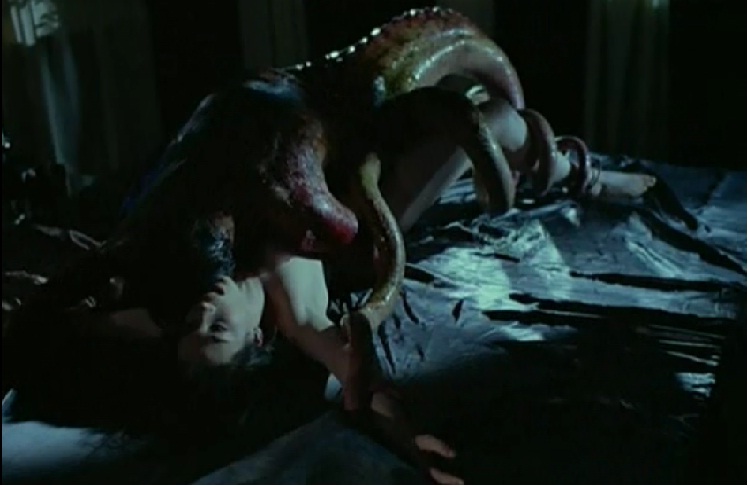
“A woman who fucks an octopus” — that was the way Andrzej Żuławski pitched his 1980 film Possession to the producer, fresh after the success of his French film L’Important C’est D’aimer, about a fallen actress, played by a sad-eyed Romy Schneider, who is made to act in pornographic movies, surrounded by other failed artists, including an unusually melancholic, tender performance from Klaus Kinski. He was also right after the fiasco of his three-hour long monumental metaphysical SF On a Silver Globe (1978) — an adaptation of a futurological fin-de-siècle novel by his great-uncle, Jerzy Żuławski — pulled before completion by the hostile communist authorities and shelved until 1987, when only Żuławski had a chance to “finish” the film. Around that time, he was abandoned by his wife Malgorzata Braunek, actress in his Third Part of the Night and The Devil, due to his famously domineering and possessive personality as a partner and a director. Left in shock and depression, he started plotting a misogynist fairy tale about a monster…

The sleep of reason produces demons, and one of them materialized when Anna, living in West Berlin with her functionary nice husband and child in a neat, three-storey block estate, realized she despised her husband. She confesses that to him. The rest is what happens after that confession.

Possession was made in the golden era of the genre of exploitation, and it must be due to the communal genius that things conceived as forgettable schlock to this day shine with a magnificent mixture of the visceral and the metaphysical, with cinematography, colors, costumes and set design taken from a masterpiece. Argento and the lesser gialli creators, Jean Rollin with his erotic horror, the expansion of an intellectual SF, started and inspired Tarkovsky, all paved the way for Possession, a still unrivaled study of a marital break-up, thrown in the middle of political turmoil in divided cold war Berlin. Still, Possession had a special “career” in the UK, if by career we understand horrible reception, extremely negative reviews and eventually putting it to the “video nasties” list of banned films. “Film nobody likes,” it was deemed too arty for the flea pits and too trashy for the art house.*

Possession21 0004

Today perhaps we can’t imagine what it was like to live in a city surrounded by barbed wire and under a constant look of armed guards. When we first see Anna, played by a disturbingly pale, un-Holy Mary-like Isabelle Adjani and Mark (Sam Neill), we instantly see something is terribly wrong: their windows are under constant scrutiny, and surrounded by wire — the symbol of political oppression just as of the marital prison, of conventional life. Continue reading

May Day

Once there was an international, revolutionary workers’ movement. May Day was one of its central and most important holidays. Unfortunately, this movement is no more. Luxemburg rather sunnily surmised that “when better days dawn, when the working class of the world has won its deliverance, then too humanity will probably celebrate May Day in honor of the bitter struggles and the many sufferings of the past.” Today, however, these better days seem far more distant than they did when she first spoke of them in 1894.

Yesterday I linked to volumes 1-49 of Marx and Engels’ Collected Works. Below are two speeches, one by Rosa Luxemburg and the other by Vladimir Lenin, which at present must be regarded more as historical documents than anything that addresses a living reality.

Мая 1

Rosa Luxemburg

What are the origins
of May Day? (1894)

.
The happy idea of using a proletarian holiday celebration as a means to attain the eight-hour day was first born in Australia. The workers there decided in 1856 to organize a day of complete stoppage together with meetings and entertainment as a demonstration in favor of the eight-hour day. The day of this celebration was to be April 21. At first, the Australian workers intended this only for the year 1856. But this first celebration had such a strong effect on the proletarian masses of Australia, enlivening them and leading to new agitation, that it was decided to repeat the celebration every year.

In fact, what could give the workers greater courage and faith in their own strength than a mass work stoppage which they had decided themselves? What could give more courage to the eternal slaves of the factories and the workshops than the mustering of their own troops? Thus, the idea of a proletarian celebration was quickly accepted and, from Australia, began to spread to other countries until finally it had conquered the whole proletarian world.

The first to follow the example of the Australian workers were the Americans. In 1886 they decided that May 1 should be the day of universal work stoppage. On this day 200,000 of them left their work and demanded the eight-hour day. Later, police and legal harassment prevented the workers for many years from repeating this [size of] demonstration. However in 1888 they renewed their decision and decided that the next celebration would be May 1, 1890. Continue reading

Radical ideologies today: Marxism and anarchism

Christoph LichtenbergEva Curry
Alex KhasnabishChris Parsons


This spring, the Platypus Affiliated Society hosted a series panels on “Radical ideologies today: Marxism and anarchism” in New York, Frankfurt, Halifax, Thessaloniki, and Chicago. The panel description reads: “It seems that there are still only two radical ideologies: Marxism and anarchism. They emerged out of the same crucible — the Industrial Revolution, the unsuccessful revolutions of 1848 and 1871, a weak liberalism, the centralization of state power, the rise of the workers movement, and the promise of socialism. They are the revolutionary heritage, and all significant radical upsurges of the last 150 years have returned to mine their meaning for the current situation. In this respect, our moment seems no different.

There are a few different ways these ideologies have been taken up. Recent worldwide square occupations reflect one pattern: a version of Marxist theory — understood as a political-economic critique of capitalism — is used to comprehend the world, while anarchist practice — understood as an anti-hierarchical principle that insists revolution must begin now — is used to organize, in order to change it. Some resist this combination, claiming that Marxism rejects anti-statist adventurism, and call for a strategic reorganization of the working class to resist austerity, and perhaps push forward a “New New Deal”. This view remains wedded to a supposedly practical welfarist social democracy, which strengthens the state and manages capital. There is a good deal of hand waving in both these orientations with regard to politics, tactics, and the end goal. Finally, there have been attempts to leave the grounds of these theories entirely — but these often seem either to land right back in one of the camps or to remain marginal.

To act today we seek to draw up the balance sheet of the 20th century. The historical experience concentrated in these ideas must be unfurled if they are to serve as compass points. In what ways does the return of these ideologies represent an authentic engagement and in what ways the return of a ghost? Where have the battles left us? What forms do we have for meeting, theoretically and practically, the problems of our present?”

What follows is an edited transcript of the conversation that PAS-Halifax hosted on February 1, 2014, at University of King’s College. The speakers participating in Halifax included Christoph Lichtenberg, Alex Khasnabish, Chris Parsons, and Eva Curry. A full recording of each of the events held in this series can be found online.

.
Christoph Lichtenberg: When I think of Marxism and anarchism, I think of two tendencies within the workers’ movement, both of which see themselves as revolutionary, as opposed to the tendency that is known as Social Democracy, which would work through reforms. I think of Marxism as interchangeable with Leninism or Trotsykism. I do not associate it with Maoism or Stalinism. I think of anarchism in its best representation as exemplified by people like Bakunin, Kropotkin, or anacho-syndicalism. There are some commonalities between the two tendencies. I just want to highlight three of them: I think Marxism and anarchism agree on the need for the liberation of humanity through the destruction of capitalism. I also think that we agree on the fact that there is a class struggle going on between the exploiters and the exploited. And finally, I think we agree on the need to destroy the existing, oppressive, capitalist state structure. What happens after that is where we diverge.

The conflict really began with the creation of the alliance with Social Democracy by Bakunin and his followers, and what it meant is that they maintained a somewhat secret organization within the First International and started to publish articles that were critical of Marx. There was a lot of going back and forth over organizational matters, but, as with every organizational dispute, at the heart of it is really politics. The difference in politics between Marxists and anarchists really came to the fore at the 1872 Congress of the First International in The Hague, when there was a big debate between the Bakunin faction and the Marx followers about the role of the state in the transformation towards socialism. The Marxists argued that there was a role of the state in the transformation towards of socialism while followers of Bakunin insisted that the state should immediately be replaced by self-governing workplaces and communes. The Bakunin faction lost that debate and were expelled from the First International for maintaining their secret organization.

Bakunin

Around 1880, Kropotkin and other Russian revolutionaries announced the need for a permanent revolt through word, gun, and dynamite. This set the anarchists, particularly in Russia, on the course of anarchist terrorism, which removed them from the masses and isolated them.

The October Revolution in 1917 is the key event to understanding revolution. The Second International collapsed in 1914 at the outbreak of the First World War because the different sections of the International ended up supporting their own governments’ war efforts. So rather than being internationalists, they sided with their own national governments, which Lenin, the Russian revolutionary who led the Bolsheviks, identified as a complete betrayal of the spirit of socialism. The main thing he learned from the collapse of the Second International was the need for revolutionaries to set up a separate organization from the reformists — the need for a vanguard party.

Continue reading

Birthday > Earth Day: Happy 144th, Vladimir Il’ich!

Never thought of it before, but Maiakovskii’s tripled refrain

Ленин ⎯ жил,
Ленин ⎯ жив,
Ленин ⎯ будет жить!

…in his poem Lenin, seems to echo Rosa Luxemburg‘s final written words in “Order Reigns in Berlin”:

Ich war,
Ich bin,
Ich werde sein!

Vladimir Lenin, born 144 years ago today. Some rare and not-so-rare posters of Lenin appear below. Click to enlarge.

Nikolai Akimov - Lenin. For every 10,000 enemies we will raise millions of new fighters, 1925  Continue reading