Color illustration from Modern Architecture (1929) of a disurbanized dwelling

Ginzburg’s reply to Le Corbusier on deurbanization

.Untitled
IMAGE: Color illustration in Modern Architecture
of a “disurbanized” dwelling unit (1929)

.Untitled

My dear Le Corbusier,

Our recent conversation about city planning and your letter have compelled me to rethink the entire problem, to recall your objections, the objections you made when you visited me and which you now write about in your letter.

Like all my friends, I value you tremendously not only as a subtle master architect but also as a man with the ability to solve radically and fundamentally the important problems of organization.

For me you are today the greatest and most brilliant representative of the profession that gives my life content, goal, and meaning.

That is why your ideas and solutions in the area of city planning have for us a quite exceptional interest and importance. Continue reading

Le Corbusier Ville Radieuse (1930)

“Exact Air,” from Le Corbusier’s Radiant City (1930)

Untitled.
Le Corbusier’s Ville Radieuse (1930)
.Untitled

Exact air? Queens and Brooklyn could probably use it, seeing the tornado that just passed through here. Perhaps it’s too fantastic, pure technological messianism. Still, it’s interesting. Le Corbusier on “exact air”:

But then where is Utopia, where the temperature is 64.4º?…
And why the devil do men insist on living in difficult or dangerous climates? I’ve no idea! But I can observe a worsening situation:
The variety of climates had forged races, cultures, customs, dress, and work methods suited to the obtaining conditions.
Alas, the machine age has, as it were, shuffled the cards — the age-old cards of the world. Since the machine age, the product of progress, has disturbed everything, couldn’t it also give us the means to salvation?
Multiplicity of climates, play of seasons, a break with secular traditions — confusion, disorder, and the martyrdom of man.
I seek the remedy, I seek the constant; I find the human lung. With adaptability and intelligence, let’s give the lung the constant which is the prerequisite of its functioning: exact air.
Let’s manufacture exact air: filters, driers, humidifiers, disinfectors. Machines of childish simplicity.
Send exact air into men’s lungs, at home, at the factory, at the office, at the club and the auditorium: ventilators, machines so often used, but so often used badly!
Let’s give man the solar rays which will penetrate the all-glass facades. But will be too hot in the summer and terribly cold in the winter! Let’s create ‘neutralizing walls.’ (And ‘sun control’).

— Le Corbusier, The Radiant City: Elements of a Doctrine of Urbanism to be Used as the Basis of Our Magine-Age Civilization (1933), pg. 42.

Continue reading

Lenin’s critique of the politics of spontaneity in What is to be Done?

.Untitled
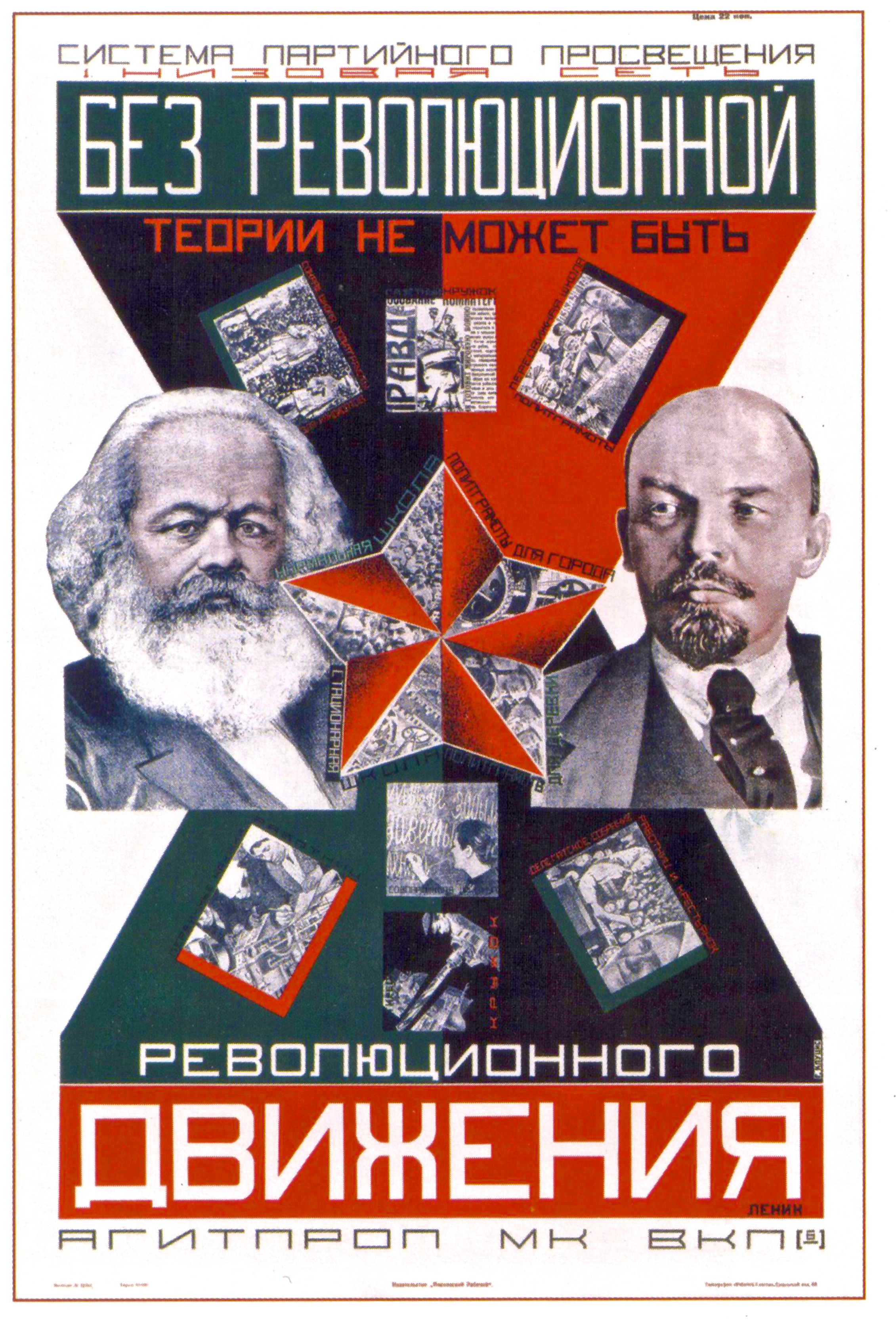
IMAGE: Agitprop poster, 1920s:
“Without revolutionary theory,
there can be no revolutionary movement.”

.Untitled

In preparing my presentation on Lenin’s What is to be Done? this week for the UChicago Platypus reading group, I found myself returning again and again to his description of the so-called “spontaneity” of the masses.  It was on this supposed spontaneity, of course, that the Economists pinned their hopes of social revolution (should there be one at all).  I noticed that in his critique of the notion of the working class’ spontaneity, Lenin employed a number of categories borrowed from classical German philosophy.  All of these categories pertain to consciousness, and constitute an epistemology of sorts.  I found, moreover, that this seemed to provide a theoretical link to Lukács’ later account of reification.  Though this began as little more than a meditation, I brought it up at the reading group and found that it was well received.  Afterward, Sunit encouraged me to elaborate on this notion and submit my thoughts online. Continue reading